High-Tier Ethereum Wallet Addresses Distribute While Retail Investors Step In to Accumulate

bitcoinistОпубликовано 2026-02-13Обновлено 2026-02-13

Введение

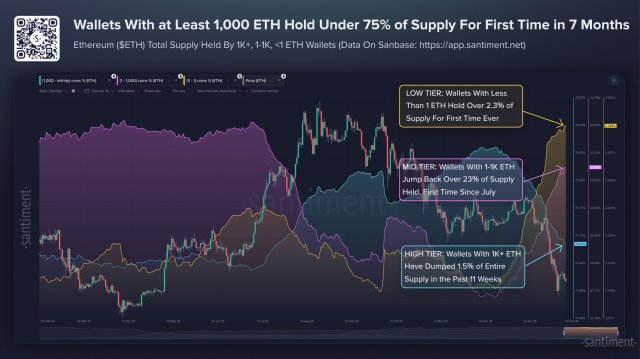
Heightened market volatility has kept Ethereum's price below $2,000, leading to a divergence in investor behavior. According to Santiment, high-tier holders (with at least 1,000 ETH) are selling, reducing their collective holdings to below 75% of the total supply after distributing about 1.5% since Christmas. Meanwhile, retail and low-tier investors (holding less than 1 ETH) are accumulating, pushing their collective stash to a record 2.3% of the supply. Mid-tier investors (1–1,000 ETH) are also buying, reaching over 23% ownership for the first time since July 2025. Additionally, Ethereum staking demand is at an all-time high, with a queue of 4.1 million ETH and a 71-day waiting period, indicating strong long-term conviction rather than short-term speculation.

Heightened volatility in the market continues to keep the price of Ethereum below the $2,000 mark, capping every attempt towards the upside. During the persistent downward price action, a divergence has emerged among ETH investors, with large holders selling while smaller holders are buying.

Ethereum Whale Selling Meets Retail Accumulation In Market Split

Ethereum’s ongoing waning price action is taking its toll on investors, as evidenced by their current activity and sentiment. Following the downward trend, a notable divergence in investors’ behavior is developing, causing large and small holders to move in separate directions.

Looking at the report from Santiment, a leading market intelligence and on-chain data analytics platform, large investors are pushing toward the sell side, while small investors are leaning towards the buy side. Even as retail and grassroots investors enter the market to purchase, this divergence raises the possibility that major holders often regarded as whales or institutional-grade participants may be locking in profits or repositioning.

The current selling activity is observed among wallet addresses holding at least 1,000 ETH, which in this case are considered high-tier holders. Meanwhile, buying activity is taking place among wallet addresses holding less than 1 ETH, flagged as low-tier investors.

Before now, these high-tier holders were collectively holding more than 75% of Ethereum’s total supply. However, after the dumping of about 1.5% of the supply since Christmas, their holdings are now below the level. Such redistribution phases have the potential to alter the market structure by shifting supply from concentrated hands to a wider base.

ETH high-tier investors in selling mode since December 2025 | Source: Chart from Santiment on X

According to data from Santiment, mid-tier investors (those holding between 1 and 1,000 ETH) have also been steadily buying the altcoin. This persistent buying has pushed their collective holdings back to over 23% of the total supply for the first time since July 2025.

For smaller holders and low-tier investors, ETH accumulation has been rising, bringing their collective stash to 2.3% of the overall supply, marking the highest level ever. Santiment highlighted that these wallet addresses are likely growing due to ETH staking.

Staking ETH Now Takes More Time

As Ethereum staking grows, the process is now taking more time than ever. Milk Road shared on X that investors are expected to wait for 71 days and 11 hours to stake ETH. Recently, Ethereum staking reached 30% of the total supply, locking up 36.8 million ETH valued at a whopping $72 billion.

The 4.1 million ETH queue suggests that demand to stake is at an all-time high while the altcoin’s price sits below $2,000. Meanwhile, the exit queue is essentially nonexistent by comparison, with just 75,872 ETH leaving. Such a trend is an indication of conviction, not yield farming behavior. When people lock up $74B during a price dip, it means they are settling in, instead of speculating. “Watch that queue, it’s a sentiment indicator,” Milk Road added.

ETH trading at $1,968 on the 1D chart | Source: ETHUSDT on Tradingview.com

Связанные с этим вопросы

QWhat divergence in investor behavior is currently observed in the Ethereum market according to the Santiment report?

AThe divergence shows that large investors (high-tier holders with at least 1,000 ETH) are selling, while small investors (low-tier holders with less than 1 ETH) and mid-tier investors (1-1,000 ETH) are buying and accumulating.

QHow much of Ethereum's total supply did high-tier holders collectively own before their recent selling activity?

AHigh-tier holders collectively owned more than 75% of Ethereum's total supply before their recent selling activity.

QWhat is the current staking queue time for Ethereum, and what does the long queue indicate about investor sentiment?

AThe current staking queue time is 71 days and 11 hours. The long queue with 4.1 million ETH waiting to be staked, coupled with a minimal exit queue, indicates strong conviction and long-term holding sentiment among investors rather than speculative yield farming.

QWhat percentage of Ethereum's total supply is now being staked, and what is its approximate value?

A30% of Ethereum's total supply is now being staked, which amounts to 36.8 million ETH valued at approximately $72 billion.

QTo what level has the collective holdings of low-tier Ethereum investors (less than 1 ETH) risen?

AThe collective holdings of low-tier investors have risen to 2.3% of the overall supply, marking the highest level ever recorded.

Похожее

AI Giants Enter the Dark Forest

In the AI industry's "dark forest," major players like Anthropic, OpenAI, and DeepSeek are strategically withholding their most advanced models to avoid becoming targets in a high-stakes competitive landscape. Anthropic released Claude Opus 4.7 but admitted it underperforms compared to their unreleased model Mythos, citing safety concerns. They delayed addressing user complaints about performance regression until OpenAI’s GPT-5.5 launch, highlighting a tactic of controlled disclosure aligned with competitors’ moves. OpenAI’s GPT-5.5, though a full retrain since GPT-4.5, was seen as incremental rather than revolutionary. Leaks revealed internal models like Glacier and Heisenberg, indicating significant unreleased capabilities. OpenAI acknowledges a "capability overhang," where real model power exceeds what users experience, often due to infrastructure-driven throttling. DeepSeek launched V4 Preview, a cost-efficient model, but its full potential (V4 Pro Max) awaits Huawei’s Ascend 950 super-nodes量产 in late 2026. Their strategy focuses on affordability and scalability, aiming to democratize AI access globally, a move noted even by NVIDIA’s CEO as a disruptive threat. Together, these actions reflect a broader trend: leading AI labs are deliberately pacing releases, hiding strengths, and aligning disclosures with competitive dynamics—each avoiding the risk of exposure in a forest where first movers become targets.

marsbit2 мин. назад

AI Giants Enter the Dark Forest

marsbit2 мин. назад

Naval Steps Into the Arena: A Historic Collision Between Ordinary People and Venture Capital

Naval Ravikant, co-founder of AngelList and a prominent Silicon Valley thinker, has taken a hands-on role as the chairman of the investment committee at USVC—a new SEC-registered fund allowing non-accredited investors to access high-growth private tech companies with a minimum investment of $500. The fund’s initial portfolio includes leading AI firms like OpenAI, Anthropic, xAI, and others. This move represents a significant shift in democratizing access to venture capital, a space traditionally dominated by institutional investors and high-net-worth individuals. USVC aims to let ordinary investors participate in the high-alpha, pre-IPO growth phase of tech companies—a stage where much of the value creation now occurs before public listings. However, the fund is not without complexities. It offers limited liquidity, with potential quarterly redemptions capped at 5%, and charges an all-in fee of 2.5% in its first year. While this is higher than traditional ETFs, it is positioned as a more accessible alternative to conventional VC fee structures. Ultimately, USVC symbolizes a broader movement toward financial inclusion in high-stakes tech investing—not through crypto or Web3 mechanisms, but via regulated, retail-friendly investment vehicles. It offers a ticket to early-stage innovation, though risks typical of venture capital remain.

marsbit4 мин. назад

Naval Steps Into the Arena: A Historic Collision Between Ordinary People and Venture Capital

marsbit4 мин. назад

Торговля

Спот
Фьючерсы

Популярные статьи

Manyu: восходящая мем-звезда на Ethereum, готовая открыть новую эру культуры Shiba

Manyu - это мемтокен на Ethereum, который приносит децентрализованную культурную и развлекательную ценность через вирусное влияние в соцсетях и вовлечённость сообщества.

1.9k просмотров всегоОпубликовано 2025.11.27Обновлено 2025.11.27

Manyu: восходящая мем-звезда на Ethereum, готовая открыть новую эру культуры Shiba

Обсуждения

Добро пожаловать в Сообщество HTX. Здесь вы сможете быть в курсе последних новостей о развитии платформы и получить доступ к профессиональной аналитической информации о рынке. Мнения пользователей о цене на ETH (ETH) представлены ниже.

活动图片