Here’s Why The Bitcoin Price Is Crashing, And Why It Could Continue

bitcoinistОпубликовано 2026-04-02Обновлено 2026-04-02

Введение

The Bitcoin price remains in a bearish trend despite a brief 2% rise, trading around $68,000 and down roughly 40% year-to-date. A key factor driving the decline is significant outflows from Spot Bitcoin ETFs, particularly from major funds like BlackRock’s IBIT, Fidelity’s FBTC, and Grayscale’s GBTC. These outflows, which totaled hundreds of millions of dollars in late March, indicate reduced institutional demand and exert downward pressure on BTC. Additionally, ongoing geopolitical tensions, especially between the US and Iran, are contributing to market uncertainty and volatility. Although ETFs recently saw modest inflows rebound, Bitcoin's price continues to struggle amid broader bearish sentiment.

The Bitcoin price has been in a prolonged downtrend but saw a slight reprieve this week, rising a bit by 2%. Despite the minor gain, the cryptocurrency remains in a broader bear market, and as of today, its price is still in the red and could continue to decline if momentum does not improve. A major driver behind BTC’s weakness is the recent outflows from its Spot Exchange-Traded Funds (ETFs). Even as institutional demand declines, the market remains under bearish pressure and faces heightened volatility amid ongoing geopolitical tensions in the Middle East.

Bitcoin Price Crash Continues As ETFs Record Outflows

Since debuting in 2024, Spot Bitcoin ETFs have played a significant role in driving BTC prices, with the volume and consistency of net daily flows often influencing the market’s direction. When these ETFs record major outflows, it typically suggests that institutional investors are reducing their exposure, likely due to profit-taking, risk management, or shifting market sentiment. Regardless of the reason, the reduced demand tends to place downward pressure on the Bitcoin price.

Notably, data from SoSoValue indicates that Spot Bitcoin ETFs recorded more outflows than inflows last week, a trend that has noticeably affected prices. On March 18 and 20, these ETFs saw total outflows of $305 million, followed by a modest influx of capital the next day.
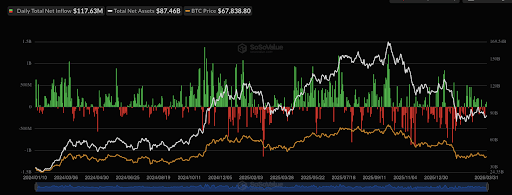
Source: Chart from SoSoValue

The most recent outflows, which appear to be contributing to Bitcoin’s ongoing downtrend, occurred on March 26 and 27. On Thursday, withdrawals from Spot Bitcoin ETFs reached $171.22 million, further exacerbated by an additional $225.48 million outflow the following day.

According to SoSoValue, the bulk of these outflows came from BlackRock’s IBIT, which alone saw $41.92 million exit on Thursday and a staggering $201.5 million outflow on Friday. Other funds, including Fidelity’s FBTC and Grayscale’s GBTC, also recorded outflows during the same period.

As of now, Spot Bitcoin ETFs have returned to net positive territory, with cumulative inflows totaling $56.12 billion after ending its two-day outflow streak and receiving over $187 million over the last two days. Despite renewed demand, Bitcoin’s price is down, recording a year-to-date decline of roughly 40%. The cryptocurrency is also trading below the $70,000 level, hovering just above $68,000, at the time of writing.

Other Factors Influencing Price

In addition to the earlier decline in ETF demand, ongoing geopolitical tensions appear to be significantly influencing investor sentiment, further pressuring BTC’s price. The latest update regarding the US-Iran war reveals that no formal peace agreement has yet been reached, even as President Donald Trump’s April 6 deadline to resume strikes on Iran’s energy infrastructure approaches rapidly.

As of now, Market watchers continue to monitor changes in oil prices, ETF inflows, and any diplomatic developments that could impact the prices of Bitcoin and other cryptocurrencies.

BTC trading at $68,442 on the 1D chart | Source: BTCUSDT on Tradingview.com

Связанные с этим вопросы

QWhat is the main reason for the recent Bitcoin price crash according to the article?

AThe main reason is the recent outflows from Spot Bitcoin ETFs, indicating reduced institutional demand and placing downward pressure on the price.

QWhich specific Spot Bitcoin ETF saw the largest outflows on Friday, March 27?

ABlackRock's IBIT saw the largest outflow on Friday, with a staggering $201.5 million exiting the fund.

QBesides ETF outflows, what other major factor is influencing investor sentiment and Bitcoin's price?

AOngoing geopolitical tensions, specifically the US-Iran war and the lack of a formal peace agreement, are significantly impacting investor sentiment.

QWhat was the net flow status of Spot Bitcoin ETFs after the two-day outflow streak ended?

AThey returned to net positive territory, with cumulative inflows totaling $56.12 billion after receiving over $187 million in the last two days.

QWhat is Bitcoin's approximate year-to-date price decline and its current price level as mentioned in the article?

ABitcoin has recorded a year-to-date decline of roughly 40% and was trading just above $68,000 at the time of writing.

Похожее

Arbitrum Pretends to Be the Hacker, 'Steals' Back the Money Lost by KelpDAO

Title: Arbitrum Poses as Hacker to Recover Stolen Funds from KelpDAO Last week, KelpDAO suffered a hack resulting in nearly $300 million in losses, marking the largest DeFi security incident this year. Approximately 30,765 ETH (worth over $70 million) remained on an Arbitrum address controlled by the attacker. In an unprecedented move, Arbitrum’s Security Council utilized its emergency authority to upgrade the Inbox bridge contract, adding a function that allowed them to impersonate the hacker’s address and initiate a transfer without access to its private key. The council’s action, approved by 9 of its 12 members, moved the stolen ETH to a frozen address in a single transaction before reverting the contract to its original state. The operation was coordinated with law enforcement, which attributed the attack to North Korea’s Lazarus Group. Community reactions are divided: some praise the recovery of funds, while others question the centralization of power, as the council can upgrade core contracts without governance votes. However, such emergency mechanisms are common among major L2s. Despite the partial recovery, over $292 million was stolen in total, with more than $100 million in bad debt on Aave and remaining funds scattered across other chains. The incident highlights escalating security challenges in DeFi, with state-sponsored hackers employing advanced tactics and L2s responding with elevated countermeasures.

marsbit7 мин. назад

Arbitrum Pretends to Be the Hacker, 'Steals' Back the Money Lost by KelpDAO

marsbit7 мин. назад

iQiyi Is Too Impatient

The article "iQiyi Is Too Impatient" discusses the controversy surrounding the Chinese streaming platform IQiyi's recent announcement of an "AI Actor Library" during its 2026 World Conference. IQiyi claimed over 100 actors, including well-known names like Zhang Ruoyun and Yu Hewei, had joined the initiative. CEO Gong Yu suggested AI could enable actors to "star in 14 dramas a year instead of 4" and that "live-action filming might become a world cultural heritage." The announcement quickly sparked backlash. Multiple actors named in the list issued urgent statements denying they had signed any AI-related authorization agreements. This forced IQiyi to clarify that inclusion in the library only indicated a willingness to *consider* AI projects, with separate negotiations required for any specific role. The incident, which trended on social media with hashtags like "IQiyi is crazy," is presented as a sign of the company's growing desperation. Facing intense competition from short-video platforms like Douyin and Kuaishou, as well as Bilibili and Xiaohongshu, IQiyi's financial performance has weakened, with revenues declining for two consecutive years. The author argues that IQiyi is "too impatient" to tell a compelling AI story to reassure the market, especially as it pursues a listing on the Hong Kong stock exchange. The piece concludes by outlining three key "AI questions" IQiyi must answer: defining its role as a tool provider versus a content creator, balancing the "coldness" of AI with the human element audiences desire, and properly managing the interests of platforms, actors, and viewers. The core dilemma is that while AI can reduce costs and increase efficiency, it risks creating homogenized, formulaic content and devaluing human performers.

marsbit1 ч. назад

iQiyi Is Too Impatient

marsbit1 ч. назад

Торговля

Спот
Фьючерсы

Популярные статьи

Как купить S

Добро пожаловать на HTX.com! Мы сделали приобретение Sonic (S) простым и удобным. Следуйте нашему пошаговому руководству и отправляйтесь в свое крипто-путешествие.Шаг 1: Создайте аккаунт на HTXИспользуйте свой адрес электронной почты или номер телефона, чтобы зарегистрироваться и бесплатно создать аккаунт на HTX. Пройдите удобную регистрацию и откройте для себя весь функционал.Создать аккаунтШаг 2: Перейдите в Купить криптовалюту и выберите свой способ оплатыКредитная/Дебетовая Карта: Используйте свою карту Visa или Mastercard для мгновенной покупки Sonic (S).Баланс: Используйте средства с баланса вашего аккаунта HTX для простой торговли.Третьи Лица: Мы добавили популярные способы оплаты, такие как Google Pay и Apple Pay, для повышения удобства.P2P: Торгуйте напрямую с другими пользователями на HTX.Внебиржевая Торговля (OTC): Мы предлагаем индивидуальные услуги и конкурентоспособные обменные курсы для трейдеров.Шаг 3: Хранение Sonic (S)После приобретения вами Sonic (S) храните их в своем аккаунте на HTX. В качестве альтернативы вы можете отправить их куда-либо с помощью перевода в блокчейне или использовать для торговли с другими криптовалютами.Шаг 4: Торговля Sonic (S)С легкостью торгуйте Sonic (S) на спотовом рынке HTX. Просто зайдите в свой аккаунт, выберите торговую пару, совершайте сделки и следите за ними в режиме реального времени. Мы предлагаем удобный интерфейс как для начинающих, так и для опытных трейдеров.

1.1k просмотров всегоОпубликовано 2025.01.15Обновлено 2025.03.21

Как купить S

Sonic: Обновления под руководством Андре Кронье – новая звезда Layer-1 на фоне спада рынка

Он решает проблемы масштабируемости, совместимости между блокчейнами и стимулов для разработчиков с помощью технологических инноваций.

2.2k просмотров всегоОпубликовано 2025.04.09Обновлено 2025.04.09

Sonic: Обновления под руководством Андре Кронье – новая звезда Layer-1 на фоне спада рынка

HTX Learn: Пройдите обучение по "Sonic" и разделите 1000 USDT

HTX Learn — ваш проводник в мир перспективных проектов, и мы запускаем специальное мероприятие "Учитесь и Зарабатывайте", посвящённое этим проектам. Наше новое направление .

1.8k просмотров всегоОпубликовано 2025.04.10Обновлено 2025.04.10

HTX Learn: Пройдите обучение по "Sonic" и разделите 1000 USDT

Обсуждения

Добро пожаловать в Сообщество HTX. Здесь вы сможете быть в курсе последних новостей о развитии платформы и получить доступ к профессиональной аналитической информации о рынке. Мнения пользователей о цене на S (S) представлены ниже.

活动图片