Heavy Recommendation in Less Than a Month, Goldman Sachs Suggests "Going Short" on HALO Trade

marsbitОпубликовано 2026-03-19Обновлено 2026-03-19

Введение

Goldman Sachs has executed a sharp reversal in its investment recommendation regarding the HALO (Heavy Assets, Low Obsolescence) trade within a month. After actively promoting the HALO narrative in late February, citing the AI-driven surge in capital expenditure from tech giants and structural tailwinds for physical assets, the bank now recommends shorting a specific basket of U.S. stocks, labeled GSXUHALT. This basket targets companies with high asset density but zero or negative earnings growth expectations, whose stock prices have rallied excessively alongside the broader HALO theme without fundamental support. Goldman's analysis indicates the market has been indiscriminately buying heavy-asset stocks, pushing some low-quality names to outperform higher-quality counterparts. The bank's data shows this basket peaked in late February and has begun to decline. The shift signals that the HALO trade's initial phase may be over, and internal differentiation is crucial. Goldman advises pairing this short position with thematic long opportunities, noting that the recent market pullback has created significant "buy-the-dip" potential in other sectors. The core message is that not all heavy-asset stocks are equal; investors must now distinguish between those with durable competitive advantages and those merely riding the trend.

Goldman Sachs executed a rare strategic about-face in less than a month—transitioning from actively pitching the HALO concept to investors to proactively shorting its "overheated" component stocks, reflecting concerns about the crowding in heavy-asset trades.

On Tuesday, Faris Mourad, head of Goldman's thematic trading team, introduced the short basket GSXUHALT in a latest report, specifically targeting U.S. companies that are asset-intensive but have zero or negative earnings growth expectations, yet whose stock prices have surged significantly with the HALO trend. Goldman believes the market's pursuit of heavy-asset stocks has become indiscriminate, with gains in some individual stocks severely disconnected from fundamentals.

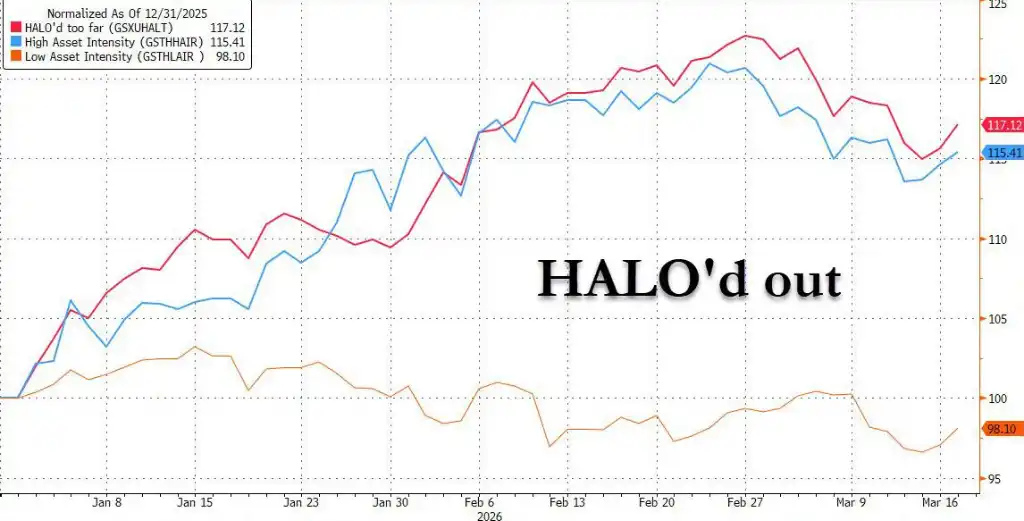
The immediate implication of this shift for the market is that the honeymoon period for the HALO trade may be over. Goldman data shows the GSXUHALT basket has begun to decline after peaking at the end of February, and the firm recommends investors pair this short position with their favored thematic long opportunities.

One Month Ago: Goldman Strongly Promoted HALO, Heavy-Asset Narrative Swept Wall Street

Going back to February 24th, Goldman Sachs Global Investment Research published a report titled "The HALO Effect: Heavy Assets, Low Obsolescence in the AI Era," joining major banks like JPMorgan in actively promoting the HALO concept—the combination of Heavy Assets and Low Obsolescence.

The logic at the time was clear and powerful: The rapid rise of AI is creating a dual impact on light-asset industries. On one hand, AI is disrupting profitability expectations in sectors like software and IT services, leading the market to reassess the terminal value of these industries; on the other hand, tech giants have embarked on an unprecedented capital expenditure cycle to maintain a competitive advantage in computing power—according to Goldman data, the top five U.S. tech giants are expected to have capital expenditures of approximately $1.5 trillion between 2023 and 2026, with spending in 2026 alone potentially exceeding $650 billion, surpassing their total pre-AI era spending.

Goldman's data at the time was equally impressive: Since 2025, its heavy-asset portfolio (GSSTCAPI) has cumulatively outperformed its light-asset portfolio (GSSTCAPL) by 35%. At the macro level, higher real interest rates, geopolitical fragmentation, and supply chain restructuring were seen as collective structural tailwinds for heavy-asset stocks.

About-Face: Indiscriminate Market Pursuit, Some Heavy-Asset Stock Gains Have Lost Fundamental Support

However, just one month later, Goldman's stance changed significantly.

Mourad pointed out in the latest report that the companies covered by the GSXUHALT basket are those that rose with the overall heavy-asset trend but themselves have no earnings growth expectations and returns that significantly lag behind high-quality HALO targets. In other words, the market, in chasing "AI-insulated" attributes, has indiscriminately poured funds into all heavy-asset stocks, no longer distinguishing between high and low quality.

Data confirms this judgment: The GSXUHALT basket's gains have actually surpassed those of the high-quality high asset intensity basket (GSTHHAIR), meaning low-return, no-growth heavy-asset stocks have instead beaten truly competitive peers. Meanwhile, the basket's stock price movement was still in sync with earnings expectations until late last year, after which a significant divergence appeared.

In screening for GSXUHALT components, Goldman selected companies from the highest asset-intensity industries in the Russell 1000 index, while剔除 all targets related to long-term trends like satellites, robotics, quantum computing, and AI, retaining only stocks with significant year-to-date gains but flat or downward revised earnings expectations. The basket's average asset intensity ratio is approximately 1.4.

Valuation Signal: Heavy-Asset Premium at Historically Medium-High Levels

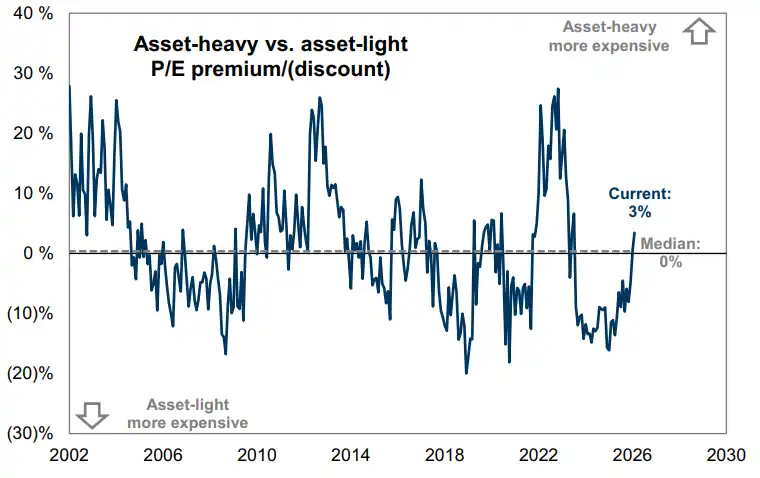
Goldman's research last month already indicated that heavy-asset stocks are currently trading at a valuation premium relative to light-asset stocks. As of last month, the P/E premium for heavy-asset stocks was about 3%, sitting at the 62nd percentile over the past few decades. While still below historical peaks seen in 2004, 2012, and 2022, they are no longer cheap.

Since last November, Goldman's sector-neutral heavy-asset basket (GSTHHAIR) has cumulatively outperformed the light-asset basket (GSTHLAIR) by about 20%. In Goldman's view, the root of this strong performance by heavy assets lies in investors' strong demand for "AI-insulated" assets—namely, the search for physical asset-class stocks that are less susceptible to AI disruption and have underperformed for years.

Goldman recommends pairing the GSXUHALT short position with the firm's favored thematic long opportunities. The report notes that recent market adjustments have created the largest "buy the dip" opportunity in global equities since "Liberation Day," allowing investors to establish long exposure in directions supported by long-term trends while shorting heavy-asset stocks lacking fundamental support.

Behind this strategic shift is Goldman's clear judgment on the internal differentiation within the HALO trade: Not all heavy-asset stocks are worth holding. The time has come to distinguish between targets with true competitive moats and upward earnings momentum and those merely riding the coattails of the "heavy asset" label.

Связанные с этим вопросы

QWhat is the HALO concept that Goldman Sachs initially promoted, and why did they recommend it?

AThe HALO concept, promoted by Goldman Sachs in late February, stands for 'Heavy Assets, Low Obsolescence.' It referred to companies with significant physical assets that are less likely to be disrupted by AI. Goldman recommended it because the rise of AI was seen as a threat to 'light asset' industries like software and IT services, while simultaneously driving an unprecedented capital expenditure cycle from major tech giants to maintain a competitive advantage in computing power.

QWhy did Goldman Sachs perform a strategic U-turn' and create the GSXUHALT basket?

AGoldman Sachs performed a strategic 'U-turn' and created the GSXUHALT basket because the market's pursuit of 'AI-insulated' assets had become indiscriminate. They observed that many heavy-asset stocks with zero or negative earnings growth expectations and low returns had seen their stock prices rise significantly alongside the broader HALO theme, becoming disconnected from their fundamentals.

QWhat specific criteria did Goldman Sachs use to select stocks for its GSXUHALT short basket?

AGoldman Sachs selected stocks for the GSXUHALT basket from the Russell 1000 index by focusing on companies in the highest asset-intensity sectors. They then剔除 (excluded) all companies related to long-term trends like satellites, robotics, quantum computing, and AI. Finally, they only kept stocks that had significant year-to-date price gains but had flat or downward revised earnings expectations. The basket's average asset intensity ratio is about 1.4.

QAccording to Goldman's data, what is the current valuation premium for heavy-asset stocks, and what does it indicate?

AAccording to Goldman Sachs's data from the previous month, heavy-asset stocks were trading at a price-to-earnings (P/E) premium of approximately 3% compared to light-asset stocks. This premium was at the 62nd percentile of its historical range over recent decades, indicating that while it is not at its historical peak, these stocks are no longer cheap and are valued at a medium-to-high level historically.

QWhat trading strategy does Goldman Sachs recommend alongside the GSXUHALT short position?

AGoldman Sachs recommends pairing the GSXUHALT short position with thematic long opportunities that they favor. They suggest that investors can short the heavy-asset stocks lacking fundamental support while simultaneously establishing long exposure in directions supported by long-term trends, taking advantage of what they see as the largest 'buy the dip' opportunity in global equities since 'Liberation Day'.

Похожее

Gensyn AI: Don't Let AI Repeat the Mistakes of the Internet

In recent months, the rapid growth of the AI industry has attracted significant talent from the crypto sector. A persistent question among researchers intersecting both fields is whether blockchain can become a foundational part of AI infrastructure. While many previous AI and Crypto projects focused on application layers (like AI Agents, on-chain reasoning, data markets, and compute rentals), few achieved viable commercial models. Gensyn differentiates itself by targeting the most critical and expensive layer of AI: model training. Gensyn aims to organize globally distributed GPU resources into an open AI training network. Developers can submit training tasks, nodes provide computational power, and the network verifies results while distributing incentives. The core issue addressed is not decentralization for its own sake, but the increasing centralization of compute power among tech giants. In the era of large models, access to GPUs (like the H100) has become a decisive bottleneck, dictating the pace of AI development. Major AI companies are heavily dependent on large cloud providers for compute resources. Gensyn's approach is significant for several reasons: 1) It operates at the core infrastructure layer (model training), the most resource-intensive and technically demanding part of the AI value chain. 2) It proposes a more open, collaborative model for compute, potentially increasing resource utilization by dynamically pooling idle GPUs, similar to early cloud computing logic. 3) Its technical moat lies in solving complex challenges like verifying training results, ensuring node honesty, and maintaining reliability in a distributed environment—making it more of a deep-tech infrastructure company. 4) It targets a validated, high-growth market with genuine demand, rather than pursuing blockchain integration without purpose. Ultimately, the boundaries between Crypto and AI are blurring. AI requires global resource coordination, incentive mechanisms, and collaborative systems—areas where crypto-native solutions excel. Gensyn represents a step toward making advanced training capabilities more accessible and collaborative, moving beyond a niche controlled by a few giants. If successful, it could evolve into a fundamental piece of AI infrastructure, where the most enduring value in the AI era is often created.

marsbit10 ч. назад

Gensyn AI: Don't Let AI Repeat the Mistakes of the Internet

marsbit10 ч. назад

Why is China's AI Developing So Fast? The Answer Lies Inside the Labs

A US researcher's visit to China's top AI labs reveals distinct cultural and organizational factors driving China's rapid AI development. While talent, data, and compute are similar to the West, Chinese labs excel through a pragmatic, execution-focused culture: less emphasis on individual stardom and conceptual debate, and more on teamwork, engineering optimization, and mastering the full tech stack. A key advantage is the integration of young students and researchers who approach model-building with fresh perspectives and low ego, prioritizing collective progress over personal credit. This contrasts with the US culture of self-promotion and "star scientist" narratives. Chinese labs also exhibit a strong "build, don't buy" mentality, preferring to develop core capabilities—like data pipelines and environments—in-house rather than relying on external services. The ecosystem feels more collaborative than tribal, with mutual respect among labs. While government support exists, its scale is unclear, and technical decisions appear driven by labs, not state mandates. Chinese companies across sectors, from platforms to consumer tech, are building their own foundational models to control their tech destiny, reflecting a broader cultural drive for technological sovereignty. Demand for AI is emerging, with spending patterns potentially mirroring cloud infrastructure more than traditional SaaS. Despite challenges like a less mature data industry and GPU shortages, Chinese labs are propelled by vast talent, rapid iteration, and deep integration with the open-source community. The competition is evolving beyond a pure model race into a contest of organizational execution, developer ecosystems, and industrial pragmatism.

marsbit11 ч. назад

Why is China's AI Developing So Fast? The Answer Lies Inside the Labs

marsbit11 ч. назад

3 Years, 5 Times: The Rebirth of a Century-Old Glass Factory

Corning, a 175-year-old glass company, is experiencing a dramatic revival as a key player in AI infrastructure, driven by surging demand for high-performance optical fiber in data centers. AI data centers require vastly more fiber than traditional ones—5 to 10 times as much per rack—to handle high-speed data transmission between GPUs. This structural demand shift, coupled with supply constraints from the lengthy expansion cycle for fiber preforms, has created a significant supply-demand gap. Nvidia has invested in Corning, along with Lumentum and Coherent, in a $4.5 billion total commitment to secure the optical supply chain for AI. Corning's competitive edge lies in its expertise in producing ultra-low-loss, high-density, and bend-resistant specialty fiber, which is critical for 800G+ and future 1.6T data rates. Its deep involvement in co-packaged optics (CPO) with partners like Nvidia further solidifies its position. While not the largest fiber manufacturer globally, Corning's revenue from enterprise/data center clients now exceeds 40% of its optical communications sales, and it has secured multi-year supply agreements with major hyperscalers including Meta and Nvidia. Financially, Corning's optical communications revenue has surged, doubling from $1.3 billion in 2023 to over $3 billion in 2025. Its stock price has risen nearly 6-fold since late 2023. Key future catalysts include the rollout of Nvidia's CPO products and the scale of undisclosed customer agreements. However, risks include high current valuations and potential disruption from next-generation technologies like hollow-core fiber. The company's long-term bet on light over electricity, maintained even through the telecom bubble crash, is now being validated by the AI boom.

marsbit12 ч. назад

3 Years, 5 Times: The Rebirth of a Century-Old Glass Factory

marsbit12 ч. назад

Торговля

Спот
Фьючерсы
活动图片