Has the Winter of Crypto IPOs Arrived? Consensys and Ledger Hit Pause

marsbitОпубликовано 2026-05-14Обновлено 2026-05-14

Введение

Crypto IPO Winter Arrives? Consensys and Ledger Hit Pause. Following a boom in 2025, the window for crypto company initial public offerings has narrowed sharply in 2026. Major players like MetaMask developer Consensys and hardware wallet firm Ledger have recently postponed their US listing plans, joining exchange Kraken which paused its process earlier this year. This slowdown follows a strong 2025 where companies like Circle and Bullish went public, raising billions as Bitcoin hit all-time highs. However, in 2026, declining Bitcoin prices and trading volumes have cooled investor risk appetite. Newly listed crypto stocks, including BitGo, have seen significant price drops post-IPO, reinforcing investor caution. The cooling crypto IPO market contrasts sharply with the red-hot AI sector, where companies like SpaceX and OpenAI command massive valuations and investor interest based on "productivity revolution" narratives. Crypto firms, seen as more cyclical and volatile, struggle to compete for capital. The IPO delays are prompting a strategic shift. Companies are focusing on strengthening fundamentals, pursuing private funding, and expanding into more stable revenue streams like institutional services. This phase may accelerate industry consolidation, favoring firms with robust compliance and infrastructure. Analysts suggest a potential second wave of crypto IPOs in late 2026 could depend on a Bitcoin price recovery and clearer regulatory developments.

Original Author: Ma He, Foresight News

On May 14th, MetaMask wallet developer Consensys temporarily postponed its IPO until at least this autumn. Meanwhile, crypto hardware wallet giant Ledger also suspended its U.S. IPO plans on May 13th. Previously, exchange Kraken had repeatedly delayed its listing plans. This series of IPO delays and suspensions indicates a clear narrowing of the IPO window in 2026, following the surge in crypto company listings in 2025.

2025 was seen as a "bumper year for IPOs" in the industry: stablecoin issuer Circle successfully listed on the NYSE, and companies like Bullish and Gemini completed their IPOs, initially opening exit channels for crypto VCs. Crypto-related IPOs in 2025 raised approximately $14.6 billion, and total VC deal volume soared to $19.7 billion. The price of BTC once surged to a historic high of $126,000. Inflows of institutional capital and a relatively friendly regulatory environment propelled strong first-day performances for several crypto stocks.

Entering 2026, Bitcoin's price saw a significant correction, trading volume declined, and investor risk appetite for crypto stocks rapidly cooled. BitGo, as the first crypto IPO of 2026, listed in January at a price of $18. Despite a brief rise on the first day, its price subsequently fell, at one point dropping to $7, and has now recovered to $11.9.

Specifically, the listing pace of several leading companies has noticeably slowed. Kraken's parent company, Payward, confidentially filed an S-1 form in November 2025, originally planning to proceed in Q1 2026, with a valuation once targeting $20 billion. On March 18th this year, the company paused its plans citing "difficult market conditions." Co-CEO Arjun Sethi stated that despite a recent funding round lowering the valuation to $13.3 billion, the IPO filing remains active, awaiting the optimal window.

Arjun Sethi

Ledger's pause was more abrupt. Known for its hardware wallets and enterprise-grade infrastructure, reports in January 2026 indicated it had hired investment banks to prepare for a U.S. listing with a target valuation of $4 billion. According to sources familiar with the matter, Ledger decided to hold off due to unfavorable market conditions and did not initiate the formal filing process. A company spokesperson declined to comment but indicated a possible turn towards private financing to sustain growth.

Notably, just in March, Ledger appointed former Circle executive John Andrews as CFO and opened a New York office to strengthen its U.S. business presence. This expansion shows its business strategy remains unchanged, and the listing suspension is more a result of external pressures.

Meanwhile, MetaMask parent company Consensys has also joined the wait-and-see ranks. The company had hired JPMorgan and Goldman Sachs as underwriters, originally planning to submit its S-1 form around the end of February, targeting a 2026 listing. However, due to weak market conditions, Consensys has postponed its IPO to at least this autumn.

The suspension of these crypto company IPOs is, of course, the result of multiple overlapping factors.

The stock performance of the first wave of crypto IPOs in 2025 has heightened market caution towards the 2026 listing window.

This year, Circle's stock price has fallen from a high of $300 to below $50 at one point, and Bullish's dropped from $118 to below $25. Even BitGo, the first crypto IPO of 2026, was not spared—after listing at $18 in January, it briefly rebounded but then fell all the way to around $7 at its lowest.

This year's performance collectively confirms that crypto-related stocks can easily attract capital during the tail end of a bull market but struggle to resist valuation resets during cyclical downturns. Traditional institutional investors are significantly increasing their risk premium requirements for "cycle-bound" assets.

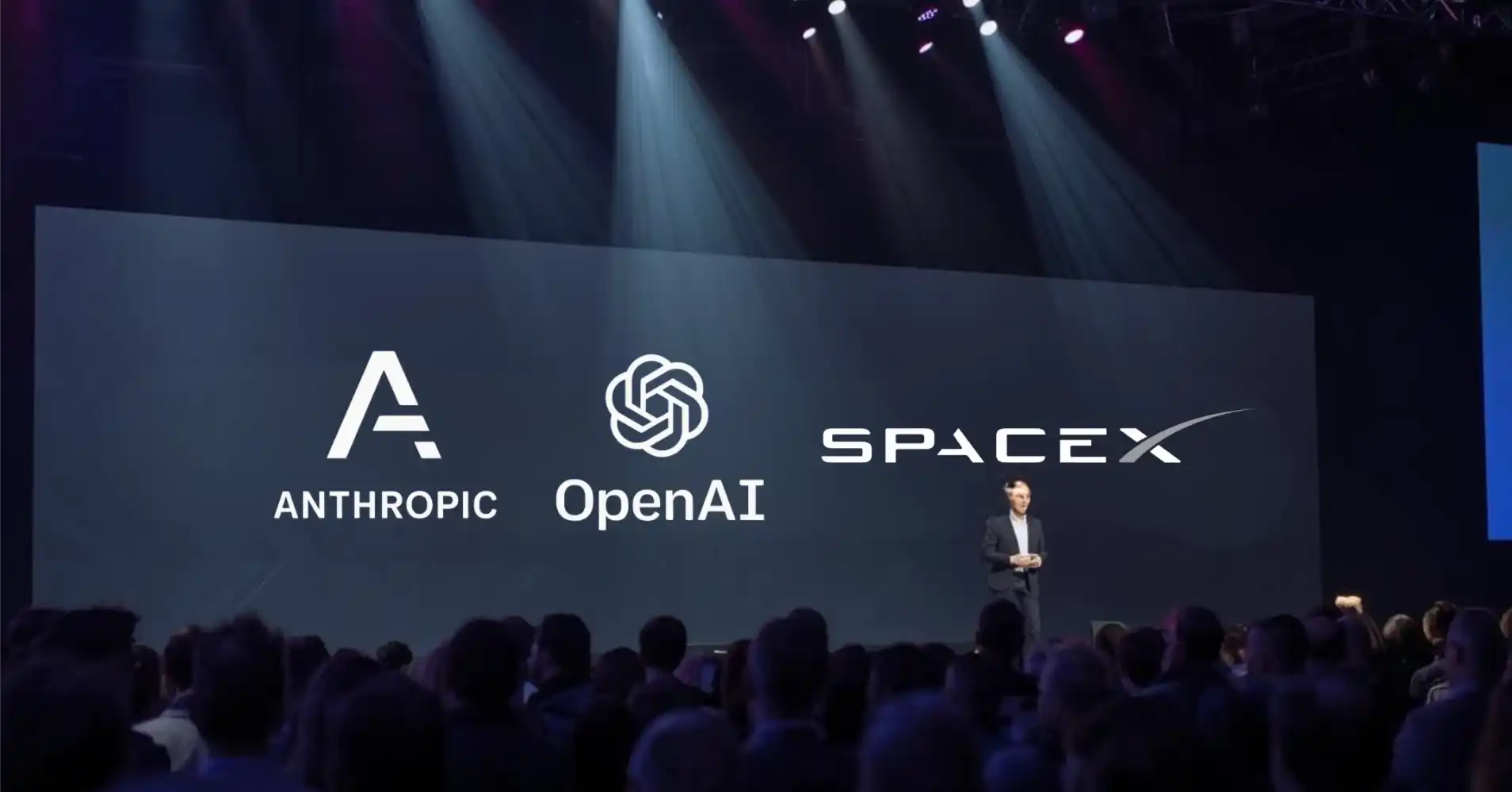
In stark contrast to the "cooling-off period" for crypto IPOs, the AI sector is experiencing a dual climax of IPOs and financing in 2026.

SpaceX has initiated IPO preparations with a target valuation as high as $1.75 trillion to $2 trillion, making it one of the most anticipated tech listings globally.

OpenAI's valuation is approaching $1 trillion and is in close communication with multiple investment banks regarding its listing path; Anthropic's valuation is nearing $900 billion and is also actively preparing IPO materials. The AI narrative, backed by the certainty of a "productivity revolution," is attracting a massive influx of long-term capital. Even in an environment of macroeconomic uncertainty, AI-related IPOs still garner far higher risk appetite than crypto assets.

In contrast, crypto companies are highly dependent on Bitcoin prices and trading volume, with more volatile revenue, making it difficult to provide the certainty of "exponential growth" promised by AI companies. This cross-sector disparity in cold and hot sentiment further amplifies investors' wait-and-see attitude towards crypto IPOs and also forces crypto enterprises to accelerate their transition from "storytelling" to "focusing on cash flow and compliance."

Furthermore, crypto companies are adopting a more pragmatic strategic shift: while private financing scales have shrunk, it can still provide a buffer; some companies choose to first optimize product lines, expand into stablecoins or institutional services, and wait to list after Bitcoin stabilizes at higher levels and market conditions improve.

The implications of this phenomenon for the industry warrant deep thought.

On one hand, it accelerates the survival of the fittest. Weaker projects face increased difficulty in financing, and resources concentrate towards companies with strong compliance and solid infrastructure, such as Ledger's institutional-grade platform and Kraken's custody business. On the other hand, it highlights the crypto industry's transition from story-driven to performance-driven. Companies that truly survive across cycles are winning long-term trust by building resilient cash flows and enhancing transparency. However, in the short term, the narrowing IPO window may lead to valuation resets and affect confidence and liquidity across the entire ecosystem.

Looking ahead, if Bitcoin returns to $90,000 or even higher, and regulatory legislation further materializes, a second wave of IPOs may emerge in the second half of 2026.

Связанные с этим вопросы

QWhat are the two major cryptocurrency companies mentioned that have postponed their IPO plans recently, and to when has Consensys delayed its IPO?

AThe two major cryptocurrency companies mentioned are Consensys (developer of MetaMask) and Ledger. Consensys has postponed its IPO until at least the fall of this year (2026).

QAccording to the article, what were the key factors that made 2025 a 'bountiful IPO year' for crypto companies?

AKey factors included Circle's successful listing on the NYSE, the IPOs of companies like Bullish and Gemini, a total of about $14.6 billion raised from crypto-related IPOs, a surge in VC deal volume to $19.7 billion, Bitcoin's price reaching a then all-time high of $126,000, institutional capital inflows, and a relatively friendly regulatory environment.

QHow does the article contrast the current market reception for crypto company IPOs with that of AI company IPOs in 2026?

AThe article states that crypto company IPOs are in a 'cooling-off period' with multiple delays, while AI is in a 'double climax' for IPOs and financing. AI companies like SpaceX, OpenAI, and Anthropic attract high valuations and capital due to the 'certain narrative of productivity revolution,' offering more perceived certainty than the high volatility and Bitcoin-price-dependent revenues of crypto firms.

QWhat is cited as a primary reason behind the recent wave of IPO delays and suspensions for crypto companies in 2026?

AA primary reason cited is the poor stock performance of the first wave of crypto IPOs from 2025, such as Circle and Bullish experiencing significant price drops from their highs. This has increased caution among investors and raised the risk premium demanded for crypto stocks, which are seen as highly cyclical.

QWhat potential positive developments does the article suggest could open a new IPO window for crypto companies in the second half of 2026?

AThe article suggests that if Bitcoin's price returns to $90,000 or higher and if further regulatory legislation is passed, the second half of 2026 could see a second wave of IPO opportunities for crypto companies.

Похожее

Agents Take Over Traffic Distribution Power: What Are Tencent, ByteDance, and Alibaba Competing For?

In the race to dominate the AI era's entry point, China's tech giants—Tencent, ByteDance, and Alibaba—are aggressively deploying AI Agents to control the future of traffic distribution. Alibaba is pursuing a dual-track "closed loop + openness" strategy. Its Qianwen app is evolving into a super-Agent integrated across its ecosystem (Taobao, Alipay, etc.) to handle complex tasks like travel planning. Concurrently, it is opening its platform to external brands (Luckin Coffee, KFC) and has launched a B2B Agent platform, "Wukong," targeting enterprise automation. Its other flagship, Quark, aims to be an "AI super search box" for information and tasks. ByteDance is executing an omnipresent "sprawl strategy." Its Doubao app boasts over 300 million monthly active users and is evolving into a default AI entry point for daily life, with plans for paid versions and e-commerce integration. Its core weapon is the Kouzi platform, a visual "AI assembly factory" for developers to build custom Agents. ByteDance is also pushing hardware integration, collaborating on AI phones and developing smart glasses to embed Doubao everywhere. Tencent is playing its long-held "ultimate card" by quietly embedding an AI Agent directly into WeChat. This Agent, accessible via a swipe, can understand user commands and automatically execute tasks by calling upon WeChat's millions of mini-programs (e.g., finding and ordering coffee). This leverages WeChat's unparalleled 1.4-billion-user ecosystem to position the app as an AI-powered "service operating system," a move that could dramatically reshape the competitive landscape. The core battleground is shifting from competing for "user screen time" to competing to be the "default execution layer" for user intent. The business model is evolving from an "attention economy" to an "intent economy," where the Agent that can most efficiently fulfill a user's need gains control over service access and token flow. This represents a fundamental change in how users connect with digital services, making the fight for the Agent入口 (entry point) a pivotal moment for redefining industry leadership in the AI age.

marsbit35 мин. назад

Agents Take Over Traffic Distribution Power: What Are Tencent, ByteDance, and Alibaba Competing For?

marsbit35 мин. назад

From Banning Doubao to Embracing Honor: Why Did WeChat Suddenly 'Change Its Face'?

The article explores the sudden shift in WeChat's strategy towards AI assistants from mobile phone manufacturers, transitioning from strict opposition to active collaboration. For over a year, WeChat fiercely resisted attempts by phone AI assistants (like ByteDance's Doubao in late 2025) to control its features via GUI automation ("simulated clicking"), citing security and data control concerns. This stance created a significant barrier for system-level AI integration. Now, Tencent has initiated A2A (Agent-to-Agent) partnerships with major phone brands like Honor, Xiaomi, OPPO, and vivo. This model allows a phone's system AI (e.g., Honor's YOYO) to parse a user's voice command and send a structured request directly to WeChat's own internal AI agent via secure APIs. WeChat then executes the action (e.g., sending a message) and returns the result. The article attributes Tencent's "change of face" to strategic pressure. While leading in social app usage, Tencent trails rivals like ByteDance and Alibaba in standalone AI app popularity. WeChat, with its vast mini-program ecosystem, is Tencent's key asset for an AI comeback. The upcoming WeChat AI agent aims to handle tasks like booking and payments within the app. However, phone system assistants remain the primary AI entry point for most users. The A2A collaboration allows Tencent to extend WeChat's AI reach to this crucial system layer while maintaining control over its core functions and data. For phone manufacturers, embracing A2A is a pragmatic move. The GUI route proved unviable due to WeChat's blocks. A2A offers a compliant path to integrate a vital service, enhancing their AI assistants' usefulness. It allows them to focus on developing their own AI ecosystems for other services while cooperating on WeChat access. The collaboration is framed as a mutual, strategic necessity: Tencent gains a distribution channel, and manufacturers gain a key functionality. The partnership relies on a "dual authorization" mechanism for security, requiring both user and app consent for each action. While questions about long-term data privacy practices remain, experts note A2A is more secure and compliant than GUI automation. Ultimately, this cooperation is seen as a tentative, calculated truce. Tencent's long-term goal is to make WeChat an AI-powered "service OS." Phone manufacturers aim to make their system AI the central user interface. Their paths may converge or clash in the future, but for now, the A2A deal represents the opening chapter in the battle for the AI-era user入口, driven by necessity and strategic calculus on both sides.

marsbit2 ч. назад

From Banning Doubao to Embracing Honor: Why Did WeChat Suddenly 'Change Its Face'?

marsbit2 ч. назад

Торговля

Спот
Фьючерсы
活动图片