Hacker Attack Cuts Flow in Half, Rollback Plan Sparks Civil War Within Ecosystem

Odaily星球日报Опубликовано 2025-12-29Обновлено 2025-12-29

Введение

A severe hack targeting the Flow blockchain, developed by Dapper Labs, led to the theft of approximately $3.9 million due to an execution layer vulnerability. The incident caused the token FLOW to plummet by over 50%, dropping from $0.173 to $0.079, though it later partially recovered to around $0.107. Initially, the Flow Foundation proposed rolling back the network to a checkpoint before the attack to remove all transactions within a six-hour window, aiming to eliminate fraudulent activity. However, this plan faced strong opposition from cross-chain bridge partners and community members. Key partners, including deBridge and LayerZero, warned that a rollback could cause severe issues like double-spending and inconsistent asset states across chains, potentially harming legitimate users and bridge operators. Under significant criticism, Flow abandoned the rollback plan and instead adopted an "Isolation and Recovery" strategy. This new approach involves no chain reorganization, preserves all legitimate user transactions, and temporarily restricts accounts that received illicitly minted assets. The recovery is being executed in phases, with Cadence environment repairs prioritized first, followed by gradual reactivation of EVM functionality and cross-chain services. The incident sparked a broader debate about decentralization and chain integrity, with critics arguing that the initial rollback proposal revealed excessive centralization. The revised recovery plan has eased some t...

Original | Odaily Planet Daily (@OdailyChina)

Author | Asher (@Asher_ 0210)

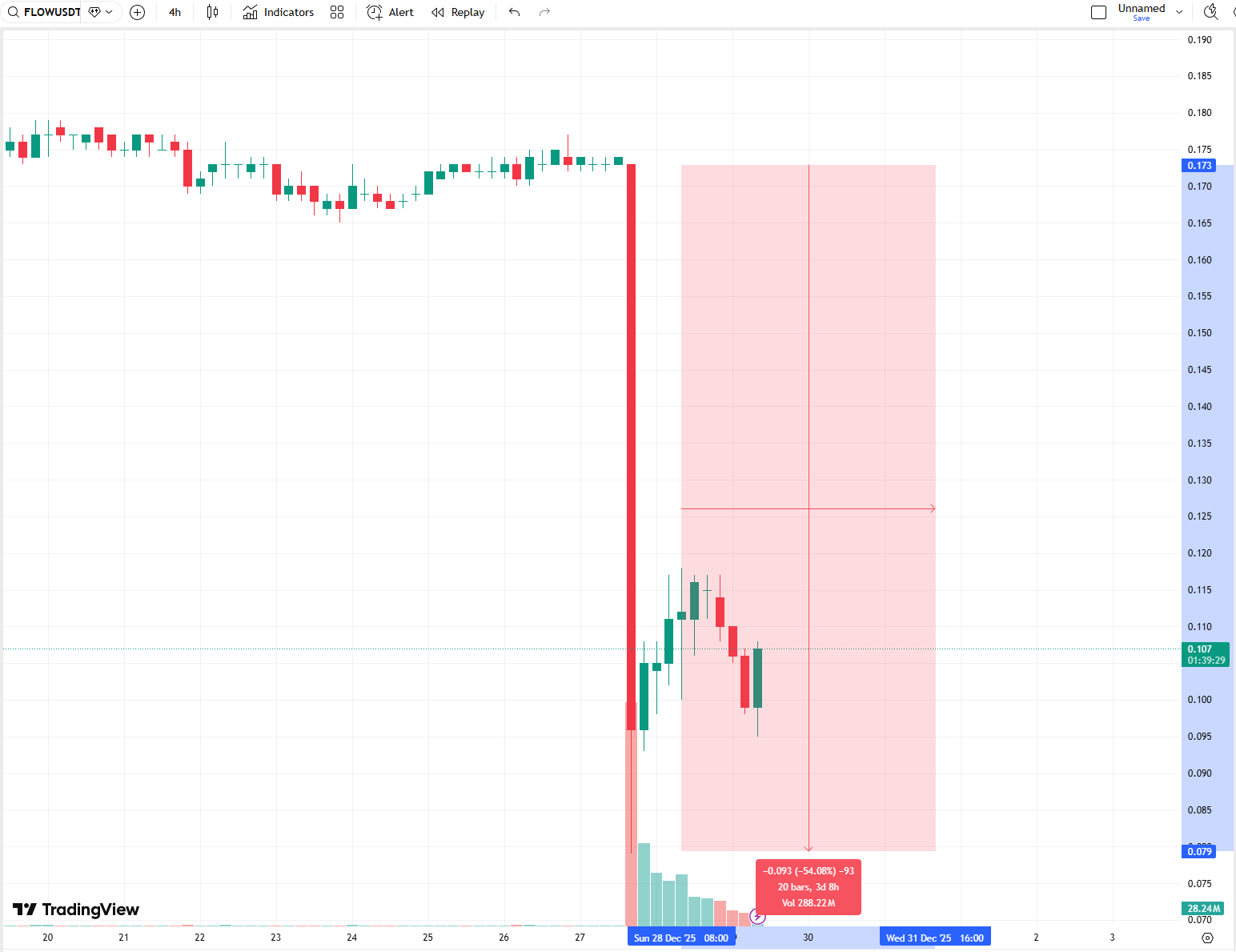
Last Saturday afternoon, a sudden hacker attack threw the Flow network into chaos. This Layer 1 network, built by the Dapper Labs team and tailored for the next generation of applications, games, and digital assets, watched helplessly as assets worth $3.9 million were transferred off-chain due to an exploited execution layer vulnerability. Following the attack, its token FLOW was temporarily cut in half, plummeting from $0.173 to $0.079, and has since rebounded slightly to around $0.107.

FLOW K-Line Chart

Below, Odaily Planet Daily breaks down this Flow theft incident, the official response, and why it has sparked strong质疑 (questioning/doubts) from Flow's partners and community.

Flow Official Emergency Response: Isolate Network, and Announce Rollback Plan

After the attack, the Flow Foundation quickly responded and confirmed the details of the incident. The attacker exploited an execution layer vulnerability to transfer approximately $3.9 million in assets; the incident did not affect users' existing balances, and user deposits remain safe. The relevant attack addresses have been marked, money laundering paths are being continuously tracked, and the Foundation has submitted asset freeze requests to Circle, Tether, and several major exchanges.

To clean up illegal on-chain transactions and repair the vulnerability, the Flow Foundation isolated the network and simultaneously published Mainnet 28, a patched version for the mainnet vulnerability. The Foundation's initial proposed solution was to roll back the network state to a checkpoint before the attack, specifically to Cadence block height 137363395, thereby deleting all transaction records generated within approximately a 6-hour window. Regardless of whether the transactions were legitimate, they would all be erased, and users would need to resubmit transactions after node restart. The Foundation believed this plan was the safest path to restore network integrity, repeatedly emphasized that user funds would not be affected throughout the process, and promised to provide external updates on progress every two hours.

This rollback decision, seemingly decisive, quickly ignited an ecosystem firestorm—because the hacker's funds had already been bridged off-chain, the rollback would not affect the attacker but would only impact honest users and partners.

Cross-Chain Bridge Partners, Community Users Strongly Oppose, Rollback Plan Heavily Criticized

After the rollback plan was announced, cross-chain bridge partners within the Flow ecosystem and community users quickly faced collective质疑 (questioning/doubts). Alex Smirnov, co-founder of deBridge, a major cross-chain bridge partner for Flow, publicly criticized the decision on platform X as too hasty and stated that no prior communication had been made with key bridge partners beforehand. As a crucial asset channel for the Flow ecosystem, deBridge did not receive any advance notice regarding the rollback.

Smirnov pointed out that the potential damage from a rollback could far exceed that of the initial hack itself. Since cross-chain assets had already circulated across multiple systems, a forced rollback would cause serious issues like asset duplication and inconsistent custodial states, ultimately harming the bridges, users, and counterparties who operated normally during the window. He disclosed that approximately $200,000 and $50,000 in deposits on deBridge fell within the rollback time window; once the rollback was executed, it could lead to funds disappearing on one side or the extreme case of assets being double-minted.

Based on these risks, Smirnov called on Flow validators to suspend block production and validation until compensation plans, partner coordination mechanisms, and plans for independent security team involvement were all clarified. Similar issues were not isolated cases. As the main cross-chain custodian for USDC on the Flow network, LayerZero also faced risks with approximately $220,000 and $180,000 in cross-chain transactions falling within the rollback window.

Beyond cross-chain bridge partners within the Flow ecosystem, users on platform X began集中 (concentratedly) expressing concerns about fund safety, developers questioned the network's reliability and governance mechanisms under extreme circumstances, investor sentiment turned cautious accordingly, and selling pressure intensified. A significant number of voices directly pointed out that the rollback itself exposed the reality of centralized control on the chain, rapidly turning a technical incident into a crisis of trust.

Some community views further targeted the core principles of blockchain. Some argued that the rollback directly shook transaction finality and immutability, making Flow resemble an alliance chain subject to administrative intervention at a critical moment. Others compared it to historical security incidents on other public chains, pointing out that similar situations are usually handled by isolating attacker addresses and freezing fund flows, rather than performing a global rollback of the entire network state.

Crypto KOL Wazz (@WazzCrypto) stated bluntly on platform X that Flow's rollback decision was one of the worst handling methods he had ever seen. In his view, the attacker had already transferred nearly $4 million in assets off-chain and would hardly be substantively affected by the rollback; the real cost would instead be borne by innocent users who used the network normally via cross-chain bridges.

Flow Official Changes Stance: Abandons Rollback, Adopts New Isolation Recovery Plan

Facing strong opposition from partners and the community, the Flow official team ultimately decided to abandon the network rollback and shift to an "Isolation Recovery Plan". This plan was developed through direct consultation with cross-chain bridges, exchanges, and infrastructure partners. Key points include:

  • No rollback/reorganization, preserving all legitimate user activity;
  • No need for partners to replay transactions;
  • Over 99.9% of accounts unaffected, normal operation upon restart;
  • Temporary restriction of accounts that received illegally minted tokens upon restart;

Furthermore, the network will be restored in phases:

  • Phase 1: Cadence environment goes online, EVM temporarily restricted;
  • Phase 2: Cadence repair (approx. 24 to 48 hours);
  • Phase 3: EVM repair and restart;
  • Phase 4: Cross-chain bridges/exchanges resume operation, specific recovery time determined by operators based on actual conditions after confirming stability.

Additionally, Dapper Labs, the team behind Flow, expressed support for this plan on platform X, stating it "preserves legitimate activity and provides a clear path to recovery".

This "abandon rollback" stance alleviated ecosystem tensions in the short term and avoided the systemic risk扩散 (spread/proliferation) a rollback might have caused. As of now, the network is still in a phased coordination and recovery process, with officials stating user funds remain safe.

In the highly uncertain environment of the crypto market, this crisis may become a significant watershed in Flow's development path. Its long-term impact remains to be tested by time.

Связанные с этим вопросы

QWhat was the immediate impact of the hack on the Flow network's native token, FLOW?

AThe FLOW token experienced a sharp price drop, falling from $0.173 to $0.079, effectively halving its value in a short period. It later saw a small rebound to around $0.107.

QWhat was the initial recovery plan proposed by the Flow Foundation after the hack, and why was it controversial?

AThe initial plan was to roll back the network state to a checkpoint before the attack, which would have erased all transactions from a 6-hour window. This was controversial because it would have affected legitimate user transactions and cross-chain bridge operations, potentially causing more damage than the hack itself, while the hacker's funds were already off-chain and unaffected.

QWhich key cross-chain bridge partner publicly criticized the rollback plan, and what was their main concern?

AAlex Smirnov, the co-founder of deBridge, publicly criticized the plan. The main concern was that the rollback was decided without prior communication with key bridge partners and would create severe problems like double-spending and inconsistent custodial states for assets that had already been bridged to other chains during that window.

QWhat was the final recovery solution that Flow adopted instead of a network rollback?

AFlow abandoned the rollback and adopted an 'Isolation Recovery Plan.' This plan involved no rollback, preserved all legitimate user activity, did not require partners to replay transactions, and temporarily restricted accounts that received illegally minted tokens. The network was to be restored in phases.

QWhat broader principle of blockchain technology did the proposed rollback crisis call into question according to the community?

AThe community argued that the proposed rollback shook the core blockchain principles of transaction finality and immutability, making Flow appear more like a centrally controlled consortium chain that could be administratively interfered with, rather than a decentralized ledger.

Похожее

First Batch of Keynote Speakers and Partners Announced! Web2+3 Summit: Defining the Next Generation of Digital Economy

Web2+3 Summit: Defining the Next Generation of Digital Economy The 6th BEYOND International Technology Innovation Expo (BEYOND Expo 2026), Asia's largest tech and ecosystem exhibition, is launching a dedicated Web2+3 stage for the first time. Co-hosted by BEYOND Expo and ChainNeXT Group, the Web3 Summit will take place from May 28–30, 2026. Against the backdrop of accelerating global tech integration, the boundaries between Web2 and Web3 are rapidly blurring. With clearer global regulations for blockchain-driven internet (Web3) and the special issuance of a Hong Kong dollar stable币 license by the Hong Kong SAR government on April 10, 2026, Web3's decentralized principles are quickly merging with traditional industries (Web2) such as e-commerce, finance, and artificial intelligence. Focused on blockchain-driven digital economy elements, the summit will center on three core principles—implementability, commercial viability, and compliance. It will bring together top Web3 experts to discuss key integration areas like stablecoin payment finance (PayFi), real-world asset tokenization (RWA), and decentralized AI (DeAI), unveiling new opportunities for industrial innovation. The first wave of confirmed speakers includes Jack Kong (Director of Hong Kong Cyberport, Chairman of Nano Labs), Yat Siu (Chairman of Animoca Brands), Michael Wu (Co-founder & CEO of Amber Group), Michael Heinrich (Co-founder & CEO of 0G), and Art Abal (Co-founder of Vana). More Web3 ecosystem pioneers, AI, and fintech experts will be announced soon. Core forum topics include: - Web2+DeAI: New AI Paradigms Driven by Decentralized Infrastructure - Web2+RWA: Real-World Asset Tokenization and Global Liquidity - Web2+PayFi: Cross-Border Payments and Financial Innovation Powered by Crypto Infrastructure - Web2+3 AI: Autonomous Agents and the Crypto Economy - Web2+3 Wealth: On-Chain and Off-Chain Integrated Investment Ecosystems - Web2+3 Commerce: A New Landscape for Global Trade Driven by Stablecoins Additional agenda details will be released in the near future.

marsbit3 ч. назад

First Batch of Keynote Speakers and Partners Announced! Web2+3 Summit: Defining the Next Generation of Digital Economy

marsbit3 ч. назад

Торговля

Спот
Фьючерсы

Популярные статьи

Как купить FLOW

Добро пожаловать на HTX.com! Мы сделали приобретение Flow (FLOW) простым и удобным. Следуйте нашему пошаговому руководству и отправляйтесь в свое крипто-путешествие.Шаг 1: Создайте аккаунт на HTXИспользуйте свой адрес электронной почты или номер телефона, чтобы зарегистрироваться и бесплатно создать аккаунт на HTX. Пройдите удобную регистрацию и откройте для себя весь функционал.Создать аккаунтШаг 2: Перейдите в Купить криптовалюту и выберите свой способ оплатыКредитная/Дебетовая Карта: Используйте свою карту Visa или Mastercard для мгновенной покупки Flow (FLOW).Баланс: Используйте средства с баланса вашего аккаунта HTX для простой торговли.Третьи Лица: Мы добавили популярные способы оплаты, такие как Google Pay и Apple Pay, для повышения удобства.P2P: Торгуйте напрямую с другими пользователями на HTX.Внебиржевая Торговля (OTC): Мы предлагаем индивидуальные услуги и конкурентоспособные обменные курсы для трейдеров.Шаг 3: Хранение Flow (FLOW)После приобретения вами Flow (FLOW) храните их в своем аккаунте на HTX. В качестве альтернативы вы можете отправить их куда-либо с помощью перевода в блокчейне или использовать для торговли с другими криптовалютами.Шаг 4: Торговля Flow (FLOW)С легкостью торгуйте Flow (FLOW) на спотовом рынке HTX. Просто зайдите в свой аккаунт, выберите торговую пару, совершайте сделки и следите за ними в режиме реального времени. Мы предлагаем удобный интерфейс как для начинающих, так и для опытных трейдеров.

425 просмотров всегоОпубликовано 2024.03.29Обновлено 2025.05.13

Как купить FLOW

Обсуждения

Добро пожаловать в Сообщество HTX. Здесь вы сможете быть в курсе последних новостей о развитии платформы и получить доступ к профессиональной аналитической информации о рынке. Мнения пользователей о цене на FLOW (FLOW) представлены ниже.

活动图片