Grayscale Files Spot BNB ETF Application With US SEC — Report

bitcoinistОпубликовано 2026-01-24Обновлено 2026-01-24

Введение

Grayscale has filed an application with the U.S. SEC to launch a spot exchange-traded fund (ETF) for BNB, the native token of the Binance ecosystem. The proposed ETF, to be listed under the ticker GBNB on Nasdaq if approved, would allow U.S. investors to gain exposure to BNB without directly holding the asset. This move follows a similar earlier application by VanEck and reflects Grayscale's continued expansion into crypto-linked investment products. Former Binance CEO Changpeng Zhao welcomed the filing as a step toward making the U.S. a hub for crypto. Bloomberg ETF analyst James Seyffart suggested that approval could imply the SEC views BNB as a commodity rather than a security. At the time of reporting, BNB was trading around $890, down nearly 5% over the past week.

In an interesting development, Grayscale has applied to the United States Securities and Exchange Committee to launch a spot exchange-traded fund (ETF) linked to BNB, the Binance Ecosystem’s native token. This move marks a power play by the asset management firm to further establish itself in the cryptocurrency space.

Grayscale Looks To Add To List Of Crypto-Linked ETFs

On Friday, January 23, Grayscale filed an S-1 registration statement with the SEC to launch a spot BNB exchange-traded fund in the US. According to the SEC filing, the proposed Grayscale ETF would hold the Binance ecosystem’s native token directly and issue shares designed to track the token’s market value.

This Grayscale investment product, if approved, would offer US investors exposure to the BNB token without having to own or hold the asset themselves. The asset manager’s registration statement also revealed that the exchange-traded fund would trade on the Nasdaq exchange under the ticker symbol GBNB, subject to regulatory approval.
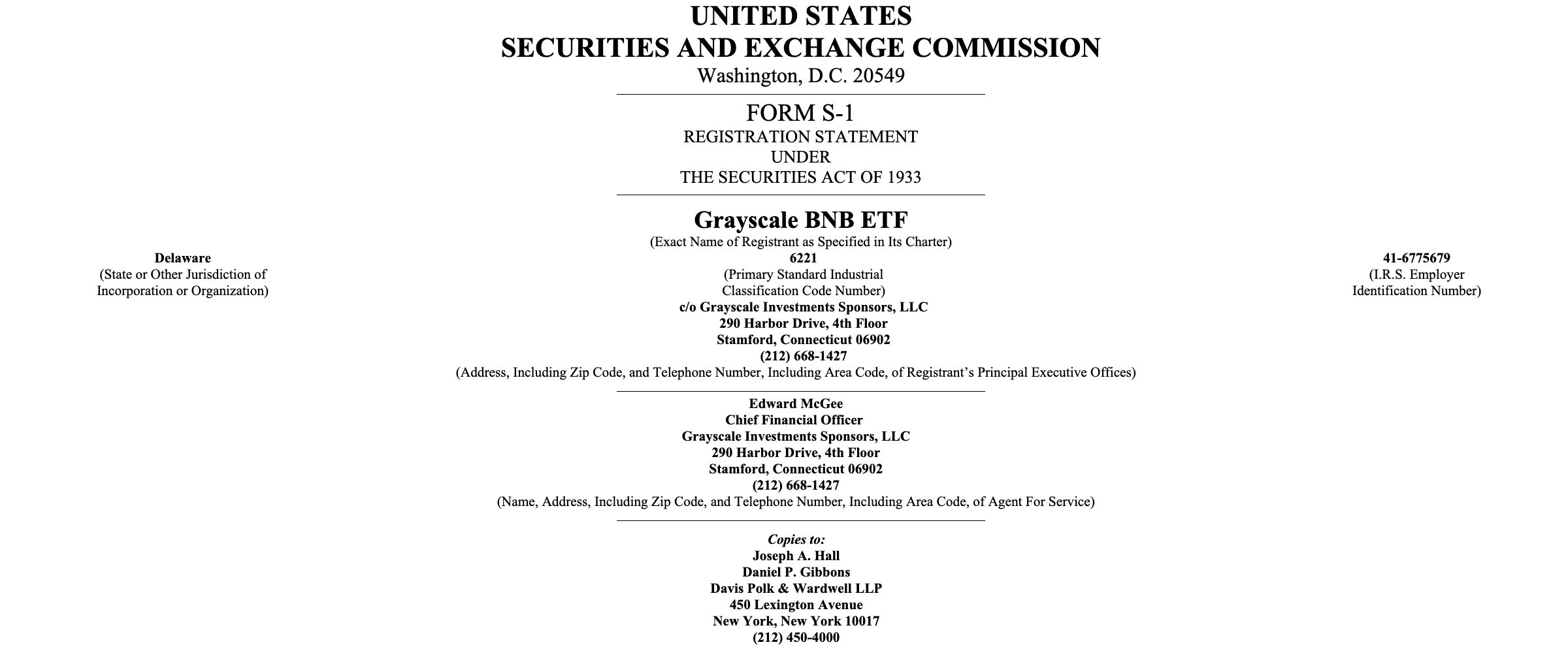
Source: SEC

It is worth mentioning that Grayscale is not the first asset manager to file for a spot BNB ETF, as VanEck applied as far back as April 2025. However, this latest filing reflects the firm’s resolve to expand its list of crypto-linked investment products, especially after the successful launch of the Bitcoin and Ethereum ETFs.

It was always only a matter of time before BNB, the fourth-largest cryptocurrency by market capitalization, received extra attention from institutions focused on exchange-traded products. As such, this move by Grayscale has caught the attention of the cryptocurrency market, including former Binance CEO Changpeng ‘CZ’ Zhao.

In a Friday post on the social media platform X, CZ said that Grayscale’s submission of its S-1 filing to the SEC represents a small step toward making the United States the capital of crypto. “A small step in helping to make America the Capital of Crypto, by giving access to the 3rd largest crypto,” the Binance co-founder wrote on Friday.

Meanwhile, Bloomberg ETF expert James Seyffart concurred that a spot ETF approval could mean that the BNB token will be classified as a commodity rather than a security. This is because the approval of an exchange-traded fund is often an indication that the SEC views the underlying asset as a commodity rather than as a security.

BNB Price At A Glance

After making a play for $900 on Friday afternoon, the price of BNB now stands at around $890. According to data from CoinGecko, the fourth-largest cryptocurrency is down by nearly 5% in the past seven days.

The price of BNB on the daily timeframe | Source: BNBUSDT chart on TradingView


Связанные с этим вопросы

QWhat type of ETF application has Grayscale filed with the SEC, and for which cryptocurrency?

AGrayscale has filed an application for a spot exchange-traded fund (ETF) linked to BNB, the native token of the Binance ecosystem.

QOn which exchange and under what ticker symbol would the proposed Grayscale BNB ETF trade, if approved?

AIf approved, the ETF would trade on the Nasdaq exchange under the ticker symbol GBNB.

QAccording to the article, who was the first asset manager to file for a spot BNB ETF, and when did they do it?

AVanEck was the first asset manager to file for a spot BNB ETF, applying back in April 2025.

QWhat did Bloomberg ETF expert James Seyffart suggest an ETF approval could mean for the classification of BNB?

AJames Seyffart suggested that an ETF approval could mean the BNB token would be classified as a commodity rather than a security.

QWhat was the price of BNB and its 7-day performance at the time the article was written?

AThe price of BNB was around $890, and it was down by nearly 5% over the past seven days.

Похожее

iQiyi Is Too Impatient

The article "iQiyi Is Too Impatient" discusses the controversy surrounding the Chinese streaming platform IQiyi's recent announcement of an "AI Actor Library" during its 2026 World Conference. IQiyi claimed over 100 actors, including well-known names like Zhang Ruoyun and Yu Hewei, had joined the initiative. CEO Gong Yu suggested AI could enable actors to "star in 14 dramas a year instead of 4" and that "live-action filming might become a world cultural heritage." The announcement quickly sparked backlash. Multiple actors named in the list issued urgent statements denying they had signed any AI-related authorization agreements. This forced IQiyi to clarify that inclusion in the library only indicated a willingness to *consider* AI projects, with separate negotiations required for any specific role. The incident, which trended on social media with hashtags like "IQiyi is crazy," is presented as a sign of the company's growing desperation. Facing intense competition from short-video platforms like Douyin and Kuaishou, as well as Bilibili and Xiaohongshu, IQiyi's financial performance has weakened, with revenues declining for two consecutive years. The author argues that IQiyi is "too impatient" to tell a compelling AI story to reassure the market, especially as it pursues a listing on the Hong Kong stock exchange. The piece concludes by outlining three key "AI questions" IQiyi must answer: defining its role as a tool provider versus a content creator, balancing the "coldness" of AI with the human element audiences desire, and properly managing the interests of platforms, actors, and viewers. The core dilemma is that while AI can reduce costs and increase efficiency, it risks creating homogenized, formulaic content and devaluing human performers.

marsbit16 мин. назад

iQiyi Is Too Impatient

marsbit16 мин. назад

Торговля

Спот
Фьючерсы
活动图片