Author: Nancy, PANews
Today, it is no longer news for Wall Street giants to enter the crypto space. In crypto sectors such as ETFs, RWA, and derivatives, the presence of mainstream institutions is becoming increasingly clear. What the market truly cares about has long moved from whether to enter to how to position.
Recently, Goldman Sachs disclosed its crypto allocation of up to $2.3 billion. Although this is still a "small position" in its overall asset landscape and has significantly reduced compared to before, its holding structure is quite meaningful. Despite the vast difference in market capitalization, Goldman Sachs maintains nearly equal exposure to BTC and ETH.
This detail may be more significant than the size of the holdings itself.
On Equal Footing with BTC, Goldman Sachs Casts a Vote of Confidence in ETH
At a time when Ethereum's price continues to face pressure and market sentiment has noticeably cooled, Goldman Sachs' latest disclosed holding structure sends a signal different from market sentiment.
According to the 13F filing, as of Q4 2025, Goldman Sachs indirectly holds approximately $2.361 billion in crypto assets through ETFs.

In the context of its overall portfolio, this allocation is not prominent. Goldman Sachs' total investment portfolio size in the same period was as high as $811.1 billion, with crypto asset exposure accounting for only about 0.3%. For traditional financial giants managing trillions of dollars, such a proportion can only be described as a trial. In the eyes of mainstream players, crypto remains an alternative asset, not a core allocation. Small-scale participation can meet client demands, maintain market participation, and strictly control risks in a volatile environment.
What is truly noteworthy is not the size, but the holding structure and direction.
In the fourth quarter of last year, the crypto market overall corrected, and spot ETF products also saw large net outflows. Goldman Sachs also reduced its positions accordingly, with Bitcoin spot ETF and Ethereum spot ETF holdings decreasing by 39.4% and 27.2% quarter-on-quarter, respectively. At the same time, it newly established positions in XRP ETF and Solana ETF in the quarter, beginning to dabble in second-tier assets.
By the end of the quarter, Goldman Sachs held approximately 21.2 million shares of spot Bitcoin ETF, with a market value of about $1.06 billion; held approximately 40.7 million shares of spot Ethereum ETF, with a market value of about $1 billion; and allocated about $152 million to XRP ETF and $109 million to Solana ETF.
In other words, nearly 90% of crypto exposure is still concentrated in the two core assets, BTC and ETH. Compared to some aggressive asset managers or crypto-native funds, Goldman Sachs' strategy is clearly偏向稳健, with liquidity, compliance, and institutional acceptance remaining its priority allocation logic.
But more significant is the nearly equal weighting of BTC and ETH.
Currently, Bitcoin's market capitalization is about 5.7 times that of Ethereum, yet Goldman Sachs did not allocate based on market cap weighting but instead placed ETH on essentially equal footing with BTC. This means that within its asset framework, Ethereum has been elevated to a second strategic-level crypto asset. Moreover, during the position reduction in Q4 2025, the reduction in ETH positions was 12% less than that of BTC positions. To some extent, this is an over-allocation vote of confidence.
This preference is not a temporary move.
Over the past few years, Goldman Sachs has continuously布局 around asset tokenization, derivative structure design, infrastructure, and OTC trading, most of which are highly related to the Ethereum ecosystem.
In fact, several years ago, Goldman Sachs' research department publicly predicted that ETH's market capitalization could potentially surpass BTC in the coming years, citing its network effects and ecological application advantages as a native smart contract platform.
This judgment continues to this day. In the "Global Macro Research" report released last year, Goldman Sachs再次强调 that from dimensions such as real utility, user base, and technological iteration speed, Ethereum has the potential to become the core carrier of mainstream crypto assets.
Although Ethereum has recently shown a divergence between price and fundamentals, Goldman Sachs maintains a relatively positive judgment. It pointed out that Ethereum's on-chain activity paints a different picture, with the number of new daily addresses reaching 427,000 in January, a record high, far exceeding the average of 162,000 addresses per day during the DeFi Summer of 2020. Meanwhile, the number of daily active addresses reached 1.2 million, also setting a historical record.
Perhaps, in the asset logic of Wall Street institutions, Bitcoin has become a macro hedging tool, while Ethereum carries the structural narrative of on-chain finance and application ecology. The two represent different dimensions of allocation logic: the former偏向 value storage, the latter betting on infrastructure and network effects.
Goldman's Turnaround, Wall Street's Hesitation and Entry
Goldman Sachs is also a "late" crypto player.
If the timeline is extended, this typical traditional financial institution's entry path has not been激进, adopting a "compliance first, gradual trial" approach.
As early as 2015, Goldman Sachs filed a patent application for a securities settlement system based on SETLcoin, attempting to explore using类区块链 technology to optimize the clearing process. At that time, Bitcoin had not yet entered the mainstream view, and this was more of a technical interest rather than asset-level recognition.
In 2017, when Bitcoin's price soared to a historical high, Goldman Sachs一度 planned to set up a crypto trading desk to provide Bitcoin-related services; in 2018, it hired former crypto traders to prepare a Bitcoin trading platform. At that time, Goldman Sachs had already begun to正面接触 this emerging market.
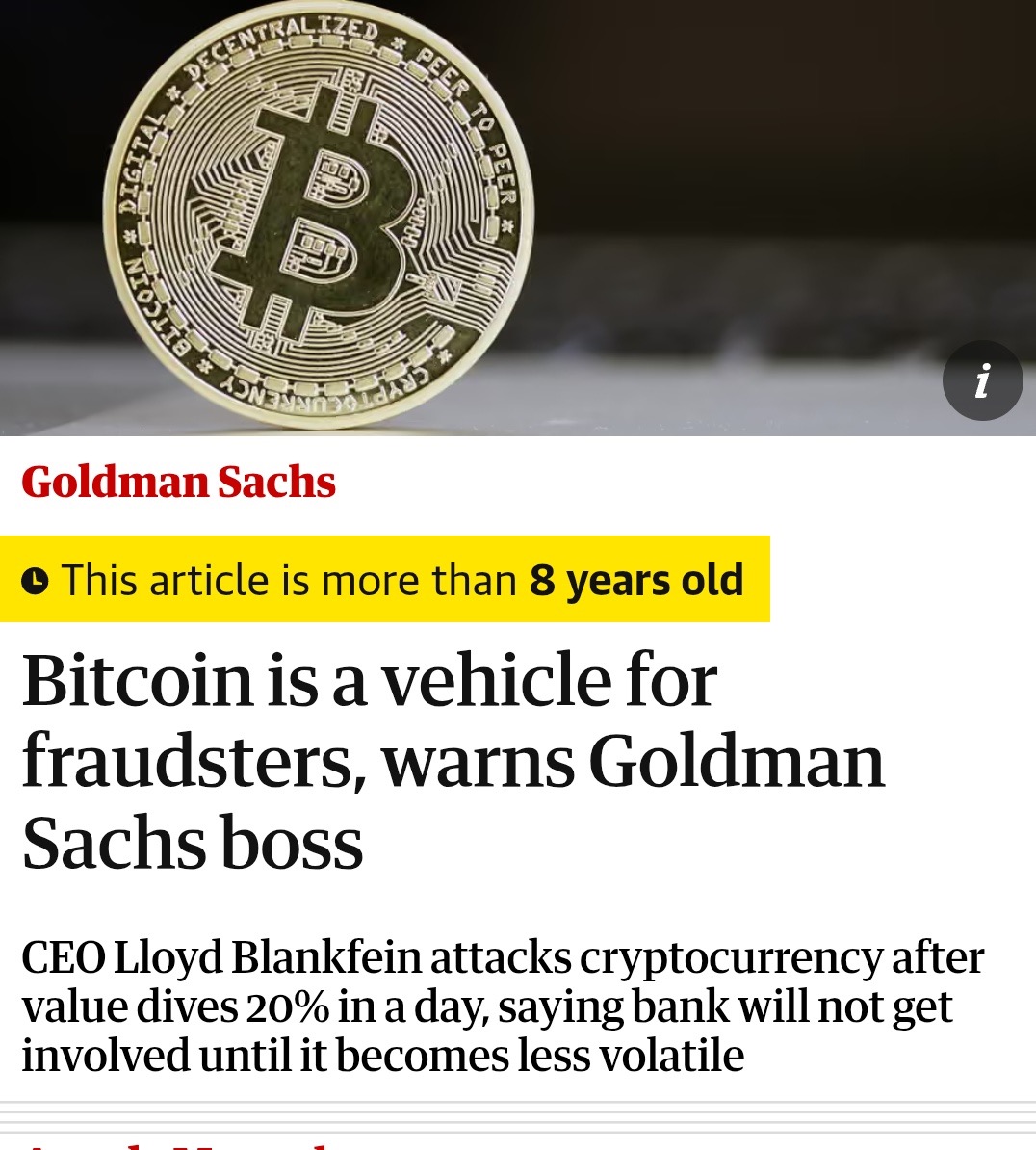
But the real attitude shift occurred in 2020. That year, Goldman Sachs explicitly stated in a client conference call that Bitcoin could not even be considered an asset class, as it neither generates cash flow nor effectively hedges inflation. This public bearishness sparked considerable market controversy.
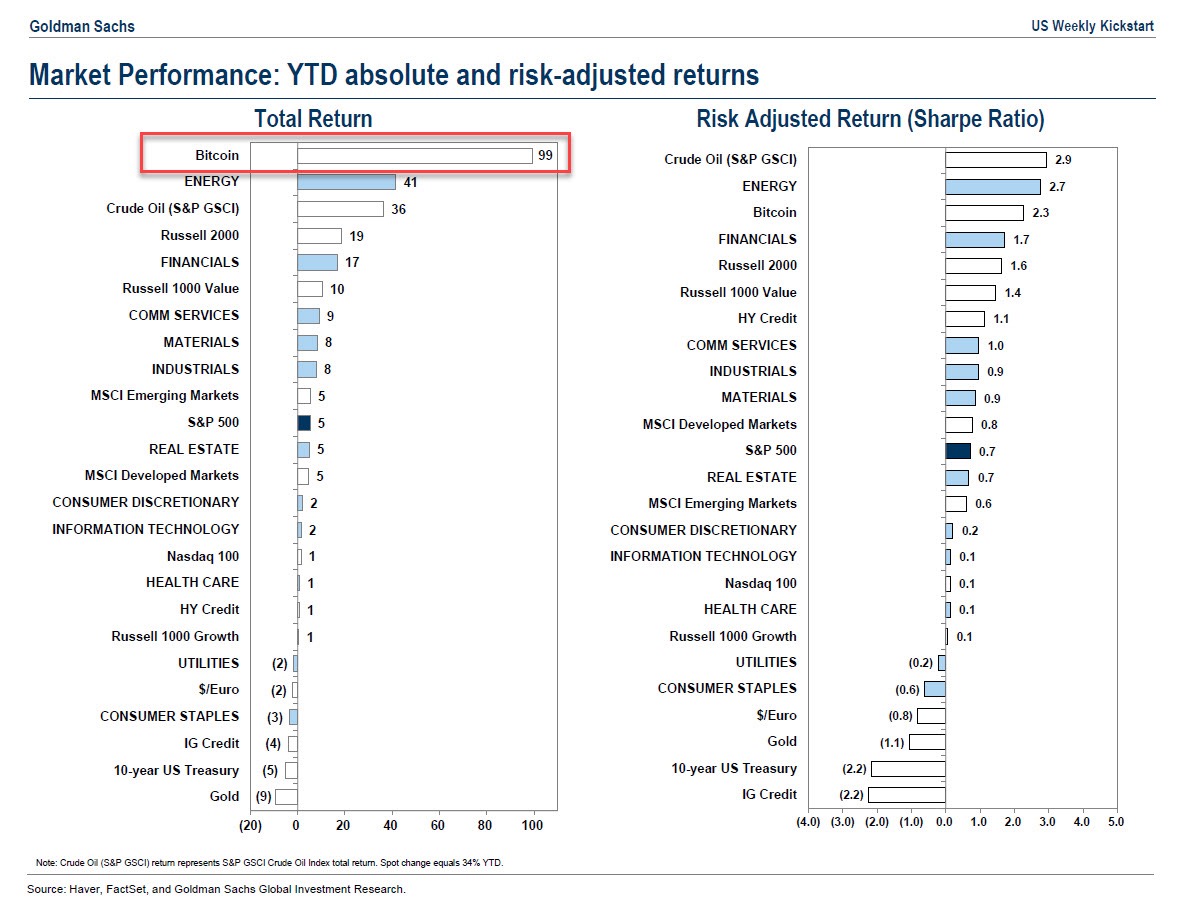
A year later, Goldman Sachs' stance quickly softened. In 2021, against the backdrop of rising institutional client demand, Goldman Sachs restarted its cryptocurrency trading department, began trading Bitcoin-related derivatives, and partnered with Galaxy Digital to launch Bitcoin futures trading products. In 2022, Goldman Sachs completed its first crypto OTC transaction and expanded its digital asset team. By 2024, it not only invested in several crypto companies but also formally entered the crypto spot ETF market.
The true comprehensive acceptance occurred in the last two years.
In March 2025, Goldman Sachs首次 mentioned cryptocurrency in its annual shareholder letter, acknowledging intensified industry competition and judging that regulatory clarity would drive a new wave of institutional adoption, with areas such as tokenization, DeFi, and stablecoins expected to grow under new regulations. More recently, its CEO David Solomon publicly confirmed that it is increasing research and investment in tokenization, stablecoins, and prediction markets.
This转变剧本 is not uncommon among traditional old money.
For example, in 2025, Skybridge Capital founder Anthony Scaramucci admitted that although he had接触 Bitcoin as early as 2012, it took him a full eight years to make his first Bitcoin investment because he initially did not understand it and was full of doubts. It wasn't until he真正研究 blockchain and Bitcoin mechanisms that he realized it was a "great technological breakthrough." He even stated that 90% of people would lean towards Bitcoin if they "did some homework."
Today, Skybridge Capital holds a significant amount of Bitcoin and invests about 40% of client funds in digital assets. Amid the recent bearish sentiment, Scaramucci revealed that the institution has been building Bitcoin positions in batches at $84,000, $63,000, and the current range, describing buying Bitcoin in a downward trend as "catching a falling knife" but remains firmly long-term bullish.
These elite Wall Street investors always prioritize risk at the core of their decisions, typically choosing to allocate on a规模化 scale only when risks are controllable.
Moreover, the decision-making cycle of institutions determines that真正的资金入场 is a marathon.
According to Bitwise Chief Investment Officer Matt Hougan in a recent interview, the next batch of potential buyers仍然是 financial advisors, large brokerages like Morgan Stanley, family offices, insurance companies, and sovereign nations. Bitwise's average client requires 8 meetings before allocating assets. We typically meet quarterly, so "8 meetings" means a decision cycle of up to 2 years. Morgan Stanley only approved Bitcoin ETFs in Q4 2025; their "8-meeting alarm clock" has just started, and真正的资金流入 may not爆发 until 2027. This is similar to the situation when gold ETFs were launched in 2004; inflows increased year by year, taking a full 8 years to reach the first peak. Most professionally managed money does not currently hold Bitcoin.
The journey of crypto assets from边缘资产 to mainstream assets is itself a slow and曲折 process. When former bears start holding in compliant ways, when skeptics turn into long-term allocators, the real change in the crypto market may not be in the行情, but in the upgrade of participant structure.