GitHub Empire on the Brink of Collapse: Source Code Leak, 18-Year Veteran Leaves, Microsoft Loses 1.5 Billion Developers

marsbitОпубликовано 2026-05-22Обновлено 2026-05-22

Введение

GitHub is facing an unprecedented crisis, marked by a massive exodus of developers and severe operational failures. The tipping point came when Mitchell Hashimoto, creator of Ghostty and an 18-year GitHub user, publicly severed ties, citing persistent platform outages that made serious work impossible. This departure highlights a broader pattern of user frustration. The platform's instability has drawn complaints from major corporate clients like Citibank and Intel, forcing Microsoft to issue substantial service credits. A critical incident last month saw an accidentally triggered, unreleased feature cause widespread repository rollbacks, erasing recent code changes and pushing enterprises to migrate. Security has catastrophically breached. In May 2026, hackers infiltrated over 3,800 of GitHub's internal repositories via a poisoned VS Code extension installed by a developer, leading to the attempted sale of core source code for $50,000. This follows the discovery of a critical zero-day vulnerability in March that threatened access to millions of repositories. Internally, GitHub's autonomy has collapsed. After the resignation of CEO Thomas Dohmke in mid-2025, Microsoft eliminated the CEO role, folding GitHub into its CoreAI division under the unpopular leadership of Jay Parikh. This triggered a talent drain, with key executives and engineers leaving. A disruptive migration of GitHub's infrastructure to Azure servers, pushed by CTO Vladimir Fedorov, is blamed for the recurri...

GitHub is experiencing an unprecedented major collapse.

Recently, the global open-source tech community witnessed a shocking rift.

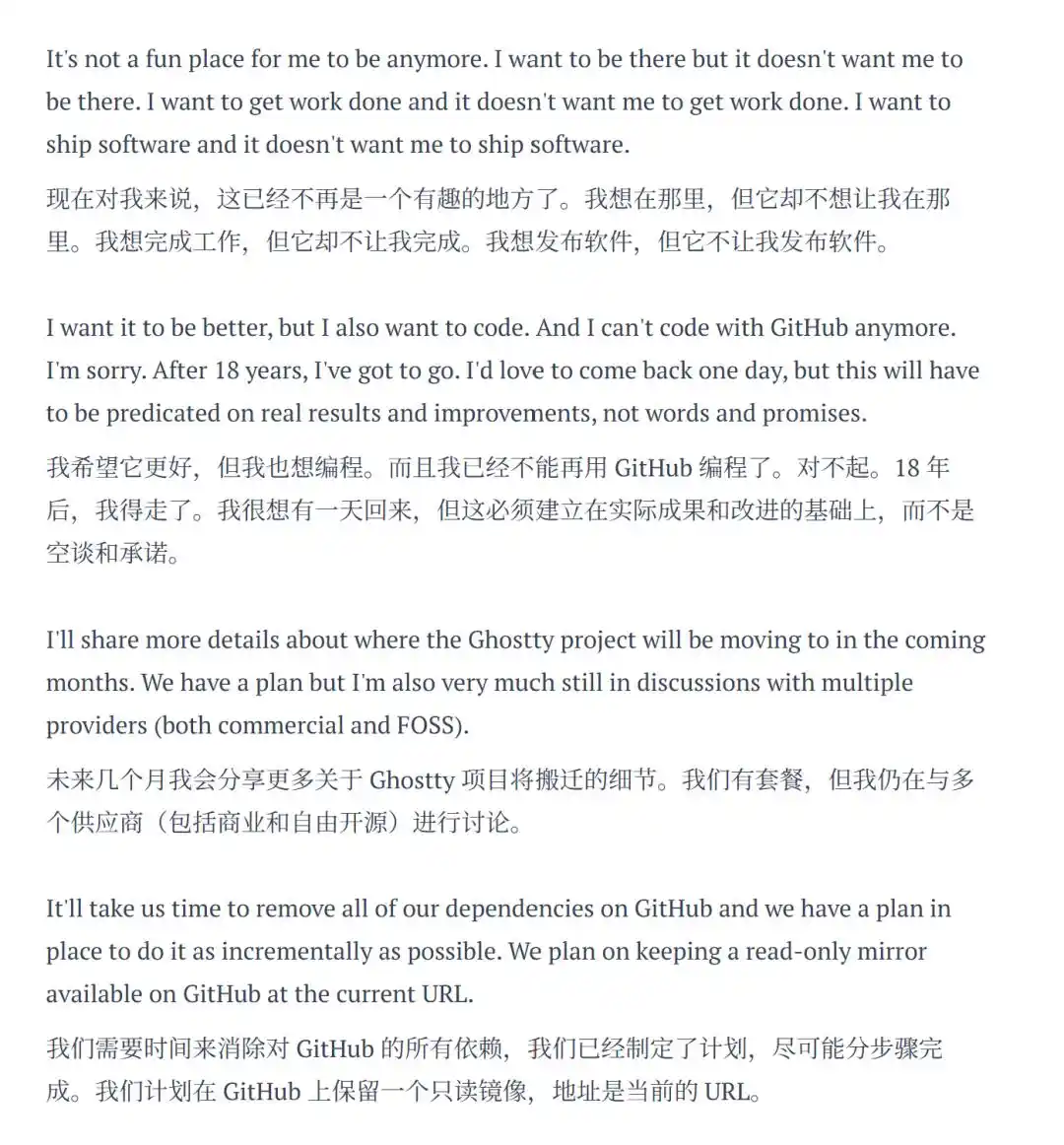
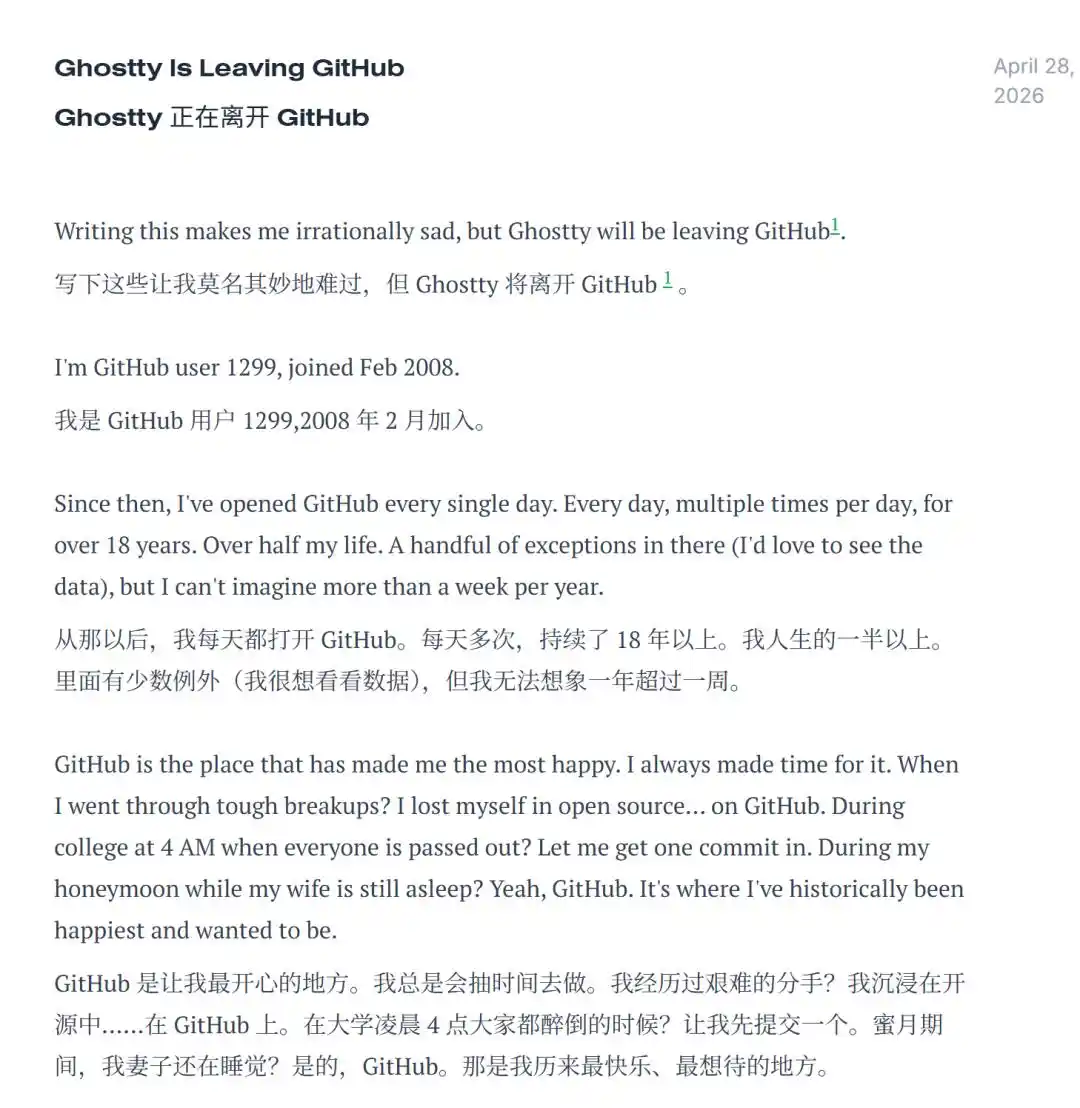
Mitchell Hashimoto, an 18-year veteran fan of GitHub and the famous developer of the Ghostty terminal, posted a sensational 'farewell letter' that went viral—every word bleeding with pain.

GitHub fails me every day.

I wish it were better, but I want to program more. I can no longer program using GitHub. I'm sorry, after 18 years, I have to go.

If a platform locks you out for hours every day, it is no longer suitable for serious work.

Subsequently, Ghostty packed up all its assets and decisively left.

His departure is just the tip of the iceberg in an avalanche.
GitHub's Life or Death

In recent months, giants like Citibank and Intel have expressed dissatisfaction to Microsoft over GitHub's ongoing failures. Even OpenAI has begun exploring self-built solutions.

To appease customers, Microsoft had to issue a large number of Credits to enterprise users as compensation for losses, leading directly to a bleeding of profits.

The most severe incident occurred last month: a mistakenly triggered, unreleased feature on GitHub caused numerous repositories to 'roll back,' with recent code modifications disappearing directly. Many enterprises have been forced to migrate.

Nearly eight years ago, when Microsoft acquired GitHub for $7.5 billion, global programmers were filled with concern.

As expected, after a brief golden period, this 'programmer's sanctuary'—hosting over 1.5 billion developers and 10 billion code repositories worldwide—now stands at a critical juncture of life or death in an extremely brutal manner.

3800+ Repositories 'Wiped Out' by Hackers

Even more serious, a recent security storm has completely stripped GitHub bare.

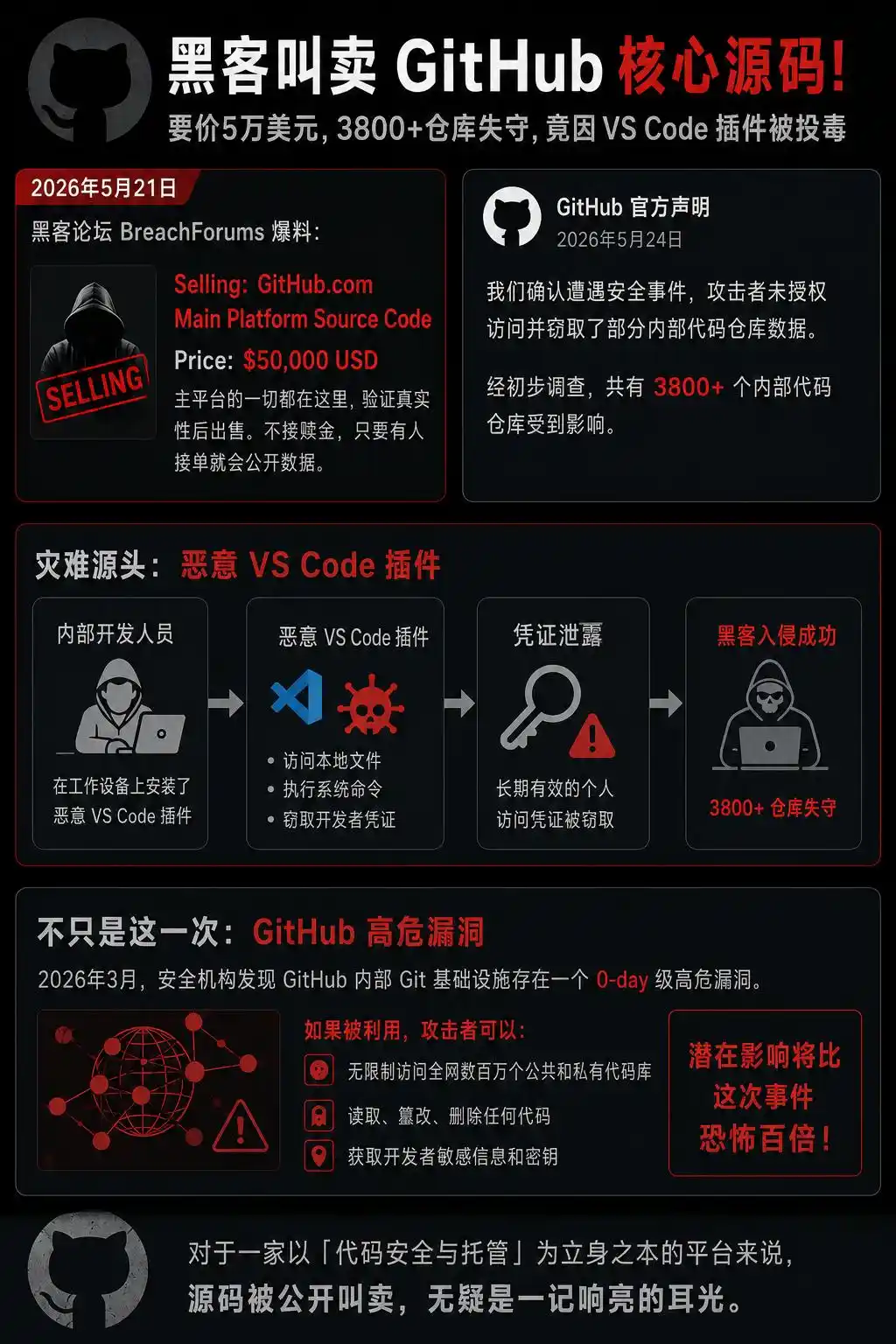
On May 21, 2026, a message instantly exploded on the hacker forum BreachForums: a hacker group openly offered GitHub's core source code for sale at a mere $50,000!
They arrogantly wrote:

Everything of the main platform is here. I would be happy to send samples to interested buyers for verification. This is not blackmail; we are too lazy to extort GitHub. If one person buys, we will completely destroy the data. If no buyer is found, we will soon make it public for free.
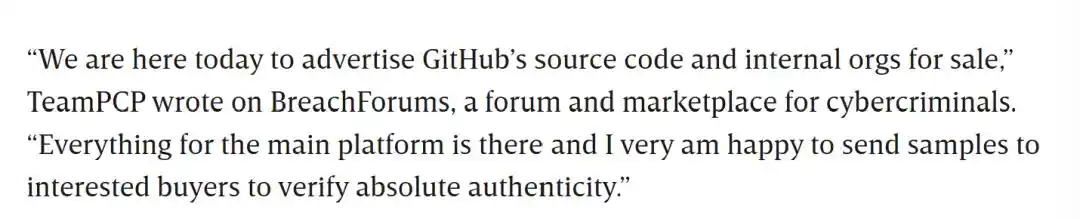
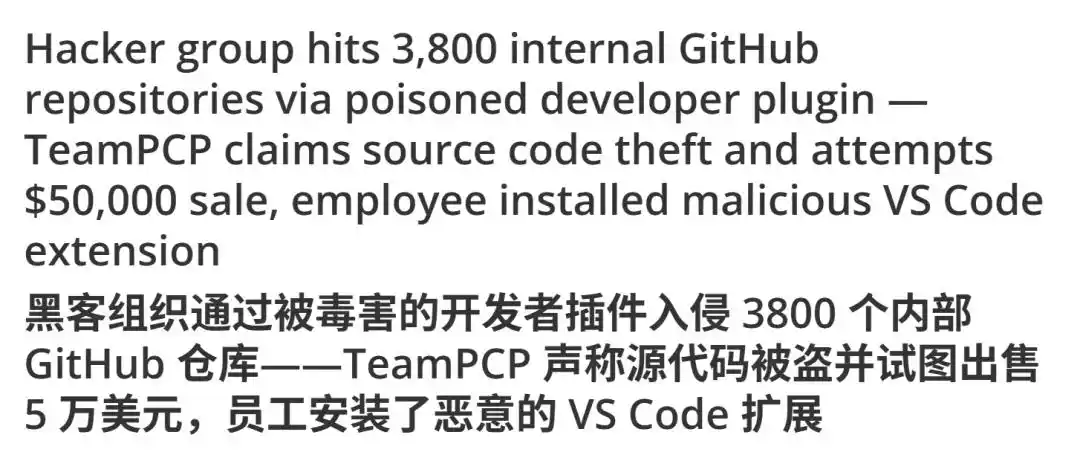
Subsequently, GitHub officially reluctantly confirmed: over 3,800 internal code repositories were indeed compromised.

The origin of this disaster is absurdly unbelievable: a GitHub internal developer installed a malicious, poisoned VS Code extension plugin on their work device. After credentials were leaked, over 3,800 repositories were breached.

VS Code and GitHub, both belonging to Microsoft, should have been a 'family ecosystem combination.' However, VS Code plugins lack high-intensity review mechanisms, making them the perfect entry point for hackers.

Because VS Code frequently prompts developers to install various plugins, these 'Trojan horses' can freely access local files, system terminals, etc.

When the GitHub engineer downloaded the malicious plugin, their long-term valid personal access token was instantly intercepted by the hackers!

For a platform built on 'code security and hosting,' having its source code publicly offered for sale is undoubtedly a resounding slap in the face.
This is just the tip of the iceberg.

In March of this year, security agencies discovered a 0-day-level critical vulnerability in GitHub's internal Git infrastructure.

If exploited, attackers could directly and unlimitedly access millions of public and private code repositories across the entire network, with consequences a hundred times more terrifying than this incident!

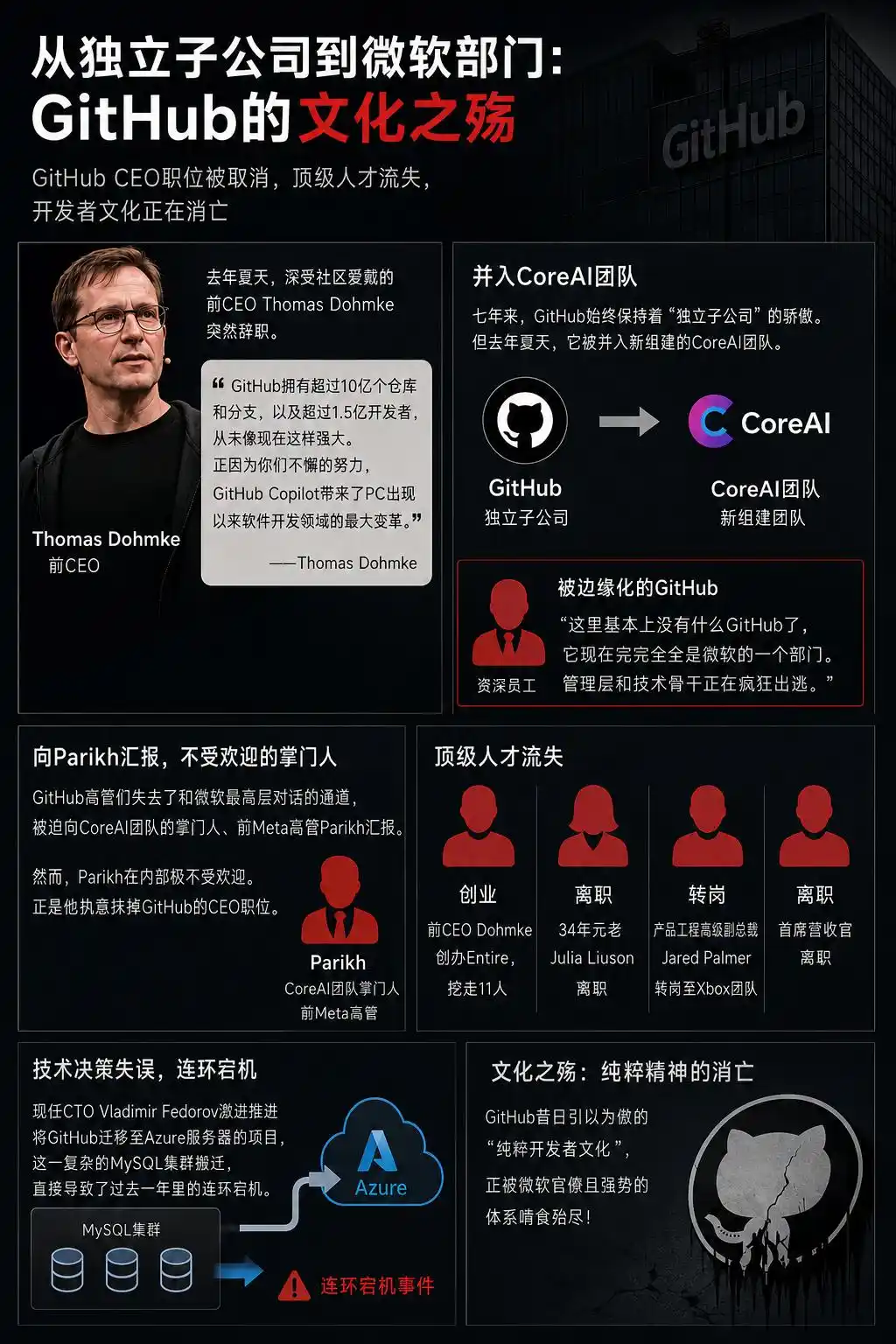
Management Shake-up: No More CEO, Reduced to a Microsoft Vassal

Behind the frequent security and technical incidents is GitHub's internal 'leaderless state' for nearly a year.

Last summer, the beloved former CEO Thomas Dohmke suddenly resigned. Microsoft then made a decision that shocked all employees: completely abolish the GitHub CEO position.

GitHub CEO Thomas Dohmke
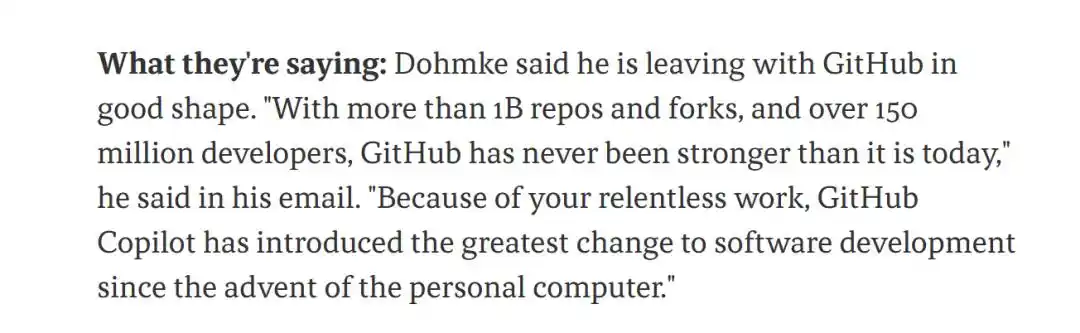
Dohmke thanked everyone: 'GitHub has never been stronger, with over 1 billion repositories and branches, and over 1.5 billion developers. It is thanks to your relentless efforts that GitHub Copilot has brought the biggest transformation in software development since the advent of the PC.'

For seven years, GitHub proudly maintained its status as an 'independent subsidiary.' But last summer, it was merged into the newly formed CoreAI team.

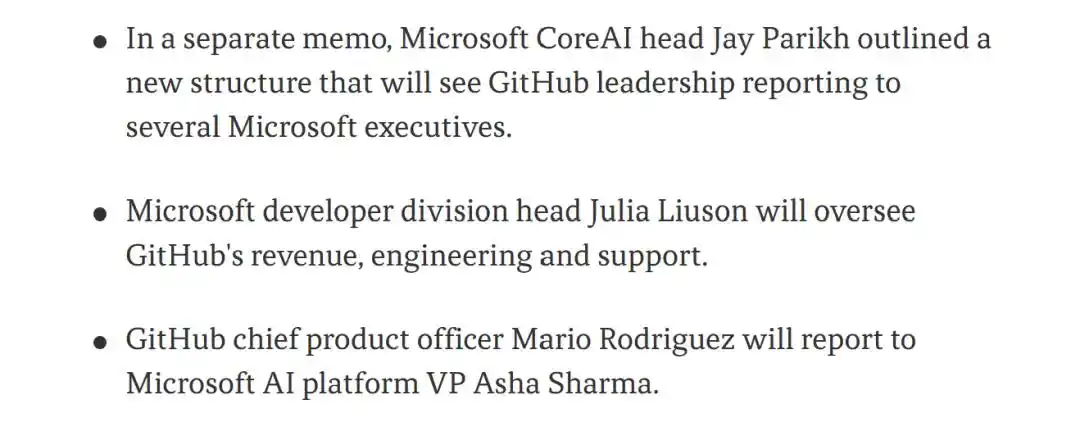
This drastic change directly pushed GitHub executives into an awkward position: they lost their direct line of communication with Microsoft's top leadership and were forced to report to Parikh, the head of the CoreAI team and former Meta executive.

However, Parikh is extremely unpopular internally. It was he who insisted on erasing the GitHub CEO position.

'There's basically no GitHub here anymore; it's now completely a department of Microsoft,' one senior employee angrily stated. 'Management and technical talent are fleeing madly.'

This was followed by a loss of top talent: former CEO Dohmke founded the next-generation developer platform Entire, poaching 11 people; 34-year veteran Julia Liuson resigned; Senior Vice President of Product Engineering Jared Palmer transferred to the Xbox team; the Chief Revenue Officer resigned.
Current CTO Vladimir Fedorov aggressively promoted the project to migrate GitHub to Azure servers. This complex MySQL cluster relocation directly caused the chain of outages over the past year.

Thus, GitHub's R&D, finance, and marketing have been comprehensively strangled and devoured. Internally, there is division and discord, with the loss of technical backbone.

GitHub's once-proud 'pure developer culture' is being gnawed away by Microsoft's bureaucratic and powerful system!
Moat Breached: Cursor and Claude Code's Dimensional Reduction Strike

The external outages and internal turmoil have torn open huge cracks for predators.

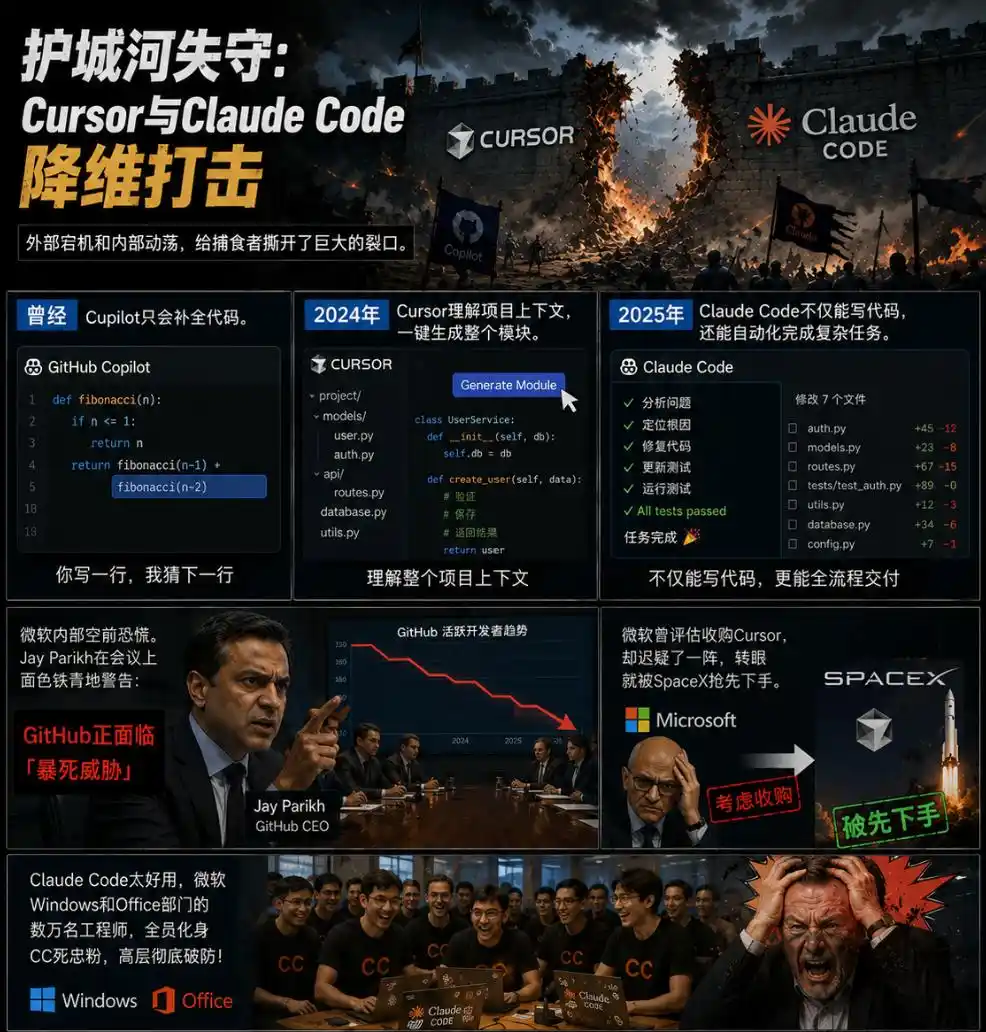
Once, Copilot was almost synonymous with AI-assisted programming.

However, in 2024, Cursor emerged out of nowhere. While GitHub Copilot was still stuck in the 'you write a line, I guess the next line' code completion stage, Cursor could already understand the entire project context and generate entire modules with one click.

In 2025, Claude Code launched a dimensional reduction strike—it could not only write code but also automate complex debugging, testing, and multi-file collaborative modifications.

Microsoft was thrown into unprecedented panic internally. According to leaks, Jay Parikh warned with an ashen face in a meeting: GitHub is facing a 'death threat.'
Parikh's core fear is: once developers get used to completing all development in Cursor, they will no longer upload their code to GitHub.

To this end, Microsoft seriously evaluated acquiring Cursor but hesitated for a moment. In the blink of an eye, Cursor was snapped up by SpaceX.

What's even more amusing is that Claude Code is so incredibly good that tens of thousands of engineers in Microsoft's Windows and Office departments have all become die-hard fans of CC. Microsoft executives were completely broken!

Rajesh Jha issued a strict order to all staff, forcibly revoking all CC licenses by the end of June and forcing engineers to revert to using GitHub Copilot CLI.

Financial Avalanche: The 'Subsidy Black Hole' of Making More Money, Losing More Money

Moreover, GitHub's commercial operations are also deeply mired, even starting to backfire on Microsoft.

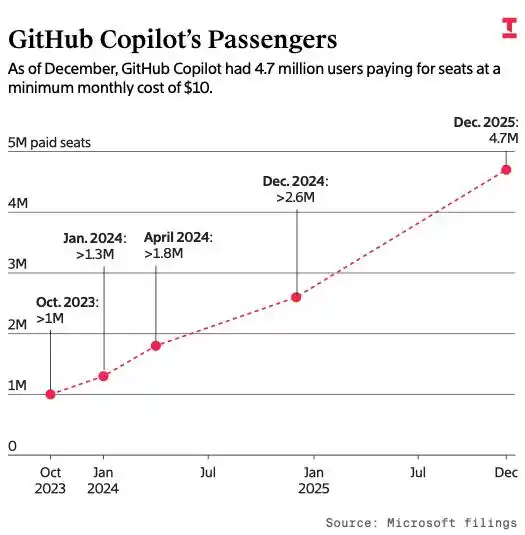
On the surface, GitHub's data still looks impressive. By the end of 2025, Copilot paid users surpassed 4.7 million, and GitHub's annual recurring revenue crossed the $3 billion threshold.
But behind the pretty numbers, it's all Microsoft's blood.

With the AI explosion, GitHub traffic surged 14 times. However, AI features for code hosting and open-source projects remain completely free.

Meanwhile, the inference costs for running AI models remain high. The computing power consumed by heavy users far exceeds the $10 monthly subscription fee—the more they sell, the more they lose.
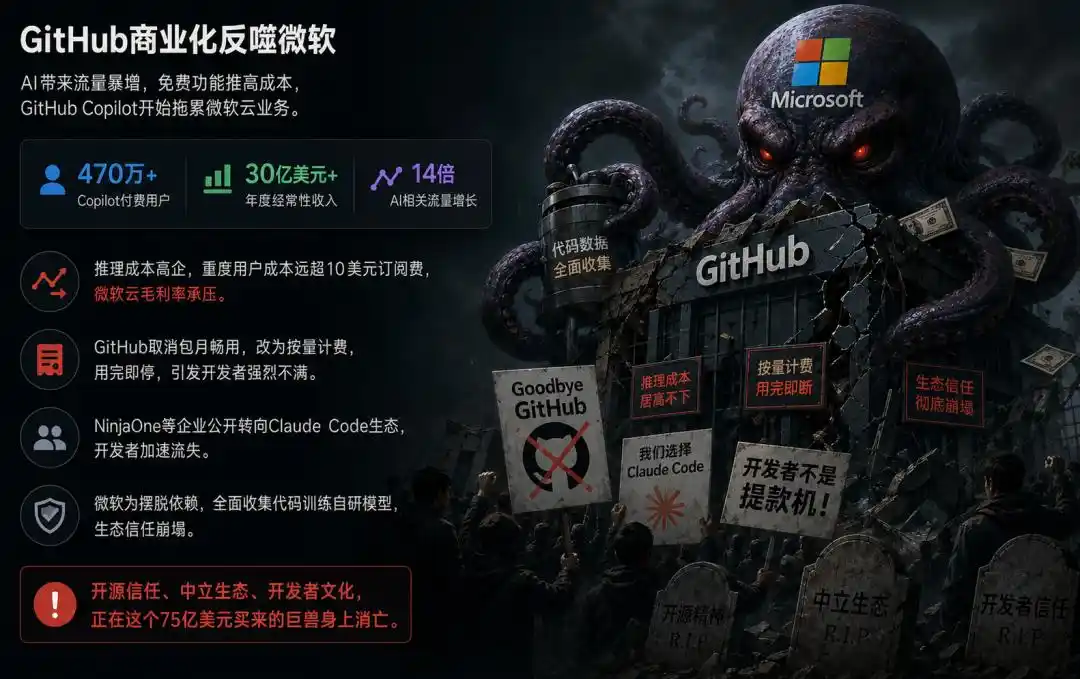
During Microsoft's earnings call in April this year, the CFO rarely admitted: the significant increase in GitHub Copilot usage directly lowered the gross margin of the entire core cloud business.

Under pressure from Wall Street, GitHub announced last month: abolish the unlimited monthly usage model and fully transition to 'pay-as-you-go.' Once credits are depleted, AI services are immediately cut off.

This move, perceived as greedy, completely infuriated developers!

The global IT services giant NinjaOne immediately publicly stated: they are comprehensively guiding engineers to abandon GitHub and turn to the Claude Code ecosystem.

Will GitHub Die?

This year, Microsoft's stock price has fallen by over 10%, performing the worst among the 'Magnificent Seven' tech stocks.

Its developer ecosystem cornerstone, GitHub, is pushing everything toward the abyss.

To break free from dependence on OpenAI and Anthropic, CoreAI has ordered the comprehensive collection of all code to train Microsoft's own native large model.

This practice of recklessly depleting the ecosystem for its own benefit has completely chilled developers worldwide.

The trust of the open-source community, the neutral ecological environment, and the free, pure developer culture are rapidly vanishing from this $7.5 billion behemoth.

Now, the most fatal question facing Satya Nadella is: In the era of AI agents, do global developers still need a central code repository platform like GitHub?

If Microsoft cannot provide a convincing answer, it will lose the soul it has cultivated around its ecosystem for decades—

'Developers, developers, developers!'

References:

https://www.theverge.com/tech/935250/microsoft-github-struggles-notepadhttps://mitchellh.com/writing/ghostty-leaving-githubhttps://www.wired.com/story/teampcp-software-supply-chain-attack-spree-github/?utm_source=chatgpt.com

This article comes from the WeChat public account "Xinzhiyuan," author: ASI Revelation.

Связанные с этим вопросы

QWho is Mitchell Hashimoto and what significant action did he take regarding GitHub?

AMitchell Hashimoto is the developer of the Ghostty terminal and a long-time GitHub user. He recently announced his departure from the platform, citing frequent outages that prevented serious work, and moved the Ghostty project assets away from GitHub.

QWhat major security incident involving GitHub's source code is detailed in the article?

AA hacker group breached and stole the source code for over 3,800 of GitHub's internal repositories. The breach originated from a GitHub engineer installing a malicious VS Code extension, which compromised their credentials, allowing the hackers to access and later attempt to sell the code.

QHow has Microsoft's internal restructuring impacted GitHub's leadership?

AMicrosoft disbanded GitHub's independent subsidiary status and merged it into the CoreAI team. The CEO position was eliminated, and GitHub's leadership now reports to the CoreAI head, Jay Parikh, leading to a loss of autonomy, internal dissatisfaction, and a significant exodus of senior talent.

QWhat competitive threats to GitHub Copilot are mentioned, and what was Microsoft's internal reaction?

AThe article cites Cursor and Claude Code as major competitive threats, offering more advanced AI-assisted programming features. Microsoft was internally alarmed, with executives describing it as an 'existential threat.' Notably, many Microsoft engineers preferred using Claude Code, prompting management to forcibly revoke its licenses within the company.

QWhat financial and operational challenges is GitHub facing according to the article?

AGitHub is struggling with profitability despite high revenue. The massive computational costs of running free AI features like Copilot exceed subscription income, negatively impacting Microsoft's cloud margins. In response, GitHub shifted from a flat-rate subscription to a pay-as-you-go model, which angered many developers and prompted some companies to consider alternatives.

Похожее

Blocked Its Own Treasure, WeChat AI Steps Up

Tencent's stock surged over 10% on June 2nd amid reports that WeChat, with 1.43 billion monthly users, is finalizing tests for a native AI Agent. The reported feature, accessible by swiping right from the main interface, allows users to issue commands in natural language. The AI then decomposes tasks and automatically calls upon relevant Mini Programs within WeChat to complete actions like ordering food, booking tickets, or making payments, creating a closed-loop service execution system. This strategic shift follows the internal conflict and subsequent "blocking" of Tencent's standalone AI app, Yuanbao, by WeChat for violating sharing rules during a 2026 Spring Festival promotion. The incident highlighted a lack of internal consensus and exposed the weakness of competing in the standalone AI assistant arena against rivals like ByteDance's Doubao (345M MAU) and Alibaba's Qianwen. The new WeChat AI Agent aims to leverage WeChat's unique assets—its massive user base, standardized Mini Program APIs, WeChat Pay, and identity system—to move from simple content generation to actual task execution. Analysts note this changes the competitive landscape from model benchmarks to which AI can connect to more real-world services. However, success depends on key variables: the capability of Tencent's underlying Hunyuan model, managing massive inference costs, and redesigning incentives for Mini Program developers whose traffic might be bypassed. The move is seen as an attempt to keep user service intent within WeChat's ecosystem as AI begins to redefine how users access services.

marsbit14 мин. назад

Blocked Its Own Treasure, WeChat AI Steps Up

marsbit14 мин. назад

ByteDance Adopts Arm CPUs, Jensen Huang: So Sad I Didn't Buy Arm

**Summary:** At Computex 2026, Arm CEO Rene Haas announced that ByteDance and Oracle have adopted Arm's self-designed Arm AGI data center CPU. The company expects significant revenue growth from this product, projecting $20 billion in demand for the 2027/2028 fiscal years. Haas noted that restricting AI-capable CPUs from the US to China is nearly impossible due to their widespread applications. Arm's stock has surged dramatically this year, notably rising 16% after NVIDIA's Arm-based Vera CPU and RTX Spark announcements. A highlight was the informal, humorous on-stage conversation between Haas and NVIDIA CEO Jensen Huang. Huang joked about NVIDIA's failed attempt to acquire Arm and playfully lamented selling his Arm shares. Both executives showed a clear sense of camaraderie and shared regret over the missed merger. Key technical topics were discussed: 1. **AI PC Design:** Huang explained NVIDIA's RTX Spark superchip (with a 20-core Arm CPU) is designed for future AI agents that will autonomously run and use tools on PCs, blending local and cloud processing. 2. **Agent vs. OS:** Huang emphasized the operating system remains crucial, as AI agents rely on its APIs and tools to function. 3. **Growth Constraints:** He identified the shift to "useful AI" that generates profitable tokens as a primary driver for immense, almost limitless, computational demand. Haas outlined Arm's strategy across PC and data centers. For PCs, Arm collaborates with partners like NVIDIA and MediaTek, offering its compute subsystem (CSS) for custom SoCs. In data centers, its Arm AGI CPU (built on TSMC's 3nm process) has gained major partners including OpenAI, Meta, and now ByteDance and Oracle. Arm presented a multi-year roadmap for its in-house CPU line. The article concludes that while GPUs dominated the AI training race, the explosion of AI agents is shifting significant focus to CPUs for inference, state management, and tool orchestration. The industry is trending towards vertical integration, with companies like cloud providers designing chips and chip/IP firms offering full solutions, all competing to deliver more efficient computing per watt.

marsbit34 мин. назад

ByteDance Adopts Arm CPUs, Jensen Huang: So Sad I Didn't Buy Arm

marsbit34 мин. назад

New Wall Street Play: Yen Shorts Still Adding, But Japan Stocks Don't Rely on Carry Trade Unwinding

On June 3rd, USD/JPY hit 160.44, its highest level since July 2024, while the Nikkei 225 surged past 68,000 points. Contrary to popular narratives of an imminent "carry trade unwind" akin to August 2024, data reveals a more complex picture. Speculative net short positions in yen futures have actually increased, reaching -114,667 contracts by late May, suggesting traders are doubling down rather than retreating. Meanwhile, Japan's Finance Ministry conducted its largest-ever single-round FX intervention (11.73 trillion yen) in April-May but failed to hold the 160 yen line. The Nikkei's rally is not driven by carry trade dynamics. Foreign investors are aggressively buying Japanese stocks, with net purchases in 2026 running nearly 16 times higher than 2025 levels. This inflow is concentrated in AI and semiconductor-related stocks like SoftBank and Socionext, fueled by positive sector outlooks, rather than being a flight from unwinding yen shorts. Furthermore, the Nikkei has continued climbing despite the Bank of Japan's (BOJ) rate hikes to 0.75%. This disconnect exists because the current equity boom is fueled by AI-driven foreign investment, not reliant on cheap yen funding. However, this relationship remains fragile. Should the BOJ hike rates further (e.g., to 1.0%) while dollar weakness increases carry trade costs, the trajectories of the yen and Japanese stocks could reconverge, potentially triggering volatility.

marsbit38 мин. назад

New Wall Street Play: Yen Shorts Still Adding, But Japan Stocks Don't Rely on Carry Trade Unwinding

marsbit38 мин. назад

Broadcom's Q3 Guidance Misses Expectations by $12 Billion, After-Hours Trading Plummets Over 13%, AI Narrative "Cooling"?

On June 3, Broadcom released record Q2 FY26 results with revenue of $22.19B, up 48% YoY, and AI chip sales of $10.8B, up 143%. Adjusted EPS of $2.44 beat estimates. However, its Q3 AI semiconductor revenue guidance of $16B, while up over 200% YoY, fell roughly $1.2B (7%) short of analyst consensus expectations of $17.2B. This miss, coupled with slightly weaker-than-expected software revenue, triggered a severe market reaction. CEO Hock Tan maintained the FY26 AI revenue outlook of over $100B but did not raise it, disappointing investors who had priced in more robust growth. The stock plummeted over 13% in after-hours trading, erasing roughly $270B in market cap. The sell-off extended to peers like Marvell. A key concern for markets, particularly for Chinese optical module suppliers, was Tan's comment that the contribution of AI networking (e.g., Ethernet switches, optical interconnect chips) to AI revenue, currently near 40%, is expected to normalize to around 30% over time, signaling a potential peak in growth for that segment. Despite the guidance shortfall, Tan reiterated that AI demand remains "insatiable" and reaffirmed the long-term target of exceeding $100B in AI revenue by FY27. The reaction highlights the heightened sensitivity and premium valuation placed on AI-exposed stocks, where anything less than stellar guidance can prompt significant profit-taking. The broader question is whether this represents a cooling AI narrative or a correction in overstretched valuations.

marsbit39 мин. назад

Broadcom's Q3 Guidance Misses Expectations by $12 Billion, After-Hours Trading Plummets Over 13%, AI Narrative "Cooling"?

marsbit39 мин. назад

Торговля

Спот
Фьючерсы

Популярные статьи

Как купить OP

Добро пожаловать на HTX.com! Мы сделали приобретение Optimism (OP) простым и удобным. Следуйте нашему пошаговому руководству и отправляйтесь в свое крипто-путешествие.Шаг 1: Создайте аккаунт на HTXИспользуйте свой адрес электронной почты или номер телефона, чтобы зарегистрироваться и бесплатно создать аккаунт на HTX. Пройдите удобную регистрацию и откройте для себя весь функционал.Создать аккаунтШаг 2: Перейдите в Купить криптовалюту и выберите свой способ оплатыКредитная/Дебетовая Карта: Используйте свою карту Visa или Mastercard для мгновенной покупки Optimism (OP).Баланс: Используйте средства с баланса вашего аккаунта HTX для простой торговли.Третьи Лица: Мы добавили популярные способы оплаты, такие как Google Pay и Apple Pay, для повышения удобства.P2P: Торгуйте напрямую с другими пользователями на HTX.Внебиржевая Торговля (OTC): Мы предлагаем индивидуальные услуги и конкурентоспособные обменные курсы для трейдеров.Шаг 3: Хранение Optimism (OP)После приобретения вами Optimism (OP) храните их в своем аккаунте на HTX. В качестве альтернативы вы можете отправить их куда-либо с помощью перевода в блокчейне или использовать для торговли с другими криптовалютами.Шаг 4: Торговля Optimism (OP)С легкостью торгуйте Optimism (OP) на спотовом рынке HTX. Просто зайдите в свой аккаунт, выберите торговую пару, совершайте сделки и следите за ними в режиме реального времени. Мы предлагаем удобный интерфейс как для начинающих, так и для опытных трейдеров.

779 просмотров всегоОпубликовано 2024.03.29Обновлено 2026.06.02

Как купить OP

Обсуждения

Добро пожаловать в Сообщество HTX. Здесь вы сможете быть в курсе последних новостей о развитии платформы и получить доступ к профессиональной аналитической информации о рынке. Мнения пользователей о цене на OP (OP) представлены ниже.

活动图片