From Wall Street to Silicon Valley, Anthropic Steals All the Spotlight from OpenAI

marsbitОпубликовано 2026-04-13Обновлено 2026-04-13

Введение

From Wall Street to Silicon Valley, Anthropic is seizing the spotlight from OpenAI. In just one year, the power dynamics in the AI have shifted significantly. Anthropic is now challenging OpenAI across multiple fronts: market share, secondary market valuation, venture capital sentiment, and public perception. At the recent HumanX AI conference, the consensus was clear—Anthropic is the new darling of Silicon Valley. Its annualized recurring revenue (ARR) has reportedly reached $300 billion, surpassing OpenAI's $250 billion. In the secondary market, Anthropic's valuation has overtaken OpenAI's, with strong investor preference for its shares. Anthropic dominates the enterprise sector, holding 42-54% of the code generation market and 40% of the enterprise agent market, compared to OpenAI's 21% and 27%, respectively. It also leads in new enterprise adoption and cost efficiency. While OpenAI retains a strong consumer user base with ChatGPT, it faces challenges inization and high operational expenses. A leaked internal memo from OpenAI identified Anthropic as its biggest threat, emphasizing its compute infrastructure advantage, but the very need for such a memo highlights its defensive position. Despite OpenAI's strong backing from Amazon and NVIDIA, the market is now valuing efficiency, cost-effectiveness, and precise market fit—areas where Anthropic currently leads. However, experts caution that the AI race is far from over and the landscape remains highly fluid.

Written by: Dong Jing

In just one year, the power balance in the AI industry has quietly shifted. OpenAI, once a dominant force in the investment world, is now facing a comprehensive challenge from Anthropic—from enterprise market share to secondary market valuation, from venture capital reputation to social media buzz, Anthropic is eroding OpenAI's leading position in almost every dimension.

This shift in sentiment was amplified to the extreme at the HumanX AI Conference held in San Francisco last week. According to Business Insider, the attending venture capitalists and entrepreneurs almost reached a unified consensus: Anthropic is the new darling of Silicon Valley.

Roseanne Wincek of Renegade Partners stated bluntly, "Last year in Las Vegas, it felt like OpenAI was the clear winner, but now Anthropic seems to be several steps ahead." Meanwhile, Anthropic announced its annualized recurring revenue (ARR) has surpassed $30 billion, exceeding OpenAI's previously announced $25 billion, making it the world's highest-revenue AI unicorn.

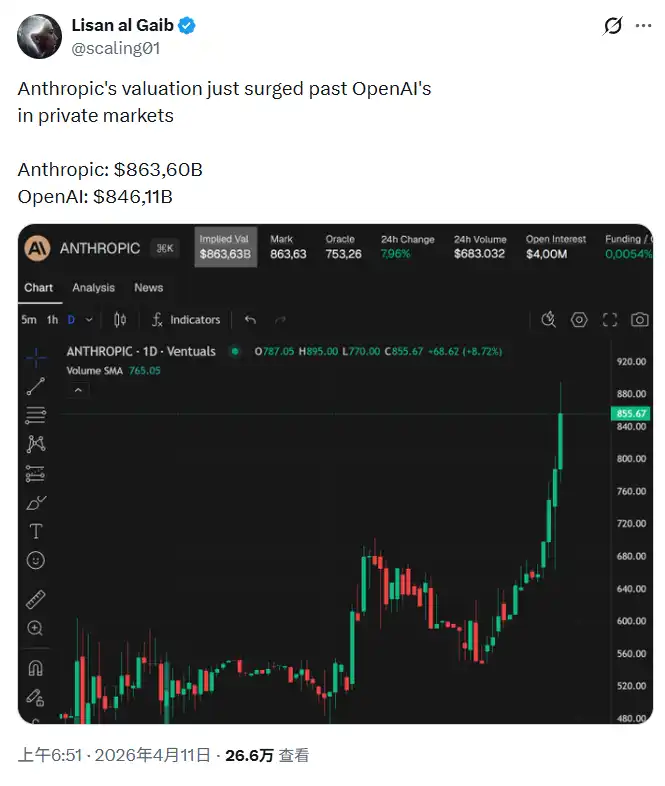
The flow of market capital speaks volumes. According to Bloomberg, Anthropic's valuation on the secondary market has surpassed OpenAI's. Data circulating on social platforms shows that Anthropic's private market valuation is approximately $863.6 billion, while OpenAI's is about $846.1 billion. Furthermore, OpenAI's secondary shares are experiencing unprecedented cold reception, while buyers are queuing up to purchase Anthropic's shares.

Silicon Valley's Sudden Shift: Anthropic Becomes the Conference Protagonist

This year's HumanX conference was twice the size of last year's, with about 6,700 attendees paying over $4,000 per ticket. However, in stark contrast to last year's atmosphere in Las Vegas where everyone was betting on OpenAI, inside San Francisco's Moscone Center this year, Anthropic was the center of conversation.

Jared Quincy Davis, founder and CEO of AI cloud platform Mithril, said,

"They (Anthropic) have strong momentum. It's evident that their focus on the enterprise market, cutting-edge capabilities, and code generation, while deliberately avoiding some consumer scenarios, are all the right decisions."

Halfway through the conference, Anthropic released its latest model, Mythos, stating it was so powerful that it would not be released to the public due to cybersecurity risks, instead being made available only to select enterprises through a new initiative called "Project Glasswing." Tomasz Tunguz, founder and general partner at Theory Ventures, commented, "The Mythos model is significant; there is tremendous excitement in the market."

In contrast, it was almost impossible to find public supporters for OpenAI at the conference. Attendees' doubts about OpenAI centered on two points: the perplexing acquisition of the internet talk show TBPN, and the controversy surrounding CEO Altman's dealings with the Pentagon. Former Coatue and Kleiner Perkins partner Andy Chen stated, "A significant number of people have objections to Altman and his actions," and predicted a talent exodus from OpenAI.

Secondary Market: Unwanted Shares and Valuation Reversal

The signals from the capital market are more direct. As pointed out in a Wall Street Seen article, Bloomberg reported that in early April, six OpenAI institutional shareholders—including hedge funds and well-known VCs—attempted to sell approximately $600 million worth of OpenAI shares through the secondary market platform Next Round Capital. However, the platform contacted hundreds of institutional buyers, and not a single one was willing to take them.

Ken Smythe, founder of Next Round Capital, stated bluntly, "We simply couldn't find a single institutional investor willing to take these shares, and we have resources with hundreds of institutions." He also revealed that buyers told him they had $2 billion in cash, waiting solely to buy Anthropic stock.

This scenario is playing out on other trading platforms as well. On SPV trading platforms like Augment and Hiive, the trend of investors flocking to Anthropic and shunning OpenAI is already evident. Adam Augment, co-founder of Augment, stated, everyone believes Anthropic's valuation can catch up to OpenAI's, so they all want to buy in as soon as possible.

Valuation data confirms this judgment. Reports indicate that OpenAI's secondary market trading valuation is approximately $765 billion, a discount of about 10% from its last funding round valuation; whereas Anthropic's secondary market trading valuation has reached $600 billion, a premium of over 50% compared to its last funding round. The latest data circulating on social platforms shows that Anthropic's private market valuation has slightly surpassed OpenAI's.

The actions of Wall Street investment banks are equally telling. It is reported that several investment banks, including Morgan Stanley and Goldman Sachs, have begun pitching OpenAI shares to high-net-worth clients without charging performance fees; whereas Goldman Sachs still charges clients investing in Anthropic the customary 15% to 20% profit share.

B2B Market: Anthropic Has Formed an Overwhelming Advantage

Behind the revenue numbers, deeper structural changes are occurring in the enterprise market.

In the currently most important B2B sector for AI large models—code generation—Anthropic's Claude model already holds 42% to 54% of the global market share, while OpenAI has only 21%. In the enterprise agent market, Anthropic's share is 40%, OpenAI's is 27%.

Incremental data better illustrates the trend. Ramp data indicates that among enterprises newly procuring AI services in March 2026, a whopping 65% chose Anthropic, while only 32% chose OpenAI. By April 2026, Anthropic had over 1,000 enterprise customers with annual consumption exceeding $1 million, doubling in the past two months. API calls and enterprise customization services now account for over 80% of its total revenue.

The gap in cost efficiency is equally staggering. According to Wall Street Journal estimates, OpenAI's annual training costs will reach $125 billion by 2030, while Anthropic will need only about $30 billion—a difference of over four times. With its high revenue growth, Anthropic could achieve cash flow breakeven by 2027, while OpenAI's profitability timeline remains distant.

In contrast, OpenAI's only area of overwhelming dominance is the consumer side—ChatGPT currently has over 900 million weekly active users, but over 98% are free users, consuming vast amounts of computing power while generating almost no revenue. In February 2026, OpenAI attempted to introduce ads in ChatGPT, sparking widespread controversy.

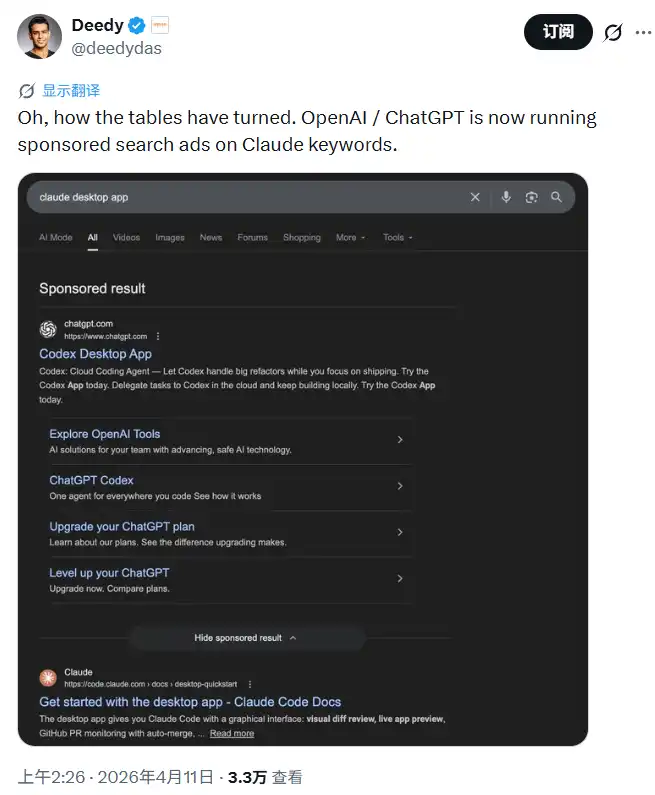
On social platforms, user @deedy pointed out that OpenAI/ChatGPT has now begun placing bid ads on Claude-related keywords, remarking on how "the tables have turned." The post quickly gained significant attention.

OpenAI's Counterattack: Compute Advantage and Leaked Memo

Facing external doubts, OpenAI sent a confidential memo to shareholders this week, which was subsequently leaked. In the memo, OpenAI characterized Anthropic as its biggest competitive threat, while emphasizing its own leading advantage in compute infrastructure.

According to the memo's contents, OpenAI had 1.9 gigawatts (GW) of compute capacity in 2025, expects to increase this to the low double digits next year, and reach approximately 30 GW by 2030; in comparison, OpenAI estimates Anthropic had only 1.4 GW at the end of 2025 and expects to reach 7-8 GW next year. "Even by the highest estimates, our expansion pace is substantively leading and the gap continues to widen," the memo stated.

On Anthropic's side, it has agreements with Google and Broadcom to secure 5 GW of next-generation TPU compute power support starting in 2027.

However, the very leak of this memo has, to some extent, exposed OpenAI's defensive posture. The fact that a company once seen as the absolute industry leader now needs to specifically write to its shareholders explaining why it remains competitive is a signal telling enough in itself.

This Race is Far From Over

Despite Anthropic's strong momentum, several attendees cautioned against drawing conclusions too early. "These things change so fast," said Roseanne Wincek, "OpenAI could come back." Tomasz Tunguz also noted, "You wake up every day, and something has changed substantively."

OpenAI's fundraising capability remains strong. In its latest completed $122 billion financing round, Amazon contributed $50 billion and Nvidia $30 billion. Both are not purely financial investors but have locked in strategic returns through compute supply and cloud service contracts.

But the market's judgment has undergone a structural shift. The logic determining the outcome of the AI race is shifting from "who raises the most money, who has the grandest narrative" to "who can create value for users with the lowest cost, highest efficiency, and most precise market positioning." Under this new logic, Anthropic currently holds the upper hand.

Связанные с этим вопросы

QWhat are the key areas where Anthropic is challenging OpenAI's dominance according to the article?

AAnthropic is challenging OpenAI in multiple dimensions, including enterprise market share, secondary market valuation, venture capital sentiment, and social media buzz. It has surpassed OpenAI in annual recurring revenue (ARR), with $300 billion compared to OpenAI's $250 billion, and leads in code generation and enterprise agent market share.

QHow did the perception of Anthropic and OpenAI differ at the HumanX AI conference compared to the previous year?

AAt the previous year's conference in Las Vegas, OpenAI was seen as the clear winner. However, at this year's HumanX AI conference in San Francisco, Anthropic became the central topic of discussion, with attendees viewing it as the new Silicon Valley darling, while OpenAI faced criticism and a lack of public support.

QWhat does the secondary market activity reveal about investor preference between Anthropic and OpenAI?

ASecondary market activity shows a strong preference for Anthropic over OpenAI. OpenAI's shares faced unprecedented cold reception, with no institutional buyers for a $600 million offering, while investors were eager to buy Anthropic's shares, with some having $2 billion ready to invest. Anthropic's secondary market valuation also saw a premium of over 50%, while OpenAI's traded at a discount.

QIn which specific enterprise markets does Anthropic hold a significant advantage over OpenAI?

AAnthropic holds a significant advantage in the enterprise market, particularly in code generation, where it captures 42% to 54% of the global market share compared to OpenAI's 21%, and in the enterprise agent market, where it has a 40% share versus OpenAI's 27%. Additionally, 65% of new enterprise AI service purchases in March 2026 chose Anthropic.

QHow does OpenAI defend its competitive position against Anthropic in the leaked memo?

AIn the leaked memo, OpenAI highlights its compute infrastructure advantage, stating it had 1.9 GW of computing capacity in 2025, expected to grow to low double digits next year and reach about 30 GW by 2030. It estimates Anthropic had only 1.4 GW at the end of 2025 and projects it will reach 7-8 GW next year, emphasizing that OpenAI's expansion pace is substantially faster.

Похожее

After 50x Storage Surge, Justin Sun Always Looks to the Next Decade

Sun Yuchen, known for his controversial stunts like a $30 million lunch with Warren Buffett (canceled due to a kidney stone) and eating a $6.2 million duct-taped banana, is often overshadowed by a significant fact: his decade-long track record of spotting major investment trends. In 2016, he famously advised young people to invest in Bitcoin, Nvidia, Tesla, and Tencent instead of buying property. A hypothetical $20,000 investment in Nvidia and Tesla from that list would now be worth over 50 million RMB. His latest major call was on November 6, 2025, predicting a "50x storage opportunity" tied to the AI boom, which materialized with Sandisk's stock surging nearly 50-fold by 2026. Looking ahead, Sun now focuses on the next frontier: Physical AI. He identifies four key areas: 1. **Embodied AI/Robotics**: He sees this reaching its "iPhone moment," with companies like UBTech and Galaxy General leading in commercialization. 2. **Drones**: Viewed as the first commercially viable form of Physical AI, revolutionizing sectors from warfare (e.g., AeroVironment's Switchblade) to logistics. 3. **Spatial Computing**: Beyond VR, it's about AI understanding physical space, a foundational technology for robotics and autonomous systems, exemplified by Apple's Vision Pro. 4. **Space Exploration**: After a 2025 suborbital flight with Blue Origin, Sun advocates for space as the ultimate frontier, discussing blockchain's potential role in space asset management and data transactions. His investment philosophy involves betting on entire, inevitable trends rather than single companies. For robotics, he sees Tesla (the body/manufacturer) and Nvidia (the brain/AI platform) as complementary plays. In defense drones, he highlights companies making tanks obsolete (AeroVironment) and those augmenting fighter jets (Kratos). For space, he participated in Blue Origin's flight and anticipates SpaceX's potential IPO to redefine the sector's valuation. Sun Yuchen's vision frames the next two decades not as a revolution in information flow (like the internet), but in the fundamental operation of the physical world through AI-powered robots, autonomous systems, and spatial intelligence, ultimately extending human and AI activity into space. While many still focus on conventional assets, he continues to look toward the next technological horizon.

marsbit39 мин. назад

After 50x Storage Surge, Justin Sun Always Looks to the Next Decade

marsbit39 мин. назад

The Billionaires Behind the Most Expensive Midterm Election in History

"The Most Expensive Midterm Elections and Their Billionaire Backers" This analysis details the unprecedented scale of spending in the 2026 midterm elections, highlighting the key billionaire donors shaping the political landscape. Jeff Yass, founder of Susquehanna International Group, has contributed over $81 million, ranking third among individual donors behind George Soros ($102.6M) and Elon Musk ($84.8M). Yass is a major donor to Trump's MAGA Inc. and supports school choice and various candidates. Overall, federal committees have raised over $4.7 billion this cycle, with political ad spending projected to reach $10.8 billion. Republican-aligned groups are significantly out-raising their Democratic counterparts. "Dark money" from undisclosed sources continues to grow. The core stakes involve control of Congress and policy direction for Trump's final term. Donors are also motivated by specific issues: Sergey Brin and Chris Larsen are funding opposition to a proposed California wealth tax and supporting crypto-friendly policies. Other top donors include OpenAI's Greg Brockman and his wife Anna ($50M total to MAGA Inc. and an AI-focused PAC), Richard Uihlein ($45.3M to conservative causes), venture capitalists Marc Andreessen and Ben Horowitz (each over $44M to crypto/AI PACs and MAGA Inc.), Miriam Adelson ($42.6M to GOP leadership PACs), Paul Singer ($33.9M), and Diane Hendricks ($25.8M to MAGA Inc.). The article notes that the peak fundraising period is still ahead, with major primaries approaching.

marsbit41 мин. назад

The Billionaires Behind the Most Expensive Midterm Election in History

marsbit41 мин. назад

The Largest IPO in History Is Approaching, Surpassing SpaceX, 28 Years of AI Self-Iteration, Countdown to Intelligence Explosion

"Anthropic Nears Trillion-Dollar IPO, Fueled by Explosive Growth and 2028 'Intelligence Explosion' Warning Anthropic is considering a deal valuing the AI company near $1 trillion, potentially leading to one of the largest IPOs ever and surpassing SpaceX. Its revenue has skyrocketed, with Annual Recurring Revenue (ARR) reaching $45 billion in May 2026—a 500% increase in just five months. This vertical growth curve is attributed to its key products, Claude Code and Cowork, dominating AI coding and enterprise collaboration. Beyond commercial success, co-founder Jack Clark issued a pivotal warning in an interview: there is a greater than 50% chance that by the end of 2028, AI systems will achieve recursive self-improvement—the ability to autonomously build a 'better version' of themselves, initiating an 'intelligence explosion.' This prophecy underpins the company's astronomical valuation, as the market prices in the potential for transformative and disruptive AI. Further signaling its ambition, Anthropic formed a $1.5 billion joint venture with Goldman Sachs and Blackstone, aiming to disrupt traditional consulting firms like McKinsey by deploying Claude AI for complex strategic work. This move tests AI's capacity to replace high-level cognitive labor, a precursor to its predicted autonomous evolution. The narrative presents a dual future: unprecedented economic opportunity alongside significant risks like economic restructuring and security threats. Anthropic's meteoric rise and Clark's 2028 prediction frame the coming years as a countdown to a potential technological singularity."

marsbit53 мин. назад

The Largest IPO in History Is Approaching, Surpassing SpaceX, 28 Years of AI Self-Iteration, Countdown to Intelligence Explosion

marsbit53 мин. назад

Торговля

Спот
Фьючерсы

Популярные статьи

Неделя обучения по популярным токенам (2): 2026 может стать годом приложений реального времени, сектор AI продолжает оставаться в тренде

2025 год — год институциональных инвесторов, в будущем он будет доминировать в приложениях реального времени.

1.8k просмотров всегоОпубликовано 2025.12.16Обновлено 2025.12.16

Неделя обучения по популярным токенам (2): 2026 может стать годом приложений реального времени, сектор AI продолжает оставаться в тренде

Обсуждения

Добро пожаловать в Сообщество HTX. Здесь вы сможете быть в курсе последних новостей о развитии платформы и получить доступ к профессиональной аналитической информации о рынке. Мнения пользователей о цене на AI (AI) представлены ниже.

活动图片