From Stanford Labs to Silicon Valley Streets: How OpenMind Solves the 'Last Mile' Problem of the Machine Economy?

marsbitОпубликовано 2026-03-02Обновлено 2026-03-02

Введение

OpenMind, a Silicon Valley robotics infrastructure company, is tackling the "last mile" problem in the machine economy by developing foundational technologies that enable robots to become autonomous economic agents. Its core contributions include OM1, an open-source, AI-native operating system that gives robots advanced perception, memory, and decision-making capabilities, and FABRIC, a decentralized protocol providing on-chain identity, secure collaboration, and automated USDC-based payment settlement for machines. Backed by a team from Stanford, Google DeepMind, and other leading institutions, and having raised $20M from investors like Pantera Capital and Sequoia China, OpenMind is already deploying real-world solutions. Key milestones include a pilot with Circle where robots autonomously navigate to and pay for charging, and the BrainPack—a plug-and-play compute module that upgrades existing robots with advanced AI and crypto-economic functions. By building an open ecosystem akin to "Android for robots," OpenMind aims to solve the industry's fragmentation and lack of economic interoperability, positioning itself as a pioneering infrastructure project at the intersection of robotics, AI, and crypto.

Author: momo, ChainCatcher

On February 27, Binance Alpha and Binance Futures Market listed Fabric Protocol (ROBO), with its 24-hour trading volume exceeding 140 million in the first two days. Additionally, ROBO was subsequently listed on spot or futures markets of several major exchanges including OKX, Coinbase, Kraken, Bybit, Gate.io, HTX, etc., becoming one of the first batch of new projects to enter mainstream liquidity channels after the Spring Festival holiday resumption, sparking extensive attention and discussion.

In a phase where the overall crypto market is returning to rationality, few new tokens can sustain discussion热度. ROBO had already formed strong expectations before TGE, was oversubscribed on Kaito, and its热度 further amplified after listing. Clearly, it's not just a short-term effect of exchange listings.

The key lies more in its fundamentals. OpenMind, one of the core contributing teams of the Fabric Foundation, is a Silicon Valley company focused on robotics infrastructure. Unlike common projects that remain conceptual, it切入 a direction with greater industrial certainty: one end is the global tech主线 of embodied AI and robotics, the other end is the machine economy framework carried by on-chain identity, collaboration, and settlement networks.

It attempts to solve not a single-point application, but the more fundamental, harder-to-replace infrastructure problems that have long existed in the process of large-scale robot deployment: system fragmentation, inefficient collaboration, and lack of economic capabilities.

Furthermore, while many projects are still in the whitepaper and vision stage, OpenMind's products have already begun real-world deployment, installed in robotic devices around the world. It can be said that OpenMind is currently a rare, even unique, robotics infrastructure project in the related crypto market. Precisely because of this, ROBO更像 a fundamental industry sample that can be dissected, rather than a short-term sentiment-driven trading opportunity.

Next, let's look specifically at the team background, core products, and deployment progress: What exactly is OpenMind doing? Is its scaling path proven? And can this robotics × Crypto infrastructure logic truly open up new growth space?

I. The Composite Team from Stanford and Google DeepMind

Unlike most projects starting from the Crypto community and then adding hype narratives, OpenMind's team background更像 a typical Silicon Valley robotics/AI startup.

Founder Jan Liphardt is a professor of bioengineering at Stanford University, long engaged in AI, biocomputing, and distributed systems research, having received research grants from NIH, NSF, NCI, and the US Department of Energy.

CTO Boyuan Chen comes from MIT CSAIL and previously worked on cutting-edge AI and robotics research at Google DeepMind, with core capabilities focused on reinforcement learning and embodied AI systems.

The advisory layer also consists mainly of academic and industrial technical leaders, including former Willow Garage CEO and key promoter of the ROS ecosystem Steve Cousins, University of Oxford blockchain researcher Bill Roscoe, and Imperial College London safe AI professor Alessio Lomuscio.

Overall, this is a composite team from top academic institutions and the front lines of Silicon Valley tech—a "research派 + engineering派" blend. Their tech stack covers robotics, AI, and Crypto等多个前沿交叉领域, understanding both underlying algorithms and system architecture, and having truly worked with complex hardware and real-world deployment.

Precisely because of this明显偏 hard tech infrastructure capability structure, OpenMind from the start更像 building a long-term technical foundation, not a short-cycle project围绕 concepts讲故事. This is likely also a key reason for its continued support from top-tier capital.

According to RootData, in August 2025, OpenMind completed a $20 million funding round led by Pantera Capital, with participation from Ribbit Capital, Sequoia China, Coinbase Ventures, Digital Currency Group, Lightspeed Faction, Anagram, Primitive Ventures, Amber Group, and others. The investors span deep tech, fintech, and crypto infrastructure.

Why could OpenMind secure collective bets from头部 capital of both Web2 and Web3? When such a group from the forefront of research and engineering starts a company together, what structural pain points in the robotics industry did they see? And why use blockchain protocols to重构 the underlying infrastructure of this track?

II. Solving the 'Last Mile' Problem of the Machine Economy

Simply put, if we compare today's robotics industry to the smartphone era over a decade ago, what OpenMind wants to do is essentially build an "Android" system for robots.

In the past two years, robots have truly moved out of the lab. Tesla has sent humanoid robots into factories for production line testing, Unitree's quadruped robots have begun shipping at scale, and Boston Dynamics is also accelerating commercial deployment. Robots are moving from demonstration prototypes to warehousing, manufacturing, inspection, and even consumer scenarios, gradually becoming new productivity infrastructure.

But as deployment numbers scale, problems emerge, and the robotics industry begins to face issues similar to the "山寨机 era": system fragmentation, closed ecosystems, and lack of interoperability.

Founder Jan Liphardt mentioned in a previous ChainCatcher interview that, on one hand, there are over 150 robot hardware manufacturers globally, each building their own systems and ecosystems, almost every one wanting to be the iPhone of robots. The result is the same capabilities being repeatedly developed and adapted, applications难以复用, ecosystems remain fragmented,始终 lacking a universal base like Android. On the other hand, mainstream software systems still focus on motion control and navigation. Robots can work but have no identity, cannot automatically settle income, cannot establish credit, and更无法 participate in real-world collaboration and transactions.

In other words, they look like humans with hands and feet, but lack a unified brain and neural network like humans, making it difficult for them to become economic agents capable of independent decision-making, continuous learning, and mutual collaboration.

From OpenMind's perspective, what robots lack is never more hardware, but an infrastructure layer that simultaneously connects devices, applications, and the network, both unifying system capabilities like Android to carry the application ecosystem, and赋予 robots identity, collaboration, and settlement capabilities, allowing them to truly integrate into the real-world economic system. Only then can robots evolve from tools into participants that can perceive, learn, collaborate, and create value. This is precisely the starting point of OpenMind's venture.

After two years of refinement, OpenMind has built two core products: the open-source robot operating system OM1 + the decentralized collaboration network FABRIC. The former solves单体智能, the latter solves群体协作.

1. OM1: Giving Robots a Real "Brain"

If today's robots are still at the stage of being able to move, what OM1 does is make them start to understand and think.

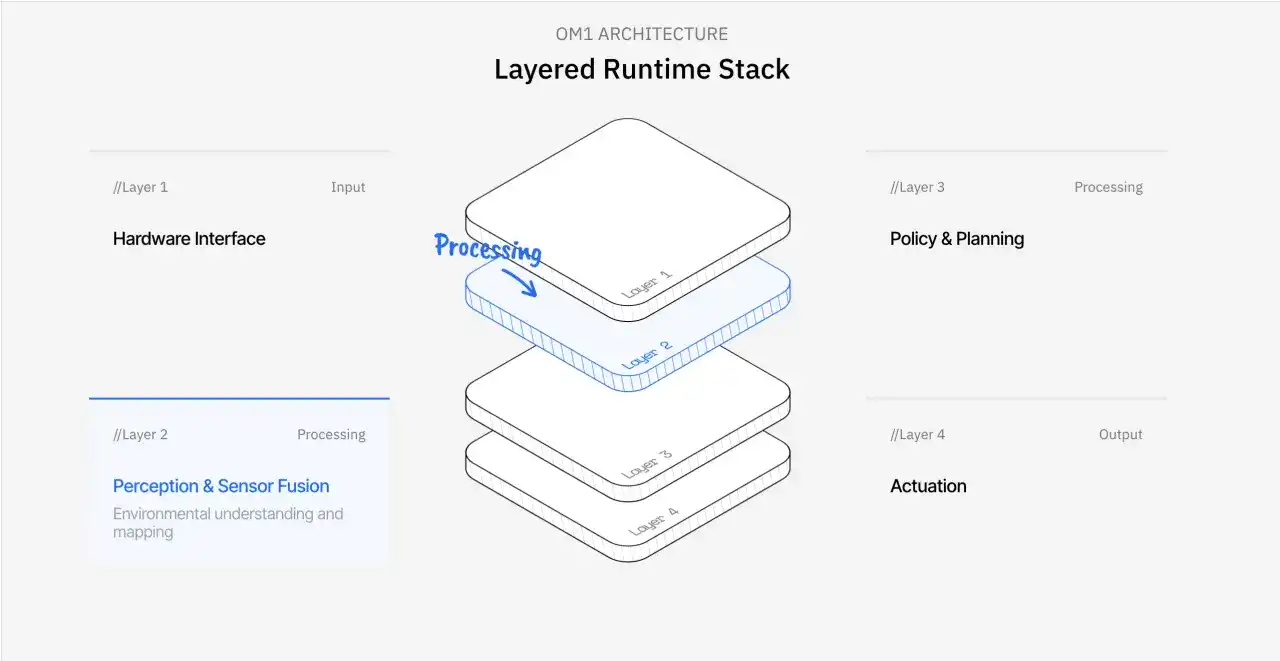
OM1 is essentially an open-source, AI-native robot operating system. Unlike traditional ROS, which only handles motion control and navigation, it integrates perception, memory, reasoning, and action into a unified framework, giving robots a complete decision-making loop similar to humans.

Simply understood, it's four steps: See the world, Remember information, Think about tasks, Execute actions. The implementation is driven by large models and multimodal models. For example, cameras, lidar, voice, and other sensors handle perception; a long-term memory system saves environment and history; mainstream LLMs handle planning and reasoning; which are then converted into specific control commands to complete actions.
This gives robots真正的 "natural language interaction + autonomous decision-making" capabilities for the first time, rather than just being preset script executors.

The highlight of OM1 is its openness and generality. Its hardware-agnostic design allows developers don't need to rewrite code for each robot type. It currently supports various forms like the Unitree G1 humanoid robot, quadruped robots, etc. Software-wise, it integrates mainstream LLMs like GPT-4o, Gemini, equipped with functions like lidar, SLAM navigation, voice interaction, etc. The team will prioritize technical integration with Unitree, Agibot, UBTECH, Dobot, Cloudminds, Accelerated Evolution, Jueji Power, Zhongqing.

Furthermore, OM1's AI-native architecture supports plug-and-play integration of mainstream models, enabling natural interaction. Its modular structure, like an App Store, facilitates skill expansion.

OM1 released its Beta version in September 2025, is open-sourced on GitHub (MIT license), attracting thousands of global developers to contribute and test, and has been adapted to various robot forms including Unitree, DEEP Robotics, Dobot, and UBTECH, beginning the phase of real device deployment.

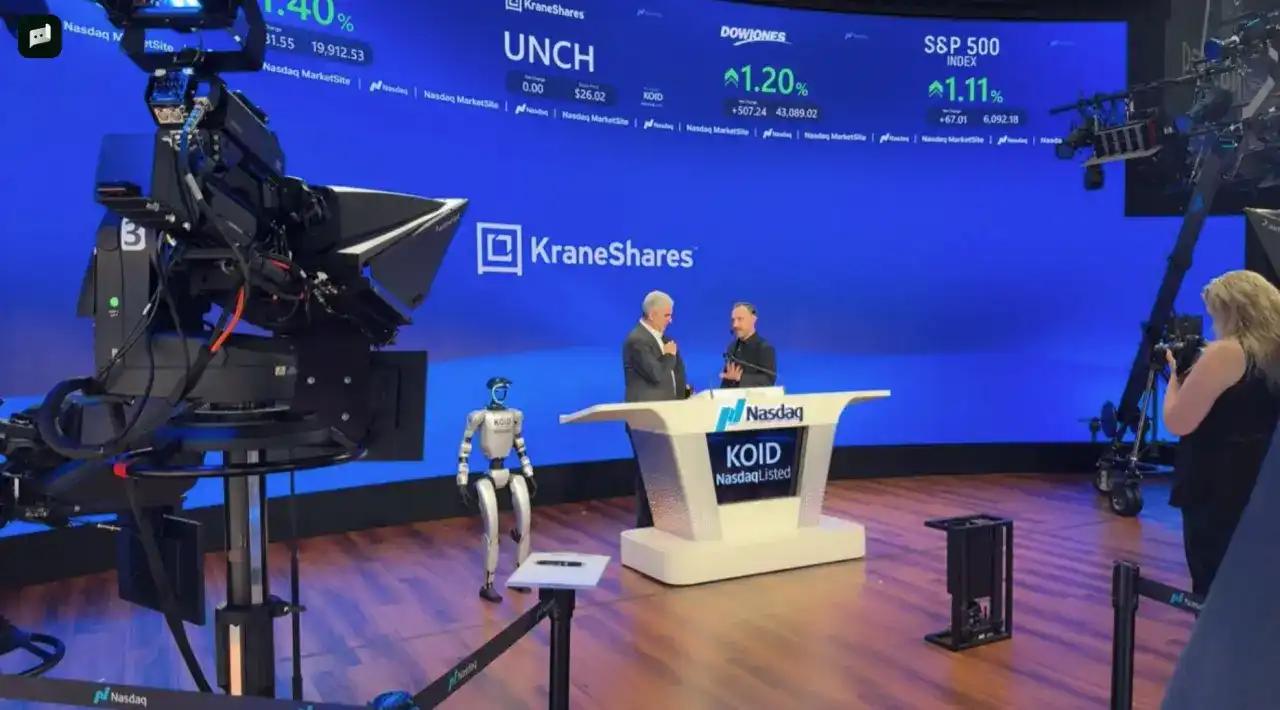
It is worth mentioning that at the ETF listing ceremony hosted by Nasdaq and launched by KraneShares, OpenMind's humanoid robot equipped with the OM1 operating system appeared on site and participated in the listing启动仪式.
Overall, OM1更像 a "universal brain + application platform" for robots. This model essentially replicates the successful path of Android当年: unify the base, reduce development costs to attract developers, and form an application ecosystem.

2. FABRIC: The Network Layer Letting Robots "Know" and "Collaborate" with Each Other

But a brain alone is not enough. In the real world, robots rarely operate alone. They need cross-manufacturer coordination, information sharing, task分配, and even automated settlement.

The problem is, traditional robot systems are mostly closed networks. Once跨品牌 or跨平台, collaboration almost has to start from scratch.

This is why, beyond OM1, OpenMind also built the Fabric Protocol (FABRIC).

If OM1 solves whether I am smart enough, FABRIC solves how I securely cooperate with other robots. FABRIC is essentially a decentralized collaboration and trust network. It assigns an on-chain identity to each robot, allowing devices to be identified, build credit, record behavior, and automatically complete task settlement.

In other words, robots are no longer just tools executing commands, but economic nodes with identity and accounts.

In this network, robots can share skills, synchronize experiences, call each other's capabilities, and even complete automated stablecoin micropayments and incentive distribution. From a Web3 perspective, it's closer to the identity layer + trust layer + collaboration layer between machines.

III. From Vision to Reality: OpenMind's Actual Deployment Progress

After talking so much about protocols, networks, and visions, the only真正关键 question is: Are these things actually running?

In the crypto industry, we've seen too many projects that issue coins first and then look for落地场景. Whitepapers are grand, demo videos are炫, but products remain in the testnet stage, with almost no real deployment in the real world.

The reason OpenMind has attracted so much attention this time is perhaps because its path is the opposite: it推进 TGE after OM1 and FABRIC were already running in real robots.

Currently, the two most representative pieces of落地成果 are: 1) the USDC automatic payment charging network launched in cooperation with Circle; 2) the BrainPack robot intelligence module sold to developers and hardware manufacturers.

1. Letting Robots Pay for Charging Themselves for the First Time

Last December, OpenMind announced a cooperation with Circle, deploying the world's first "USDC Robot Self-Charging Point" in Silicon Valley.

Simply put, robots can pay by themselves. When battery is low, it automatically navigates to the charging station, identifies the location, completes the USDC payment, then charges and continues working, all without human intervention.

It sounds small, but the significance is huge. This should be the first time robots possess autonomous consumption capability. They are no longer just managed devices, but begin to resemble economic agents.

2. Equipping Robots with a Universal Brain "BrainPack"

At the same time, OpenMind launched BrainPack and配套 robot solutions, aiming to help a larger scale of robots solve the problem of insufficient intelligence.

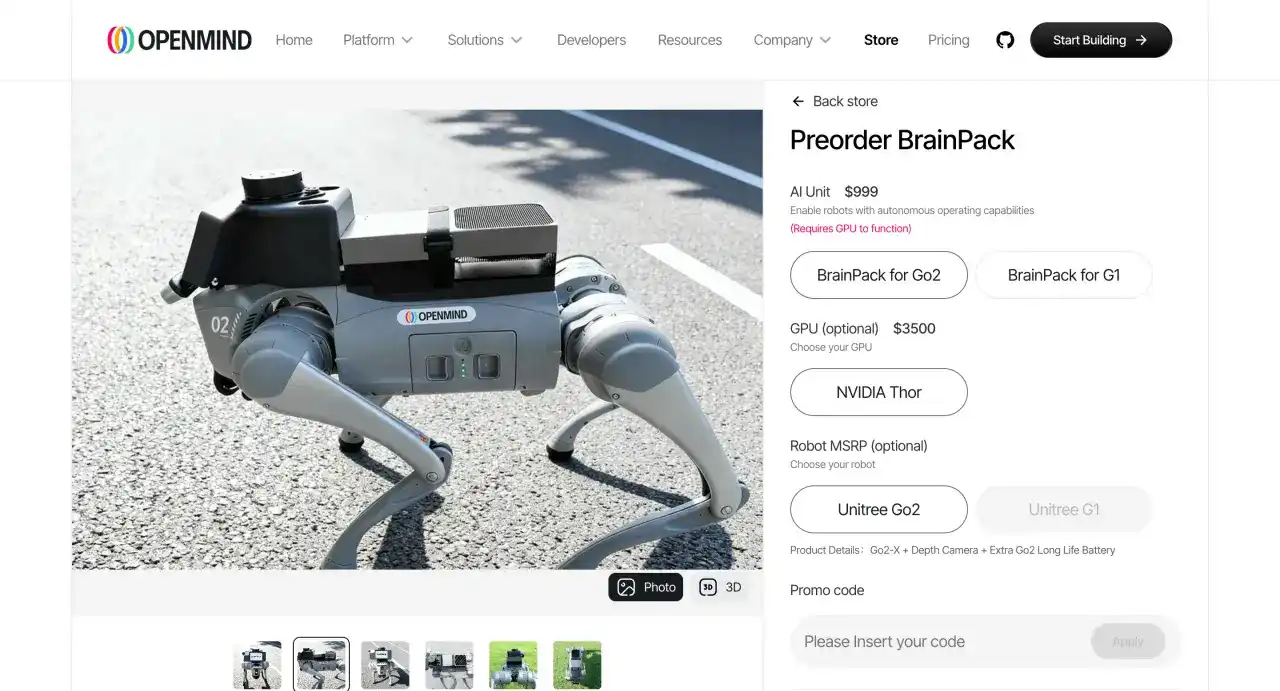
It is essentially a plug-and-play computing backpack, a module about the size of a backpack, integrating high-performance computing, sensors, and software. It can be directly installed on third-party robots. Once installed, ordinary robots immediately gain perception, mapping, planning, memory, and the complete autonomous capabilities like the aforementioned USDC payment-based self-charging management, edge inference, etc.

For example, it can help robots achieve real-time 3D mapping, object recognition/annotation, privacy-preserving vision (automatically blurring faces), and other operations.

Its core hardware is based on NVIDIA Jetson Thor and runs the self-developed OM1 system and FABRIC protocol, supporting ROS2, JetPack 7.05, etc. You can understand it as installing an Android system-level brain for the robot. No need to rebuild hardware or wait for the next generation of robots; old equipment is directly upgraded to AI-native robots.

BrainPack announced specific robot dog products last November. According to the official pre-sale page, the deposit is $999. It supports bundled Unitree robot packages. The first batch of complete deliveries is expected around Q1 2026. Although currently in the pre-order stage, some developers and labs have received beta or early delivery versions.
3.配套 App Store: Beginning to Form an Ecosystem

While hardware is being delivered, OpenMind is also building another key piece of the puzzle—the application ecosystem—launching a robot version of the App Store.

The logic is simple, just like we download Apps on our phones, developers can develop skills and applications for robots, and users can install them on their devices with one click.

Currently, the first batch of applications for quadruped and humanoid robots has been launched. Although still in the early stages, the significance of this step is that OpenMind is not just selling hardware or systems, but attempting to establish a sustainably scalable developer platform.

As more and more robots connect to OM1 + FABRIC, coupled with application distribution capabilities, the entire network truly gains scale effects.

Conclusion: Will OpenMind Drive the "Robotics+Crypto" Concept Heat?

In recent years, the market has just experienced a wave of AI + Crypto热潮. But most projects are essentially "computing power narrative + token model", with a layer still separating the chain from the real world. The special thing about OpenMind is that it is the first to truly embed Crypto into robots, this kind of physical world productivity tool.

From the industry side, OpenMind is already doing something more long-term: education and ecosystem. They jointly with Unitree Robotics' largest distributor in the US, RobotShop (Robostore), launched complete humanoid robot education courses and solutions, currently serving over 100 research and education institutions, including Harvard University, Massachusetts Institute of Technology, Stanford University, and other top universities. This may lay a good foundation for the future ecosystem and network effects of its machine economy, as well as卡位 in the "robotics + Crypto" track.

Perhaps precisely because of this, many people started to seriously pay attention to the robotics+Crypto infrastructure track through OpenMind.

Of course, for OpenMind, deployment speed is more important than concept热度. If viewed more rationally, OpenMind's advantages are very clear:

First, the team: top academic background + robotics/AI/blockchain交叉 capabilities. This kind of composite team from various fields is not common in Crypto projects.

Second, track卡位. In the加密 field, there are almost no similar projects truly深耕 "robotics infrastructure". It is the leader and seed player in this direction. When the market starts talking about "embodied AI + Web3", capital and attention will naturally集中 on it first.

Third,落地 rhythm. OM1, FABRIC, USDC self-charging points, BrainPack, App Store—these are not roadmaps, but products that have already begun delivery. This makes it更像 a technology company building long-term infrastructure, rather than a narrative-driven token project.

Of course, challenges also exist. The robotics industry itself is a hard tech track with heavy assets and long cycles. Hardware deployment is slow, costs are high, and commercialization paths are complex. It cannot replicate the exponential expansion of pure software protocols. At the same time, whether跨厂商 standards can truly be unified, whether the developer ecosystem can take off, and whether the machine economy truly forms a closed loop all still need time to verify.

In other words, OpenMind faces a marathon requiring patience and sustained effort.

Связанные с этим вопросы

QWhat is the core problem that OpenMind is trying to solve in the robotics industry?

AOpenMind is tackling the fundamental infrastructure problems hindering the large-scale adoption of robots: systemic fragmentation, inefficient collaboration, and a lack of economic capabilities. It aims to create a unified operating system and a decentralized collaboration network to allow robots from different manufacturers to work together, share information, and perform automated transactions.

QWhat are the two core products developed by OpenMind and what are their respective functions?

AOpenMind has developed two core products: 1) OM1: An open-source, AI-native robot operating system that serves as a 'general brain' for individual robots, enabling perception, memory, reasoning, and action. 2) FABRIC Protocol: A decentralized collaboration and trust network that provides robots with on-chain identities, allowing them to be recognized, build credit, record behavior, and perform automated task settlement, enabling machine-to-machine collaboration and micro-payments.

QWhat was the significance of OpenMind's collaboration with Circle in December?

AThe collaboration with Circle led to the deployment of the world's first 'USDC robot self-charging point' in Silicon Valley. This allows robots to autonomously navigate to a charging station, identify their location, complete a USDC payment, and charge themselves without human intervention. This is significant as it marks one of the first instances of robots acting as independent economic agents capable of autonomous consumption.

QWhat is the purpose of the BrainPack hardware module launched by OpenMind?

ABrainPack is a plug-and-play 'computing backpack' module designed to upgrade existing third-party robots. It integrates high-performance computing, sensors, and software (including the OM1 OS and FABRIC protocol) to instantly grant ordinary robots advanced capabilities such as perception, mapping, planning, memory, autonomous charging management with USDC payments, and edge inference, effectively giving them a generic 'Android-like' AI brain.

QHow does OpenMind's approach to the 'robot economy' differ from typical AI + Crypto projects?

AUnlike many AI + Crypto projects that focus primarily on 'compute narrative + tokenomics' with a disconnect from the physical world, OpenMind embeds crypto (specifically its FABRIC protocol and stablecoins like USDC) directly into physical robots—the productivity tools of the real world. It provides the essential layers of identity, trust, and settlement, enabling robots to become verifiable economic participants that can collaborate and transact autonomously, thus bridging the gap between blockchain and real-world physical assets and actions.

Похожее

The Cost of an 11.5% Annualized Return: Will MicroStrategy's STRC Face a Moment of Reckoning?

This article analyzes the potential risks associated with MicroStrategy's (MSTR) use of structured financial products like STRC to leverage its BTC exposure. While these tools have enabled impressive returns (e.g., 11.5% annualized) and fueled significant capital inflows ($13.5B outstanding), they also create substantial annual dividend obligations (~$400M). The author argues that this structure, while effective in a bull market, could become a liability if BTC price stagnates or declines. The core risk is a potential negative feedback loop: the growing dividend burden from continued STRC issuance may eventually outweigh the benefits of increased BTC holdings. To meet these obligations, MicroStrategy might need to use new issuance proceeds for dividends instead of buying more BTC, which could disappoint equity investors. If the market capitalization (mNAV) falls below the value of its BTC holdings, the company could be forced to sell BTC instead of issuing new shares, potentially triggering a panic. The author estimates a potential inflection point in 6 months, where annual dividend costs reach $3-4B. At that stage, CEO Michael Saylor might face a difficult choice: sell BTC to meet obligations or sacrifice the credibility of the preferred shares by halting dividends. The article concludes that this financial engineering, while powerful, could ultimately "backfire" on MicroStrategy if market conditions turn.

marsbit52 мин. назад

The Cost of an 11.5% Annualized Return: Will MicroStrategy's STRC Face a Moment of Reckoning?

marsbit52 мин. назад

Торговля

Спот
Фьючерсы

Популярные статьи

Что такое PONKE BNB

Ponke BNB: Новый подход в криптовалютной сфере Введение Ponke BNB, новичок на криптовалютной арене, был запущен в 2024 году и работает на платформе BNB Smart Chain (BEP20). Этот инновационный проект стремится создать уникальное и вовлеченное сообщество, сосредотачиваясь на устойчивом генерировании вознаграждений. По мере эволюции криптовалютного ландшафта, Ponke BNB нацелен на решение критических проблем, связанных с устойчивостью вознаграждений, что делает его проектом, за которым стоит следить как энтузиастам, так и инвесторам. Что такое Ponke BNB? В своей основе, Ponke BNB представляет собой криптовалюту, специально разработанную для экосистемы BNB Smart Chain. С огромным общим предложением в 370,000,000,000,000,000 токенов, стоит отметить, что в настоящее время нет токенов в обращении. Основная миссия Ponke BNB заключается в том, чтобы способствовать созданию устойчивой системы вознаграждений, которая смягчает проблемы, связанные с исчерпанием вознаграждений, что является распространенной проблемой во многих криптовалютах сегодня. Механика функциональности Ponke BNB сосредоточена на поощрении участия пользователей, одновременно предоставляя вознаграждения, которые могут выдержать испытание временем. Уникальная структура его системы вознаграждений направлена на обеспечение долговечности и стабильности, что позволяет решить важные рыночные проблемы. Кто создатель Ponke BNB? Несмотря на обширные исследования, личность создателя Ponke BNB остается неизвестной. Заметно отсутствие общедоступной информации о создателе проекта или его команде разработчиков. Эта анонимность, хотя и не редкость в криптовалютном пространстве, вызывает некоторые вопросы о прозрачности и подотчетности в управлении проектом. Кто инвесторы Ponke BNB? Подобно отсутствию четкости относительно его создателя, нет и публичной информации о каких-либо инвестиционных фондах или организациях, поддерживающих Ponke BNB. Это отсутствие данных об инвесторах часто порождает неуверенность среди потенциальных инвесторов, которые, как правило, предпочитают ясное понимание поддержки, стоящей за криптовалютами, с которыми они рассматривают возможность взаимодействия. Как работает Ponke BNB? Ponke BNB выделяется благодаря своей изобретательной двухуровневой системе устойчивого генерирования вознаграждений. Эта система построена для эффективной борьбы с проблемой исчерпания вознаграждений. Привлекая пользователей и создавая яркое сообщество, Ponke BNB стремится предоставить стабильную и приятную среду, акцентируя внимание на взаимодействии пользователей и вознаграждениях. Операционная основа Ponke BNB поощряет участие через различные активности и испытания, которые разработаны для стимуляции пользователей, обеспечивая при этом устойчивость системы вознаграждений. Проект нацелен на стимулирование сообщества и создание вовлекающей атмосферы, где участники могут чувствовать себя ценными и оцененными. Хронология Ponke BNB Эволюция Ponke BNB может быть кратко охарактеризована несколькими ключевыми моментами: 2024: Начало Ponke BNB на платформе BNB Smart Chain (BEP20) отметило значительный вход в рынок криптовалют. 2024: Выпускwhitepaper проекта и официального сайта предоставил исчерпывающую информацию о целях и задачах Ponke BNB, формируя основу для его ориентированного на сообщество подхода. Ключевые особенности Ponke BNB Ponke BNB основан на нескольких ключевых функциях, которые отличают его от других криптовалютных проектов: Устойчивая система вознаграждений Двухуровневая система вознаграждений разработана для содействия вовлечению, предотвращения исчерпания вознаграждений и обеспечения долговечности доходов для участников экосистемы Ponke BNB. Вовлечение сообщества Проект придает большое значение активному вовлечению сообщества, подстегивая участие через мероприятия, предназначенные для создания социального и коллаборативного окружения. Такой ориентированный на сообщество подход предоставляет пользователям возможность участвовать в формировании будущих направлений проекта. Интеграция с BNB Smart Chain Работая на платформе BEP20, Ponke BNB укреплен безопасностью и эффективностью, предоставляемой BNB Smart Chain. Пользователи получают выгоду от быстрых и экономически выгодных транзакций, что позиционирует Ponke BNB хорошо в более широкой криптовалютной экосистеме. Заключение В заключение, Ponke BNB — это развивающийся криптовалютный проект, который стремится занять свою нишу в растущем ландшафте цифровых валют. С акцентом на устойчивую систему вознаграждений и вовлечение сообщества, он представляет собой свежий взгляд в иначе волатильном секторе. Несмотря на неопределенности в отношении создателей и инвесторов проекта, Ponke BNB продолжает стремиться к прозрачности и инновациям. Поскольку рынок криптовалют продолжает развиваться, принципы устойчивости и динамика, ориентированные на сообщество, ставят Ponke BNB в обнадеживающее положение для будущих наблюдателей и участников.

503 просмотров всегоОпубликовано 2024.04.06Обновлено 2024.12.03

Что такое PONKE BNB

Как купить BNB

Добро пожаловать на HTX.com! Мы сделали приобретение Binance Coin (BNB) простым и удобным. Следуйте нашему пошаговому руководству и отправляйтесь в свое крипто-путешествие.Шаг 1: Создайте аккаунт на HTXИспользуйте свой адрес электронной почты или номер телефона, чтобы зарегистрироваться и бесплатно создать аккаунт на HTX. Пройдите удобную регистрацию и откройте для себя весь функционал.Создать аккаунтШаг 2: Перейдите в Купить криптовалюту и выберите свой способ оплатыКредитная/Дебетовая Карта: Используйте свою карту Visa или Mastercard для мгновенной покупки Binance Coin (BNB).Баланс: Используйте средства с баланса вашего аккаунта HTX для простой торговли.Третьи Лица: Мы добавили популярные способы оплаты, такие как Google Pay и Apple Pay, для повышения удобства.P2P: Торгуйте напрямую с другими пользователями на HTX.Внебиржевая Торговля (OTC): Мы предлагаем индивидуальные услуги и конкурентоспособные обменные курсы для трейдеров.Шаг 3: Хранение Binance Coin (BNB)После приобретения вами Binance Coin (BNB) храните их в своем аккаунте на HTX. В качестве альтернативы вы можете отправить их куда-либо с помощью перевода в блокчейне или использовать для торговли с другими криптовалютами.Шаг 4: Торговля Binance Coin (BNB)С легкостью торгуйте Binance Coin (BNB) на спотовом рынке HTX. Просто зайдите в свой аккаунт, выберите торговую пару, совершайте сделки и следите за ними в режиме реального времени. Мы предлагаем удобный интерфейс как для начинающих, так и для опытных трейдеров.

1.7k просмотров всегоОпубликовано 2024.05.07Обновлено 2025.04.02

Как купить BNB

Что такое BNB CARD

Понимание BNB Card: Революция цифровой идентичности в Web3 В быстро развивающемся мире блокчейн-технологий и криптовалют BNB Card или $BNBCARD выделяется как примечательный проект. Этот мем-токен с утилитарной направленностью, созданный сообществом, использует BNB Smart Chain (BSC) и стремится интегрировать мем-культуру с инновационными решениями цифровой идентичности. Поскольку все больше пользователей погружается в мир децентрализации, важно разобрать, что предлагает BNB Card, его операционные нюансы и потенциальное влияние на рынок. Что такое BNB Card ($BNBCARD)? В своей основе BNB Card представляет собой мем-токен с значительной утилитарной функцией. Он предназначен для расширения возможностей пользователей, позволяя создавать персонализированные цифровые идентификационные карты, которые являются как выразительными, так и функциональными. Проект включает несколько ключевых особенностей: Настраиваемые ID-карты: Пользователи имеют возможность разрабатывать цифровые ID-карты в стиле Binance, предоставляя им платформу для самовыражения и улучшенного взаимодействия в сообществе. Децентрализованная структура: Разработанный на BSC, BNB Card подчеркивает такие ключевые характеристики, как безопасность, прозрачность и суверенитет пользователей. Децентрализованный характер структуры позволяет проводить транзакции, которые являются как эффективными, так и безопасными. Модель, ориентированная на сообщество: Акцент на участии на grassroots-уровне, а не на лабораторно управляемых финансовых моделях создает увлекательную среду для пользователей. Используя врожденную вирусность мем-культуры, BNB Card способствует созданию мощного движения сообщества. Основная цель BNB Card заключается в демократизации инструментов цифровой идентичности в Web3, предлагая доступные решения, которые приносят пользу пользователям без обременений, обычно связанных с традиционными системами управления идентичностью. Создатели и инвесторы При исследовании идентичности BNB Card важно отметить, что нет единственного создателя, которому явно приписывается заслуга. Вместо этого проект кажется созданным сообществом, что подразумевает коллективные усилия, вдохновленные концепцией “Early Builder Card” от Binance. Такой органический подход к разработке является обычным явлением среди проектов в спектре мем-токенов, где развитие часто зависит от увлечения сообщества, а не от центральной власти. Что касается инвестиций, то отсутствие публично раскрытых институциональных спонсоров еще больше подчеркивает основание проекта на grassroots-уровне. Он процветает благодаря органической поддержке сообщества, что отражает обычную характеристику проектов, движимых мемами, которые часто вовлекают свою аудиторию через социальные каналы, а не через формальные инвестиционные пути. Как это работает BNB Card использует несколько механизмов, которые определяют его функционирование и инновационный дух: Утилита токена: Токен BNBCARD предоставляет пользователям доступ к набору инструментов для создания ID, а также предлагает платформу для управления сообществом. Токен служит связующим звеном, которое позволяет реализовать эти функции. Интеграция с блокчейном: Используя BSC, BNB Card обеспечивает совместимость с приложениями на основе Ethereum Virtual Machine (EVM). Эта интеграция предоставляет пользователям преимущества низких транзакционных сборов, улучшая доступность. DIY-экосистема: Центральным элементом привлекательности BNB Card является его подход “сделай сам” (DIY) к созданию цифровых идентификационных карт. Этот элемент участия побуждает пользователей заниматься творческим самовыражением, способствуя инклюзивной культуре, которая процветает за счет вклада и сотрудничества. Хронология Хронология имеет важное значение для понимания траектории BNB Card. Важные вехи в истории проекта включают: 18 марта 2025 года: BNB Card был добавлен на LBank, что стало значительным шагом в его пути на биржу и открыло двери для ликвидности и доступности для пользователей. 19 марта 2025 года: Произошел ключевой момент, когда токен испытал астрономический рост на 26,000% за 24 часа, привлекая внимание к своему потенциалу и энтузиазму сообщества. Текущие разработки: Проект постоянно расширяет свои партнерства с децентрализованными биржами (DEX), такими как PancakeSwap, что дополнительно улучшает ликвидность и вовлеченность пользователей. Инновации и дифференциация Понимание того, что отличает BNB Card, требует более глубокого изучения его инновационной структуры: Гибрид мем-утилиты: BNB Card успешно сочетает игривую привлекательность мем-культуры с практическими приложениями в управлении цифровой идентичностью. Этот нишевый подход эффективно охватывает широкую демографию, привлекая как технически подкованных пользователей, так и тех, кто только начинает знакомиться с криптовалютами. Децентрализованное управление: Работа без централизованного контроля позволяет проекту напрямую использовать мнения сообщества. Коллективный процесс принятия решений, поддерживаемый вовлечением сообщества, наделяет пользователей властью, обеспечивая, чтобы их голоса способствовали развитию и направлению проекта. Масштабируемость: BNB Card может значительно выиграть от обновлений дорожной карты 2025 года для BNB Chain, которые включают улучшения, такие как увеличение скорости транзакций и интеграция инструментов искусственного интеллекта. Эти улучшения выгодно позиционируют проект в условиях высокой конкуренции. Заключение BNB Card является символом новой волны решений цифровой идентичности в экосистеме Web3. Сочетая развлечение, вовлечение сообщества и практическую утилитарность, он приглашает пользователей активно участвовать в формировании своих цифровых личностей. Поскольку проект ориентируется на динамичный рынок криптовалют, его успех, вероятно, будет зависеть от поддержания сильной поддержки сообщества, одновременно адаптируясь к технологическим достижениям и потребностям пользователей. Интеграция децентрализации с мем-культурой служит не только средством для вовлечения пользователей, но и основой для развивающегося нарратива вокруг цифровой идентичности в эпоху блокчейна. В заключение, BNB Card не только иллюстрирует слияние креативности и утилитарности в крипто-пространстве, но и подчеркивает важность сообщества в определении будущего децентрализованных технологий.

497 просмотров всегоОпубликовано 2025.03.26Обновлено 2025.03.26

Что такое BNB CARD

Обсуждения

Добро пожаловать в Сообщество HTX. Здесь вы сможете быть в курсе последних новостей о развитии платформы и получить доступ к профессиональной аналитической информации о рынке. Мнения пользователей о цене на BNB (BNB) представлены ниже.

活动图片