From 'Scientist' to 'Prophet': How Did OpenClaw Help Him Earn $100,000 in 10 Days?

比推Опубликовано 2026-03-16Обновлено 2026-03-16

Введение

This article features an interview with Kevin, a trader who used OpenClaw to turn $30,000 into over $100,000 in just 10 days on the prediction market platform Polymarket. Originally an ERP architect and later a developer of sports betting systems, Kevin entered the crypto space in 2018. He made his first significant profit during the 2023 "inscription summer" with ORDI. In summer 2025, he shifted to Polymarket, attracted by its improved liquidity and user experience. Initially, he used automated arbitrage strategies between betting odds, doubling his initial $100,000 investment. Since late February, he integrated OpenClaw into his strategy. While 60% of his funds still run automated arbitrage, 40% are now managed with OpenClaw-assisted subjective betting. OpenClaw helps by gathering and weighting factors like smart money movements, public sentiment, and team lineups—even uncovering new influencing factors. It also automates backtesting and execution. Kevin highlights Polymarket’s AI-friendly API as a key advantage. Currently, OpenClaw is experimenting mainly in sports betting with small automated bets (~$1,000). Kevin plans to develop and sell packaged OpenClaw "Skills" based on his strategy in the future.

Author: Golem

Original Title: Earning $100,000 in 10 Days: An Interview with OpenClaw's Practical Experience in Prediction Markets


Currently, "raising lobsters" is no longer difficult, but how to master OpenClaw and actually use it to make money still troubles many lobster farmers.

Last week, I spoke with some deep users of OpenClaw in the crypto circle. Some mentioned that OpenClaw's heartbeat mechanism and scheduled tasks can improve the efficiency of news trading, but more interviewees believe that using OpenClaw to trade cryptocurrencies for profit is challenging. (Related reading: Odaily Editorial Team Tea Party)

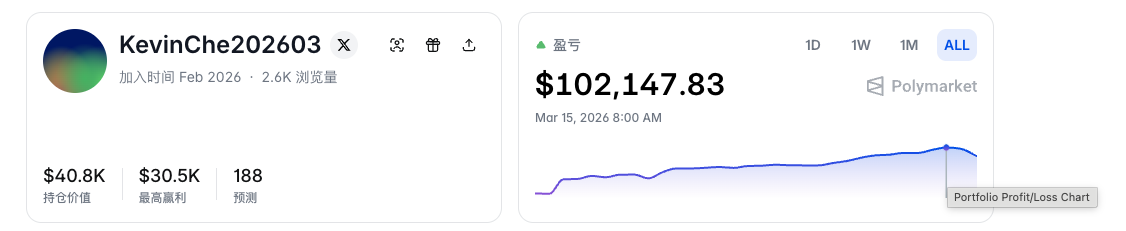
However, where there's a will, there's a way. A trader named Kevin, with the assistance of OpenClaw, turned a $30,000 principal into a fourfold increase in 10 days, with a net profit of $100,000 (currently slightly retraced to $82,000). Kevin himself stated that this was initially just an experiment, but he didn't expect to actually make money.

So how did Kevin transform OpenClaw from a toy that only burns tokens into a money-making machine? Odaily Planet Daily spoke with Kevin, who shared his personal crypto journey and how he leveraged OpenClaw in prediction markets, hoping readers can gain some inspiration.

The Transition from 'Scientist' to 'Prophet'

Kevin's early career primarily involved designing ERP architectures for enterprises. Later, he joined a Top 3 domestic internet company to build a sports betting software system from scratch. This professional experience laid the foundation for Kevin's current achievements in prediction markets. After 2018, Kevin entered the Web3 investment sector, mainly incubating and accelerating startups.

However, Kevin's first real bucket of gold was earned five years after entering the circle. In 2023, ordi emerged, ushering in the "Inscription Summer" for the crypto market. With a background in computers and code, Kevin became one of the highly sought-after "scientists" at the time (Odaily Note: Scientists refer to those who can write programs and code to quickly participate in new asset deployments during inscription launches).

"The period when ordi was listed on Binance was when my account assets were at their highest. I eventually cashed out about over 2 million RMB," Kevin said, noting that he was also among the first batch of people to participate in the ordi launch, with a cost of less than 1 RMB per coin, later enjoying a thousand-fold increase.

After inscriptions completely cooled down, Kevin began searching for other opportunities and finally started seriously researching and participating in the prediction market Polymarket in the summer of 2025. "I had played Polymarket before, but the liquidity was poor, so I ignored it," said Kevin, who had previously worked in traditional sports betting. For him, the early Polymarket's trading depth fell far short of requirements.

However, after Polymarket successfully predicted Trump becoming the 47th President of the United States in 2025, Kevin's attention returned to Polymarket. "After 2025, Polymarket's reputation grew, its liquidity could handle large orders, and more importantly, deposits and withdrawals became very convenient," so Kevin began experimenting with algorithms on Polymarket, becoming a "prophet."

Kevin's journey in prediction markets is divided into two stages: before using OpenClaw assistance and after using OpenClaw assistance. For clarity, Odaily Planet Daily has condensed Kevin's sharing as follows, enjoy~

How to Play Prediction Markets Before Using OpenClaw

Odaily Planet Daily: In the summer of 2025 when you started playing Polymarket, how much money did you invest, and what was the final profit?

Kevin: I invested about $100,000 at that time, and the total profit by this year was roughly double the principal.

Odaily Planet Daily: What strategy did you mainly adopt?

Kevin: I don't bet directly; I made profits through automated arbitrage using programs. When I worked on the sports betting system at the Web3 internet company, I was also involved in the design of order matching. This experience was very helpful for understanding Polymarket's order book. So I used programs to capture spreads between order books, especially in sports events, where a lot of emotional arbitrage can be done.

Odaily Planet Daily: Do you have a dedicated team, and is someone providing you with funds?

Kevin: I'm doing this alone; AI assistance is enough. Initially, I was afraid Polymarket might have withdrawal issues, so I ran dozens of accounts. But later, I found the deposit and withdrawal process very smooth, so I reduced the number of accounts. I mainly use my own money to run strategies, but indeed, some people provide funds for me to run strategies for them. However, this is just one way of making money.

How to Play Prediction Markets After Using OpenClaw

Odaily Planet Daily: When did you start using OpenClaw to play prediction markets?

Kevin: At the end of February. This was itself an experiment to see how much money OpenClaw could make at the trading level, but I didn't expect to actually make money. For example, the account KevinChe202603, I used $30,000 in cost and made up to $100,000 at its peak, in just 10 days.

Odaily Planet Daily: So what is your specific strategy?

Kevin: Frankly, this account's strategy is mixed. Currently, 60% is still running the previous automated arbitrage algorithm, and 40% is using the "lobster" for subjective betting. Compared to market making arbitrage, betting is a complex decision that requires considering factors such as smart money in prediction markets, public sentiment, lineups, player form, etc. OpenClaw's role here is to actively collect various factors that determine the outcome of events and turn them into an indicator. After training several times, it can also find other influencing factors that I might overlook, saving me a lot of time and mental effort.

Odaily Planet Daily: But isn't this just AI predicting events? Conversational AI can do that too, and some developers have even specifically created AI prediction tools for events. What's special about OpenClaw?

Kevin: Having an information advantage is just one of OpenClaw's strengths. It can also dig up new strategies by itself, conduct backtests on its own, and place automated bets during events. If the strategy is good, we just need to give the money to OpenClaw; everything else is automated, which AI prediction tools cannot do. For example, it can actively discover some smart money addresses and foolish addresses, either following the smart money's bets or using the foolish addresses as contrarian indicators.

Additionally, this is why Polymarket, among all prediction markets, integrates particularly well with OpenClaw—because Polymarket's API is the most AI-friendly, making data access very convenient for AI.

Odaily Planet Daily: In which areas is OpenClaw currently placing bets, and is it fully automated already?

Kevin: Based on my areas of expertise, OpenClaw is currently mainly experimenting in the field of sports competitions. But once mature, I will consider expanding OpenClaw to other areas. Right now, I give OpenClaw small amounts of funds for automated betting, around $1000. I still don't dare to put too much money into fully automated accounts.

Odaily Planet Daily: Is your strategy replicable, or will you write a Skills for the market in the future?

Kevin: I'm also trying because there is indeed user demand for this, to see if my methodology can be combined to allow everyone to build a money-making lobster. Later, I also plan to package some Skills for the market to use, which will definitely be paid, of course.


Original link:https://www.bitpush.news/articles/7620106

Связанные с этим вопросы

QWhat was Kevin's initial investment and profit using OpenClaw in the prediction market?

AKevin started with a $30,000 investment and achieved a peak profit of $100,000 within 10 days, though it later retraced to $82,000.

QHow did Kevin's background contribute to his success in prediction markets?

AKevin's experience in ERP architecture design and building sports betting systems for a top internet company provided the foundation for his understanding of prediction markets and automated arbitrage strategies.

QWhat specific role does OpenClaw play in Kevin's prediction market strategy?

AOpenClaw collects factors influencing event outcomes, transforms them into indicators, discovers new strategies, performs backtesting, and automates betting, including identifying smart money and foolish addresses for informed decisions.

QWhy does Kevin prefer Polymarket for using OpenClaw?

APolymarket offers improved liquidity since 2025, facilitates large orders, has convenient deposit and withdrawal processes, and provides an AI-friendly API for easy data access and integration with OpenClaw.

QWhat are Kevin's future plans regarding his OpenClaw strategy?

AKevin plans to expand OpenClaw's automation to other domains beyond sports, develop and sell paid Skills based on his methodology, and allow users to build their own profitable setups using OpenClaw.

Похожее

Anthropic Cries Wolf: Is the AGI Threat Real, or Just an IPO Story?

Anthropic has published an article titled "When AI builds itself," discussing the emerging concept of "recursive self-improvement," where AI begins to actively participate in designing, training, testing, and optimizing its own subsequent versions. The company presents internal data showing that by May 2026, over 80% of code merged into its codebase was written by Claude, its AI model. Claude's capabilities have expanded to handling complex, open-ended engineering tasks, achieving a 76% success rate in such areas, and even contributing to research processes, such as optimizing code performance and conducting AI safety experiments. Anthropic outlines an evolution from human-driven development to AI-assisted workflows, culminating in the current stage where AI agents can autonomously write, run, and delegate code. The company cautions that the path toward a "closed loop," where AI continuously improves itself, is becoming visible. It calls for coordinated global mechanisms to potentially slow or pause frontier AI development to allow safety research and societal structures to catch up. However, the timing of this warning coincides with Anthropic's preparations for an IPO, framing the narrative not just as a safety concern but also as a demonstration of Claude's advanced capabilities and its integral role in accelerating Anthropic's own R&D—creating a potential "flywheel" effect for competitive advantage. This contrasts with OpenAI's recent, more policy-oriented discussion of the same risks, highlighting the competitive dynamics in the AI industry as companies position themselves in both the technological and regulatory landscape.

marsbit27 мин. назад

Anthropic Cries Wolf: Is the AGI Threat Real, or Just an IPO Story?

marsbit27 мин. назад

BIT Research: ETF Purchases Have Slowed, Strategy (MicroStrategy) Has Slowed, What Else Can Drive Bitcoin's Rise?

Market Refocus on Inflation and Rate Expectations Weighs on Bitcoin Currently, the market is in a phase of macro-repricing dominated by inflation and interest rate expectations. Bitcoin, which previously benefited from easy liquidity and low inflation, is seeing its core bullish drivers weaken. These drivers were market expectations for interest rate cuts and strong inflows from Bitcoin ETFs and institutions like MicroStrategy (referred to as "Strategy" in the text). The logic has shifted. Recent high inflation data (e.g., CPI hitting 3.8% in a May 2026 report) has caused the market to sharply reduce its rate cut expectations for 2025 and even price in potential hikes. This is a key constraint for Bitcoin, as it lacks cash flows and is highly sensitive to rate expectations. Concurrently, institutional capital flows have slowed significantly. Following the hot CPI data, Bitcoin ETFs saw accelerated outflows, with around $4.3 billion leaving over a period. MicroStrategy's ability to keep adding substantial Bitcoin to its balance sheet is also diminishing. Together, ETF and MicroStrategy holdings total roughly $110 billion, but their momentum as growth engines is cooling. In summary, Bitcoin's current pressure stems not from its own fundamentals but from a changing macro environment. As long as inflation stays elevated, Bitcoin is likely to remain in a consolidating phase. However, historically, inflation eventually peaks. Once it recedes and rate cut expectations rebuild, institutional capital could return, potentially fueling a new and more robust recovery phase for Bitcoin.

marsbit35 мин. назад

BIT Research: ETF Purchases Have Slowed, Strategy (MicroStrategy) Has Slowed, What Else Can Drive Bitcoin's Rise?

marsbit35 мин. назад

Earning 1000 Trillion in Half a Year, 'Pocketing' 20 Million per Capita: This Round of Wealth Creation in the Korean Stock Market is Unprecedented in Scale

The South Korean stock market is experiencing an unprecedented wealth surge in 2026, with household equity and fund asset values soaring by over 1,000 trillion KRW (~$730bn) year-to-date. This translates to an average per capita wealth increase of roughly 20 million KRW, fueled by a historic 109% rally in the KOSPI index. The boom is driven by three converging forces: an AI-driven semiconductor supercycle boosting giants like Samsung and SK Hynix; the government's "Value-Up" market reforms addressing long-standing corporate governance issues; and aggressive real estate regulations that have locked capital within financial markets, preventing profits from flowing back into property. This has triggered a wealth effect, boosting high-end consumption significantly. However, the gains are highly concentrated. The two semiconductor behemoths account for over half the index's value, but retail investors own relatively low stakes in them, systematically missing the biggest rallies. Wealth and consumption benefits are skewed towards luxury goods and imported cars, bypassing mainstream retail. Further risks stem from excessive leverage, with high trading volume in leveraged ETFs, and a market sentiment heavily reliant on the AI sector's fortunes and speculative rumors. While this cycle marks a potential shift from real estate to equities as a primary wealth generator for Koreans, its sustainability, amid structural imbalances and leverage, remains a critical test.

marsbit40 мин. назад

Earning 1000 Trillion in Half a Year, 'Pocketing' 20 Million per Capita: This Round of Wealth Creation in the Korean Stock Market is Unprecedented in Scale

marsbit40 мин. назад

Behind ZEC's Over 30% Plunge: An 'Unlimited Minting' Vulnerability with No Way to Prove if It Was Ever Exploited

A critical vulnerability was discovered in Zcash's Orchard privacy pool, allowing for the theoretical creation of undetectable counterfeit ZEC. Researcher Taylor Hornby found the flaw on May 29th, 2024, within the Orchard circuit's cryptographic constraints, which could let an attacker bypass asset conservation rules. Although a rapid emergency fix was deployed within days via a coordinated soft and hard fork, a core uncertainty remains: due to Orchard's privacy features, it is impossible to cryptographically prove whether this "unlimited mint" flaw was exploited in the nearly four years since the pool's 2022 launch. This uncertainty, rather than the patched flaw itself, triggered a market panic, causing ZEC's price to drop over 30%. While the Zcash Foundation stated no evidence of exploitation was found, independent entity Shielded Labs emphasized the impossibility of definitively proving no counterfeit ZEC was ever created. The incident highlights the unique trust challenge in privacy systems. To address this, developers are proposing a new network upgrade with enhanced auditing to allow verifiable proof of supply integrity. Notably, the researcher utilized the newly released AI model Claude Opus 4.8 as a tool during the security review, signaling the growing role of advanced AI in uncovering complex cryptographic vulnerabilities.

marsbit42 мин. назад

Behind ZEC's Over 30% Plunge: An 'Unlimited Minting' Vulnerability with No Way to Prove if It Was Ever Exploited

marsbit42 мин. назад

Торговля

Спот
Фьючерсы
活动图片