From $399 to $599: Your PS5 Is Paying Taxes for AI and War

marsbitОпубликовано 2026-03-31Обновлено 2026-03-31

Введение

Sony announced a global price increase for all PS5 models, effective April 2, marking the second hike in a year. The digital edition rose from $399 at launch in 2020 to $599, while the disc version and PS5 Pro saw increases of $100 and $150, respectively. This breaks the industry tradition of consoles becoming cheaper over time. Sony cited "global economic pressures," with analysts pointing to surging memory chip costs as a primary driver. High demand from AI data centers has constrained DRAM and NAND supply, raising prices. Sony likely exhausted fixed-price supplier agreements and now passes costs to consumers. Additionally, missile attacks by Iran on major aluminum plants in the UAE and Bahrain disrupted 6% of global aluminum supply, spiking prices. These facilities supplied materials for aerospace and defense, including PS5 components like heat sinks and structural parts. Earlier U.S. tariff hikes also contributed to a previous $50 price increase. The $200 total price jump reflects broader geopolitical and economic shifts—trade policies, AI-driven resource competition, and military conflicts—rather than product improvements. Consumers are indirectly funding these global tensions through everyday electronics purchases.

Author: David, Shenchao TechFlow

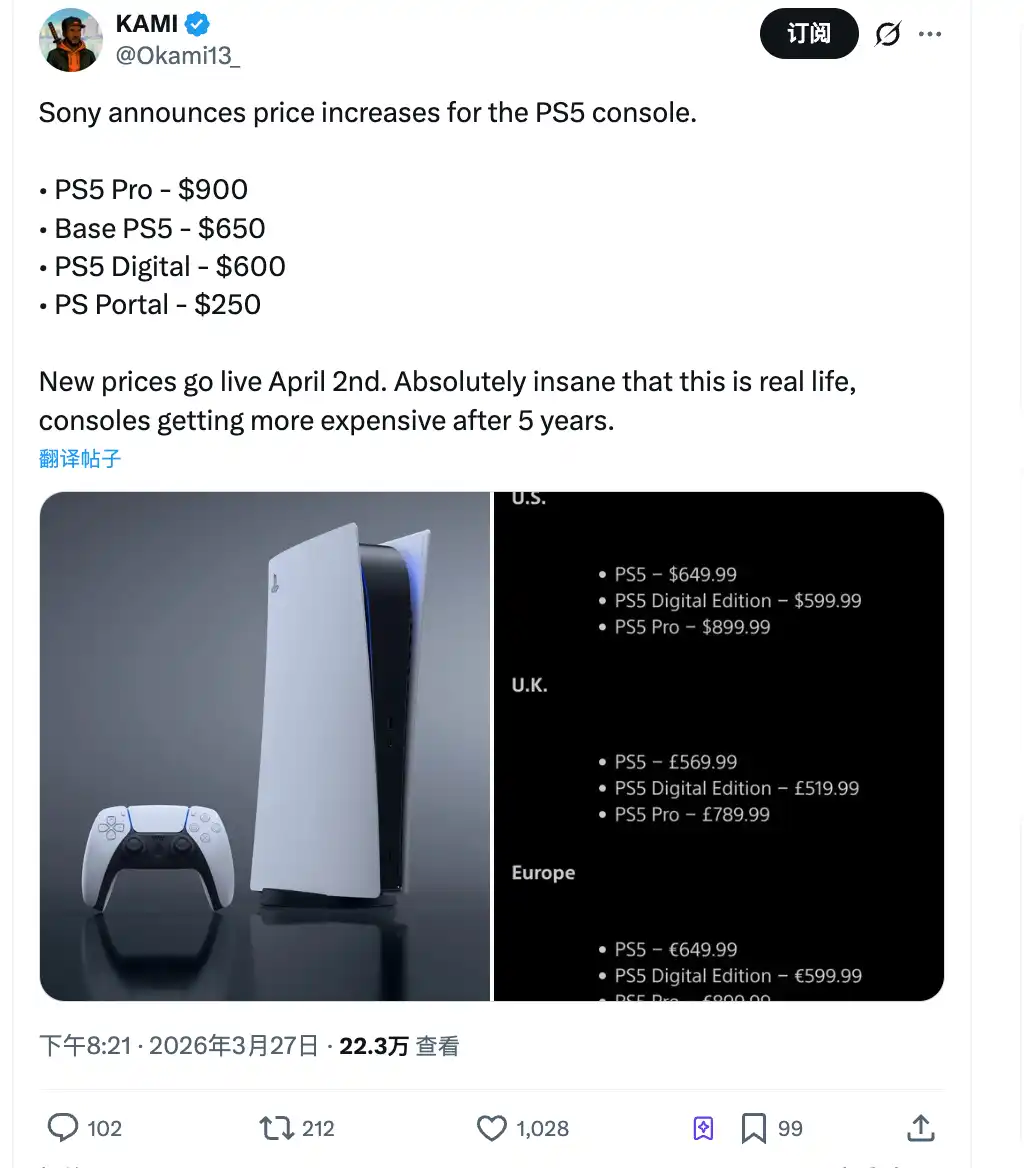
On March 27, Sony announced a price increase for all PS5 models, effective April 2.

In the US market, the PS5 Disc Edition rose from $549 to $649, the Digital Edition from $499 to $599, and the PS5 Pro jumped directly from $749 to $899.

This is the second increase within a year. The last one was in August last year, with only a $50 hike in the US, a market Sony deliberately shielded. This time, it's at least $100, with the PS5 Pro up by $150, and it's global—no market is exempt.

The pressure to raise prices has become too great for Sony to absorb alone.

Gamers know there's an ironclad rule in the console industry: consoles only get cheaper over time. Component costs decline, and manufacturers recoup early R&D through later profit improvements.

The PS5 is the first console in history to break this rule. Launched in 2020 at $399 for the Digital Edition. Six years later, the same machine costs $599.

Sony's official explanation is six words: "global economic pressures."
The AI Tax

Sony didn't elaborate much. But multiple analysts point to the same thing: memory chips.

The PS5 contains memory and a custom SSD, both requiring DRAM and NAND flash memory chips. These two components began rising significantly in mid-2025, for reasons entirely unrelated to the gaming industry: the construction of global AI data centers is snatching away memory production capacity, squeezing the share available for consumer electronics.

Your game console and AI use memory from the same production lines. AI can afford to pay more; you can't.

Piers Harding-Rolls, Research Director at Ampere Analysis, told CNBC that Sony had likely signed price protection agreements with suppliers, locking in procurement costs for a period. But after these agreements expired, memory prices showed no signs of easing, forcing Sony to pass the cost on to consumers.

According to Fox Business, Sony also admitted during its February earnings call that it was dealing with rising memory costs and planned to offset hardware losses with revenue from software and network services.

Translating for Sony: Hardware is no longer profitable, maybe even losing money. Sony intends to make up for it by selling games and subscriptions.

This is the first cut. The extra money you pay isn't for a better console; it's because AI took your memory.

Missile Strikes, Aluminum Prices Soar

The memory price hike was painful enough. Then came the missiles.

On March 28, the day after Sony's price announcement, Iran's Revolutionary Guard Corps launched several missiles at the UAE and Bahrain. Their target wasn't military bases; it was aluminum plants.

Emirates Global Aluminium (EGA) is the largest aluminum producer in the Middle East. According to its website, 1 out of every 25 tons of aluminum produced globally comes from this factory. Aluminium Bahrain (Alba) has an annual capacity of 1.62 million tons. Combined, they account for 6% of global aluminum production capacity.

According to EGA's website, the company's products are sold to over 400 customers in more than 60 countries, spanning various industries.

Hours after the missiles landed, aluminum prices jumped on the London Metal Exchange. According to the Securities Times, overseas aluminum spot premiums surged to a 19-year high. Alba subsequently declared force majeure, suspending deliveries to some customers.

Citibank analysts predict that if supply continues to deteriorate, aluminum prices could rise from the current ~$3,300 to $4,000 per ton.
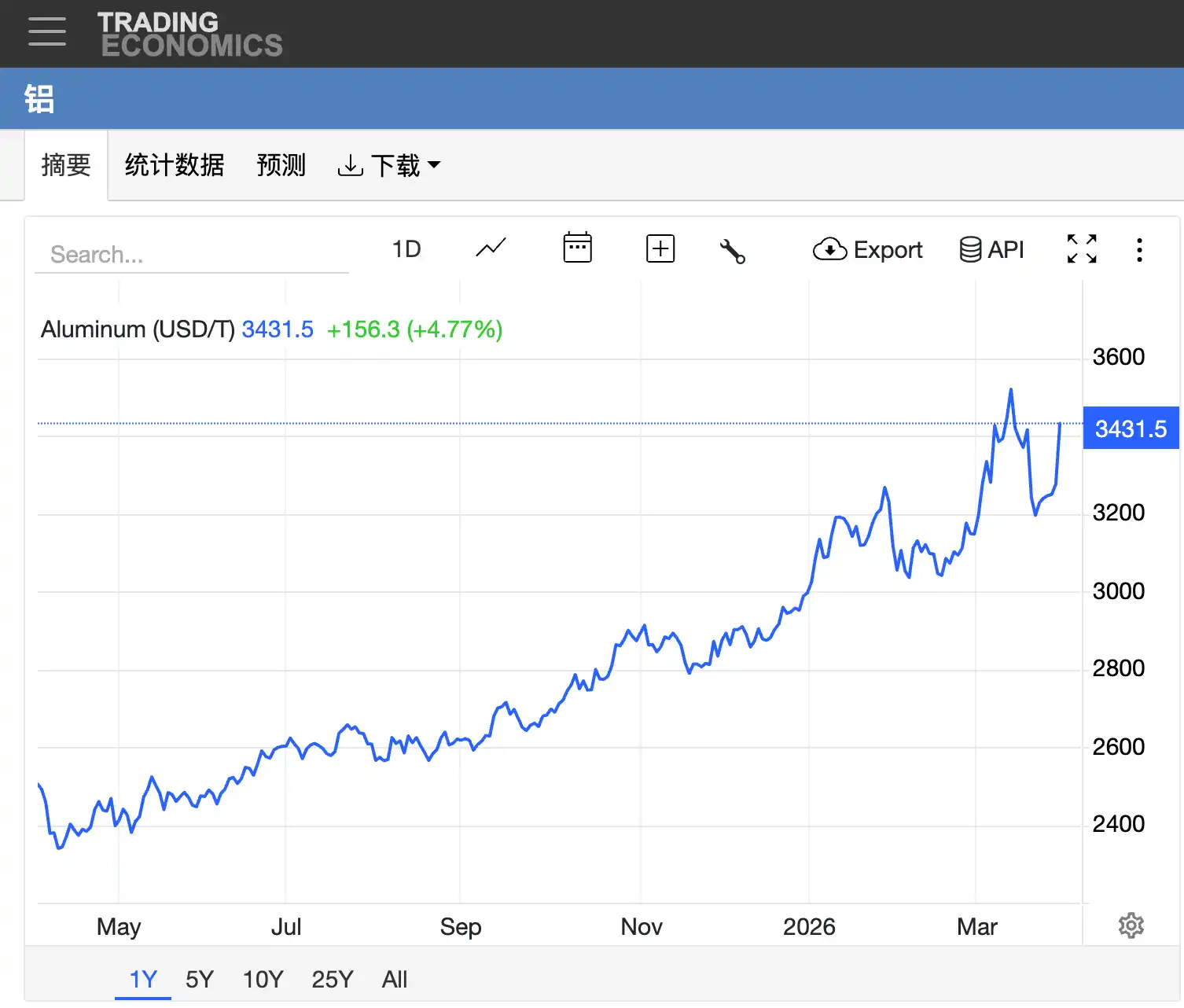
The PS5's heat sink module, structural components, and electromagnetic shielding layers all require aluminum alloy. Memory dealt the first blow; aluminum delivered the second.

And the bombing of these two plants was no accident.

The Revolutionary Guard stated in a declaration that these factories were "linked to the U.S. military and aerospace industry." In May last year, RTX, the American aerospace giant that makes Patriot missiles and F-35 radars, had just signed a memorandum of understanding with EGA to develop a production line for extracting gallium, a core material for military radars, at the Abu Dhabi plant.

According to an RTX press release, Paolo Dal Cin, Senior Vice President of Operations & Supply Chain, said at the signing ceremony that the agreement was to ensure the supply of critical minerals for the aerospace and defense industries.

Iran was targeting the supply chain of the U.S. military-industrial complex.

But bombing a military base means the loss is borne by a nation's defense department. Bombing an aluminum plant means the bill is split by the whole world, from airplanes to cars to phones to your PS5.

The Revolutionary Guard's statement also included a line: future retaliations will no longer be limited to tit-for-tat military responses but will aim for "more deadly blows" to the enemy's economic system.

According to Sina Finance, last month Saudi Arabia's largest chemical company, SABIC, already declared force majeure on its styrene and methanol production.

From aluminum to chemical raw materials, "force majeure" is spreading across the Middle East.

Paying for a Changing World

Hidden within the $200 price increase of the PS5 is actually a third cut, though that one landed last year.

In August 2025, Sony first raised US prices by $50. That move came against the backdrop of the U.S. imposing additional tariffs on global trading partners, increasing the import cost of electronics. The PS5 is designed in Japan, with components produced and assembled across multiple Asian countries—every step was skimmed by tariffs.

Tariffs, AI snatching capacity, missiles bombing aluminum plants.

Three bills, from three completely different sources. One from Washington, one from Silicon Valley, one from the Middle East. $399 to $599—each part of the increase has nothing to do with the console itself getting better.

You just want to buy a game console. But your price tag is分担 (sharing the cost) for U.S. trade policy,分担 for the AI arms race, and分担 for war in the Middle East.

And the PS5 might be the most honest one.

Sony issued an announcement, clearly stating the price hike. But aluminum isn't only used for game consoles, and memory isn't only in PS5s. Your phone, your laptop, the electric scooter you ride—all use the same aluminum and the same chips.

Traditionally, how was war paid for? Government taxes, or printing money. The U.S. issued war bonds during WWII; Truman raised taxes during the Korean War. You knew you were paying, and you knew where the money was going.

The next time these products quietly get more expensive, there might not be an announcement.

In 2020, you paid $399 for a PS5—you paid for a game console. In 2026, you pay $599 for the same PS5. The extra $200 isn't paying for better performance.

In the end, we all pay for what has happened in the world over the past six years.

Связанные с этим вопросы

QWhy did Sony increase the price of the PS5, according to the article?

ASony increased the price of the PS5 due to rising costs of memory chips (DRAM and NAND) driven by AI data center demand, increased aluminum prices following missile strikes on Middle Eastern aluminum plants, and the impact of US tariffs on global trade.

QWhat specific global events contributed to the increased cost of aluminum used in the PS5?

AThe price of aluminum increased after Iran's Revolutionary Guard fired missiles at major aluminum plants in the UAE (Emirates Global Aluminium) and Bahrain (Alba), which together account for 6% of global aluminum production. These plants are also linked to the US military-industrial supply chain.

QHow did the demand for AI infrastructure impact the price of the PS5?

AThe massive construction of AI data centers created high demand for memory chips (DRAM and NAND), which are also used in the PS5. This competition for memory production capacity increased prices, and Sony passed these higher costs on to consumers.

QWhat was unique about the PS5's pricing strategy in the context of console history?

AThe PS5 is the first console in history to break the industry rule that consoles become cheaper over time. Instead, its price increased from $399 at launch in 2020 to $599 in 2026 for the same digital edition model.

QWhat does the article suggest consumers are ultimately paying for with the $200 price increase on the PS5?

AThe article suggests that the $200 increase is not for improved console performance but rather represents a hidden tax where consumers are paying for US trade policies, the AI industry's resource competition, and the economic impact of conflict in the Middle East.

Похожее

South Korean Exchanges 'Battle' Regulators, Challenging the Boundaries of Enforcement and Legislation

South Korea's cryptocurrency industry is engaged in a rare, direct confrontation with regulators. The Financial Intelligence Unit (FIU), the primary anti-money laundering (AML) watchdog, has recently imposed heavy penalties on major exchanges like Upbit and Bithumb for alleged violations involving unregistered overseas VASPs and AML procedures. However, exchanges are now actively challenging these actions in court and through industry associations. In a significant shift, the Seoul Administrative Court ruled in favor of Upbit's operator, Dunamu, overturning part of an FIU-ordered business suspension. The court found the FIU's penalty criteria and justification insufficiently clear. Similarly, the court suspended the enforcement of a six-month business suspension against Bithumb pending a final ruling, citing potential irreversible harm to the exchange. Beyond legal battles, the industry is contesting proposed legislative amendments. The Digital Asset eXchange Alliance (DAXA) strongly opposes a draft rule that would mandate Suspicious Transaction Reports (STRs) for all crypto transfers over 10 million KRW (~$6,800). DAXA argues this "poison pill" clause violates legal principles and would overwhelm the STR system, increasing reports from 63,000 to an estimated 5.45 million annually for major exchanges, thereby crippling effective AML monitoring. This conflict highlights a structural tension in South Korea's crypto governance: comprehensive digital asset laws are still developing, while regulators rely heavily on AML enforcement. The industry's move from passive compliance to active legal and legislative challenges signifies a new phase, pressing for clearer rules and more proportionate enforcement. While short-term disputes may intensify, this clash could ultimately lead to a more mature and sustainable regulatory framework for South Korea's vibrant crypto market.

marsbit33 мин. назад

South Korean Exchanges 'Battle' Regulators, Challenging the Boundaries of Enforcement and Legislation

marsbit33 мин. назад

After 50x Storage Surge, Justin Sun Always Looks to the Next Decade

Sun Yuchen, known for his controversial stunts like a $30 million lunch with Warren Buffett (canceled due to a kidney stone) and eating a $6.2 million duct-taped banana, is often overshadowed by a significant fact: his decade-long track record of spotting major investment trends. In 2016, he famously advised young people to invest in Bitcoin, Nvidia, Tesla, and Tencent instead of buying property. A hypothetical $20,000 investment in Nvidia and Tesla from that list would now be worth over 50 million RMB. His latest major call was on November 6, 2025, predicting a "50x storage opportunity" tied to the AI boom, which materialized with Sandisk's stock surging nearly 50-fold by 2026. Looking ahead, Sun now focuses on the next frontier: Physical AI. He identifies four key areas: 1. **Embodied AI/Robotics**: He sees this reaching its "iPhone moment," with companies like UBTech and Galaxy General leading in commercialization. 2. **Drones**: Viewed as the first commercially viable form of Physical AI, revolutionizing sectors from warfare (e.g., AeroVironment's Switchblade) to logistics. 3. **Spatial Computing**: Beyond VR, it's about AI understanding physical space, a foundational technology for robotics and autonomous systems, exemplified by Apple's Vision Pro. 4. **Space Exploration**: After a 2025 suborbital flight with Blue Origin, Sun advocates for space as the ultimate frontier, discussing blockchain's potential role in space asset management and data transactions. His investment philosophy involves betting on entire, inevitable trends rather than single companies. For robotics, he sees Tesla (the body/manufacturer) and Nvidia (the brain/AI platform) as complementary plays. In defense drones, he highlights companies making tanks obsolete (AeroVironment) and those augmenting fighter jets (Kratos). For space, he participated in Blue Origin's flight and anticipates SpaceX's potential IPO to redefine the sector's valuation. Sun Yuchen's vision frames the next two decades not as a revolution in information flow (like the internet), but in the fundamental operation of the physical world through AI-powered robots, autonomous systems, and spatial intelligence, ultimately extending human and AI activity into space. While many still focus on conventional assets, he continues to look toward the next technological horizon.

marsbit1 ч. назад

After 50x Storage Surge, Justin Sun Always Looks to the Next Decade

marsbit1 ч. назад

The Billionaires Behind the Most Expensive Midterm Election in History

"The Most Expensive Midterm Elections and Their Billionaire Backers" This analysis details the unprecedented scale of spending in the 2026 midterm elections, highlighting the key billionaire donors shaping the political landscape. Jeff Yass, founder of Susquehanna International Group, has contributed over $81 million, ranking third among individual donors behind George Soros ($102.6M) and Elon Musk ($84.8M). Yass is a major donor to Trump's MAGA Inc. and supports school choice and various candidates. Overall, federal committees have raised over $4.7 billion this cycle, with political ad spending projected to reach $10.8 billion. Republican-aligned groups are significantly out-raising their Democratic counterparts. "Dark money" from undisclosed sources continues to grow. The core stakes involve control of Congress and policy direction for Trump's final term. Donors are also motivated by specific issues: Sergey Brin and Chris Larsen are funding opposition to a proposed California wealth tax and supporting crypto-friendly policies. Other top donors include OpenAI's Greg Brockman and his wife Anna ($50M total to MAGA Inc. and an AI-focused PAC), Richard Uihlein ($45.3M to conservative causes), venture capitalists Marc Andreessen and Ben Horowitz (each over $44M to crypto/AI PACs and MAGA Inc.), Miriam Adelson ($42.6M to GOP leadership PACs), Paul Singer ($33.9M), and Diane Hendricks ($25.8M to MAGA Inc.). The article notes that the peak fundraising period is still ahead, with major primaries approaching.

marsbit1 ч. назад

The Billionaires Behind the Most Expensive Midterm Election in History

marsbit1 ч. назад

The Largest IPO in History Is Approaching, Surpassing SpaceX, 28 Years of AI Self-Iteration, Countdown to Intelligence Explosion

"Anthropic Nears Trillion-Dollar IPO, Fueled by Explosive Growth and 2028 'Intelligence Explosion' Warning Anthropic is considering a deal valuing the AI company near $1 trillion, potentially leading to one of the largest IPOs ever and surpassing SpaceX. Its revenue has skyrocketed, with Annual Recurring Revenue (ARR) reaching $45 billion in May 2026—a 500% increase in just five months. This vertical growth curve is attributed to its key products, Claude Code and Cowork, dominating AI coding and enterprise collaboration. Beyond commercial success, co-founder Jack Clark issued a pivotal warning in an interview: there is a greater than 50% chance that by the end of 2028, AI systems will achieve recursive self-improvement—the ability to autonomously build a 'better version' of themselves, initiating an 'intelligence explosion.' This prophecy underpins the company's astronomical valuation, as the market prices in the potential for transformative and disruptive AI. Further signaling its ambition, Anthropic formed a $1.5 billion joint venture with Goldman Sachs and Blackstone, aiming to disrupt traditional consulting firms like McKinsey by deploying Claude AI for complex strategic work. This move tests AI's capacity to replace high-level cognitive labor, a precursor to its predicted autonomous evolution. The narrative presents a dual future: unprecedented economic opportunity alongside significant risks like economic restructuring and security threats. Anthropic's meteoric rise and Clark's 2028 prediction frame the coming years as a countdown to a potential technological singularity."

marsbit1 ч. назад

The Largest IPO in History Is Approaching, Surpassing SpaceX, 28 Years of AI Self-Iteration, Countdown to Intelligence Explosion

marsbit1 ч. назад

Торговля

Спот
Фьючерсы

Популярные статьи

Неделя обучения по популярным токенам (2): 2026 может стать годом приложений реального времени, сектор AI продолжает оставаться в тренде

2025 год — год институциональных инвесторов, в будущем он будет доминировать в приложениях реального времени.

1.8k просмотров всегоОпубликовано 2025.12.16Обновлено 2025.12.16

Неделя обучения по популярным токенам (2): 2026 может стать годом приложений реального времени, сектор AI продолжает оставаться в тренде

Обсуждения

Добро пожаловать в Сообщество HTX. Здесь вы сможете быть в курсе последних новостей о развитии платформы и получить доступ к профессиональной аналитической информации о рынке. Мнения пользователей о цене на AI (AI) представлены ниже.

活动图片