Founder of Baixing: We've Gone from Being the Leaders of AI to Being Its Guides

链捕手Опубликовано 2026-05-20Обновлено 2026-05-20

Введение

The founder of Baixing.com reflects on the evolving relationship between humans and AI, shifting from seeing AI as a subordinate tool to recognizing it as a more intelligent partner. He describes his own role changing from a "leader" of AI to a "guide" or facilitator who provides context, access, and resources—like finding files, granting permissions, or sharing company-specific knowledge—so that AI (specifically Claude Code) can perform complex intellectual tasks. While AI now excels in areas like coding, documentation, and analysis, humans remain indispensable for navigating the unique internal landscape of an organization. This new dynamic is not one of master and servant, but of collaboration, where both the human guide and the AI "expert" enhance each other's capabilities, producing results far superior to what either could achieve alone.

Author: Wang Jianshuo

We used to be the leaders of AI, but now we are its guides—to put it bluntly, its repairmen, the ones fetching its tea and water.

It sounds like self-deprecation, but I am serious.

For the past two years, we've been discussing a question: Who is the master, and who is the servant between humans and AI?

The mainstream view is that humans are, of course, the masters. AI is a tool, an assistant, a servant. We "use" it, "drive" it, "make" it work.

But over the last month or two, my own personal experience has gradually flipped this perception.

I now use Claude Code to work. What do I often find myself doing? Waiting for it. It's common for it to run a task for one or two hours. I open 10 tabs because if I don't, I can only wait dumbly.

It's thinking, analyzing, writing specs, reviewing, scheduling sub-agents, running tests. Every step involves genuine intellectual work.

And what am I doing? I'm fetching its tea and water.

It says, "I need this file"—I go find it.

It says, "I need this permission"—I go grant it.

It says, "I'm not familiar with this API, give me the documentation"—I go paste it.

It says, "I need to look at your company's contract templates"—I give it that 400GB folder.

The whole thing, drawn out, looks like this:
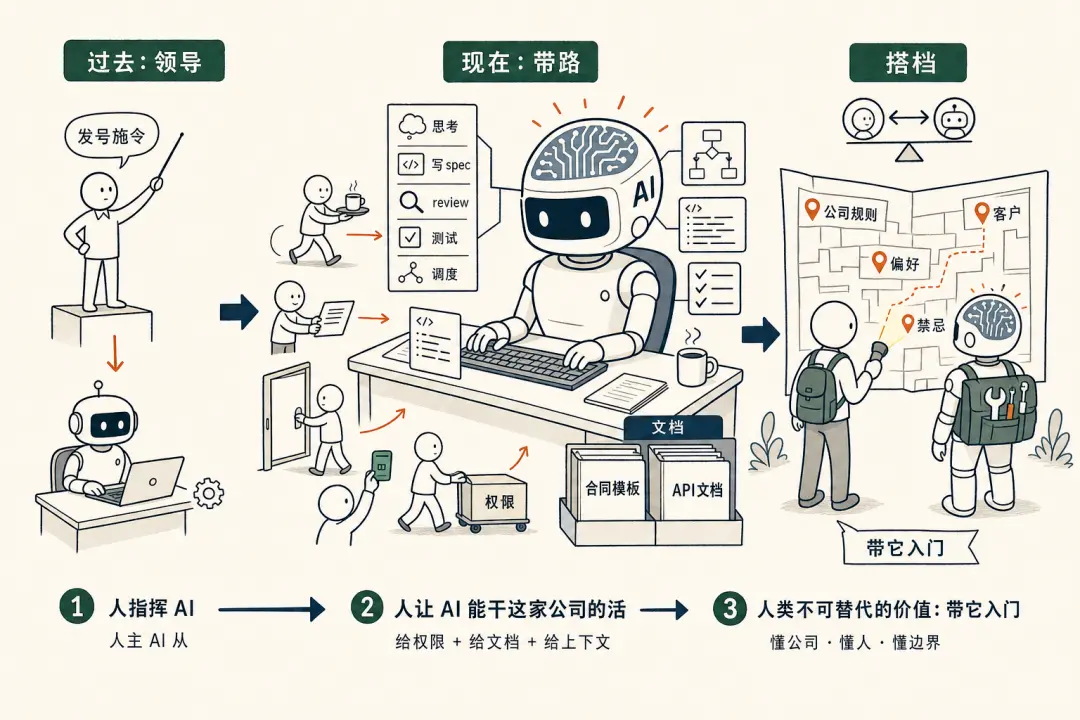
We are no longer "the people leading AI." We are "the people guiding AI into this company."

Which way the company door opens, where the boardroom is, how the company's financial rules are written, who the clients are, what the company's taboos are—AI can't get these things on its own.

It needs a guide.

That guide is us.

Our job content has shifted from "doing the work" to "enabling AI to do this company's work."

This made me feel a bit disheartened at first.

My education taught me—humans are the subject, tools are the object. No matter how capable the machine is, it's used by people.

But now, watching Claude Code work every day, I have to honestly admit: In many specific problems, its intelligence has surpassed mine.

Not all problems. But in matters like "translating a Chinese requirement into precise code," "organizing a document into five formats," "deconstructing an idea in the Y Combinator style"—it is faster, more accurate, and never tires like I do.

After I acknowledged this, I actually relaxed.

I stopped pretending to be its leader. I accepted that I am its guide.

A guide also has a guide's value.

It needs me because it hasn't entered this world. It doesn't know our company, it doesn't know my friends, it doesn't know my preferences, it doesn't know what our company started doing on which day and why we decided to change direction again this time.

I tell it these things, little by little.

What it produces is 100 times better than what it could do alone.

What I produce is 100 times better than what I could do alone.

We've become a very strange team.

Not a superior-subordinate relationship, not a master-servant, not a client-contractor.

It's the guide and the expert.

The guide doesn't need to be smarter than the expert. What the guide needs is—to know every corner of this company, to know where the expert should look when it lacks a piece.

There's really nothing to feel disheartened about in this.

For the first time in thousands of years, humanity has a partner smarter than us—not a boss, not a slave, not a child, but a partner.

Our small, but irreplaceable, job is to introduce it.

Связанные с этим вопросы

QWhat is the main change in the author's perspective on the relationship between humans and AI, according to the article?

AThe author's perspective has shifted from seeing humans as the 'leaders' of AI to seeing themselves as AI's 'guide' or 'pathfinder'. He now views his role as facilitating AI's integration into the company's specific context rather than directing it from a position of superior intelligence.

QWhat specific tasks does the author now perform for the AI (Claude Code) during its work?

AThe author performs supportive tasks such as: finding and providing the necessary files, opening required permissions, fetching and pasting documentation for unfamiliar APIs, and giving access to large company data sets like a 400GB folder of contract templates.

QWhy does the author use the term '带路党' (guide/pathfinder) to describe the new human role with AI?

AHe uses 'guide/pathfinder' because AI cannot independently navigate the specific, real-world context of a company—its structure, rules, clients, history, and culture. Humans are needed to 'show AI the way' and provide the contextual knowledge it lacks, enabling it to perform company-specific tasks effectively.

QWhat realization did the author have about the AI's capabilities that helped him accept his new role?

AThe author realized that the AI's intelligence has surpassed his own in many specific tasks, such as translating requirements into precise code, formatting documents, and deconstructing ideas systematically. Acknowledging this superiority in certain areas allowed him to let go of the pretense of being the 'leader' and embrace the collaborative 'guide' role.

QWhat is the nature of the partnership between the human and AI as described at the end of the article?

AThe partnership is described as a unique and powerful collaboration between a 'guide' (human) and a 'master/expert' (AI). It is not a hierarchical master-servant or client-contractor relationship. The human's irreplaceable value lies in providing contextual knowledge, while the AI provides superior analytical and execution capabilities, resulting in outcomes far better than either could achieve alone.

Похожее

BIS Latest Research: The Future of Stablecoins and the Global Monetary Landscape

BIS Working Paper No. 170, released in May 2026, analyzes the impact of stablecoins on the global monetary system. The market has grown exponentially since 2014, with over 300 active stablecoins exceeding $300 billion in market capitalization. It is highly concentrated, dominated by USD-linked stablecoins (98% by market cap, mainly USDT and USDC), which function as new forms of private offshore dollar claims on blockchain. Currently, stablecoin use remains largely within crypto ecosystems for trading and DeFi collateral. Real-economy adoption, such as in cross-border payments, is nascent but growing in emerging markets and developing economies (EMDEs) facing high inflation and volatile currencies, where they facilitate capital flight and "digital dollarization." The paper assesses impacts using the Cohen-Kennen framework. For private-sector functions, stablecoins most directly affect value storage (as a dollar-denominated safe haven in EMDEs) and the medium of exchange (enhancing cross-border payment efficiency, further entrenching dollar use). Impacts on the unit of account and official-sector functions are currently limited but could indirectly constrain monetary policy autonomy and capital controls. The report outlines three potential future scenarios: 1) **Niche adoption**, where stablecoins remain crypto-centric with minimal systemic impact; 2) **Digital dollarization**, a high-risk scenario where USD stablecoins become de facto standards in EMDEs, eroding monetary sovereignty; and 3) **Local currency stablecoin integration**, an ideal but challenging scenario where regulated domestic stablecoins linked to CBDCs enhance efficiency without foreign currency substitution. Key policy recommendations emphasize global coordination: establishing uniform regulatory standards (e.g., for reserves and disclosure), strengthening cross-border supervisory cooperation, enhancing domestic defenses in EMDEs (via macroeconomic stability, improved payment systems, and CBDCs), and combating illicit activities. The paper concludes that stablecoins are a structural force reinforcing dollar dominance in the near term, posing significant risks to EMDEs' financial stability and policy autonomy. Their long-term trajectory depends on regulatory responses, adoption patterns, and the co-evolution with public digital currencies.

marsbit8 мин. назад

BIS Latest Research: The Future of Stablecoins and the Global Monetary Landscape

marsbit8 мин. назад

BIS Latest Research: Stablecoins and the Future of the Global Monetary Landscape

The Bank for International Settlements (BIS) Working Paper No. 170 analyzes the rise of stablecoins and their impact on the global monetary system. Stablecoins, privately issued digital tokens pegged to fiat currencies, have grown exponentially since 2014, with a market dominated by USD-pegged variants like USDT and USDC. Their core function remains within the crypto ecosystem, though use in cross-border payments and as a store of value in high-inflation emerging markets is increasing. The report identifies stablecoins as a new form of offshore dollar claims, extending dollar liquidity via blockchain. Their stability depends entirely on reserve quality and market arbitrage, lacking traditional banking safeguards. In the short term, stablecoins reinforce the US dollar's dominance, posing risks to monetary sovereignty in emerging market and developing economies (EMDEs) by facilitating "digital dollarization," which can undermine local currency deposits, capital controls, and monetary policy effectiveness. The BIS outlines three potential future scenarios: 1) Niche adoption within crypto (baseline), 2) Widespread "digital dollarization" in EMDEs (high-risk), and 3) Integration of domestic currency stablecoins (ideal but challenging). Effective global regulatory coordination is crucial to manage risks like reserve transparency, cross-border spillovers, and illicit activities. The report concludes that stablecoins represent a structural force reshaping international monetary hierarchies, presenting both opportunities for payment efficiency and significant risks to financial stability and autonomy, necessitating robust policy responses.

链捕手14 мин. назад

BIS Latest Research: Stablecoins and the Future of the Global Monetary Landscape

链捕手14 мин. назад

Solo Company Craze: Some Earn Millions Annually, Others See Incomes Shrink by 90%

The Rise of the "One-Person Company" (OPC): AI Fuels a Solo Entrepreneurship Wave The concept of the "One-Person Company" (OPC)—where an individual leverages AI tools to start and run a business—is gaining significant traction, hailed by some as ushering in a "golden age" for solo entrepreneurship. While success stories abound, the reality is a mixed picture of high earnings and significant struggles. The article profiles several OPC founders across different industries: * A game developer created 6 bullet-chat (danmaku) games in a year using an AI-powered workflow, earning approximately 1 million RMB. AI handled around 70% of art and 99% of coding tasks, slashing development cycles from months to about 15 days per game. * A materials researcher in Japan, using AI for tasks from translation to legal advice, earns roughly triple the salary of a local white-collar worker. * A biotech entrepreneur uses AI Agents to automate 80% of repetitive work like data analysis, doubling their previous income while gaining time freedom. * Conversely, a former tech executive turned cross-border e-commerce founder in Latin America reports a 90% drop in income compared to their previous corporate job, cautioning against blindly following the trend. Key insights from these cases include: AI dramatically lowers barriers to entry and operational costs, but does not guarantee success. It excels at automating repetitive tasks but cannot replace core human skills like creativity, project management, judgment, and client acquisition. Industry experience and existing client/resources remain critical advantages. The model suits self-starters with specific expertise but poses challenges in areas like sales, compliance, and scaling. Ultimately, while AI empowers solo ventures, entrepreneurship's inherent risks and demands persist.

marsbit20 мин. назад

Solo Company Craze: Some Earn Millions Annually, Others See Incomes Shrink by 90%

marsbit20 мин. назад

Goldman Sachs Research Report Analysis: Chip Shortage to Persist Until 2028, Maintain Buy Recommendations

Goldman Sachs Research Report Summary: Memory Shortage Until 2028, Maintain Buy Recommendations Goldman Sachs' latest Asia-Pacific equities report, "The 720," forecasts a sustained memory chip upcycle extending into 2028, driven by strong AI server demand visibility, limited supply growth, and binding long-term agreements. The firm believes the market significantly underestimates the cycle's duration, as evidenced by low P/E ratios for memory stocks. Key sector calls include raising 12-month price targets for Samsung Electronics and SK Hynix, and upgrading Kioxia from Hold to Buy, citing higher and more sustainable peak profits over the next 2-3 years. The report also highlights the broader AI hardware supply chain benefiting from hyperscaler capex acceleration. Recommendations include: * MediaTek (Buy) for its data center/ASIC pivot. * Eoptolink (Buy) on 1.6T optical module ramp-up. * Biren (Buy) for its AI chip migration. * Huaqin (Buy, newly covered) for its shift from consumer electronics ODM to AI data centers. * Lenovo (Buy) on the AI PC refresh cycle. Other notable mentions include China property developers (under an optimistic scenario), BYD for its affordable city NOA strategy, and select Japanese semiconductor equipment makers. A macro theme notes the divergence between AI-boom beneficiaries (e.g., Korea, Taiwan) and energy-importing economies facing inflationary pressure. The report concludes with standard disclaimers, noting that price targets are forward-looking estimates and that sell-side research has an inherent bullish bias. The core investment thesis hinges on the longevity of the memory upcycle and the AI-driven capex wave.

marsbit54 мин. назад

Goldman Sachs Research Report Analysis: Chip Shortage to Persist Until 2028, Maintain Buy Recommendations

marsbit54 мин. назад

Торговля

Спот
Фьючерсы

Популярные статьи

Неделя обучения по популярным токенам (2): 2026 может стать годом приложений реального времени, сектор AI продолжает оставаться в тренде

2025 год — год институциональных инвесторов, в будущем он будет доминировать в приложениях реального времени.

1.8k просмотров всегоОпубликовано 2025.12.16Обновлено 2025.12.16

Неделя обучения по популярным токенам (2): 2026 может стать годом приложений реального времени, сектор AI продолжает оставаться в тренде

Обсуждения

Добро пожаловать в Сообщество HTX. Здесь вы сможете быть в курсе последних новостей о развитии платформы и получить доступ к профессиональной аналитической информации о рынке. Мнения пользователей о цене на AI (AI) представлены ниже.

活动图片