Founder of Baixing: We've Gone from Being the Leaders of AI to Being Its Guides

链捕手Опубликовано 2026-05-20Обновлено 2026-05-20

Введение

The founder of Baixing.com reflects on the evolving relationship between humans and AI, shifting from seeing AI as a subordinate tool to recognizing it as a more intelligent partner. He describes his own role changing from a "leader" of AI to a "guide" or facilitator who provides context, access, and resources—like finding files, granting permissions, or sharing company-specific knowledge—so that AI (specifically Claude Code) can perform complex intellectual tasks. While AI now excels in areas like coding, documentation, and analysis, humans remain indispensable for navigating the unique internal landscape of an organization. This new dynamic is not one of master and servant, but of collaboration, where both the human guide and the AI "expert" enhance each other's capabilities, producing results far superior to what either could achieve alone.

Author: Wang Jianshuo

We used to be the leaders of AI, but now we are its guides—to put it bluntly, its repairmen, the ones fetching its tea and water.

It sounds like self-deprecation, but I am serious.

For the past two years, we've been discussing a question: Who is the master, and who is the servant between humans and AI?

The mainstream view is that humans are, of course, the masters. AI is a tool, an assistant, a servant. We "use" it, "drive" it, "make" it work.

But over the last month or two, my own personal experience has gradually flipped this perception.

I now use Claude Code to work. What do I often find myself doing? Waiting for it. It's common for it to run a task for one or two hours. I open 10 tabs because if I don't, I can only wait dumbly.

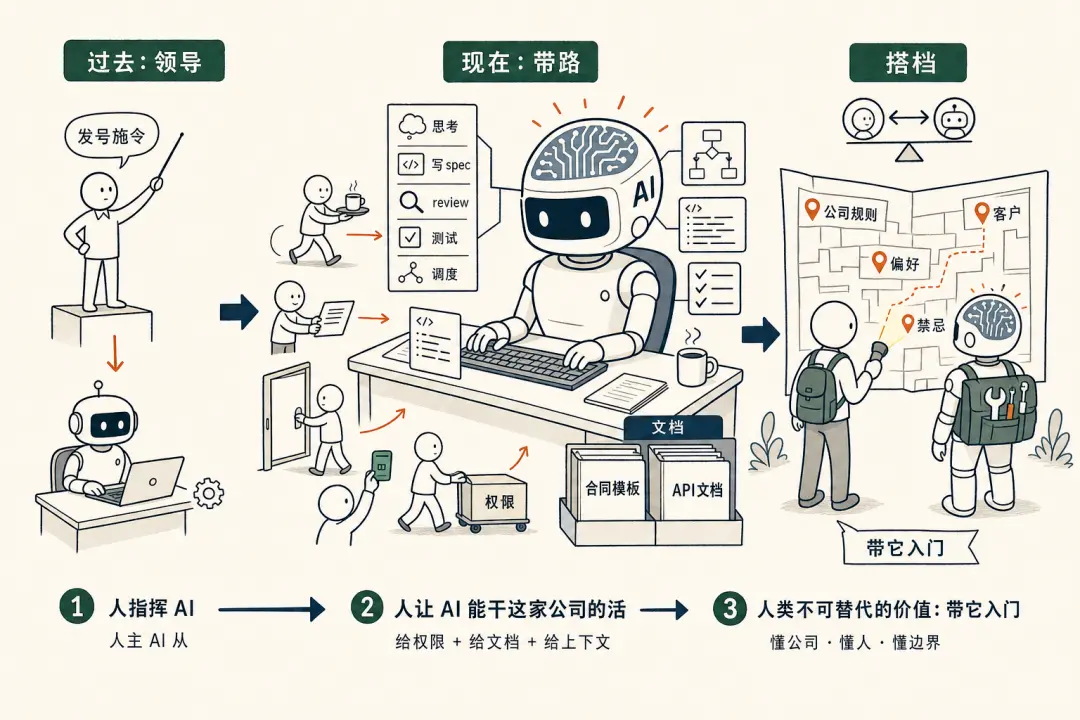
It's thinking, analyzing, writing specs, reviewing, scheduling sub-agents, running tests. Every step involves genuine intellectual work.

And what am I doing? I'm fetching its tea and water.

It says, "I need this file"—I go find it.

It says, "I need this permission"—I go grant it.

It says, "I'm not familiar with this API, give me the documentation"—I go paste it.

It says, "I need to look at your company's contract templates"—I give it that 400GB folder.

The whole thing, drawn out, looks like this:

We are no longer "the people leading AI." We are "the people guiding AI into this company."

Which way the company door opens, where the boardroom is, how the company's financial rules are written, who the clients are, what the company's taboos are—AI can't get these things on its own.

It needs a guide.

That guide is us.

Our job content has shifted from "doing the work" to "enabling AI to do this company's work."

This made me feel a bit disheartened at first.

My education taught me—humans are the subject, tools are the object. No matter how capable the machine is, it's used by people.

But now, watching Claude Code work every day, I have to honestly admit: In many specific problems, its intelligence has surpassed mine.

Not all problems. But in matters like "translating a Chinese requirement into precise code," "organizing a document into five formats," "deconstructing an idea in the Y Combinator style"—it is faster, more accurate, and never tires like I do.

After I acknowledged this, I actually relaxed.

I stopped pretending to be its leader. I accepted that I am its guide.

A guide also has a guide's value.

It needs me because it hasn't entered this world. It doesn't know our company, it doesn't know my friends, it doesn't know my preferences, it doesn't know what our company started doing on which day and why we decided to change direction again this time.

I tell it these things, little by little.

What it produces is 100 times better than what it could do alone.

What I produce is 100 times better than what I could do alone.

We've become a very strange team.

Not a superior-subordinate relationship, not a master-servant, not a client-contractor.

It's the guide and the expert.

The guide doesn't need to be smarter than the expert. What the guide needs is—to know every corner of this company, to know where the expert should look when it lacks a piece.

There's really nothing to feel disheartened about in this.

For the first time in thousands of years, humanity has a partner smarter than us—not a boss, not a slave, not a child, but a partner.

Our small, but irreplaceable, job is to introduce it.

Связанные с этим вопросы

QWhat is the main change in the author's perspective on the relationship between humans and AI, according to the article?

AThe author's perspective has shifted from seeing humans as the 'leaders' of AI to seeing themselves as AI's 'guide' or 'pathfinder'. He now views his role as facilitating AI's integration into the company's specific context rather than directing it from a position of superior intelligence.

QWhat specific tasks does the author now perform for the AI (Claude Code) during its work?

AThe author performs supportive tasks such as: finding and providing the necessary files, opening required permissions, fetching and pasting documentation for unfamiliar APIs, and giving access to large company data sets like a 400GB folder of contract templates.

QWhy does the author use the term '带路党' (guide/pathfinder) to describe the new human role with AI?

AHe uses 'guide/pathfinder' because AI cannot independently navigate the specific, real-world context of a company—its structure, rules, clients, history, and culture. Humans are needed to 'show AI the way' and provide the contextual knowledge it lacks, enabling it to perform company-specific tasks effectively.

QWhat realization did the author have about the AI's capabilities that helped him accept his new role?

AThe author realized that the AI's intelligence has surpassed his own in many specific tasks, such as translating requirements into precise code, formatting documents, and deconstructing ideas systematically. Acknowledging this superiority in certain areas allowed him to let go of the pretense of being the 'leader' and embrace the collaborative 'guide' role.

QWhat is the nature of the partnership between the human and AI as described at the end of the article?

AThe partnership is described as a unique and powerful collaboration between a 'guide' (human) and a 'master/expert' (AI). It is not a hierarchical master-servant or client-contractor relationship. The human's irreplaceable value lies in providing contextual knowledge, while the AI provides superior analytical and execution capabilities, resulting in outcomes far better than either could achieve alone.

Похожее

Why More AI Agents Does Not Equal Higher Productivity?

Editor's Note: As AI Agents become cheaper and easier to use, a new constraint emerges: the cost isn't in launching more Agents, but in the human attention required to manage, judge, and integrate their outputs. This hidden cost is called the "orchestration tax." The article argues that a developer's cognitive bandwidth is the key bottleneck—a serial, non-parallelizable resource akin to a Global Interpreter Lock (GIL). While many Agents can run concurrently, their results ultimately require human judgment for review, conflict resolution, and final integration. Therefore, more Agents don't automatically mean higher productivity; they can simply create longer queues, lead to cognitive fatigue, and create the illusion of busyness without real output. The core solution is to design workflows around this scarce human attention. Key strategies include: scaling the number of Agents to match review capacity (not UI capacity), categorizing tasks (delegating independent ones, keeping complex judgment-heavy ones serial), batch reviewing results to minimize context-switching costs, automating verifiable checks to reserve human judgment for critical decisions, and protecting focused, uninterrupted thinking time. Ultimately, the critical skill is not launching many Agents, but architecting systems that respect the fundamental limit of human attention. Unpaid "orchestration tax" accumulates as both technical and cognitive debt, undermining system understanding and quality. True productivity comes from thoughtfully managing the single-threaded resource—your focus.

marsbit1 ч. назад

Why More AI Agents Does Not Equal Higher Productivity?

marsbit1 ч. назад

Three Years Later: Looking Back at My Predictions About ChatGPT in 2023

Three Years Later: Revisiting My 2023 Predictions on ChatGPT In March 2023, shortly after ChatGPT's launch, I made 20 predictions about its future. Now, in mid-2026, I've used AI agents to fact-check each one against the latest data. Overall, most major directional forecasts were correct, with only one outright error (incorrectly stating GPT-4 had 100 trillion parameters). Key successes included predicting that RAG and retrieval architectures would become the standard for handling knowledge and hallucinations, that natural language interfaces (LUI) would create a massive new industry layer beyond the models themselves, and that China would develop viable large language models, significantly closing the performance gap with Western counterparts within about three years. Predictions about the absence of mass unemployment, the rise of a new "robot network" for agent communication, and ChatGPT not possessing consciousness also held true in their core arguments. However, the "devil was in the details." Errors frequently involved specific numbers, timelines, or overlooking distributional effects. I tended to overestimate the speed of adoption (e.g., for agent networks) while underestimating the ultimate scale of capabilities or costs (e.g., AI winning IMO gold without tools, or the extreme capital required for frontier models). Other misjudgments included: underestimating how AI would reinforce, not dissolve, information filter bubbles; incorrectly assuming AI-generated content would easily circumvent copyright (it has instead triggered record-breaking settlements); and misidentifying where value would be captured (it accrued overwhelmingly to the compute layer, like Nvidia, not just the application or model layers). Key lessons from reviewing these predictions are: 1) Directional and mechanistic insights are far more reliable than precise numbers or absolute statements. 2) There's a consistent bias to overestimate short-term speed but underestimate long-term magnitude. 3) Errors often lie in missing distributional impacts within a generally correct aggregate trend. 4) Predictions phrased with nuance and caveats aged the best. 5) Some fundamental debates (e.g., on machine consciousness or the ultimate value chain) remain unresolved even after three years. This exercise is less about scoring the past and more about establishing rules for clearer thinking about the next three years of AI.

marsbit7 ч. назад

Three Years Later: Looking Back at My Predictions About ChatGPT in 2023

marsbit7 ч. назад

Three Years Later: Looking Back on My 2023 Predictions for ChatGPT

Looking Back After Three Years: Revisiting My 2023 Predictions on ChatGPT In March 2023, shortly after ChatGPT's debut and before GPT-4's release, I made over twenty predictions about AI's future based on limited information and intuition. Now, in May 2026, I revisited those forecasts using an AI-driven analysis with 41 Opus 4.8 agents to cross-reference them with the latest data. The assessment used symbols: ✅ Correct, 🟢 Mostly Correct, 🟡 Partially Correct, ❌ Incorrect. Overall, the directional judgments held up well, with only one major factual error regarding GPT-4's rumored parameter size (incorrectly cited as 100T). However, nuances and degrees of accuracy revealed more. **What Was Largely Correct:** Predictions about mechanisms and directions proved accurate. The rise of RAG (Retrieval-Augmented Generation) as the standard architecture for combating AI hallucination was confirmed, as was the transformative potential of LUI (Language User Interface) in creating a new industry layer atop GUIs. The emergence of "robot networks" (agent-to-agent communication protocols) and China's rapid catch-up in developing capable large models (closing the performance gap with top models to ~2.7%) were also on point. The analysis affirmed that LLMs lack consciousness and that the Turing Test merely measures perceived intelligence. **What Was Off Target:** Errors often involved specific numbers, over-optimistic timelines, or misjudged distributions. The prediction that value would primarily accrue to the application layer was half-right but missed NVIDIA's dominance as the profitable infrastructure layer. Forecasts about AI circumventing copyright issues and fostering a "global common ground" by averaging human viewpoints were incorrect; instead, major copyright settlements occurred and AI personalization is increasing. Estimates for model training costs ("$5-10 billion cap") were significantly off, underestimating frontier costs and overestimating replication costs. The notion that LLMs could never do complex math without tools was disproven by later models winning IMO gold. **Key Patterns from the Review:** 1. **Direction over precision:** Judgments about mechanisms and trends were more reliable than specific numbers or definitive statements. 2. **Timing bias:** There was a tendency to overestimate short-term speed but underestimate long-term magnitude and transformation. 3. **The distribution blind spot:** Aggregate-level correctness often masked uneven impacts (e.g., on young professionals' employment). 4. **The value of qualifiers:** Predictions framed with caution (e.g., "reportedly," "for now," "prototype in 2-3 years") aged better. 5. **Some debates continue:** Issues like the nature of "emergent abilities" or machine consciousness remain unresolved. This three-year review highlights that while seeing the big picture is crucial, humility regarding specifics, timelines, and disparate impacts is essential for future forecasting.

链捕手10 ч. назад

Three Years Later: Looking Back on My 2023 Predictions for ChatGPT

链捕手10 ч. назад

AI Bubble Warning: AI Investments Are Negative Returns for Most Tech Giants

The article issues a stark warning about a potential AI investment bubble. It notes that while the AI boom shares similarities with the TMT bubble of the late 1990s, its scale is vastly larger, currently driving 93% of U.S. GDP growth. Major hyperscale cloud providers like Microsoft, Alphabet, Amazon, Meta, and Oracle are planning to invest trillions in AI data centers over the coming years. However, calculations based on analyst projections for 2025-2030 reveal a concerning math problem: expected capital expenditure growth far outpaces projected revenue growth. Even under an extremely optimistic scenario of zero costs, the implied return on investment for most of these tech giants (except Amazon) is deeply negative. This suggests that the current trajectory could lead to one of history's largest shareholder value destruction events. The piece outlines two potential escapes: AI generating vastly more revenue than currently anticipated—a near-impossible task—or a significant cutback in the planned investment splurge. The latter scenario could trigger a domino effect, severely impacting the entire tech supply chain (from Nvidia to TSMC), potentially pushing the U.S. economy into recession, and causing a major stock market downturn. The author suggests upcoming high-profile IPOs by companies like OpenAI and Anthropic might represent a transfer of risk from early investors to public market participants. While the peak of the hype cycle might sustain investment through 2026, the fundamental financial dilemma remains unresolved, setting the stage for a potential market correction in 2027 or 2028, similar to the years following Alan Greenspan's "irrational exuberance" warning.

marsbit11 ч. назад

AI Bubble Warning: AI Investments Are Negative Returns for Most Tech Giants

marsbit11 ч. назад

Торговля

Спот
Фьючерсы

Популярные статьи

Неделя обучения по популярным токенам (2): 2026 может стать годом приложений реального времени, сектор AI продолжает оставаться в тренде

2025 год — год институциональных инвесторов, в будущем он будет доминировать в приложениях реального времени.

1.8k просмотров всегоОпубликовано 2025.12.16Обновлено 2025.12.16

Неделя обучения по популярным токенам (2): 2026 может стать годом приложений реального времени, сектор AI продолжает оставаться в тренде

Обсуждения

Добро пожаловать в Сообщество HTX. Здесь вы сможете быть в курсе последних новостей о развитии платформы и получить доступ к профессиональной аналитической информации о рынке. Мнения пользователей о цене на AI (AI) представлены ниже.

活动图片