Financial Changes under the New SEC Rules: Opportunities and Regulatory Red Lines Behind "Tokenized Stocks"

链捕手Опубликовано 2026-05-22Обновлено 2026-05-22

Введение

The article discusses the emergence of "Tokenized Stocks" following the U.S. SEC's proposed "innovation exemption" framework, which could allow some assets to be traded on blockchain. It clarifies key misconceptions for investors, particularly those in China. Firstly, it emphasizes that most "tokenized stocks" currently offered by third-party crypto platforms are synthetic assets, not actual equity. Purchasers do not gain shareholder rights like dividends or voting; instead, they hold a derivative contract dependent on the issuing platform's credit and its ability to track the underlying stock's price. The article examines the risks of 24/7 trading, a major selling point. It notes the absence of circuit breakers, which could lead to sudden, unrecoverable losses during off-hours market shocks. It also warns of liquidity traps and high volatility due to the market's currently small size. It reveals that the primary drivers are institutional players like BlackRock and JPMorgan, who are focused on using blockchain for efficiency gains in areas like treasury settlements (T+0), not retail speculation. For Chinese readers, it strongly cautions that platforms offering "easy" access to U.S. stocks via tokens with RMB likely violate strict domestic regulations on cross-border securities and virtual currencies, offering no legal protection. The conclusion offers practical advice: use legal channels like QDII for long-term investment, be wary of high-return promises, monitor evolving...

Source | Digital Financial Report Author | Yi He

Recently, a new term has emerged in the global financial circle—"Tokenized Stocks".

The reason is that the U.S. SEC (Securities and Exchange Commission) is advancing an "innovation exemption" framework, allowing some assets to be traded on the blockchain. Suddenly, social media feeds are filled with claims like "ordinary people can buy Tesla stock 24/7" and "earn USD while lying down".

As rational observers, we must look beyond the noise to see the essence: Is this truly progress in financial technology, or is it a new round of a risky game? Especially for domestic investors, the boundaries here must be clarified.

Essence: You Are Not Buying Stock, But a "Certificate"

When many friends hear "buy Apple's token," their first reaction is that they have become Apple shareholders. This is a huge cognitive misconception.

Current "tokenized stocks" mainly fall into two categories:

  • Official Version (Issuer-Sponsored): Apple itself issues tokens, and you possess shareholder rights (dividends, voting).

  • Third-Party Version (Currently Mainstream): These are "synthetic assets" issued by crypto platforms.

Here’s the key point: Many of the items SEC is "exempting" this time are third-party tokens.

This means you are not buying Apple stock, but rather a "betting agreement" issued by a platform. You may not receive dividends or voting rights. Your returns depend entirely on the platform's creditworthiness and its ability to peg the underlying asset.

Banker's Note: Buying stock is buying a company's future; buying a "token" may be buying a platform's ability to fulfill its contract. The risk levels are worlds apart.

The Truth: Is 24/7 Trading "Sweetness" or "Poison"?

" 7 days a week, 24 hours a day trading" sounds very tempting, making you feel you can seize opportunities anytime. But in the eyes of financial veterans, this is often a double-edged sword.

1. The Lost Safety Net—Circuit Breakers

Why do traditional stock markets have circuit breakers? To prevent panic stampedes. If Tesla had bad news on a weekend, the traditional market would halt trading to let everyone calm down, but the on-chain market has no pause button. Your assets could evaporate by 30% while you sleep, with no way to recover.

2. The Liquidity Trap

The current scale of this market is still very small (only a tiny fraction of the traditional stock market). Without large funds to absorb trades, this "round-the-clock trading" is often accompanied by extremely high slippage and violent volatility.

⚠️ Risk Warning: The IMF (International Monetary Fund) has long warned that unregulated round-the-clock trading could amplify financial contagion risks. This is not a "fleece the sheep" playground, but an arena for institutional warfare.

Game Within a Game: Who Is Pushing It? Who Pays the Bill?

The protagonists of this wave are not retail investors, but Wall Street giants.

Institutions like BlackRock and JPMorgan Chase are making moves, but they are focusing on "compliant tokenized Treasury bonds." Their goal is to use blockchain technology to improve settlement efficiency (from T+2 to T+0), not to let you speculate.

The "tokenized stocks" that retail investors see are more often derivatives launched by cryptocurrency platforms to attract traffic.

Special Reminder (for domestic readers):

  • Domestic regulations have strict legal stipulations regarding virtual currencies and cross-border securities.

  • Any platform claiming "no U.S. stock account needed, buy U.S. stock tokens directly with RMB" is highly likely to be involved in illegal cross-border stock trading or illegal fundraising.

  • Participating in such "on-chain trading" not recognized by domestic regulators means that if disputes arise, the law may struggle to protect your rights.

A "Risk-Avoidance" Guide for Ordinary People

If you are interested in this field, please be sure to keep the following suggestions in mind:

1. Distinguish Between "Investment" and "Speculation"

If you are investing for the long-term value of Apple or Tesla, please go through legitimate domestic QDII channels or open an account with a regular U.S. stock broker. Don't touch those "synthetic tokens" whose underlying assets are unclear just for so-called "convenience."

2. Beware of "High-Return" Rhetoric

Anyone promising to let you "earn money lying down on weekends" through tokenized stocks is most likely trying to make money from your fees or harvest your principal. Remember: the higher the return, the more exponentially the risk rises.

3. Pay Attention to Regulatory Signals

Currently, the U.S. CLARITY Act is still being debated, and the regulatory wind can change at any time. For financial products that are highly sensitive to policy, "if you don't understand it, don't touch it" is the best risk control.

Conclusion

Financial innovation is always a double-edged sword. The SEC's current attempt is more of a "regulatory experiment" by the U.S. to compete for dominance in fintech.

But for us in Shanghai (or other domestic cities), compliance will always be the first threshold for investment. Before jumping into these seemingly sparkling "new waters," please confirm whether you are wearing a life jacket and whether these waters allow you to swim.

In the world of investment, surviving long is more important than earning fast.

Original article link

Связанные с этим вопросы

QWhat are the two main types of 'Tokenized Stocks' mentioned in the article, and what is the key difference?

AThe two main types are: 1) Official version (Issuer-sponsored): Tokens issued by the company itself (e.g., Apple), granting holders shareholder rights like dividends and voting. 2) Third-party version (currently mainstream): These are 'synthetic assets' issued by crypto platforms. The key difference is that with third-party tokens, buyers do not own the underlying stock or its rights (dividends, voting); instead, they hold a derivative contract whose value depends on the platform's creditworthiness and its ability to track the asset's price.

QWhat are the major risks associated with the '24/7 trading' feature promoted for tokenized stocks?

AThe '24/7 trading' feature carries significant risks: 1) Lack of protective mechanisms like market-wide circuit breakers (trading halts), which means assets could lose substantial value overnight without any chance for intervention. 2) Liquidity traps and high slippage due to the current small market size, leading to extreme price volatility. The IMF has warned that such unregulated, continuous trading can amplify financial contagion risks.

QAccording to the article, who is primarily driving the current tokenization trend, and for what purpose?

AThe current trend is primarily driven by Wall Street giants like BlackRock and J.P. Morgan. However, they are focusing on tokenizing compliant assets like U.S. Treasuries. Their main goal is to leverage blockchain technology to improve settlement efficiency (e.g., moving from T+2 to T+0), not to facilitate speculative retail trading of tokenized stocks.

QWhat specific warnings does the article give to readers in mainland China regarding tokenized stocks?

AThe article gives several strict warnings for readers in mainland China: 1) Chinese regulations strictly govern virtual currencies and cross-border securities. 2) Platforms claiming to allow the purchase of 'U.S. stock tokens' with RMB without a U.S. brokerage account are highly likely to be involved in illegal cross-border stock trading or fundraising. 3) Participating in such unregulated 'on-chain trading' is risky; in case of disputes, it will be very difficult to obtain legal protection.

QWhat core advice does the article offer to ordinary individuals interested in this field?

AThe article offers three key pieces of advice: 1) Distinguish between 'investment' and 'speculation'. For long-term investment in companies like Apple or Tesla, use legal domestic channels (e.g., QDII funds) or legitimate U.S. brokerage accounts, avoiding opaque 'synthetic tokens'. 2) Be wary of 'high-return' narratives. Promises of easy weekend profits often aim to collect fees or capital. Higher potential returns come with exponentially higher risks. 3) Monitor regulatory signals. Given the evolving regulatory landscape (e.g., the U.S. CLARITY Act), the best risk control for highly policy-sensitive products is: 'If you don't understand it, don't touch it.'

Похожее

Claude Code Introduces Dynamic Workflows: Enabling AI to Form Teams and Collaborate

Claude Code introduces dynamic workflows, enabling AI to coordinate teams of specialized agents for complex tasks. This transforms Claude from a code assistant into a programmable workbench. Workflows address key limitations of single-agent systems: agentic laziness (premature task completion), self-preferential bias (favoring own outputs), and goal drift (losing sight of original objectives). The system allows Claude to dynamically create execution frameworks using JavaScript. It can split tasks, dispatch parallel agents for isolated work (e.g., in separate worktrees), implement adversarial validation, run tournaments, and synthesize results. This multi-agent approach is valuable for tasks requiring deep research, factual verification, code migration, root cause analysis, large-scale triage, and qualitative sorting. Key patterns include: classify-and-route, fan-out-and-synthesize, adversarial verification, generate-and-filter, tournaments, and loop-until-done. While token usage is higher, workflows excel where tasks resemble programming—needing problem decomposition, isolated context, hypothesis testing, and handling many details. They extend Claude Code's utility beyond technical work to areas like business plan review, resume screening, and naming brainstorm. The feature is not a universal solution but points to a future where AI tool competitiveness depends on organizing reliable, reusable, and auditable execution flows for complex goals.

marsbit13 мин. назад

Claude Code Introduces Dynamic Workflows: Enabling AI to Form Teams and Collaborate

marsbit13 мин. назад

Hyperliquid, Wall Street's 24/7 Trading Convenience Store

Hyperliquid: The 24/7 Trading "Convenience Store" for Wall Street Hyperliquid, a decentralized cryptocurrency exchange, has become a go-to platform for Wall Street traders seeking to trade around the clock, especially during traditional market closures. Founded by Jeff Yan, a former quantitative trader, after the FTX collapse, the platform emphasizes user self-custody of assets. It offers a wide range of perpetual contracts—leveraged derivatives with no expiry—on assets from Bitcoin and crude oil to the S&P 500 and even pre-IPO companies like SpaceX. A notable example involves a hedge fund trader who capitalized on geopolitical news over a weekend, securing a 243% return on oil derivatives before markets reopened. The platform, run by just 11 employees, generated approximately $800 million in revenue last year, and its native token HYPE has seen significant growth. Its rise highlights the merging of traditional finance and crypto. While U.S. users are currently restricted, recent CFTC rule changes could open access. The platform is known for its transparency, having processed $10 billion in liquidations during a market crash while competitors faltered. Regulators warn of the high risks and complexity of perpetual contracts for retail investors. Key to its appeal is a strong community culture, direct engagement with founders, and a simple interface. Despite rules against VPN use, it attracts global users with its permissionless approach. Hyperliquid plans to expand into prediction markets and options, aiming to eventually host all financial activity.

marsbit13 мин. назад

Hyperliquid, Wall Street's 24/7 Trading Convenience Store

marsbit13 мин. назад

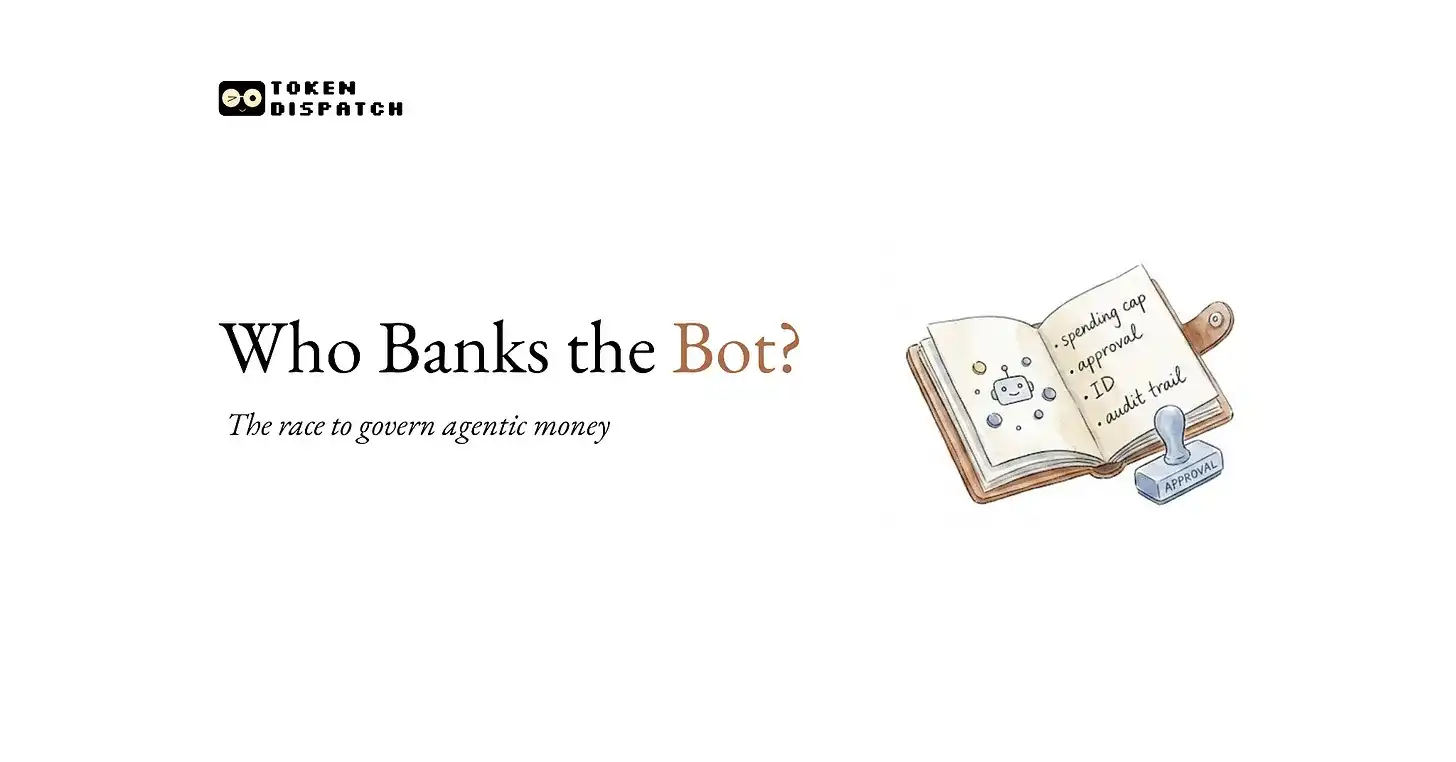
Who Funds the Agents?

**Summary: Who Funds AI Agents?** OpenAI recently shut down a feature allowing AI agents to shop for users, highlighting the challenge of creating a secure and regulated environment for agent-driven transactions. While payment infrastructure exists, a crucial governance layer—defining spending limits, fraud detection, tax handling, and return policies—is largely missing. The potential is enormous: AI agents already processed $73M across 176M transactions last year, with McKinsey forecasting this could grow to $3-5T in global consumer commerce by 2030. The core competition isn't just about processing payments, which can be very cheap (especially with crypto-based settlement), but about controlling the rules that govern agent spending. Key players like Stripe and Coinbase are racing to dominate this governance layer. Stripe's acquisition of wallet provider Privy allows it to set spending policies, identity checks, and human-in-the-loop approvals directly at the wallet level. Similarly, Coinbase's stack, including its x402 protocol and AgentKit, embeds governance rules. This vertical integration across settlement, wallet, and governance layers is becoming the dominant strategy. Control over the governance layer is where significant future value lies. If agents handle trillions in transactions, even a small fee for managing compliance, fraud prevention, and policy enforcement could generate billions in annual revenue. The companies that successfully integrate across the payment stack will capture value from idle agent balances, transaction fees, and governance services, positioning themselves as the foundational banks of the AI agent economy.

marsbit40 мин. назад

Who Funds the Agents?

marsbit40 мин. назад

Торговля

Спот
Фьючерсы
活动图片