Fed seeks input on account type attractive to crypto firms

cointelegraphОпубликовано 2025-12-22Обновлено 2025-12-22

Введение

The US Federal Reserve is seeking public input on a proposed "payment account" or "skinny master account" that would grant fintech and crypto firms access to the central bank's payment system without requiring full master account approvals. Fed Governor Christopher Waller stated these accounts aim to support innovation while maintaining safety, reflecting rapid developments in payments. However, Governor Michael Barr expressed concerns over potential money laundering and terrorist financing risks, especially for institutions not directly supervised by the Fed. Crypto firms like Circle, Coinbase, Kraken, and Block could benefit, potentially bridging crypto and traditional banking. Unlike master accounts, these payment accounts would not earn interest, lack access to Fed credit, and have balance caps. The comment period closes 45 days after Federal Register publication, with operational launch expected in Q4 2026.

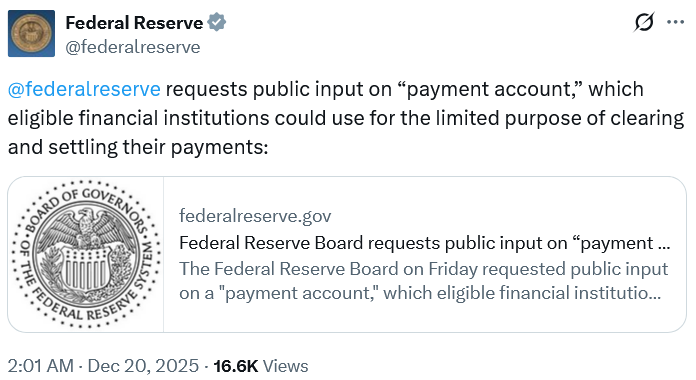
The US Federal Reserve is requesting public input on its proposed “payment account,” dubbed a “skinny master account” which fintechs and crypto firms are drawn to as it would allow access to the central bank without needing the typical approvals.

"These new payment accounts would support innovation while keeping the payments system safe," Fed Governor Christopher Waller said on Friday. In October, Waller recommended that the Fed explore the idea of implementing payment accounts to clear and settle certain transaction activities of eligible financial institutions.

Waller added the Fed is introducing the payment accounts feature to reflect the “rapid developments” in the payments industry that have led to “innovative approaches to banking” and new changes in business models.

“This tailoring could result in lower risk to the payment system and, as a result, requests for payment accounts could generally receive a streamlined review.”

Not all Fed officials agreed with the decision to seek public input, with Governor Michael Barr arguing that it could pose risks if safeguards against money laundering and terrorist financing are not clearly defined, especially for institutions the Fed does not directly supervise.

Several payment-focused crypto firms could be in the running to connect to the Fed’s banking rails, potentially strengthening the bridge between crypto and traditional banking. Among the largest US-based crypto payments companies are Circle, Coinbase, Kraken, and Block, Inc.

Source: Federal Reserve


Inclusion of crypto firms into the Fed’s banking system would mark a significant turnaround for the industry. Crypto companies last year claimed the Biden administration worked to deliberately cut them off from banking services to stifle the industry with what crypto backers have dubbed Operation Chokepoint 2.0.

Waller noted that the Fed has already been experimenting with blockchain-based payment technologies to modernize the US payment system.

Crypto wouldn’t get the same privileges

Payment platforms granted payment accounts, however, won’t receive the same privileges as big banks and Wall Street institutions that currently have master accounts.

Related: US Clarity Act unlikely to be ‘world-shaking’ for Bitcoin’s price: Brandt

Unlike master accounts, the proposed payment accounts would not earn interest, have access to Fed credit, and would be subject to balance caps, among other restrictions.

The comment period to give feedback on the payments account plan will close 45 days after publication in the Federal Register. Waller said last month that the payment account feature is expected to be operational in the fourth quarter of 2026.

Magazine: Bitcoin’s critical level is $82.5K, Ethereum ‘not done yet’: Trade Secrets

Связанные с этим вопросы

QWhat is the Federal Reserve proposing that is attractive to crypto firms?

AThe Federal Reserve is proposing a 'payment account,' also known as a 'skinny master account,' which would allow fintechs and crypto firms access to the central bank's payment system without needing the typical approvals required for a full master account.

QAccording to Fed Governor Christopher Waller, what is the purpose of these new payment accounts?

AAccording to Fed Governor Christopher Waller, the purpose of these new payment accounts is to 'support innovation while keeping the payments system safe' and to reflect the rapid developments and innovative approaches in the payments industry.

QWhich Fed official expressed disagreement with the proposal and what was their concern?

AGovernor Michael Barr expressed disagreement, arguing that the proposal could pose risks if safeguards against money laundering and terrorist financing are not clearly defined, especially for institutions the Fed does not directly supervise.

QWhat are some of the key limitations of the proposed 'payment accounts' compared to full master accounts?

AUnlike full master accounts, the proposed payment accounts would not earn interest, would not have access to Fed credit, and would be subject to balance caps, among other restrictions.

QWhen is the Fed's payment account feature expected to become operational?

AFed Governor Waller said the payment account feature is expected to be operational in the fourth quarter of 2026.

Похожее

Fu Peng's First Public Speech in 2026: What Exactly Are Crypto Assets? Why Did I Join the Crypto Asset Industry?

Fu Peng, a renowned macroeconomist and now Chief Economist at New火 Group, delivered his first public speech of 2026 at the Hong Kong Web3 Festival. He explained his perspective on crypto assets and why he joined the industry, framing it within the context of macroeconomic trends and financial evolution. Fu emphasized that crypto assets are transitioning from an early, belief-driven phase to a mature, institutionally integrated asset class. He drew parallels to the 1970s-80s, when technological advances (like computing) revolutionized traditional finance, leading to the rise of FICC (Fixed Income, Currencies, and Commodities). Similarly, current advancements in AI, data, and blockchain are reshaping finance, with crypto assets becoming part of a new "FICC + C" (C for Crypto) framework. He noted that institutional capital, including traditional hedge funds, avoided early crypto due to its speculative nature but are now engaging as regulatory clarity emerges (e.g., stablecoin laws, CFTC classifying crypto as a commodity). Fu predicted that 2025-2026 marks a turning point where crypto becomes a standardized, financially viable asset for diversified portfolios, akin to commodities or derivatives in traditional finance. Fu defined Bitcoin not as "digital gold" in a simplistic sense but as a value-preserving, financially tradable asset. He highlighted that crypto's future lies in regulated, institutional adoption, moving away from retail-dominated trading. His entry into crypto signals this maturation, where traditional finance integrates crypto into mainstream asset management.

marsbit57 мин. назад

Fu Peng's First Public Speech in 2026: What Exactly Are Crypto Assets? Why Did I Join the Crypto Asset Industry?

marsbit57 мин. назад

Justin Sun Sues Trump Family: What $75 Million Bought Was Only a Blacklist

Justin Sun, founder of Tron, has filed a lawsuit in federal court against World Liberty Financial (WLF), alleging he was made the "primary target of a fraudulent scheme" after investing $75 million. Sun claims the investment secured him an advisor title and WLFI tokens, which were later frozen by WLF, causing "hundreds of millions in losses." The dispute began in late 2024 when Sun's investment helped revive WLF's struggling token sale, which ultimately raised $550 million. Shortly after, the SEC dropped its lawsuit against Sun following Donald Trump's inauguration. However, relations soured when Sun refused WLF's demands for additional funding. In August 2025, WLF added a "blacklist" function to its smart contract, allowing it to unilaterally freeze tokens. Sun's holdings, worth approximately $107 million, were frozen, and he was threatened with token destruction. The lawsuit highlights WLF's structure, which directs 75% of token sale profits to the Trump family, who had earned $1 billion by December 2025. WLF's CEO is Zach Witkoff, son of U.S. Middle East envoy Steve Witkoff. The project faces scrutiny for opaque operations, including a controversial loan arrangement on the Dolomite platform, co-founded by a WLF advisor. Despite Sun's history with the SEC, the case underscores centralization risks within DeFi, as WLF controls governance and holds powers to freeze assets arbitrarily. Sun's tokens remain frozen as legal proceedings begin.

marsbit1 ч. назад

Justin Sun Sues Trump Family: What $75 Million Bought Was Only a Blacklist

marsbit1 ч. назад

$500 to Buy OpenAI Stock: Silicon Valley's Most Respectable Liquidity Invitation

Silicon Valley's largest venture capital platform, AngelList, has launched a new fund called USVC, allowing U.S. retail investors to buy into high-profile AI companies like OpenAI, Anthropic, and xAI with a minimum investment of $500—no accredited investor status required. Promoted by AngelList co-founder Naval Ravikant, the fund is framed as an opportunity for ordinary people to access high-growth private tech investments traditionally reserved for VCs. However, critics argue it functions more like an exit vehicle for early insiders. USVC acquires shares not through primary rounds but largely via secondary transactions—purchasing stakes from early investors, VC funds, and employees looking to cash out at peak valuations. With companies like xAI heavily weighted in the portfolio, the fund effectively channels retail money into providing liquidity for insiders who entered at much lower valuations. The fund’s structure raises concerns: shares are illiquid, with no secondary market, and buybacks are limited and discretionary. The actual annual fee reaches 3.61%, far above the advertised 1% management fee. This model parallels the "low float, high fully diluted valuation" strategy seen in crypto, where early investors profit by selling to latecomers at inflated prices. The timing—alongside similar moves by platforms like Robinhood—suggests that Silicon Valley’s sudden interest in retail inclusion may be less about democratizing access and more about securing exits for insiders.

marsbit1 ч. назад

$500 to Buy OpenAI Stock: Silicon Valley's Most Respectable Liquidity Invitation

marsbit1 ч. назад

Торговля

Спот
Фьючерсы

Популярные статьи

Как купить US

Добро пожаловать на HTX.com! Мы сделали приобретение Talus Network (US) простым и удобным. Следуйте нашему пошаговому руководству и отправляйтесь в свое крипто-путешествие.Шаг 1: Создайте аккаунт на HTXИспользуйте свой адрес электронной почты или номер телефона, чтобы зарегистрироваться и бесплатно создать аккаунт на HTX. Пройдите удобную регистрацию и откройте для себя весь функционал.Создать аккаунтШаг 2: Перейдите в Купить криптовалюту и выберите свой способ оплатыКредитная/Дебетовая Карта: Используйте свою карту Visa или Mastercard для мгновенной покупки Talus Network (US).Баланс: Используйте средства с баланса вашего аккаунта HTX для простой торговли.Третьи Лица: Мы добавили популярные способы оплаты, такие как Google Pay и Apple Pay, для повышения удобства.P2P: Торгуйте напрямую с другими пользователями на HTX.Внебиржевая Торговля (OTC): Мы предлагаем индивидуальные услуги и конкурентоспособные обменные курсы для трейдеров.Шаг 3: Хранение Talus Network (US)После приобретения вами Talus Network (US) храните их в своем аккаунте на HTX. В качестве альтернативы вы можете отправить их куда-либо с помощью перевода в блокчейне или использовать для торговли с другими криптовалютами.Шаг 4: Торговля Talus Network (US)С легкостью торгуйте Talus Network (US) на спотовом рынке HTX. Просто зайдите в свой аккаунт, выберите торговую пару, совершайте сделки и следите за ними в режиме реального времени. Мы предлагаем удобный интерфейс как для начинающих, так и для опытных трейдеров.

440 просмотров всегоОпубликовано 2025.12.11Обновлено 2025.12.11

Как купить US

Обсуждения

Добро пожаловать в Сообщество HTX. Здесь вы сможете быть в курсе последних новостей о развитии платформы и получить доступ к профессиональной аналитической информации о рынке. Мнения пользователей о цене на US (US) представлены ниже.

活动图片