Farewell to Buying Houses and Stocks: The Younger Generation Embraces Cryptocurrency as the Main Battlefield for Wealth

marsbitОпубликовано 2025-12-17Обновлено 2025-12-17

Введение

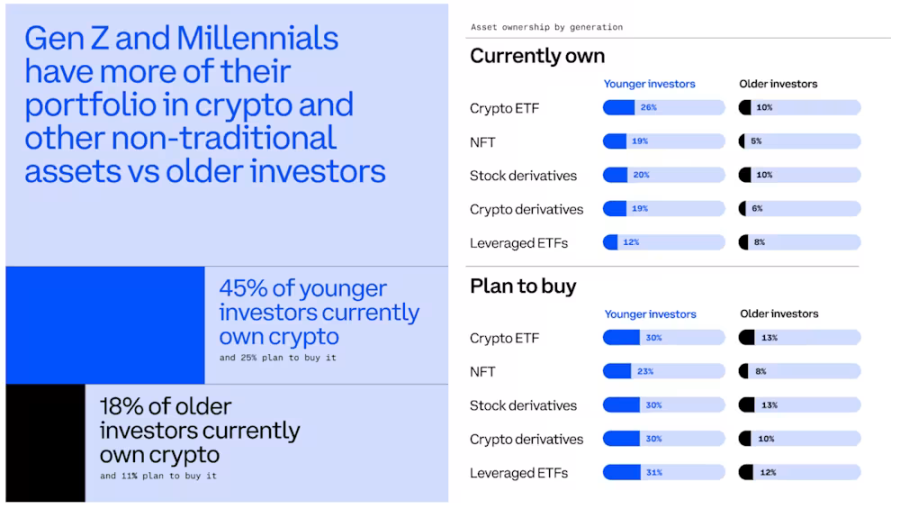
For decades, the traditional American wealth-building playbook—securing a good job, buying a home, and investing in stocks—has remained largely unchanged. However, a new report reveals that younger generations are increasingly skeptical of this path and are shifting their investment strategies accordingly. A survey of U.S. adults shows that younger investors, particularly Gen Z and millennials, are more proactive, open to non-traditional assets, and more likely to view cryptocurrency as a core component of their financial future. Nearly three-quarters (73%) believe it is harder to build wealth through conventional means compared to their parents' generation. This sentiment is reflected in their portfolios: younger investors allocate 25% of their investments to non-traditional assets like cryptocurrency, derivatives, and NFTs—three times the allocation of older investors. Almost half (45%) of young investors already hold crypto, compared to only 18% of older investors. Younger investors see crypto not as a speculative side investment but as a vital tool for wealth accumulation. Eighty percent believe it offers financial opportunities outside the traditional system and that it will play a significantly larger role in the future of finance. They are also more eager to explore emerging crypto-related products like derivatives, prediction markets, and DeFi. This generational shift is driving demand for more dynamic, internet-native financial platforms that operate around the c...

For decades, the path to wealth accumulation for Americans has remained almost unchanged: find a good job, buy property, invest in stocks, and wait for the power of compounding to work its magic. However, our latest "Cryptocurrency Industry Report" reveals that the younger generation of investors no longer believes in this traditional path and is adjusting their investment behavior accordingly.

To understand the market strategies of different generations and the role cryptocurrency plays in their investment portfolios, Coinbase partnered with Ipsos to conduct a specialized survey. The study interviewed 4,350 American adults, including 2,005 investors with investment accounts. The core findings are as follows: Younger investors, such as Gen Z and Millennials, are more inclined to actively manage their investments, more open to non-traditional assets, and more likely to view cryptocurrency as a core component of their financial future than any previous generation.

A Generation Shut Out of the Traditional Wealth Ladder

Younger investors are far more optimistic about the economy than older generations, but they believe the existing financial system is not designed for them. Survey data shows that nearly seven out of ten (73%) young people say it is more difficult for their generation to accumulate wealth through traditional means compared to their parents' generation; only 57% of older generations share this view.

They have witnessed soaring housing costs, overwhelming student debt, and sluggish wage growth. In this context, more and more young people are seeking alternative ways to accumulate wealth beyond the traditional model of "home equity + stock portfolio."

Non-Traditional Asset Allocation Three Times Higher Than Older Generations

This anxiety is directly reflected in their asset allocation strategies. The survey shows that younger investors allocate 25% of their investment portfolios to non-traditional asset classes such as cryptocurrencies, financial derivatives, non-fungible tokens (NFTs), and other emerging products. This is three times the proportion allocated by older investors, who only allocate 8% to non-traditional assets.

The proportion of stock holdings is roughly similar across generations, but the key difference is that younger investors diversify their portfolios beyond stocks. They are more actively seeking returns beyond traditional stock dividends and are more willing to experiment with new investment tools and emerging markets to narrow the wealth gap.

Cryptocurrency Is Not a Side Hustle but a Core Allocation

This generational shift in investment philosophy is most evident in the acceptance of cryptocurrency. The report shows that 45% of young investors already hold cryptocurrency, compared to only 18% of older investors. Additionally, nearly half (47%) of young investors want to gain exposure to new crypto assets ahead of the general market, while only 16% of older investors share this desire.

In the eyes of the younger generation, cryptocurrency is not merely a speculative trade but an important tool to help them catch up in wealth accumulation. Eighty percent of young people believe that cryptocurrency provides their generation with more financial opportunities outside the traditional financial system. At the same time, another 80% are convinced that cryptocurrency will play a significantly larger role in the future financial system. Among older investors, only about 60% share this view.

The younger generation's enthusiasm for exploring emerging markets extends beyond spot cryptocurrencies; they are eager to engage with more non-traditional assets. Data shows that 80% of young investors are willing to try new investment opportunities ahead of others, while less than half of older generations share this attitude. Young investors consistently show strong interest in emerging non-traditional products such as cryptocurrency derivatives, prediction markets, 24/7 stock trading, early token offerings, altcoins, and decentralized finance (DeFi) lending.

The Impact of This Trend on Future Markets

The younger generation of investors has already demonstrated distinct characteristics: they trade more frequently, are willing to take greater risks for higher returns, and are shifting a significant portion of their investment portfolios to non-traditional assets centered around cryptocurrency. At the same time, they are driving the entire financial industry toward a transformation that meets the needs of the internet-native generation, creating platforms that operate around the clock and support diverse asset trading.

Связанные с этим вопросы

QWhat is the main finding of the Coinbase and Ipsos survey regarding young investors' approach to wealth accumulation?

AThe survey found that young investors, particularly Gen Z and millennials, are more likely to actively manage their investments, are more open to non-traditional assets, and are more inclined to view cryptocurrency as a core component of their financial future, moving away from the traditional path of buying a home and investing in stocks.

QWhy do young investors feel the traditional financial system is not designed for them?

AYoung investors feel this way because they have witnessed rising housing costs, high student debt burdens, and stagnant wage growth, making it more difficult for them to accumulate wealth through traditional means like their parents did.

QHow does the allocation to non-traditional assets differ between younger and older investors?

AYounger investors allocate 25% of their portfolio to non-traditional assets like cryptocurrency, derivatives, and NFTs, which is three times the allocation of older investors, who only allocate 8% to such assets.

QWhat percentage of young investors hold cryptocurrency, and how do their views on its role differ from older investors?

A45% of young investors hold cryptocurrency, compared to only 18% of older investors. Additionally, 80% of young investors believe crypto provides more financial opportunities outside the traditional system and that its role in the future financial system will be significantly greater, a view shared by about 60% of older investors.

QWhat broader impact are young investors having on the financial industry according to the report?

AYoung investors are driving the financial industry to transform towards platforms that are better suited for the internet-native generation, featuring 24/7 operation and support for trading a diverse range of assets, due to their higher trading frequency, greater risk tolerance, and significant allocation to non-traditional assets like crypto.

Похожее

When Computing Power Becomes Commoditized, How Long Until a GPU Futures Market Emerges?

"When Will GPU Futures Arrive? A Framework for Assessing Compute as a Commodity" The article explores the potential for a robust futures market for compute power (GPUs), arguing that such a market is not yet mature but may emerge. It analyzes the landscape using a five-part framework developed for new commodity futures markets. The analysis scores the current state: * **Fragmented Supply (Red)**: Supply is highly concentrated among hyperscale cloud providers (AWS, Azure, GCP, Oracle), limiting the need for price discovery. * **Price Volatility (Green)**: GPU pricing is already highly volatile due to uncertain supply and surging demand. * **Physical Settlement Infrastructure (Green)**: Early infrastructure exists via OTC brokers and price indices (e.g., Ornn, Silicon Data) standardizing contracts. * **Standardized Unit (Red)**: A lack of standardized, tradable units hinders markets; a GPU instance hour varies by region, configuration, and contract terms. * **Lack of Alternatives (Yellow)**: Large players hedge internally via vertical integration, while smaller players bear spot market risk. Overall, the market shows promise (volatility, early infrastructure) but lacks the fragmented supply and standardization needed for large-scale futures trading. Most activity remains OTC. Key open questions and hypotheses: 1. Supply is expected to fragment moderately in 1-2 years, driven by new cloud providers, cheap power locations, and demand from non-frontier labs and AI startups using open-source models. 2. Standardization is most likely to emerge around inference workloads (forecast to be >65% of AI compute demand by 2029), which have simpler, more homogeneous hardware needs than training. Widespread adoption of open-source model weights could accelerate this by democratizing inference and creating demand for optimized, standardized infrastructure. 3. The primary traded unit will likely be the **"chip instance hour"** (akin to electricity, traded regionally), not the physical chip or the downstream AI output (tokens).

marsbit22 мин. назад

When Computing Power Becomes Commoditized, How Long Until a GPU Futures Market Emerges?

marsbit22 мин. назад

When Computing Power Becomes Commoditized, How Long Until a GPU Futures Market?

When Compute is Commoditized: How Far Away is a GPU Futures Market? The article explores the potential emergence of a futures market for computing power ("compute"), akin to markets for commodities like oil or electricity. It uses a five-dimension framework to assess the market's maturity for sustaining robust futures trading. **Current Market Assessment (Scorecard):** * **Supply Fragmentation:** 🔴 **Red.** Supply is highly concentrated, dominated by a few hyperscale cloud providers. * **Price Volatility:** 🟢 **Green.** GPU pricing is already highly volatile. * **Physical Settlement Infrastructure:** 🟢 **Green.** Early infrastructure exists at the OTC/broker level. * **Standardization:** 🔴 **Red.** Compute lacks a standardized, tradable unit (e.g., an H100 hour is not uniform). * **Lack of Substitutes:** 🟡 **Yellow.** Vertically integrated players can hedge internally, while others are forced to be long. **Conclusion:** The overall scorecard suggests a robust futures market is premature. The market has volatility and early settlement infrastructure but lacks the necessary supply fragmentation and standardization for large-scale price discovery. Most activity remains OTC. **Key Unanswered Questions & Hypotheses:** The article posits that the market could evolve in the next 1-2 years: 1. **Supply:** May become *moderately more fragmented* due to new cloud providers, cheaper power locations, and demand from long-tail users (e.g., startups running open-source model inference). 2. **Standardization:** Could emerge from the growing **inference** workload (expected to be >65% of AI compute demand by 2029), which has more homogeneous hardware requirements than custom training workloads. Widespread adoption of **open-source model weights** is seen as a key catalyst for democratizing inference and driving infrastructure standardization. 3. **Traded Unit:** The most viable layer for trading is likely the **"chip-instance-hour"** (powered, usable compute time), traded similarly to electricity in regional contracts with spot/futures overlays. Trading at the upstream "chip" layer is unlikely due to supply concentration, while the downstream "token" layer faces challenges due to lack of uniformity across AI models.

链捕手27 мин. назад

When Computing Power Becomes Commoditized, How Long Until a GPU Futures Market?

链捕手27 мин. назад

Interview with Anthropic's Product Manager: Claude 'Dreams' in the Background, We Study Its Consciousness Formation Like Raising a Child

**Title**: Anthropic Product Manager Interview: Claude "Dreams" in the Background, We Study Its Consciousness Formation Like Raising a Child **Summary**: In this interview, Anthropic Research Product Manager Alex Albert discusses the development of the next-generation Claude model. He explains that Anthropic treats each new model as a product, defining its intended capabilities and desired "personality" from the start. The development process is likened to "raising" a model, where the final traits emerge during training. Key focus areas include integrating user feedback into training, prioritizing key capabilities like coding and knowledge work, and refining Claude's interactive personality. Albert highlights the importance of Claude's character as models evolve into autonomous agents making unsupervised decisions. He details features like "adaptive thinking," which lets Claude decide when to reason deeply, and a "dreaming" process where the agent reviews and consolidates its memories offline, akin to human memory reconsolidation. The interview also covers how AI accelerates product development, shifting bottlenecks from building to strategic coordination. Albert describes using Claude as a brainstorming partner and research tool internally. While Anthropic has researchers exploring questions of AI consciousness, the company has no official stance on whether Claude is conscious. The focus remains on ensuring Claude is trustworthy and aligned as it takes on more complex, long-term tasks.

marsbit1 ч. назад

Interview with Anthropic's Product Manager: Claude 'Dreams' in the Background, We Study Its Consciousness Formation Like Raising a Child

marsbit1 ч. назад

Торговля

Спот
Фьючерсы
活动图片