Ethereum Vs. Solana: Why BlackRock’s Former Crypto Head Is Betting On ETH

bitcoinistОпубликовано 2026-01-27Обновлено 2026-01-27

Введение

In a comparison between Ethereum and Solana, Joseph Chalom, former BlackRock digital assets head and current SharpLink CEO, argues that Ethereum is the clear choice for high-value institutional use cases. He emphasizes that while Solana offers speed and low fees, Ethereum’s superior trust, security, and liquidity make it the preferred platform for serious financial applications like asset tokenization and large-scale settlements. Chalom points to market data showing that over 65% of stablecoin and tokenized asset activity occurs on Ethereum—roughly ten times more than on Solana—and notes this gap is widening. He acknowledges Solana’s strengths in areas like memecoins and gaming, where lower security and higher speed are acceptable. However, for institutional-grade applications requiring reliability, he states that "people are voting with their feet" by building on Ethereum. Notably, SharpLink itself holds significant Ethereum reserves, with public records showing around 864,840 ETH (approx. $2.5B).

SharpLink CEO Joseph Chalom, who previously led BlackRock’s digital assets strategy, framed the Ethereum-versus-Solana debate as a mismatch between narrative and actual institutional behavior: TradFi firms may praise speed and low fees, but the highest-value financial use cases are gravitating to networks optimized for trust, security, and liquidity.

Why Ethereum Beats Solana

Speaking with CoinDesk’s Jennifer Sanasie on Jan. 26, Chalom said he would avoid positioning his view as opinion and instead point to what he called observable market signals. “Maybe I’ll just share facts,” he said. “The fact is that Ethereum has been around for 10 years. It’s the secure, trusted, and liquid ecosystem. And I talk about both the layer 1 mainnet as well as the long set of layer 2s who help do that rollup strategy.”

That longevity, in his telling, matters because institutions aren’t selecting chains the way consumers pick apps. They’re selecting settlement rails for moving money, tokenizing assets, and representing ownership, workflows where operational failure and security assumptions are existential. Solana, Chalom acknowledged, has carved out a reputation for performance. But he drew a hard line on reliability. “Solana has been fast and cheap but it has not been secure. It has had downtime,” he said, arguing that downtime risk is disqualifying for “high value projects.”

Chalom’s thesis is that when the use case is “tokenizing assets” and “moving money,” the decision criteria compress into three buckets. “The real institutions who care only about three things,” he said, are “trust, security, and liquidity.” On that basis, he argued, “they’re building on Ethereum for high value projects,” adding: “It’s happening on Ethereum.”

He also anchored the comparison in stablecoin and tokenized-asset activity, citing a sharp share gap as evidence of where the market is allocating serious volume. “More than 65% of stablecoins and tokenized assets are happening there,” Chalom said, describing that as “10x what you see on Salana.” He reinforced the directional claim immediately after: “Ethereum leads in high quality assets in DeFi, tokenization, and stable coins by a factor of 10 to one over Salana. And that gap is only getting larger.”

Still, Chalom did not argue for a single-chain world. Instead, he mapped Ethereum and Solana to different product surfaces based on security tolerance. “I do think there’s a role for cheap, fast, less secure chains,” he said, and suggested Solana’s comparative advantage shows up where finality speed and cost trump institutional-grade assurances. “I think Solana will win in the memecoin, maybe the gaming space where actually security matters a lot less and speed matters more.”

The subtext is a segmentation story: Ethereum as the default rail for high-value, regulated, reputation-sensitive flows; Solana as the venue for high-throughput consumer and speculative activity where users accept different risk tradeoffs. Chalom insisted this is not about persuasion so much as migration patterns. “It’s not my perspective,” he said. “People are voting with their feet.”

Notably, SharpLink Gaming (Nasdaq: SBET) has emerged as one of the largest corporate ETH holders, with public trackers putting its holdings at roughly 864,840 ETH (about $2.5B at recent marks).

At press time, ETH traded at $2,921.
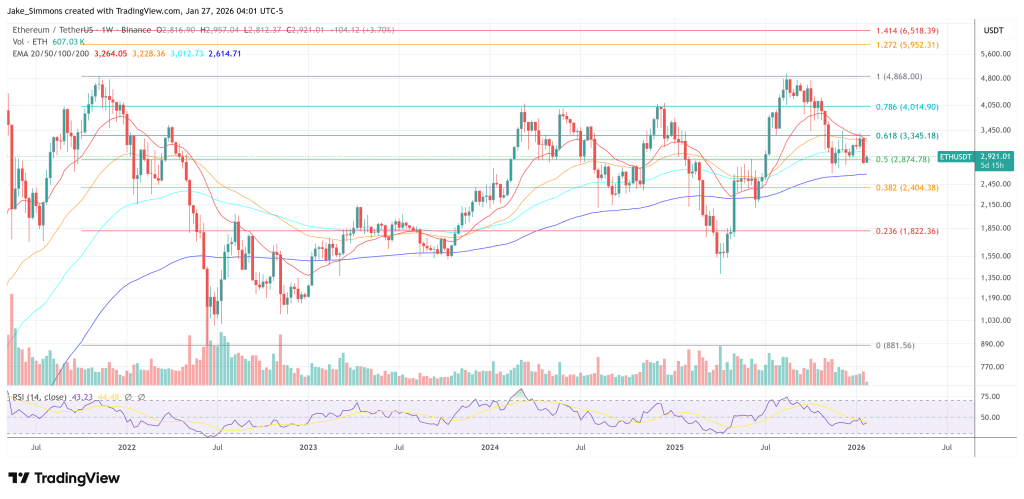
ETH recover back above the 0.5 Fib, 1-week chart | Source: ETHUSDT on TradingView.com

Связанные с этим вопросы

QAccording to Joseph Chalom, what are the three key criteria that institutions prioritize when selecting a blockchain for high-value projects?

ATrust, security, and liquidity.

QWhat percentage of stablecoins and tokenized assets does Chalom claim are happening on Ethereum, and how does this compare to Solana?

AMore than 65% are on Ethereum, which he describes as 10 times the volume seen on Solana.

QWhat specific use cases does Chalom believe Solana is better suited for, despite its perceived shortcomings in security?

AMemecoin and gaming, where speed and low cost are more important than institutional-grade security.

QHow does Chalom frame the fundamental difference in how institutions choose a blockchain versus how consumers choose applications?

AInstitutions are selecting settlement rails for moving money and tokenizing assets, where operational failure is an existential risk, not just picking apps based on features.

QWhat is the evidence provided in the article that SharpLink Gaming is putting its money behind its thesis on Ethereum?

ASharpLink Gaming is one of the largest corporate ETH holders, with public trackers showing holdings of roughly 864,840 ETH (worth about $2.5 billion).

Похожее

Anthropic's IPO Launch: Commercial Miracle or Valuation Bubble?

Anthropic has confidentially filed for an IPO, led by Morgan Stanley and Goldman Sachs, potentially going public by October. Following its latest $650 billion funding round, its pre-IPO valuation stands at $965 billion, with projections reaching up to $2 trillion at listing, which would make it the highest-valued private company ever. The article, written by Fu Sheng, addresses skepticism that this represents an AI bubble akin to the 2000 dot-com crash. It argues the current situation differs fundamentally. Unlike the internet bubble era, which relied on speculative narratives with little revenue, Anthropic's valuation is backed by unprecedented, measurable financial performance. Key data points include: * **Revenue Growth:** ARR skyrocketed from $10 billion in early 2025 to $470 billion by May 2026, targeting $100 billion by year-end—a growth curve unmatched in business history. * **Profitability:** It achieved operating profitability in Q2 2026 with an estimated $5.6 billion profit. * **Efficiency:** With ~3,000 employees and ~$470 billion ARR, its revenue per employee exceeds $10 million. Products like Claude Code, launched less than a year ago, already generate $25 billion in annualized revenue. * **Enterprise Adoption:** It boasts a strong enterprise client base, with 8 of the Fortune 10 and over 1,000 large firms spending over $1 million annually on Claude. The valuation is framed using a traditional SaaS model (e.g., a 10x Price-to-Sales multiple on $100 billion revenue). The author contends the core question for analysts has shifted from "How big could this be?" to "How much is it earning and will earn next quarter?" The discussion extends beyond Anthropic to a broader paradigm shift: the transition from a "carbon-based" to a "silicon-based" economy. Companies are increasingly prioritizing investment in compute and AI capabilities over human resources, as these directly scale productivity and competitive advantage. Anthropic's IPO is thus positioned not just as a corporate milestone, but as a price anchor for this new economic era.

链捕手2 ч. назад

Anthropic's IPO Launch: Commercial Miracle or Valuation Bubble?

链捕手2 ч. назад

Near Returns to the AI Stage: Transformation into a Public Chain Due to 'Payroll Difficulties,' Agent and Privacy Emerge as New Growth Narratives

NEAR Returns to AI Origins: From Payroll Struggles to Blockchain, Now Focusing on AI Agents and Privacy NEAR Protocol's journey began not with grand blockchain ambitions, but from a practical hurdle: its AI startup founders, including Transformer paper co-author Illia Polosukhin, couldn't efficiently pay international developers in 2017. This led them to pivot and build a high-performance, scalable blockchain. After years navigating various crypto narratives like sharding and cross-chain interoperability, NEAR is now leveraging its AI roots to re-enter the AI arena. A key driver is its "NEAR Intents" layer, which abstracts complex cross-chain transactions. Users simply state their goal (e.g., swap BTC for ETH), and a solver network finds the optimal route. This system has processed over $20B in cross-chain volume, generating significant fee revenue. A major growth area is private transactions via "Confidential Intents/Swaps," which hide trade details until settlement to protect against MEV and front-running. Remarkably, private swaps recently accounted for over 40% of NEAR's transaction volume, highlighting strong demand but also potential regulatory scrutiny. With its AI-founder pedigree, NEAR is positioning itself at the intersection of blockchain, AI agents, and privacy, aiming to become infrastructure for the emerging agent economy while navigating the challenges of its rapid adoption.

marsbit4 ч. назад

Near Returns to the AI Stage: Transformation into a Public Chain Due to 'Payroll Difficulties,' Agent and Privacy Emerge as New Growth Narratives

marsbit4 ч. назад

Торговля

Спот
Фьючерсы

Популярные статьи

Manyu: восходящая мем-звезда на Ethereum, готовая открыть новую эру культуры Shiba

Manyu - это мемтокен на Ethereum, который приносит децентрализованную культурную и развлекательную ценность через вирусное влияние в соцсетях и вовлечённость сообщества.

1.9k просмотров всегоОпубликовано 2025.11.27Обновлено 2025.11.27

Manyu: восходящая мем-звезда на Ethereum, готовая открыть новую эру культуры Shiba

Неделя обучения по популярным токенам 14: Glamsterdam — самое ожидаемое обновление Ethereum в 2026 году

Ordinals/Runes по-прежнему стимулируют доходы от комиссий за блоки и активность разработчиков, рассматриваются как отправная точка «нативной эмиссии активов» в сети.

1.5k просмотров всегоОпубликовано 2026.04.29Обновлено 2026.04.29

Неделя обучения по популярным токенам 14: Glamsterdam — самое ожидаемое обновление Ethereum в 2026 году

Обсуждения

Добро пожаловать в Сообщество HTX. Здесь вы сможете быть в курсе последних новостей о развитии платформы и получить доступ к профессиональной аналитической информации о рынке. Мнения пользователей о цене на ETH (ETH) представлены ниже.

活动图片