Ethereum price prediction – Is a breakout to $2.1K ahead after ETH shakes out weak hands?

ambcryptoОпубликовано 2026-03-31Обновлено 2026-03-31

Введение

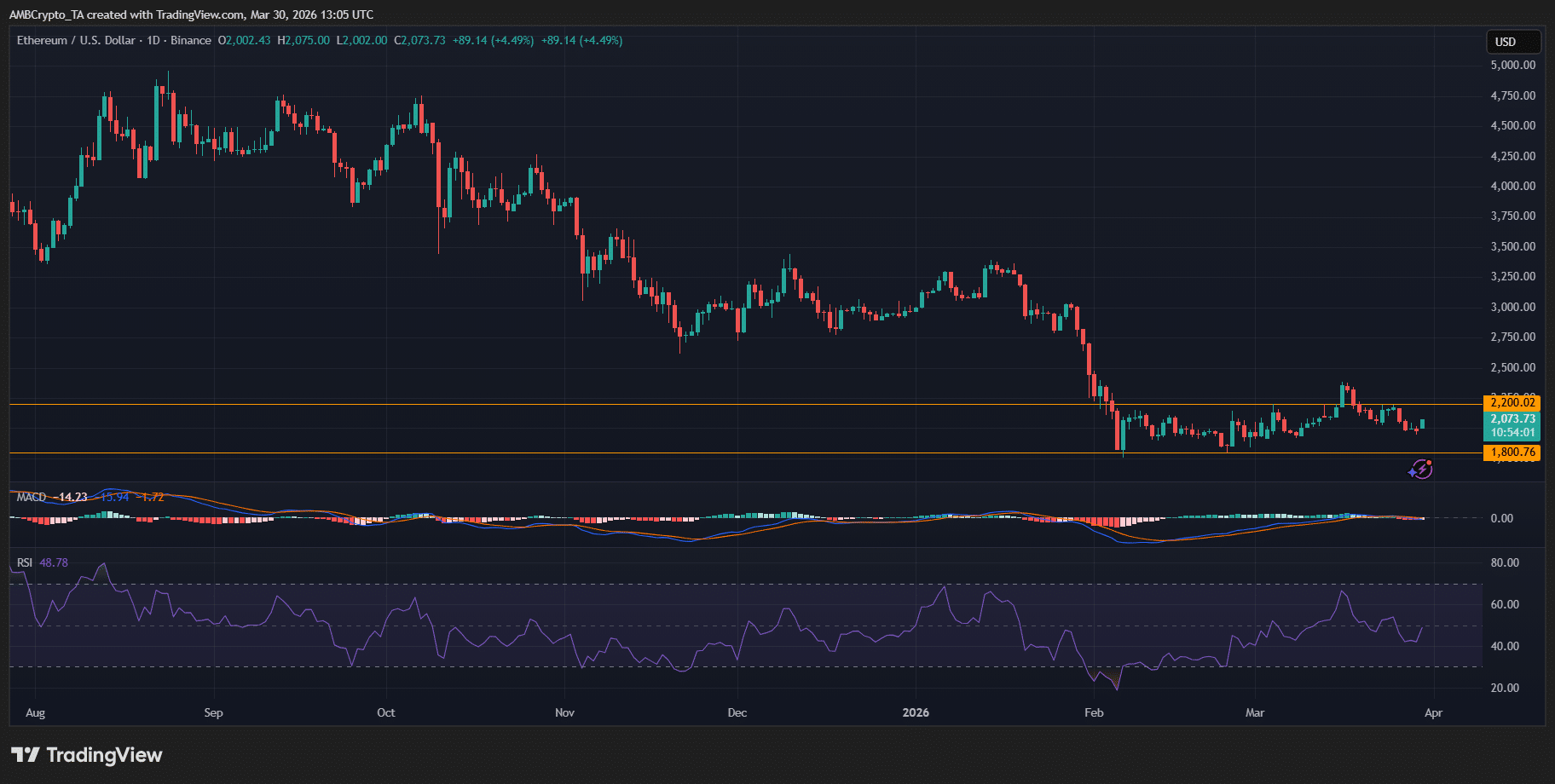
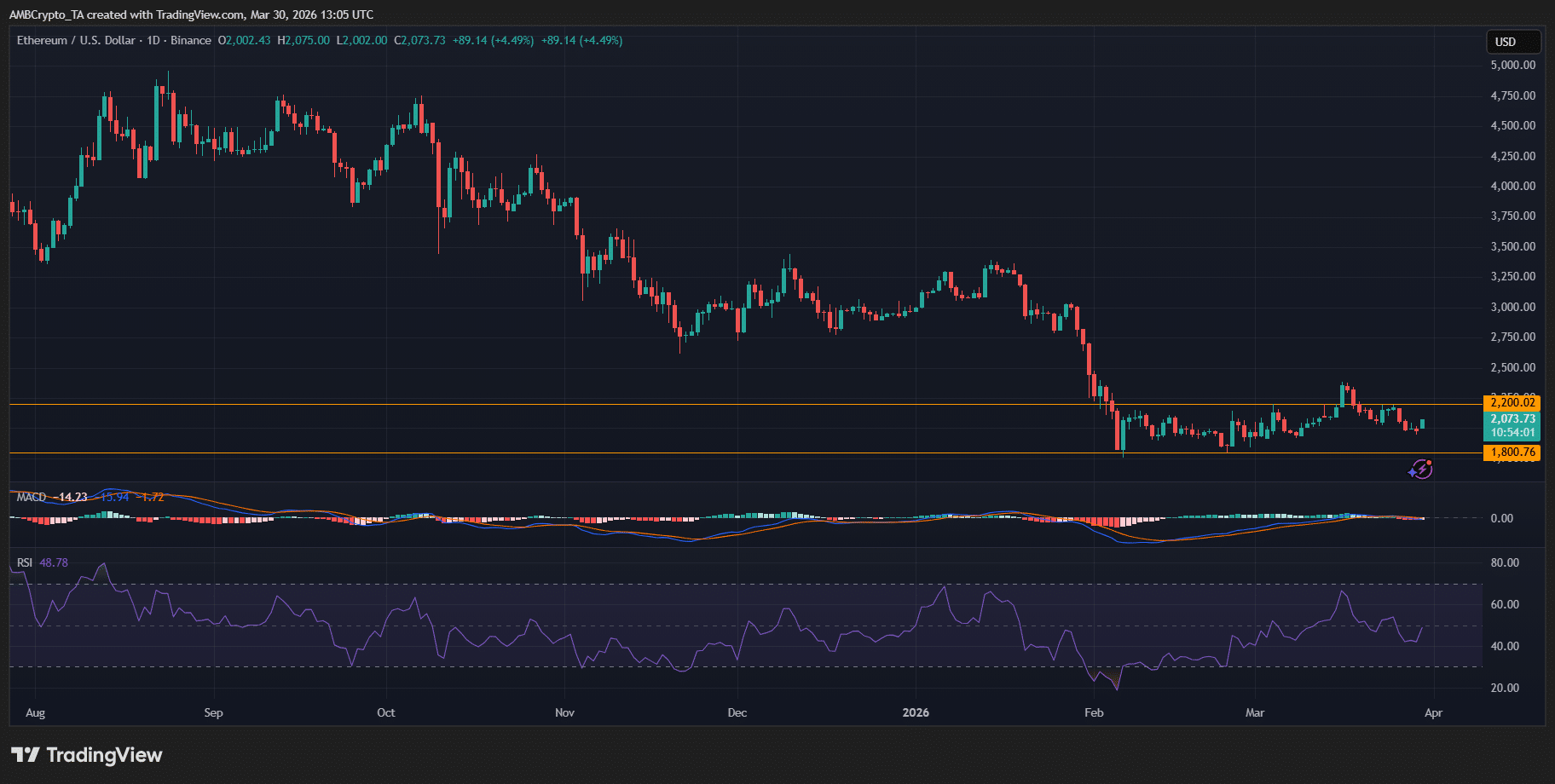
Ethereum's price reclaimed the $2,000 level, signaling a potential shift from selling pressure to recovery, with ETH trading near $2,060 at the time of writing. This move followed a brief breakdown that flushed out weak long positions in the $1,950–$2,050 liquidation zone, reducing immediate selling pressure and triggering a rebound. The price may now target the $2,100–$2,150 range, partly driven by short covering. However, the negative CMF indicates limited capital inflows, suggesting the uptrend is more due to positioning than strong demand. Key support at $2,000 must hold for the recovery to extend; a break below could see a retest of $1,800.

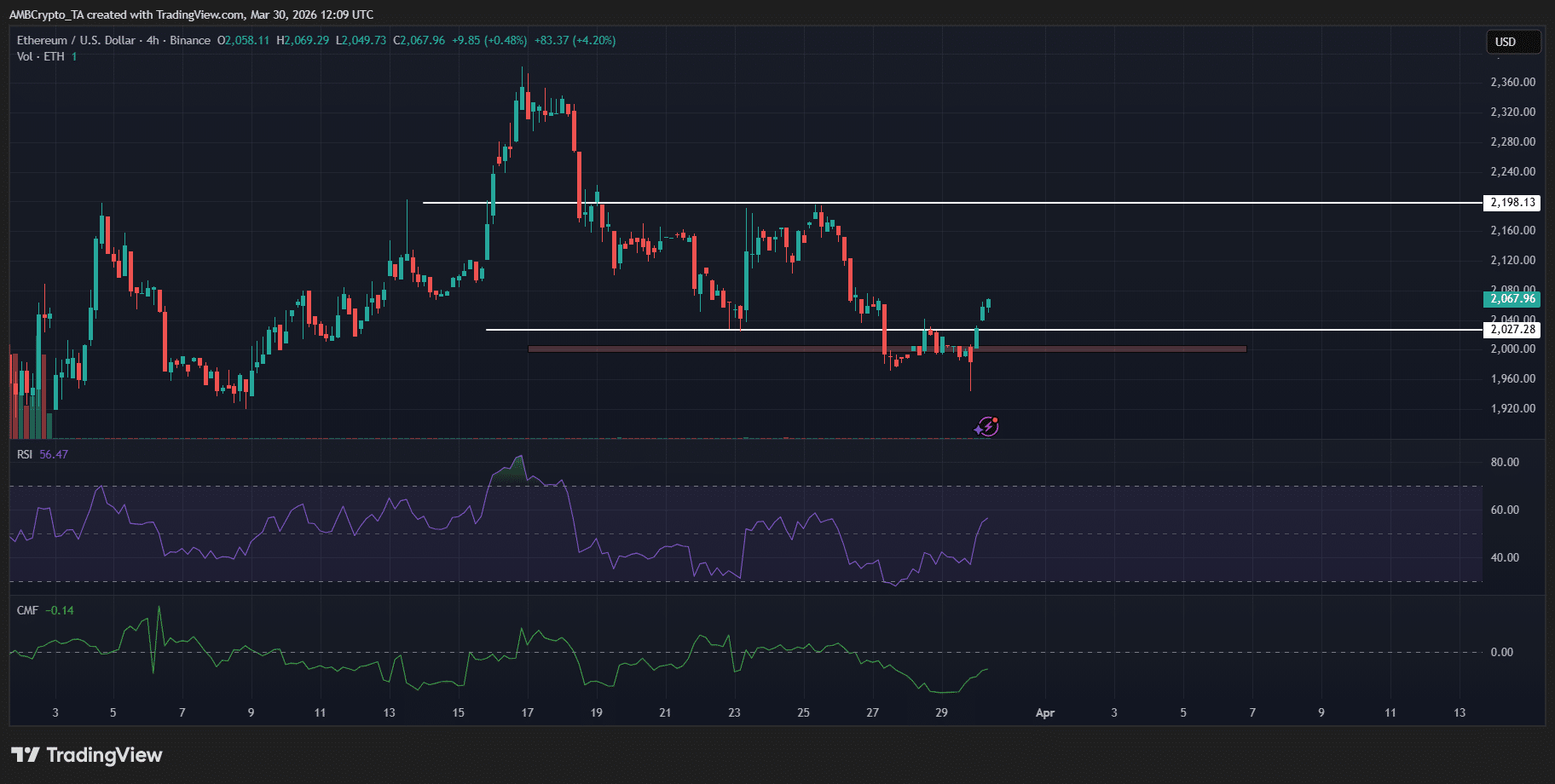
Ethereum’s [ETH] price moved above the $2,000-level following the weekend, highlighting a shift from selling pressure into early recovery. At the time of writing, the altcoin was trading near $2,060, reclaiming the $2,027 support zone after briefly breaking below it.

This move is evidence that buyers stepped in at lower levels. Especially as the breakdown failed to attract sustained selling and instead, triggered a reversal.

With the price stabilizing above this level, ETH might move towards the $2,100–$2,150 range – Its prior resistance range. This push would happen partly because short positions that entered below $2,000 are now closing, adding upward pressure.
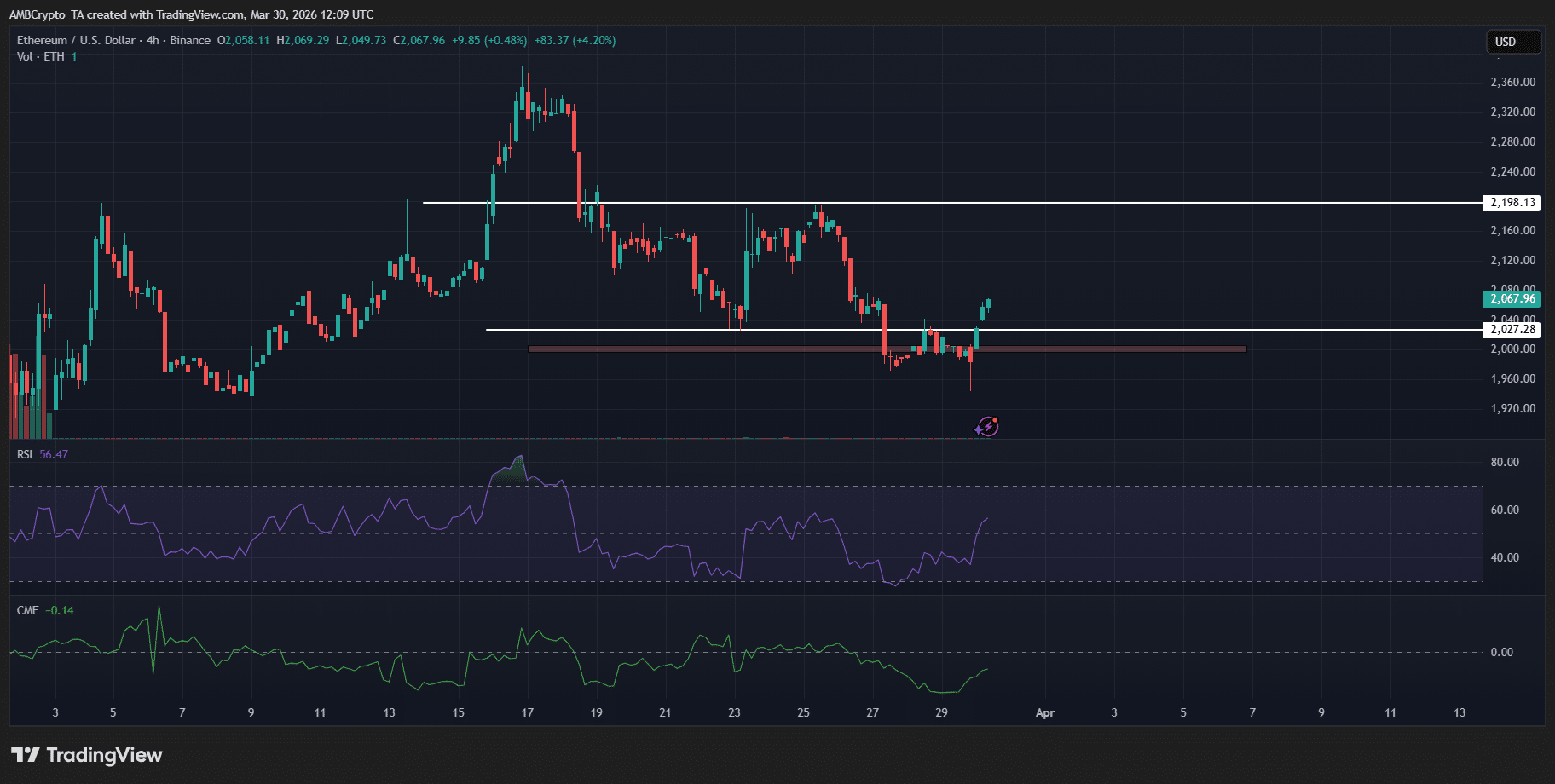
Source: ETH/USD on TradingView

At the time of writing, momentum seemed to be improving too, with the RSI near 56 showing room for further upside without overbought conditions. However, the CMF was negative near -0.14 – A sign that capital inflows continue to be limited.

These findings are indicative of a mixed market structure, one where the price rises due to positioning rather than strong demand.

Thanks to the same, while the move may extend in the short term, it could struggle to sustain itself over the long term without stronger spot buying.
Liquidation flush drives ETH reclaim and squeeze setup

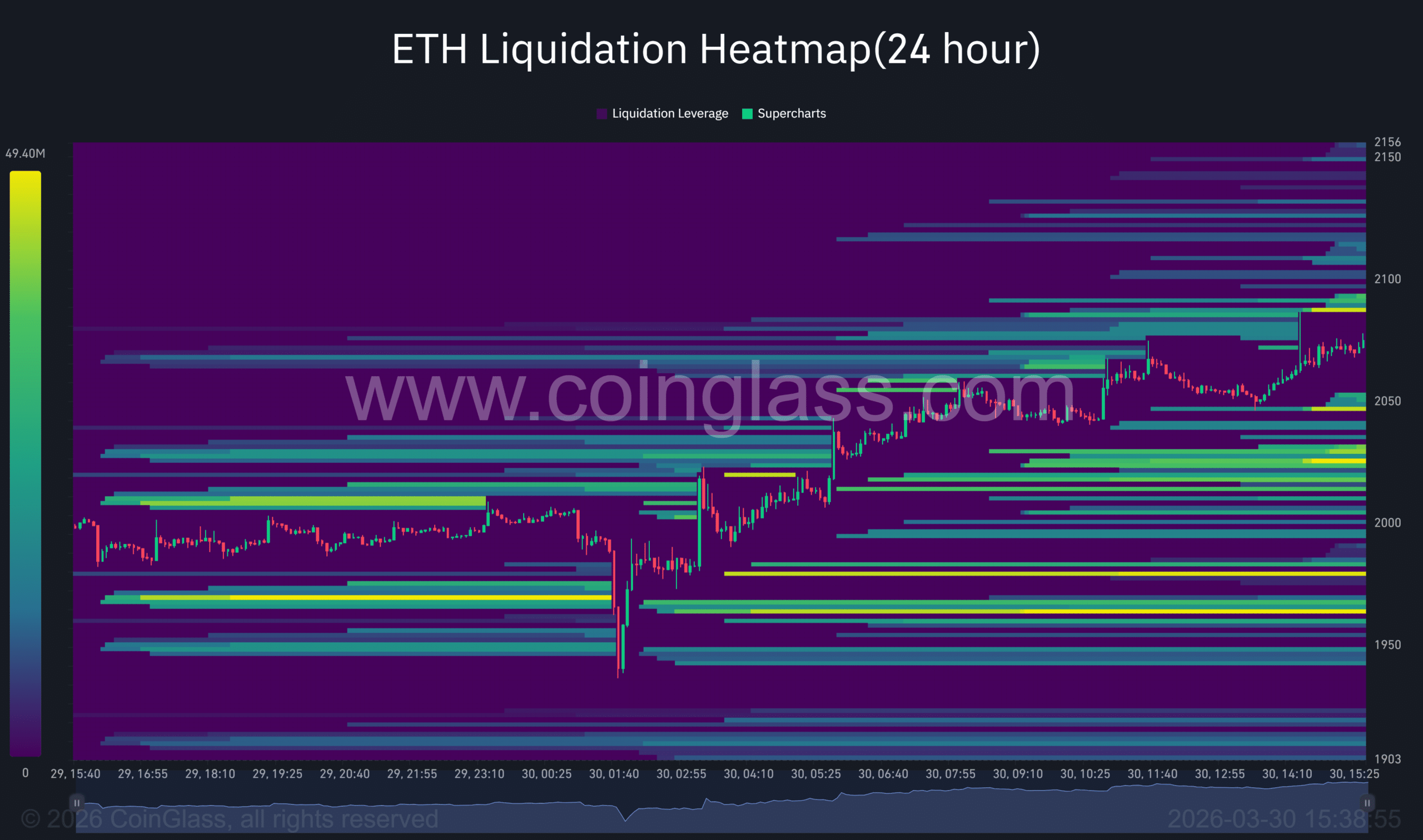
Ethereum’s move above $2,000 began with a sharp breakdown that quickly turned into opportunity.

The price dropped towards $1,930–$1,980, directly into a dense liquidation zone between $1,950 and $2,050, where leveraged longs were forced out. This flush mattered because it removed weak positions, allowing the market to reset and reduce immediate selling pressure.

Source: CoinGlass

As that pressure cleared, the market direction flipped, and the price rebounded sharply back above $2,000, reaching the $2,050–$2,080 range. This recovery happened as short positions began to close while fresh buyers stepped in, turning the earlier sell-off into upward momentum.

At press time, the price was holding near $2,040–$2,060 while new liquidation clusters formed above $2,100. This creates a setup where sustained buying can trigger a short squeeze higher. However, if support weakens, the price may revisit lower liquidity zones, testing whether demand remains strong or not.

ETH defends key trendline as structure shifts towards recovery

Ethereum now sits at a point where the market is testing whether the recent recovery can turn into a sustained move or not.

After bouncing from the $1,800-trendline, the price climbed above $2,050 to illustrate that buyers stepped in where structure matters most. This reaction was important because it confirmed that the broader range might still be intact.

Source: ETH/USD on TradingView

As the price moves towards the $2,100–$2,120 zone, traders should watch how it reacts under pressure. If buyers push through with strong participation, it would mean that demand is returning with intent. However, if the price stalls or is rejected, it would mean that sellers still control higher levels.

At the same time, holding above $2,000 will be key since it would keep short-term momentum stable. If this level holds, recovery can extend itself. However, failure would shift focus back towards $1,800.


Final Summary

  • Ethereum’s [ETH] price reclaimed $2,000 backed by liquidation-driven momentum, but weak inflows might limit sustained upside.
  • A breakout past its resistance would mean trend continuation while rejection risks a move back towards $1,800.

Связанные с этим вопросы

QWhat was Ethereum's price movement over the weekend and what key level did it reclaim?

AEthereum's price moved above the $2,000 level, reclaiming the $2,027 support zone after briefly breaking below it.

QWhat is the significance of the liquidation zone between $1,950 and $2,050 mentioned in the article?

AThis dense liquidation zone forced out leveraged longs, removing weak positions and allowing the market to reset, which reduced immediate selling pressure and enabled the price rebound.

QWhat two technical indicators are mentioned to show mixed market signals for Ethereum?

AThe RSI near 56 shows room for further upside without overbought conditions, while the CMF near -0.14 indicates limited capital inflows.

QWhat are the potential price targets if Ethereum breaks through resistance versus if it gets rejected?

AIf buyers push through with strong participation, ETH could move towards the $2,100-$2,150 range. If rejected, the price risks moving back towards $1,800.

QWhy is holding above the $2,000 level crucial for Ethereum's short-term momentum according to the article?

AHolding above $2,000 is key to maintaining stable short-term momentum. If this level holds, recovery can extend, but failure would shift focus back towards $1,800.

Похожее

From Robinhood to Polymarket: Is the Era of Integrating All Assets on a Single Platform Coming?

From Robinhood to Polymarket: The Era of All-in-One Asset Platforms Is Coming Asset classes are rapidly converging. Platforms that once specialized in single categories—such as stocks, cryptocurrencies, or prediction markets—are now moving toward offering all three. Robinhood pioneered this model, starting with equities, adding crypto in 2018, and prediction markets in 2025. This strategy has proven resilient: when crypto revenues fell, other segments like options and stocks filled the gap. Now, prediction market leaders Polymarket and Kalshi are moving in the same direction, both announcing perpetual futures trading on April 21, 2026, pending regulatory approval. These futures will cover assets like Bitcoin, gold, and stocks such as Nvidia. This trend mirrors the consolidation seen in consumer tech, like smartphones replacing dedicated cameras and MP3 players. Younger users, accustomed to interacting with multiple asset types from an early age, will increasingly demand unified platforms. A key competitive advantage in prediction markets is collateral utilization—idle assets locked during betting periods. Polymarket’s move into perpetuals may be a strategy to generate yield from that capital, similar to earlier DeFi integrations like PolyAave. As the regulatory landscape evolves, traditional finance is also likely to incorporate crypto and prediction markets, further accelerating this convergence.

marsbit35 мин. назад

From Robinhood to Polymarket: Is the Era of Integrating All Assets on a Single Platform Coming?

marsbit35 мин. назад

OpenAI Goes Left, DeepSeek Goes Right

On April 24, 2026, DeepSeek released V4, a Chinese large language model offering a free "million-token context window," enabling it to process vast amounts of data like entire books or years of corporate documents in one go. In contrast, OpenAI’s GPT-5.5, released around the same time, is more powerful but significantly more expensive, charging up to $180 per million output tokens. DeepSeek’s strategy represents a shift from a pure AI research firm to a heavy-infrastructure player, building data centers in Inner Mongolia’s Ulanqab to bypass U.S. chip export restrictions. This move, supported by Huawei’s Ascend chips and China’s cheap green electricity, highlights a fundamental divergence in AI development models: U.S. firms focus on high-cost, high-margin services, while Chinese players like DeepSeek prioritize accessibility and affordability. Facing intense talent poaching from tech giants, DeepSeek is seeking a $44 billion valuation funding round to retain researchers and scale infrastructure. Meanwhile, Chinese manufacturers are compressing AI models to run on smartphones, making AI accessible offline and across the Global South. Through open-source models and localized solutions, Chinese AI is empowering non-English speakers and low-income users, driving a form of "digital equality." While Silicon Valley builds walled gardens, DeepSeek and others are turning AI into a public utility—like tap water—flowing freely to those previously left behind.

marsbit1 ч. назад

OpenAI Goes Left, DeepSeek Goes Right

marsbit1 ч. назад

Торговля

Спот
Фьючерсы

Популярные статьи

Manyu: восходящая мем-звезда на Ethereum, готовая открыть новую эру культуры Shiba

Manyu - это мемтокен на Ethereum, который приносит децентрализованную культурную и развлекательную ценность через вирусное влияние в соцсетях и вовлечённость сообщества.

1.9k просмотров всегоОпубликовано 2025.11.27Обновлено 2025.11.27

Manyu: восходящая мем-звезда на Ethereum, готовая открыть новую эру культуры Shiba

Обсуждения

Добро пожаловать в Сообщество HTX. Здесь вы сможете быть в курсе последних новостей о развитии платформы и получить доступ к профессиональной аналитической информации о рынке. Мнения пользователей о цене на ETH (ETH) представлены ниже.

活动图片