Ethereum Network Thrives: Economic Activity Rises While Price Momentum Lags Behind

bitcoinistОпубликовано 2026-01-12Обновлено 2026-01-12

Введение

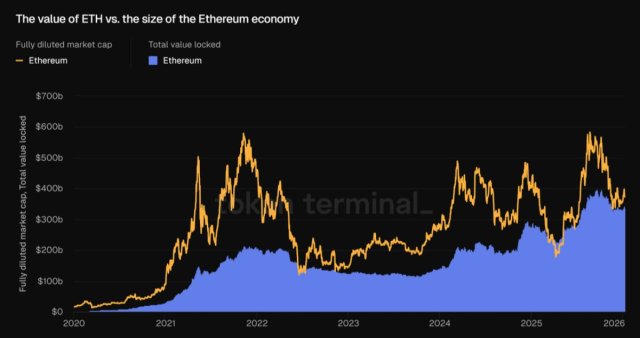
Ethereum's network is demonstrating robust growth in economic activity, despite its price performance occasionally lagging behind riskier assets. Key metrics reveal a divergence, with fundamentals strengthening beneath the surface. Institutional adoption is increasing, with a focus on uptime, liquidity, and compliance, positioning Ethereum as financial infrastructure rather than a speculative asset. Tokenized Real-World Assets (RWAs) are a major growth driver, bringing traditional finance on-chain. Stablecoins on Ethereum have a market cap of ~$190B, tokenized funds total ~$6-7B, commodities exceed $4B, and tokenized stocks are valued at ~$400-500M. This surge suggests Ethereum is becoming the default settlement layer for real assets, with adoption expected to drive future price increases.

Ethereum’s current strength is largely linked to its network performance and activity, which has been demonstrating robust growth. While the leading blockchain has witnessed sharp growth in several key areas, one area is currently standing out, and that is the economic activity on the network.

A Divergence Between Ethereum’s Real Activity And Price

With the broader cryptocurrency landscape evolving, Milk Road, a market expert and trader, has revealed that the Ethereum network is showcasing signs of robust strength. When compared to its recent price performance, the leading network subtly conveys a different narrative.

Despite the fact that ETH’s market value has occasionally fluctuated or even lagged behind riskier assets, the quantity of economic activity being settled on the blockchain has continued to rise. The disparity highlights a crucial aspect of ETH’s current cycle that its fundamentals are strengthening beneath the surface, while market sentiment is not accurately reflecting it.

At the same time, the Ethereum network is being chosen for live deployment by increasing institutional capital. This kind of increases a chain that is becoming less of a speculative asset and more of a financial infrastructure.

Source: Chart from Milk Road on X

According to Milk Road, these participants are more focused on uptime, liquidity, settlement certainty, and compliance, which narrows the set of viable networks quickly. Meanwhile, the economic weight placed on Ethereum’s base layer becomes significant as more activity occurs on the chain, increasing transaction volume and fee income.

As seen in the past, ETH has had difficulty staying flat for extended periods of time when demand is high. However, the analyst expects the price of ETH to increase as adoption rises.

Real Assets Are Swamping The Network

According to a report from Leon Waidmann, the head of research at On-Chain Foundation, Tokenized Real-World Assets (RWAs) are quickly emerging as one of Ethereum’s key growth drivers. With real-world assets moving into ETH, the development is bringing traditional finance activity on-chain at a fast rate.

This change is more than just buzz as institutional infrastructure, token issuance, and settlement volumes are all growing at the same time, transforming ETH’s status. Data shows that the market cap of stablecoins found on the network is approximately $190 billion, indicating ETH’s growing choice as the major chain for crypto finance.

Meanwhile, the total amount of tokenized funds has reached between $6 billion and $7 billion, and is still growing rapidly. Its tokenized commodities have hit over $4 billion, which appears to be still breaking out to new highs. Furthermore, ETH’s tokenized stocks are valued at around $400 million to $500 million, but this is just the beginning. Such a scenario suggests that tokenization of real-world assets may be the foundation of Ethereum’s next significant adoption phase.

Considering the robust growth in these areas, Waidmann stated that “ETH is becoming the default settlement layer for real assets.” Waidmann’s claims are not based on simple narratives, but on the fact that the network already works at scale.

ETH trading at $3,138 on the 1D chart | Source: ETHUSDT on Tradingview.com

Связанные с этим вопросы

QWhat is the main reason for Ethereum's current strength according to the article?

AEthereum's current strength is largely linked to its robust network performance and growing economic activity, despite its price momentum lagging behind.

QWhat key divergence does the article highlight about Ethereum?

AThe article highlights a divergence between Ethereum's strong network activity and economic growth, and its relatively weaker price performance in the market.

QWhich type of assets are emerging as a key growth driver for Ethereum, as mentioned in the article?

ATokenized Real-World Assets (RWAs) are quickly emerging as one of Ethereum's key growth drivers, bringing traditional finance activity on-chain.

QWhat does the $190 billion market cap of stablecoins on Ethereum indicate?

AThe $190 billion market cap of stablecoins indicates Ethereum's growing status as the major chain for crypto finance and its role as a default settlement layer.

QAccording to the analyst Milk Road, what factors are institutional participants focused on when choosing Ethereum?

AAccording to Milk Road, institutional participants are more focused on uptime, liquidity, settlement certainty, and compliance when choosing Ethereum for deployment.

Похожее

VCs on 2025 Crypto Investments: 84% of 118 Tokens Break Issue Price, Only One Type of Company is Quietly Making Money

Crypto investor Ching Tseng categorizes the market into four quadrants based on two axes: crypto-native vs. traditional finance (TradFi)-oriented, and having traction vs. no traction. In 2025, 84.7% of 118 tracked token launches fell below their issuance price, with a median fully diluted valuation drop of 71%. Crypto-native projects without traction are experiencing massive capital destruction, often relying on speculative narratives without sustainable revenue or user retention. Crypto-native teams with traction, often built in prior cycles, generate real revenue but face structural challenges with their tokens lacking direct value capture mechanisms. While some have implemented successful buyback programs, the core issue remains finding growth beyond crypto volatility. TradFi-oriented startups without traction face long, costly enterprise sales cycles but benefit from a robust M&A environment, with crypto acquisitions reaching a record $8.6 billion in 2025. The current winners are TradFi-oriented companies with traction, particularly in the Real World Asset (RWA) tokenization space, which grew from $5.5B to $18.6B in 2025. They are winning through enterprise sales, building alliances, and improving unit economics on established compliance stacks. Their main risk is being bypassed by large incumbent institutions building their own infrastructure. The overarching theme is market maturation, where narrative alone is insufficient for long-term success.

marsbit25 мин. назад

VCs on 2025 Crypto Investments: 84% of 118 Tokens Break Issue Price, Only One Type of Company is Quietly Making Money

marsbit25 мин. назад

Торговля

Спот
Фьючерсы

Популярные статьи

Manyu: восходящая мем-звезда на Ethereum, готовая открыть новую эру культуры Shiba

Manyu - это мемтокен на Ethereum, который приносит децентрализованную культурную и развлекательную ценность через вирусное влияние в соцсетях и вовлечённость сообщества.

1.9k просмотров всегоОпубликовано 2025.11.27Обновлено 2025.11.27

Manyu: восходящая мем-звезда на Ethereum, готовая открыть новую эру культуры Shiba

Обсуждения

Добро пожаловать в Сообщество HTX. Здесь вы сможете быть в курсе последних новостей о развитии платформы и получить доступ к профессиональной аналитической информации о рынке. Мнения пользователей о цене на ETH (ETH) представлены ниже.

活动图片