Ethereum Has Surpassed Bitcoin By 320% In This Major Metric, Is Price Next?

bitcoinistОпубликовано 2026-05-09Обновлено 2026-05-09

Введение

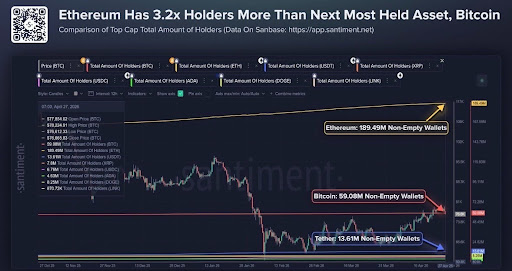
Recent on-chain data from Santiment reveals a significant shift in the cryptocurrency landscape, with Ethereum's number of non-empty addresses reaching 189.49 million—surpassing Bitcoin's 59.08 million by 320%. This substantial lead over Bitcoin and other major cryptocurrencies like XRP and stablecoins USDT/USDC highlights Ethereum's growing adoption as a platform for decentralized applications, smart contracts, DeFi, and NFTs. Despite current market volatility and selling pressure pushing ETH's price down to around $2,200, analysts present contrasting views on its future trajectory. One analyst suggests a breakout from a multi-year "Golden Triangle" pattern could propel ETH to levels as high as $8,500, $12,000, or even $48,000. Conversely, expert Ted Pillows offers a more cautious outlook, noting ETH's struggle to hold the $2,400 level but projecting a potential rise to $2,500-$2,600 and possibly $3,200-$3,900 if key resistance is broken. The surge in ETH holders may signal underlying bullish momentum that could eventually drive its price upward.

Recent on-chain reports show that Ethereum (ETH) has greatly surpassed Bitcoin (BTC) in a key metric, suggesting that the flagship cryptocurrency may not be as dominant as once thought. According to Santiment data, Ethereum’s holder count has exceeded Bitcoin’s by a staggering 320%, highlighting a surge in adoption and investor interest. With the market experiencing significant volatility, this rapid growth in ETH holders could signal renewed bullish momentum, potentially paving the way for Ethereum’s price to rise.

Ethereum Holders Exceed Bitcoin’s By 3.2x

The gap between Ethereum and other cryptocurrencies in the market is growing each day and becoming even more impossible to overlook. Santiment recently reported that Ethereum currently has more than three times Bitcoin’s user base, the world’s largest and most recognized cryptocurrency.

The market intelligence platform showed via a chart that the Ethereum network has recorded a whopping 189.49 million non-empty addresses for the first time in history, as of April 27. This amount completely dwarfs Bitcoin’s, which has just 59.08 million wallets with a balance.
Source: Santiment

In addition to Bitcoin, Ethereum’s holder count has surpassed those of XRP, Cardano, Dogecoin, and Chainlink. Furthermore, the holders on the ETH network have also overtaken two of the world’s largest stablecoins, USDT and USDC. This massive lead highlights Ethereum’s unique position in the crypto market and could strongly influence how investors perceive its value going forward.

Notably, the dramatic difference in holder count also shows growing adoption for Ethereum not just as a digital asset but as a platform for decentralized applications, smart contracts, and emerging sectors like DeFi and NFTs. The sheer scale of Ethereum’s network suggests that demand for its native token, ETH, may continue to rise as more users participate in the ecosystem. This demand could in turn exert upward pressure on its price, potentially pulling the cryptocurrency out of its current downtrend.

Analysts Project Major Rise In ETH Price

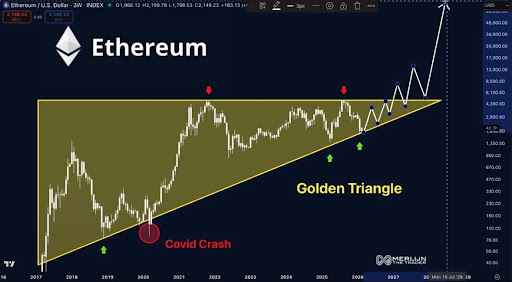
The price of Ethereum and Bitcoin is currently down as selling pressure increases. However, a crypto analyst on X believes that Ethereum’s price could soon go parabolic once it breaks out of a critical multi-year triangle pattern that has been developing since 2017.

The analyst described this pattern as a “Golden Triangle,” noting that once ETH breaks above the upper trendline of the formation, its price could rise sharply above $8,500 before pulling back and targeting much higher levels around $12,000 and possibly $48,000. Notably, this represents a rather ambitious forecast, given that Ethereum is currently trading near just $2,200.
Source: Santiment

Meanwhile, Ted Pillows, a well-known crypto expert, offers a more cautious, modest outlook on Ethereum. He noted that Ethereum has failed to hold onto the $2,400 level for the second time, and as a result, its price could continue to underperform the market. He attributed this bearishness to weakness in spot demand for the cryptocurrency.

However, Pillows predicts that if Ethereum can rise again and break above $2,400, that momentum could push the cryptocurrency toward $2,500 to $2,600. If it exceeds this level as well, the analyst projects a stronger run toward $3,200 to $3,900.

ETH price struggles as market relapses | Source: ETHUSDT on Tradingview.com

Связанные с этим вопросы

QAccording to the article, by what percentage has Ethereum's holder count exceeded Bitcoin's?

AEthereum's holder count has exceeded Bitcoin's by 320%.

QWhat specific on-chain metric is highlighted as a key area where Ethereum has surpassed Bitcoin?

AThe key metric is the number of non-empty addresses or holder count, where Ethereum has 189.49 million addresses compared to Bitcoin's 59.08 million.

QWhat are the two primary factors mentioned as drivers for Ethereum's growing adoption beyond just being a digital asset?

AThe two primary factors are Ethereum's role as a platform for decentralized applications, smart contracts, and its use in emerging sectors like DeFi and NFTs.

QWhat is the 'Golden Triangle' pattern mentioned by an analyst, and what is the potential price target if Ethereum breaks above it?

AThe 'Golden Triangle' is a critical multi-year triangle pattern that has been developing since 2017. An analyst suggests that if Ethereum breaks above its upper trendline, the price could initially rise sharply above $8,500 and later target levels around $12,000 and possibly $48,000.

QWhat price level does analyst Ted Pillows identify as critical for Ethereum to overcome to potentially initiate a bullish move towards $2,500-$2,600?

AAnalyst Ted Pillows identifies the $2,400 level as critical. If Ethereum can rise again and break above $2,400, that momentum could push it toward $2,500 to $2,600.

Похожее

Five Counterparty Risk Architectures: A Settlement-Layer Methodology for Classifying TradFi Models in Crypto Exchanges

**Summary:** This companion piece reframes the five TradFi-on-crypto exchange architectures, previously classified by "architectural fingerprint," through the lens of counterparty risk. The core question is: whose balance sheet bears the loss first in a stress scenario, and has it historically done so? Each of the five models corresponds to a distinct risk holder with its own documented failure modes. * **Model 1 (Stablecoin-Settled CEX Perpetuals):** Risk is held by the stablecoin issuer (e.g., reserve composition, bank connectivity) and the CEX's own book. History includes Tether's banking disconnections (2017) and reserve misrepresentations (CFTC 2021 Order). * **Model 2 (CFD Brokers):** Risk resides on the broker's balance sheet (B-book model). Regulatory differences (e.g., ESMA's mandatory negative balance protection vs. Mauritius FSC's lack thereof) define loss allocation rules, as seen in the 2015 SNB event (Alpari UK insolvency). * **Model 3 (Off-Chain Custody & Transfer Agent Chain):** Risk lies with the off-chain custodian/platform. User asset recovery depends on Terms of Use and corporate structure, exemplified by the Celsius bankruptcy ruling (2023) where Earn Account assets were deemed property of the estate. * **Model 4 (DEX Perpetual Protocols):** No single balance sheet bears risk. Loss absorption relies on a protocol's insurance fund and Auto-Deleveraging (ADL) mechanism, as demonstrated in the GMX V1 (2022) and dYdX v3 YFI (2023) incidents. * **Model 5 (Regulated CCP - DCM-DCO-FCM):** The most institutionalized model concentrates risk in the Central Counterparty (CCP). However, history shows CCPs can employ non-standard tools under extreme stress, such as mass trade cancellation (LME Nickel, 2022) or enabling negative price settlements (CME WTI, 2020). The report argues that regulatory choices and counterparty risk structures are co-extensive, not in an upstream-downstream relationship. It concludes with five separate observation checklists (not predictions) for monitoring the structural vulnerabilities of each risk model.

marsbit13 мин. назад

Five Counterparty Risk Architectures: A Settlement-Layer Methodology for Classifying TradFi Models in Crypto Exchanges

marsbit13 мин. назад

Торговля

Спот
Фьючерсы

Популярные статьи

Manyu: восходящая мем-звезда на Ethereum, готовая открыть новую эру культуры Shiba

Manyu - это мемтокен на Ethereum, который приносит децентрализованную культурную и развлекательную ценность через вирусное влияние в соцсетях и вовлечённость сообщества.

1.9k просмотров всегоОпубликовано 2025.11.27Обновлено 2025.11.27

Manyu: восходящая мем-звезда на Ethereum, готовая открыть новую эру культуры Shiba

Неделя обучения по популярным токенам 14: Glamsterdam — самое ожидаемое обновление Ethereum в 2026 году

Ordinals/Runes по-прежнему стимулируют доходы от комиссий за блоки и активность разработчиков, рассматриваются как отправная точка «нативной эмиссии активов» в сети.

1.3k просмотров всегоОпубликовано 2026.04.29Обновлено 2026.04.29

Неделя обучения по популярным токенам 14: Glamsterdam — самое ожидаемое обновление Ethereum в 2026 году

Обсуждения

Добро пожаловать в Сообщество HTX. Здесь вы сможете быть в курсе последних новостей о развитии платформы и получить доступ к профессиональной аналитической информации о рынке. Мнения пользователей о цене на ETH (ETH) представлены ниже.

活动图片