Ethereum Foundation's Major Overhaul: The Restructuring Challenge Behind the Loss of Several Key Veterans in Four Months

marsbitОпубликовано 2026-05-19Обновлено 2026-05-19

Введение

In just a few months, the Ethereum Foundation (EF) has seen a significant exodus of core members, including former co-executive director Tomasz Stańczak and key figures like Josh Stark and Trent Van Epps. This wave of departures coincides with the EF's ongoing internal restructuring, a shift in its declared role from the "primary guardian" to "one of many guardians," and its first public layoffs. The Protocol team, responsible for Ethereum's core protocol development, has been particularly affected but has been reorganized with three new co-leads: Will Corcoran, Kev Wedderburn, and Fredrik Svantes. Their immediate focus is on delivering the next major network upgrade, Glamsterdam, aimed at increasing mainnet throughput, though its launch is now likely delayed to Q3 2026. While concerns exist about talent drain—especially with competitive offers from newer chains—and potential delays to key upgrades, some view this turnover as a natural part of the EF's transition. The foundation's intentional move to decentralize its influence aligns with the broader goal of making Ethereum a more robust and neutral infrastructure, capable of passing the "walkaway test" where the protocol can function independently of its original core developers.

Author: Nancy, PANews

In a short span of months, the departure of several core members from the Ethereum Foundation (EF) has further dampened the already low morale within the Ethereum community, especially amidst the relatively lackluster performance of ETH's price.

Key Transition Period for EF as Seasoned Veterans Depart Collectively

In mid-2025, facing issues of slow execution, insufficient ecosystem support, and long-standing criticism over governance transparency, the Ethereum Foundation initiated an internal adjustment, restructuring its Research and Development teams and conducting its first public layoffs. This move was viewed by the outside world as a long-overdue self-correction.

In March 2026, the EF released a 38-page mission statement. While reaffirming Ethereum's core vision, the Foundation explicitly stated that its role had shifted from "first guardian" to "one of many guardians." To demonstrate its commitment, the EF even created a meme image of a "SOURCE SEPPUKU LICENSE," signifying its readiness to "face the consequences and end itself" if it failed to fulfill its promises to Ethereum.

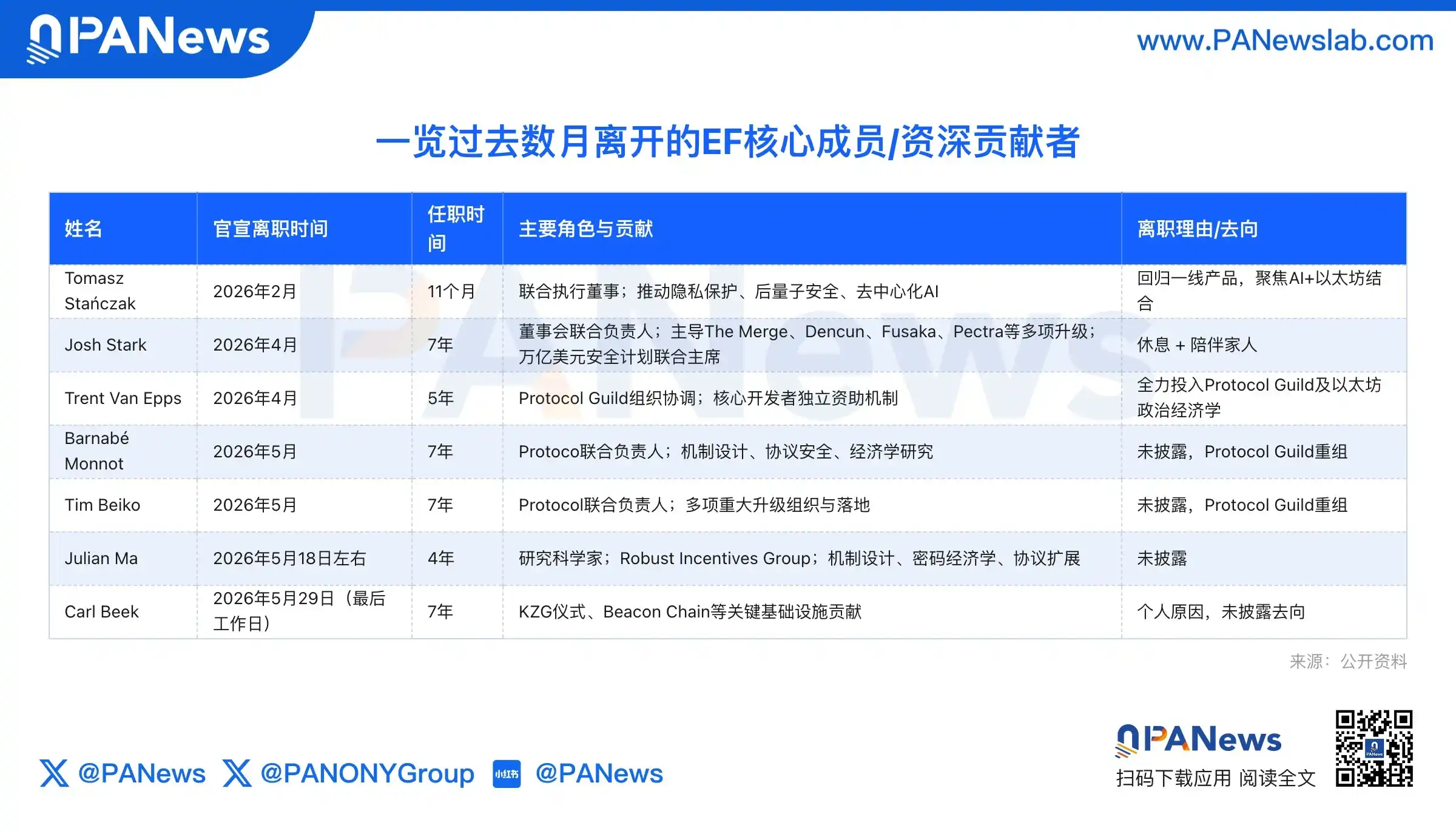
However, as EF's organizational adjustments continued to progress, core members kept leaving. Since February this year, 7 core members or senior contributors have departed.

In February, Tomasz Stańczak announced his resignation as EF's Co-Executive Director, less than a year into his tenure. During his time, he promoted initiatives in privacy protection, post-quantum security, and decentralized AI. He stated that the Ethereum ecosystem is currently in a relatively healthy phase, and he wishes to return to hands-on product development, focusing on exploring the integration paths between AI and Ethereum. He also noted that his independent execution space within the EF was gradually shrinking, and staying on felt more like a transitional handover. His successor is Bastian Aue, who joined the EF in 2019. In contrast, Aue has less publicly available information and previously focused on key supportive work such as organizational coordination and operational optimization.

About two months later, in mid-April 2026, key figure Josh Stark announced his departure after seven years at EF. He was deeply involved in several critical Ethereum upgrades, including The Merge, Dencun, Fusaka, and Pectra, and served as Co-Chair of the $1 Trillion Security Plan. He cited his reason for leaving as "plans to rest and spend time with family."

On the same day, Trent Van Epps also announced his departure from EF. He long oversaw the coordination of Protocol Guild, driving the funding mechanism for Ethereum core developers and participating in network upgrades and funding-related matters. After leaving, he will focus on Protocol Guild and research into Ethereum's political economy. He had previously publicly expressed that the EF leadership's association with the Milady NFT series was "perplexing."

In May, Alex Stokes, Co-Lead of Protocol Research, announced a leave of absence. Subsequently, Barnabé Monnot and Tim Beiko, former Co-Leads of Protocol Guild, as well as two senior researchers, Carl Beek and Julian Ma, also left, none publicly stating their reasons.

Although the vast majority of departing members did not publicly disclose specific reasons, sources indicated that EF, based on its emphasized "Anti-Censorship Principle," required internal members to sign a document named Mandate, otherwise facing immediate termination. This principle emphasizes that no entity should, through establishing persistent and exclusive control over key mechanisms, interfere with legitimate use or affect system operation. However, this claim has not yet been officially confirmed by EF.

Nevertheless, the talent drain from EF has also raised concerns about the overall Ethereum ecosystem. Protocol Guild contributor cheeky-gorilla warned that the health of L1 core development is the foundation of the entire Ethereum ecosystem, but core developers' salaries are 50% to 60% lower than market rates for similar positions. High-performance new chains like Monad and top L2 projects are precisely poaching talent with salaries over 10 times higher. He warned that once seasoned researchers familiar with the underlying protocol logic are lost, Ethereum's critical roadmap faces the real risk of stalling.

Protocol Team Leadership Change, Fears of Upgrade Delays Intensify

Within just four months, the consecutive departure of seasoned veterans from the executive to research layers has further heightened the uncertainty surrounding EF's reforms, particularly the adjustments within the Protocol team.

The Protocol team is the core unit responsible for the design, research, development, and coordination of Ethereum's base layer, covering security, cryptography, zkEVM, peer-to-peer networks, and other directions. As one of the core forces within EF, it significantly influences the long-term evolution, security, and scalability of the Ethereum protocol.

Facing personnel changes, EF completed a restructuring of the Protocol team this month, appointing three new Protocol Co-Leads: Will Corcoran, Kev Wedderburn, and Fredrik Svantes, who have been with EF for approximately 2 to 7 years.

Among them, Will Corcoran is a Protocol Research Coordinator, focusing on cutting-edge research in zkVM proof systems, post-quantum consensus, Fast Confirmation Rule, etc., with cross-team coordination experience and familiarity with the overall architecture;

Kev Wedderburn is the Lead of the zkEVM team, with deep expertise in zero-knowledge proofs, zkEVM implementation, and the integration of research and engineering. He will continue to lead zkEVM-related work, promoting the deep integration of the execution layer with zero-knowledge technology;

Fredrik Svantes is the Lead of Protocol Security Research, long overseeing core Ethereum security work, including the $1 Trillion Security Plan, the Ethereum Bug Bounty program, and audit competition organization, and will be deeply involved in cross-team collaboration.

Under the new leadership team, Protocol will prioritize pushing forward the launch of the Glamsterdam upgrade, preparing for the next Hegotá upgrade, and continuing to drive the implementation of the Strawmap roadmap in the short term.

Among these, Glamsterdam is Ethereum's next major network upgrade, with the core goal of enhancing mainnet throughput capacity. It plans to increase the Gas limit from the current ~60 million to 200 million and adjust transaction processing mechanisms and state database management methods.

However, the Glamsterdam upgrade, originally slated for June 2026, has already been delayed. Based on the latest testnet progress and Interop meeting feedback, the actual mainnet launch is more likely to be postponed to Q3 2026. Therefore, some community members and developers worry that recent core personnel changes may further impact the upgrade schedule and execution efficiency.

Nevertheless, some hold the view that this round of personnel turnover is a normal phenomenon during EF's restructuring process. Some members left after completing their phased missions, some aligned with strategic direction adjustments, while a new leadership has gradually taken over, and the core roadmap remains unchanged. More importantly, as the Ethereum ecosystem matures, the EF itself intends to diminish its central role. This helps reduce single-point control risks, alleviate external skepticism about the Foundation's influence, and further strengthen Ethereum's position as neutral infrastructure.

This also aligns with the concept of the "Walkaway Test" advocated by Vitalik, meaning that the protocol should continue to operate safely, predictably, and stably in the long term even if core developers completely exit and cease maintenance.

Связанные с этим вопросы

QAccording to the article, what is the main reason given for the recent wave of high-profile departures from the Ethereum Foundation (EF)?

AThe article states that while most departing members have not publicly disclosed specific reasons, a source indicated that the EF required internal members to sign a document called a "Mandate" based on its "anti-censorship principle," with refusal leading to immediate termination. However, this claim has not been officially confirmed by the EF. Individual reasons mentioned include Tomasz Stańczak wanting to return to hands-on product building and Josh Stark planning to rest and spend time with his family.

QWhat is the "SOURCE SEPPUKU LICENSE" meme referenced in the article, and what does it symbolize for the EF's new role?

AThe "SOURCE SEPPUKU LICENSE" is a meme image created by the Ethereum Foundation. It symbolizes a dramatic commitment to its new mission. The meme, referencing a form of ritual suicide, represents the EF's pledge to "self-destruct" or face severe consequences if it fails to uphold its promises to the Ethereum ecosystem, underscoring its shift from being the "first guardian" to just "one of many guardians."

QWhat is the Protocol team within the Ethereum Foundation responsible for, and who are its three new co-leads following the recent restructuring?

AThe Protocol team is the core team responsible for the design, research, development, and coordination of Ethereum's base layer, covering areas like security, cryptography, zkEVM, and peer-to-peer networking. Following the restructuring, the three new Protocol co-leads are Will Corcoran (focusing on research coordination and zkVM systems), Kev Wedderburn (leading the zkEVM team), and Fredrik Svantes (leading protocol security research).

QWhat major Ethereum network upgrade is currently facing potential delays according to the article, and what is its primary goal?

AThe major network upgrade facing potential delays is called Glamsterdam. Its primary goal is to significantly increase the throughput capacity of the Ethereum mainnet by raising the Gas limit from the current ~60 million to 200 million, alongside adjustments to transaction processing and state database management.

QHow does the concept of the "Walkaway Test," mentioned at the end of the article, relate to the EF's current restructuring and personnel changes?

AThe "Walkaway Test," advocated by Vitalik Buterin, is the idea that the Ethereum protocol should be robust enough to run safely, predictably, and stably in the long term even if all core developers completely stepped away. The article suggests that the EF's restructuring and intentional reduction of its central role align with this philosophy, aiming to reduce single-point-of-control risks and reinforce Ethereum's position as a neutral infrastructure, making the ecosystem less dependent on any single entity like the EF.

Похожее

When Hyperliquid Steals Solana's 'Internet Capital Market' Script

The article "When Hyperliquid Steals Solana's 'Internet Capital Markets' Playbook" discusses Solana's struggles to maintain its "internet capital markets" narrative by 2026. Despite its initial success as a high-performance "Ethereum killer," SOL's price has underperformed, dropping significantly compared to other major cryptocurrencies. Solana's vision of a global, on-chain trading network for all assets is being challenged not primarily by Ethereum, but by Hyperliquid. Hyperliquid, evolving from a perpetual contracts platform into a dedicated financial infrastructure Layer 1, has become a major beneficiary of the shift of derivatives trading from centralized exchanges to on-chain. The article argues that for high-frequency financial trading, a specialized, performance-focused chain like Hyperliquid may be more suitable than a general-purpose ecosystem like Solana. Further compounding Solana's issues was a major $200+ million exploit on its key perpetual protocol, Drift, in April, which damaged market confidence. In response, Solana founder Anatoly Yakovenko heavily promoted the protocol Phoenix as a replacement, boosting its visibility but not its trading volume, which remains far behind leading platforms. Solana supporters have launched a public critique of Hyperliquid's decentralization, pointing to its limited validators and closed-source code. Critics, however, note Solana's own declining validator count and centralization metrics. This strategy has also caused internal friction, with developers of other Solana protocols expressing discontent over the foundation's perceived favoritism towards Phoenix. The conclusion is that Hyperliquid's rise represents a challenge to the "general-purpose blockchain" narrative, proving that the core of a capital market might be a specialized trading engine rather than a broad ecosystem. If Solana cannot regain dominance in derivatives, it risks remaining a "meme coin paradise" while its grand "internet capital markets" ambition slips away.

marsbit1 ч. назад

When Hyperliquid Steals Solana's 'Internet Capital Market' Script

marsbit1 ч. назад

When Hyperliquid Steals Solana's 'Internet Capital Markets' Playbook

The article discusses how Solana's grand vision of becoming an "Internet Capital Markets" platform is facing significant challenges in 2026, primarily from the unexpected rise of Hyperliquid. Solana's performance has weakened, with its token SOL experiencing the largest price decline among major cryptocurrencies. Its core narrative of building a global, chain-based marketplace for all assets is under pressure both internally and externally. Hyperliquid, originally a perpetual futures exchange, has evolved into a dedicated Layer 1 financial infrastructure network. Its focused, trading-centric approach is attracting capital and challenging the assumption that a "general-purpose" ecosystem like Solana is necessary for a capital market. Hyperliquid's success suggests that for high-frequency trading, superior performance, liquidity, and user experience may be more critical than a broad application ecosystem. Internally, Solana's strategy suffered a blow from a major hack on the Drift Protocol in April, resulting in over $200 million in losses. In response, Solana founder Anatoly Yakovenko has heavily promoted Phoenix as a new decentralized perpetual futures platform on Solana. While this boosted Phoenix's visibility, its trading volume remains far behind leading platforms. Solana's community has launched a rhetorical attack against Hyperliquid, questioning its decentralization due to its limited validator set and closed-source code. Critics, however, point out Solana's own decreasing validator count and increasing centralization of stake. This focus on "decentralization metrics" has also caused internal friction, with other Solana ecosystem developers expressing discontent over the foundation's perceived favoritism towards Phoenix. The article concludes that the rise of Hyperliquid represents a challenge to the "general-purpose blockchain" narrative, proving that an efficient trading engine might be more central to a capital market than a vast ecosystem. If Solana cannot regain dominance in the derivatives space, it risks remaining a "meme coin paradise" rather than achieving its ambition of hosting global assets.

链捕手1 ч. назад

When Hyperliquid Steals Solana's 'Internet Capital Markets' Playbook

链捕手1 ч. назад

Торговля

Спот
Фьючерсы

Популярные статьи

Как купить S

Добро пожаловать на HTX.com! Мы сделали приобретение Sonic (S) простым и удобным. Следуйте нашему пошаговому руководству и отправляйтесь в свое крипто-путешествие.Шаг 1: Создайте аккаунт на HTXИспользуйте свой адрес электронной почты или номер телефона, чтобы зарегистрироваться и бесплатно создать аккаунт на HTX. Пройдите удобную регистрацию и откройте для себя весь функционал.Создать аккаунтШаг 2: Перейдите в Купить криптовалюту и выберите свой способ оплатыКредитная/Дебетовая Карта: Используйте свою карту Visa или Mastercard для мгновенной покупки Sonic (S).Баланс: Используйте средства с баланса вашего аккаунта HTX для простой торговли.Третьи Лица: Мы добавили популярные способы оплаты, такие как Google Pay и Apple Pay, для повышения удобства.P2P: Торгуйте напрямую с другими пользователями на HTX.Внебиржевая Торговля (OTC): Мы предлагаем индивидуальные услуги и конкурентоспособные обменные курсы для трейдеров.Шаг 3: Хранение Sonic (S)После приобретения вами Sonic (S) храните их в своем аккаунте на HTX. В качестве альтернативы вы можете отправить их куда-либо с помощью перевода в блокчейне или использовать для торговли с другими криптовалютами.Шаг 4: Торговля Sonic (S)С легкостью торгуйте Sonic (S) на спотовом рынке HTX. Просто зайдите в свой аккаунт, выберите торговую пару, совершайте сделки и следите за ними в режиме реального времени. Мы предлагаем удобный интерфейс как для начинающих, так и для опытных трейдеров.

1.3k просмотров всегоОпубликовано 2025.01.15Обновлено 2025.03.21

Как купить S

Sonic: Обновления под руководством Андре Кронье – новая звезда Layer-1 на фоне спада рынка

Он решает проблемы масштабируемости, совместимости между блокчейнами и стимулов для разработчиков с помощью технологических инноваций.

2.2k просмотров всегоОпубликовано 2025.04.09Обновлено 2025.04.09

Sonic: Обновления под руководством Андре Кронье – новая звезда Layer-1 на фоне спада рынка

HTX Learn: Пройдите обучение по "Sonic" и разделите 1000 USDT

HTX Learn — ваш проводник в мир перспективных проектов, и мы запускаем специальное мероприятие "Учитесь и Зарабатывайте", посвящённое этим проектам. Наше новое направление .

1.8k просмотров всегоОпубликовано 2025.04.10Обновлено 2025.04.10

HTX Learn: Пройдите обучение по "Sonic" и разделите 1000 USDT

Обсуждения

Добро пожаловать в Сообщество HTX. Здесь вы сможете быть в курсе последних новостей о развитии платформы и получить доступ к профессиональной аналитической информации о рынке. Мнения пользователей о цене на S (S) представлены ниже.

活动图片