Ethereum Exchange Outflows Signal Supply Is Stepping Back

bitcoinistОпубликовано 2026-01-17Обновлено 2026-01-17

Введение

Ethereum is struggling to stabilize above $3,300 amid ongoing market uncertainty. Despite the recent rebound, analysts note that a sustained recovery requires further confirmation. A key observation from CryptoQuant data shows persistent ETH outflows from exchanges during price dips, while inflows during rallies remain limited. This pattern suggests holders are not selling aggressively into weakness, indicating a reduction in sell-side pressure. This disciplined supply environment could support sharper upside moves if demand returns, as fewer coins are available on exchanges to meet new buying interest. However, the market remains cautious, and a definitive breakout depends on broader conditions aligning with improved demand.

Ethereum is struggling to push above critical supply levels after a brief surge above $3,300, as the market attempts to stabilize following weeks of sustained selling pressure. While the rebound has sparked renewed optimism, price action remains fragile, with bulls still needing clear confirmation before a broader recovery can take hold. Still, the fact that ETH is holding near key levels has led some analysts to start calling for higher prices, arguing that the market may be entering a new phase after the recent downtrend.

Supporting this view, a CryptoQuant analyst highlighted Ethereum Exchange Netflow spot data showing persistent ETH outflows from spot exchanges during price pullbacks, while inflows during upward moves remain relatively limited. This pattern suggests a more disciplined supply environment, where holders are reluctant to sell into weakness and are not aggressively distributing during rallies.

In other words, sell-side pressure appears to be easing, even as Ethereum remains capped below major resistance. If demand returns, this type of netflow structure can support sharper upside moves, as fewer coins are available on exchanges to meet new buying interest. For now, Ethereum is caught between fading fear and unfinished recovery, with the next breakout attempt likely to define the short-term trend.

Ethereum’s recent Exchange Netflow behavior suggests that the latest pullbacks have been met with holding and accumulation rather than broad-based distribution. Instead of rushing to send ETH onto exchanges during weakness, many participants appear willing to sit through volatility, reducing the immediate sell pressure that typically accelerates downtrends. This supports the idea that supply is gradually stepping back, even as price remains capped below key resistance zones and market sentiment stays cautious.
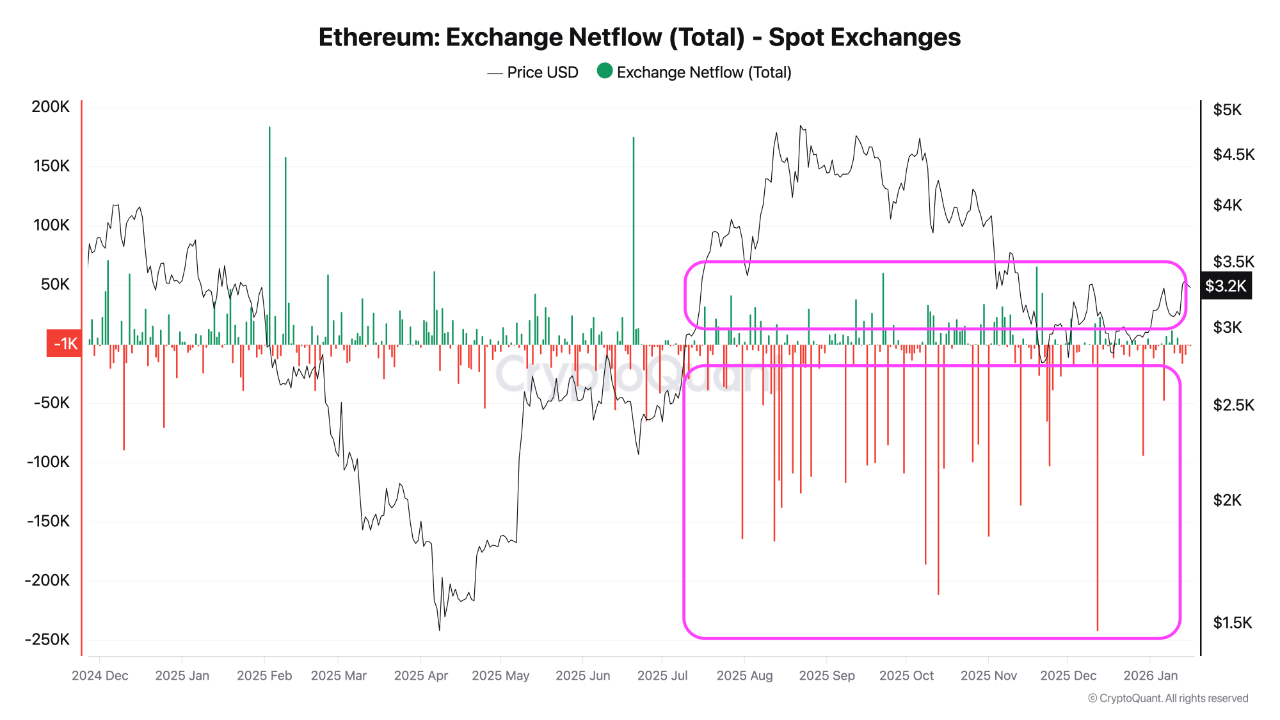
Ethereum Exchange Netflow | Source: CryptoQuant

However, Exchange Netflow alone is not enough to define direction. A favorable supply structure can still fail if demand remains weak, or if macro conditions deteriorate and force investors back into risk-off positioning. In that scenario, downside continuation cannot be ruled out, even if exchange balances remain constrained.

That said, in the absence of major systemic stress, the current netflow profile offers a constructive backdrop for upside. The lack of supply expansion during drawdowns and the restrained profit-taking during rebounds imply that sellers are not in control. If demand rotates back into Ethereum, price could respond more efficiently because there is less readily available liquidity sitting on exchanges.

In this sense, the on-chain data is not signaling an immediate breakout. Instead, it highlights a market structure that appears increasingly prepared for upward price action once broader conditions align and buyers regain conviction.


Связанные с этим вопросы

QWhat does the persistent Ethereum outflows from exchanges during price pullbacks indicate, according to the CryptoQuant analyst?

AIt indicates a more disciplined supply environment where holders are reluctant to sell into weakness and are not aggressively distributing during rallies, suggesting sell-side pressure is easing.

QHow can the current Ethereum netflow structure support sharper upside moves if demand returns?

AIt can support sharper upside moves because fewer coins are available on exchanges to meet new buying interest, as the supply is stepping back.

QWhat is the main limitation of using Exchange Netflow data alone to predict market direction?

AExchange Netflow alone is not enough because a favorable supply structure can still fail if demand remains weak or if macro conditions deteriorate, forcing investors into risk-off positioning.

QWhat does the recent Exchange Netflow behavior suggest about how participants are responding to price pullbacks?

AIt suggests that participants are responding with holding and accumulation rather than broad-based distribution, as they are willing to sit through volatility instead of rushing to sell.

QWhat is the overall implication of the on-chain data for Ethereum's price action, according to the article?

AThe on-chain data highlights a market structure that is increasingly prepared for upward price action once broader conditions align and buyers regain conviction, though it does not signal an immediate breakout.

Похожее

Google and Amazon Simultaneously Invest Heavily in a Competitor: The Most Absurd Business Logic of the AI Era Is Becoming Reality

In a span of four days, Amazon announced an additional $25 billion investment, and Google pledged up to $40 billion—both direct competitors pouring over $65 billion into the same AI startup, Anthropic. Rather than a typical venture capital move, this signals the latest escalation in the cloud wars. The core of the deal is not equity but compute pre-orders: Anthropic must spend the majority of these funds on AWS and Google Cloud services and chips, effectively locking in massive future compute consumption. This reflects a shift in cloud market dynamics—enterprises now choose cloud providers based on which hosts the best AI models, not just price or stability. With OpenAI deeply tied to Microsoft, Anthropic’s Claude has become the only viable strategic asset for Google and Amazon to remain competitive. Anthropic’s annualized revenue has surged to $30 billion, and it is expanding into verticals like biotech, positioning itself as a cross-industry AI infrastructure layer. However, this funding comes with constraints: Anthropic’s independence is challenged as it balances two rival investors, its safety-first narrative faces pressure from regulatory scrutiny, and its path to IPO introduces new financial pressures. Globally, this accelerates a "tri-polar" closed-loop structure in AI infrastructure, with Microsoft-OpenAI, Google-Anthropic, and Amazon-Anthropic forming exclusive model-cloud alliances. In contrast, China’s landscape differs—investments like Alibaba and Tencent backing open-source model firm DeepSeek reflect a more decoupled approach, though closed-source models from major cloud providers still dominate. The $65 billion bet is ultimately about securing a seat at the table in an AI-defined future—where missing the model layer means losing the cloud war.

marsbit1 ч. назад

Google and Amazon Simultaneously Invest Heavily in a Competitor: The Most Absurd Business Logic of the AI Era Is Becoming Reality

marsbit1 ч. назад

Computing Power Constrained, Why Did DeepSeek-V4 Open Source?

DeepSeek-V4 has been released as a preview open-source model, featuring 1 million tokens of context length as a baseline capability—previously a premium feature locked behind enterprise paywalls by major overseas AI firms. The official announcement, however, openly acknowledges computational constraints, particularly limited service throughput for the high-end DeepSeek-V4-Pro version due to restricted high-end computing power. Rather than competing on pure scale, DeepSeek adopts a pragmatic approach that balances algorithmic innovation with hardware realities in China’s AI ecosystem. The V4-Pro model uses a highly sparse architecture with 1.6T total parameters but only activates 49B during inference. It performs strongly in agentic coding, knowledge-intensive tasks, and STEM reasoning, competing closely with top-tier closed models like Gemini Pro 3.1 and Claude Opus 4.6 in certain scenarios. A key strategic product is the Flash edition, with 284B total parameters but only 13B activated—making it cost-effective and accessible for mid- and low-tier hardware, including domestic AI chips from Huawei (Ascend), Cambricon, and Hygon. This design supports broader adoption across developers and SMEs while stimulating China's domestic semiconductor ecosystem. Despite facing talent outflow and intense competition in user traffic—with rivals like Doubao and Qianwen leading in monthly active users—DeepSeek has maintained technical momentum. The release also comes amid reports of a new funding round targeting a valuation exceeding $10 billion, potentially setting a new record in China’s LLM sector. Ultimately, DeepSeek-V4 represents a shift toward open yet realistic infrastructure development in the constrained compute landscape of Chinese AI, emphasizing engineering efficiency and domestic hardware compatibility over pure model scale.

marsbit1 ч. назад

Computing Power Constrained, Why Did DeepSeek-V4 Open Source?

marsbit1 ч. назад

Торговля

Спот
Фьючерсы

Популярные статьи

Manyu: восходящая мем-звезда на Ethereum, готовая открыть новую эру культуры Shiba

Manyu - это мемтокен на Ethereum, который приносит децентрализованную культурную и развлекательную ценность через вирусное влияние в соцсетях и вовлечённость сообщества.

1.9k просмотров всегоОпубликовано 2025.11.27Обновлено 2025.11.27

Manyu: восходящая мем-звезда на Ethereum, готовая открыть новую эру культуры Shiba

Обсуждения

Добро пожаловать в Сообщество HTX. Здесь вы сможете быть в курсе последних новостей о развитии платформы и получить доступ к профессиональной аналитической информации о рынке. Мнения пользователей о цене на ETH (ETH) представлены ниже.

活动图片