Ethereum (ETH) Faces Crosscurrents as Scalability Upgrades Clash With Whale Selling Pressure

bitcoinistОпубликовано 2026-01-08Обновлено 2026-01-08

Введение

Ethereum (ETH) is experiencing a clash between positive structural developments and market headwinds. While developers are advancing scalability upgrades, such as increasing the blob limit to enhance network capacity and reduce fees, large holders are selling significant amounts of ETH, creating near-term downward pressure. Over 300,000 ETH was sold by whales in a short period, despite growing institutional staking activity that continues to lock supply and reduce exchange reserves. These opposing forces are shaping ETH’s outlook as it trades above $3,200, with the market assessing whether demand can outweigh the selling pressure amid ongoing protocol improvements.

The Ethereum (ETH) ecosystem is facing a mix of structural progress and market uncertainty. On one side, developers are pushing forward with a series of scalability upgrades aimed at lowering fees and expanding capacity across the network.

Related Reading: South Korea Explores Crypto Account Freezing Measure To Prevent Market Manipulation

On the other hand, large holders are using recent price strength to reduce exposure, introducing short-term selling pressure. Together, these opposing forces are building Ethereum’s near-term outlook as ETH trades above the $3,200 level.

The contrast is clear, while the protocol is absorbing more capital through staking and infrastructure improvements, parts of the market are testing how much supply and demand can absorb during a renewed rally.
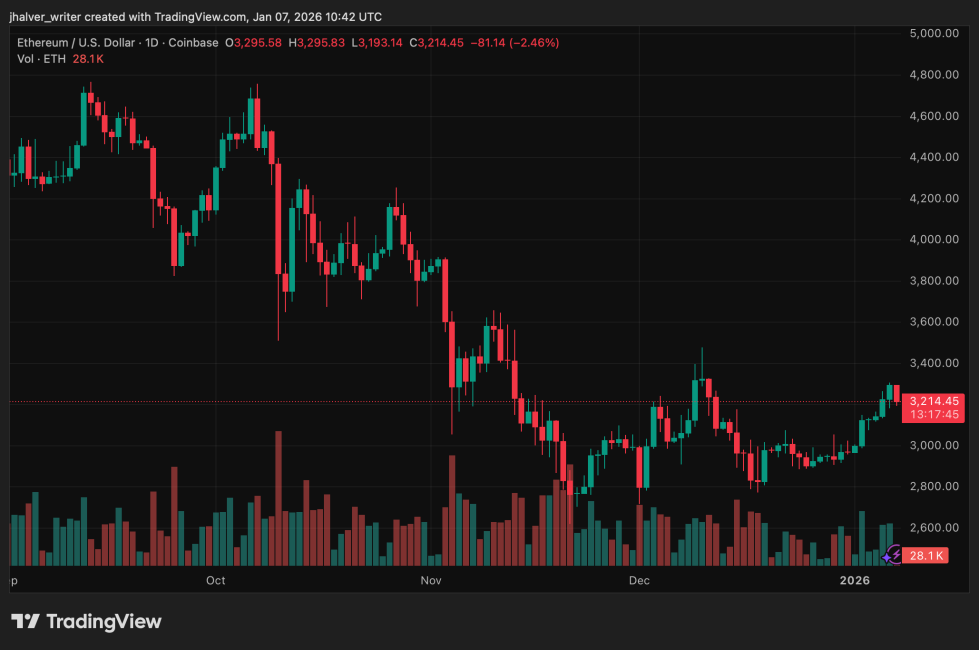
ETH's price moving sideways on the daily chart. Source: ETHUSD on Tradingview

Scalability Roadmap Moves Forward

Ethereum developers activated the second Blob Parameter-Only (BPO) hard fork this week, raising the blob limit from 15 to 21 and increasing the blob target from 10 to 14.

Blobs are temporary data containers used primarily by rollups to batch transactions more efficiently. With each blob holding 128 kilobytes, the network can now process roughly 2.6 megabytes of blob data per block.

The upgrade is part of a broader effort to scale Ethereum through layer-2 networks rather than pushing all activity onto the main chain. Since the first BPO fork in December, transaction fees on Ethereum have shown reduced volatility, reflecting lower congestion as rollups move data off-chain.

Developers are already discussing additional changes, including raising the gas limit from 60 million to 80 million, and later up to 200 million under the planned Glamsterdam hard fork in 2026. That upgrade is expected to introduce parallel transaction processing, further increasing throughput.

Ethereum’s (ETH) Staking Growth Tightens Liquid Supply

At the same time, staking activity is reshaping Ethereum’s supply dynamics. Institutional participation has increased, highlighted by BitMine’s latest deposits, which pushed its total staked ETH close to 780,000 tokens, worth over $2.5 billion.

Network-wide data indicates that more than 1.3 million ETH are waiting to enter staking, while the validator exit queue has dropped to zero. This imbalance suggests that fewer validators are choosing to exit, even amid market volatility.

As more ETH is locked into consensus contracts, circulating supply on exchanges continues to decline, potentially limiting downside pressure over the medium term.

Whale Selling Adds Near-Term Pressure

Despite these fundamentals, large holders have recently turned into net sellers. Whale wallets holding between 100,000 and 1 million ETH sold roughly 300,000 ETH over three days, valued at about $970 million.

This selling coincided with ETH’s breakout from a multi-week descending wedge, indicating that some whales are using the rally to take profits.

Related Reading: Scudo Announced: Tether’s Newest Crypto And Gold Unit – Here’s The Breakdown

While long-term holders remain largely inactive, helping to stabilize the broader structure, continued distribution by whales could slow upside momentum. Ethereum now sits at a crossroads, balancing protocol-level progress against market-driven supply pressure as traders assess whether demand can sustain the next leg higher.

Cover image from ChatGPT, ETHUSD chart from Tradingview

Похожее

Google and Amazon Simultaneously Invest Heavily in a Competitor: The Most Absurd Business Logic of the AI Era Is Becoming Reality

In a span of four days, Amazon announced an additional $25 billion investment, and Google pledged up to $40 billion—both direct competitors pouring over $65 billion into the same AI startup, Anthropic. Rather than a typical venture capital move, this signals the latest escalation in the cloud wars. The core of the deal is not equity but compute pre-orders: Anthropic must spend the majority of these funds on AWS and Google Cloud services and chips, effectively locking in massive future compute consumption. This reflects a shift in cloud market dynamics—enterprises now choose cloud providers based on which hosts the best AI models, not just price or stability. With OpenAI deeply tied to Microsoft, Anthropic’s Claude has become the only viable strategic asset for Google and Amazon to remain competitive. Anthropic’s annualized revenue has surged to $30 billion, and it is expanding into verticals like biotech, positioning itself as a cross-industry AI infrastructure layer. However, this funding comes with constraints: Anthropic’s independence is challenged as it balances two rival investors, its safety-first narrative faces pressure from regulatory scrutiny, and its path to IPO introduces new financial pressures. Globally, this accelerates a "tri-polar" closed-loop structure in AI infrastructure, with Microsoft-OpenAI, Google-Anthropic, and Amazon-Anthropic forming exclusive model-cloud alliances. In contrast, China’s landscape differs—investments like Alibaba and Tencent backing open-source model firm DeepSeek reflect a more decoupled approach, though closed-source models from major cloud providers still dominate. The $65 billion bet is ultimately about securing a seat at the table in an AI-defined future—where missing the model layer means losing the cloud war.

marsbit1 ч. назад

Google and Amazon Simultaneously Invest Heavily in a Competitor: The Most Absurd Business Logic of the AI Era Is Becoming Reality

marsbit1 ч. назад

Computing Power Constrained, Why Did DeepSeek-V4 Open Source?

DeepSeek-V4 has been released as a preview open-source model, featuring 1 million tokens of context length as a baseline capability—previously a premium feature locked behind enterprise paywalls by major overseas AI firms. The official announcement, however, openly acknowledges computational constraints, particularly limited service throughput for the high-end DeepSeek-V4-Pro version due to restricted high-end computing power. Rather than competing on pure scale, DeepSeek adopts a pragmatic approach that balances algorithmic innovation with hardware realities in China’s AI ecosystem. The V4-Pro model uses a highly sparse architecture with 1.6T total parameters but only activates 49B during inference. It performs strongly in agentic coding, knowledge-intensive tasks, and STEM reasoning, competing closely with top-tier closed models like Gemini Pro 3.1 and Claude Opus 4.6 in certain scenarios. A key strategic product is the Flash edition, with 284B total parameters but only 13B activated—making it cost-effective and accessible for mid- and low-tier hardware, including domestic AI chips from Huawei (Ascend), Cambricon, and Hygon. This design supports broader adoption across developers and SMEs while stimulating China's domestic semiconductor ecosystem. Despite facing talent outflow and intense competition in user traffic—with rivals like Doubao and Qianwen leading in monthly active users—DeepSeek has maintained technical momentum. The release also comes amid reports of a new funding round targeting a valuation exceeding $10 billion, potentially setting a new record in China’s LLM sector. Ultimately, DeepSeek-V4 represents a shift toward open yet realistic infrastructure development in the constrained compute landscape of Chinese AI, emphasizing engineering efficiency and domestic hardware compatibility over pure model scale.

marsbit2 ч. назад

Computing Power Constrained, Why Did DeepSeek-V4 Open Source?

marsbit2 ч. назад

Торговля

Спот
Фьючерсы

Популярные статьи

Manyu: восходящая мем-звезда на Ethereum, готовая открыть новую эру культуры Shiba

Manyu - это мемтокен на Ethereum, который приносит децентрализованную культурную и развлекательную ценность через вирусное влияние в соцсетях и вовлечённость сообщества.

1.9k просмотров всегоОпубликовано 2025.11.27Обновлено 2025.11.27

Manyu: восходящая мем-звезда на Ethereum, готовая открыть новую эру культуры Shiba

Обсуждения

Добро пожаловать в Сообщество HTX. Здесь вы сможете быть в курсе последних новостей о развитии платформы и получить доступ к профессиональной аналитической информации о рынке. Мнения пользователей о цене на ETH (ETH) представлены ниже.

活动图片