Ethereum activity hits 788K addresses – Can ETH finally break out?

ambcryptoОпубликовано 2026-04-03Обновлено 2026-04-03

Введение

Ethereum's network activity has surged, with over 788,000 daily active addresses and more than 255,000 new addresses created, indicating strong underlying demand and user growth. Despite this, ETH's price remains range-bound between $1,807 support and $2,371 resistance, failing to break out despite repeated tests. On-chain data shows persistent outflows from exchanges, suggesting accumulation, but this has not yet translated into significant buying pressure. Derivatives markets reveal declining open interest and a negative funding rate, reflecting bearish sentiment and reduced leverage. While network fundamentals strengthen, the price lacks the momentum for a sustained breakout due to ongoing consolidation and dominant short positioning.

Ethereum’s network activity has surged toward historic highs, with over 788K Daily Active Addresses interacting across the network.
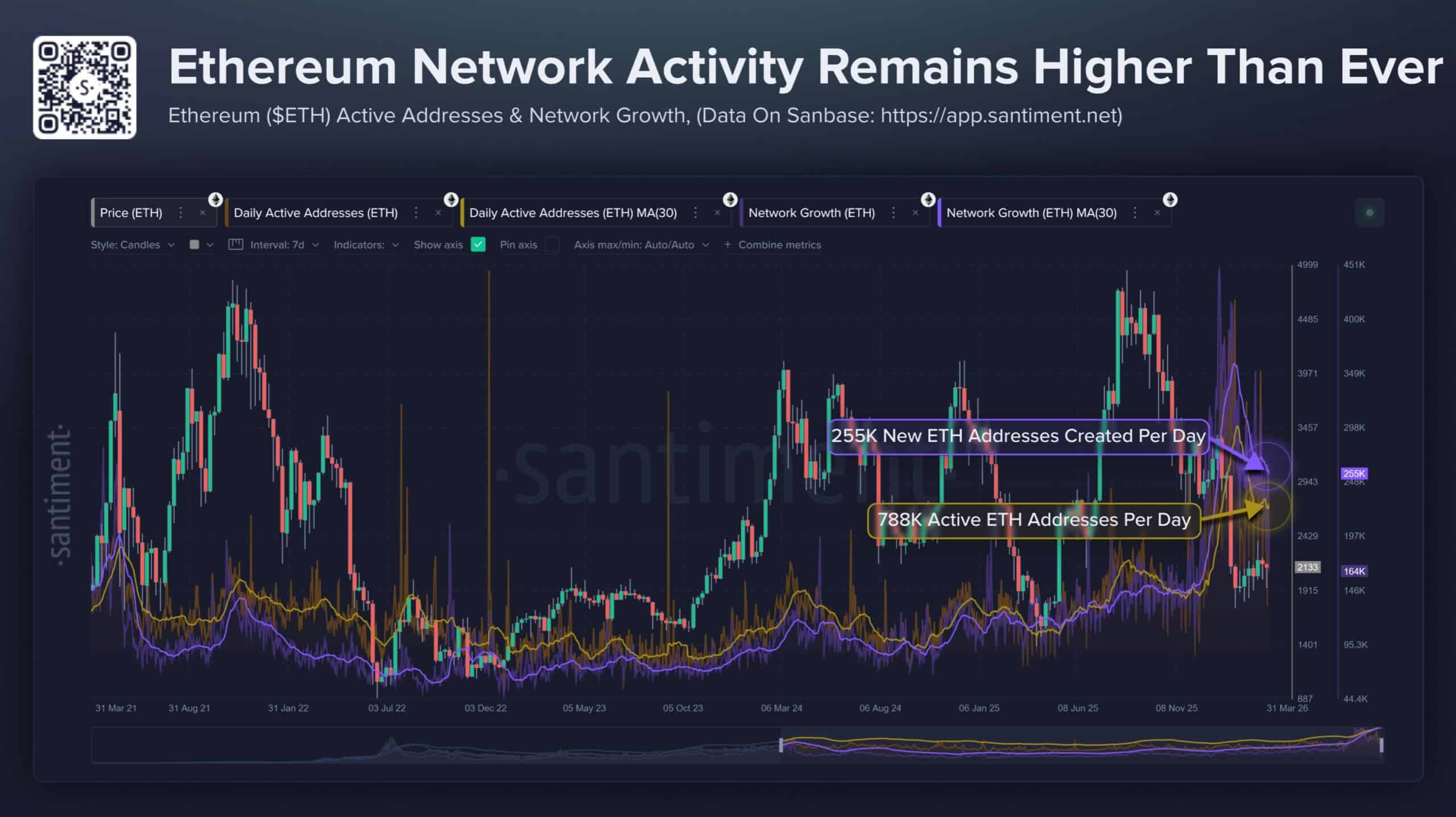
Source: Santiment

In addition, more than 255K new addresses are being created each day, reflecting sustained user onboarding.

As more addresses interact with the network daily, underlying demand appears to strengthen beneath the surface.

Yet, price behavior suggests that this demand has not fully translated into visible buying pressure.

This gap raises a critical question about how much of this activity reflects organic growth versus structural positioning, leaving the market in a state where participation increases, but price direction remains unresolved.

Ethereum price range holds as resistance caps upside

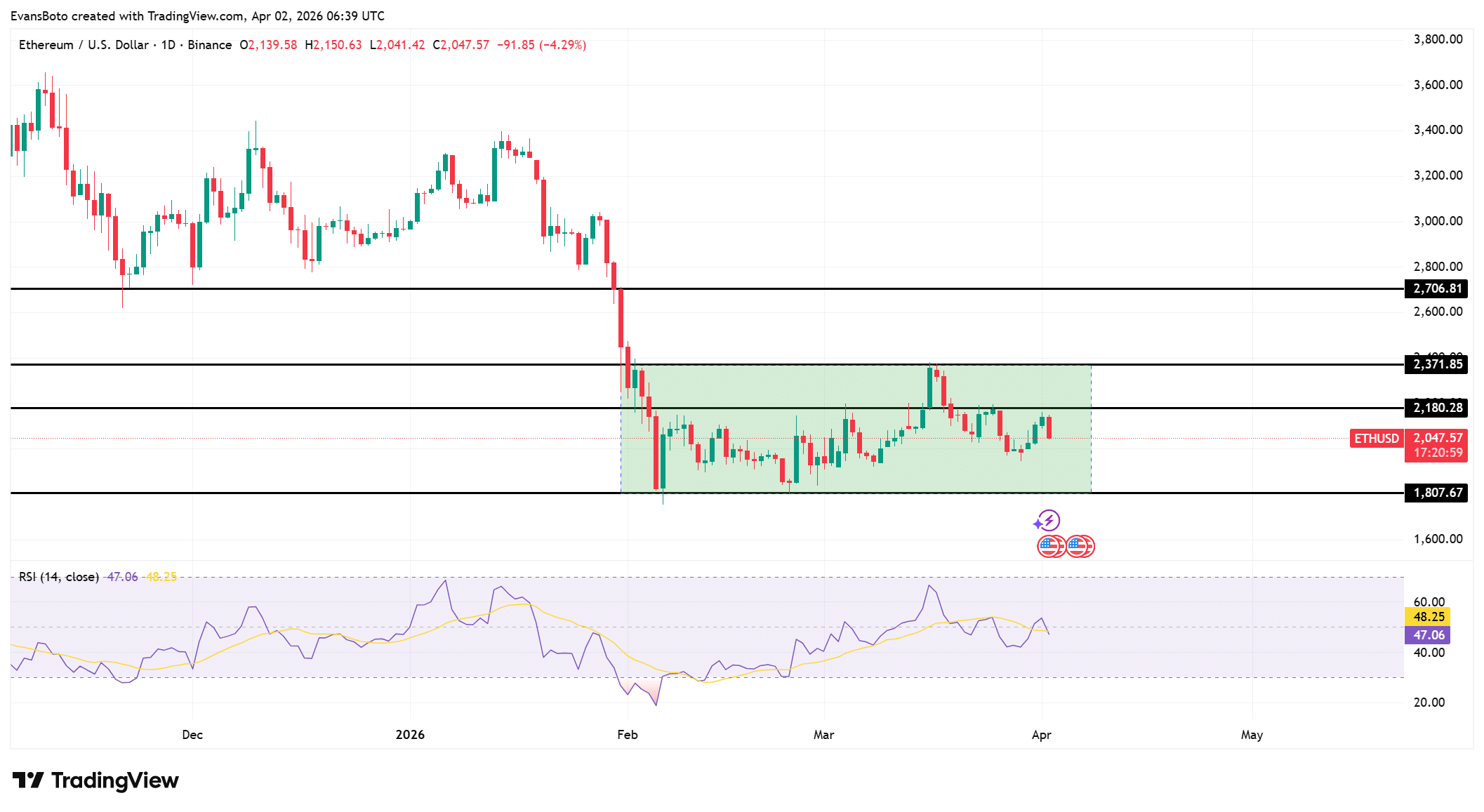
Despite strong on-chain growth, Ethereum [ETH] traded within a defined range between $1,807 support and $2,371 resistance.

Price repeatedly tested the $2,371 resistance but failed to sustain a breakout. This kept the structure compressed and limited upward expansion.

RSI stabilized near 47.06, reflecting neutral momentum without clear directional bias.

Although RSI recovered from oversold levels, it failed to break above 60. That indicated bullish strength remained limited.

Meanwhile, resistance near $2,180 continued to reject upward moves.

Each rejection maintained a pattern of lower highs within the range. This pattern limited bullish continuation.

However, repeated defenses of $1,807 showed buyers remained active at lower levels. That balance reflected ongoing indecision between accumulation and distribution.
Source: TradingView

Outflows persist despite consolidation phase

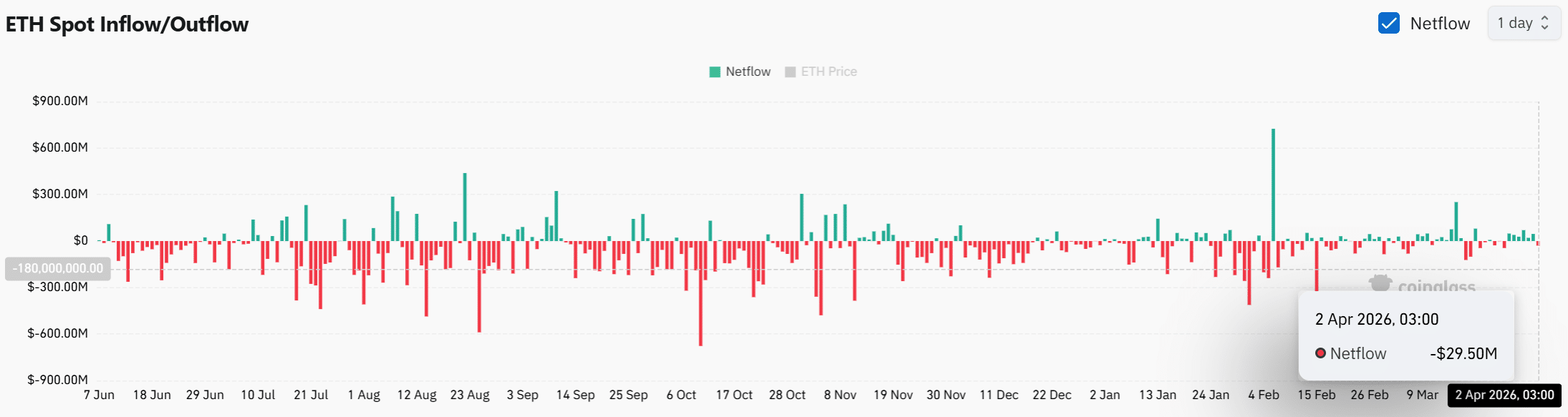
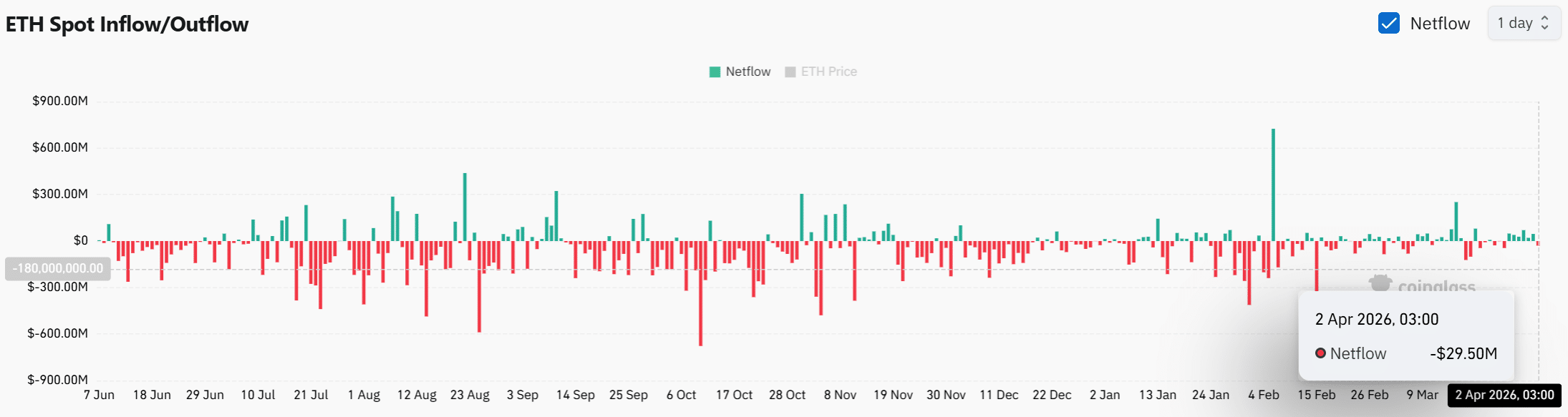
While price continues compressing, Spot Netflows remained negative, with recent data showing a $29.50M outflow.

This trend indicates that ETH continues leaving exchanges, which reduces immediately available supply for selling.

Such persistent outflows typically reflect accumulation behavior, as investors move assets into private wallets.

However, despite this supply tightening, price has not responded with upward expansion.

This suggests that although selling pressure may be decreasing, demand has not yet intensified enough to absorb resistance levels.

The continued outflow trend strengthens the underlying structure, yet price remains locked within the range as the market absorbs this shift gradually.
Source: CoinGlass

Ethereum leverage declines as shorts gain control

Beyond spot activity, derivatives data revealed a shift in positioning, as Open Interest [OI] dropped by 8.59% to $28.18B.

This decline showed that traders have reduced exposure, signaling lower participation in leveraged positions.

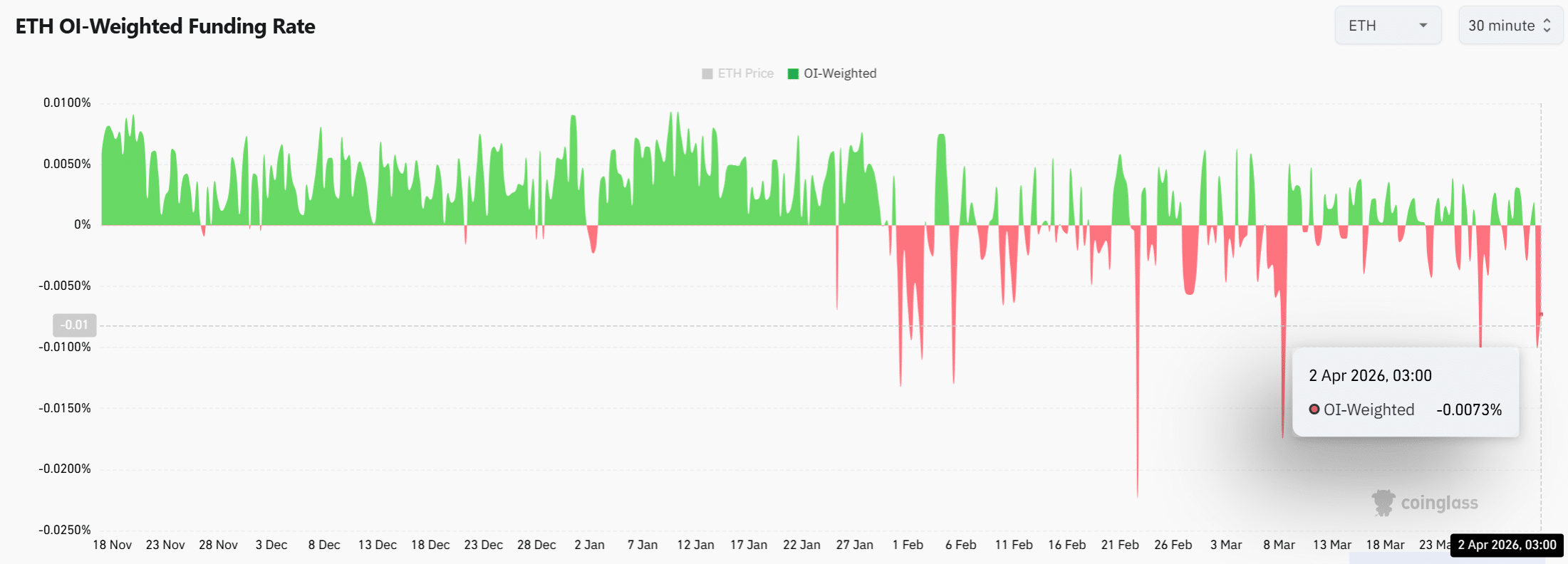
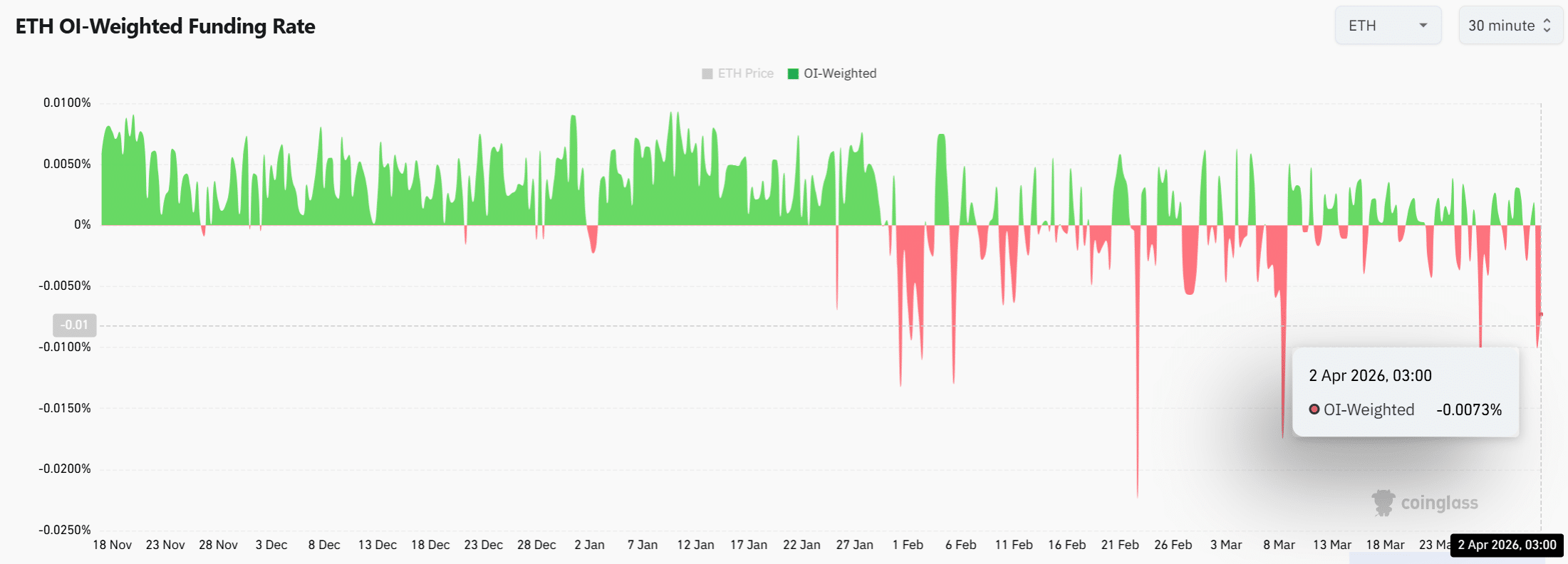
In addition, the OI-Weighted Funding Rate turned negative to -0.0073%, indicating that short positions now dominate.

This shift reflects growing bearish sentiment in the derivatives market, where traders increasingly position for downside or continued consolidation.

However, reduced leverage can also lower volatility, which reinforces the current range-bound behavior.

Therefore, as traders step back and shorts gain control, the price remains constrained, lacking the aggressive positioning needed to drive a breakout.
Source: CoinGlass

Can activity drive a breakout?

Ethereum’s network growth continues to strengthen its foundation, yet the price remains constrained within a defined range.

Reduced leverage and dominant short positioning limit upward expansion, despite ongoing accumulation signals.

This structure suggests that while underlying demand continues building, the market still requires stronger conviction to translate adoption into a sustained breakout.


Final Summary

  • Ethereum [ETH] network activity surged, with over 788K Daily Active Addresses and 255K new addresses created daily.
  • Rising participation signaled growing underlying demand, though price failed to reflect this strength.


Связанные с этим вопросы

QWhat is the current number of Daily Active Addresses on the Ethereum network mentioned in the article?

AOver 788,000 Daily Active Addresses.

QWhat are the key support and resistance levels for Ethereum's price as discussed in the article?

AThe key support level is $1,807 and the resistance level is $2,371.

QWhat does the negative Spot Netflows data indicate about Ethereum's market activity?

AIt indicates that ETH is leaving exchanges, which reduces immediately available supply and typically reflects accumulation behavior as investors move assets to private wallets.

QHow did the Open Interest (OI) and OI-Weighted Funding Rate change, and what does this signal?

AOpen Interest dropped by 8.59% to $28.18B, and the OI-Weighted Funding Rate turned negative to -0.0073%, signaling reduced trader exposure and that short positions now dominate, reflecting growing bearish sentiment.

QDespite strong on-chain growth, why has Ethereum price failed to break out according to the article?

AThe price has failed to break out due to reduced leverage, dominant short positioning in derivatives, and a lack of strong enough demand to absorb resistance levels, keeping the market range-bound.

Похожее

Circle CEO's Seoul Visit: No Korean Won Stablecoin Issuance, But Met All Major Korean Banks

Circle CEO Jeremy Allaire's recent activities in Seoul indicate a strategic shift for the company, moving away from issuing a Korean won-backed stablecoin and instead focusing on embedding itself as a key infrastructure provider within Korea’s financial and crypto ecosystem. Despite Korea accounting for nearly 30% of global crypto trading volume—with a market characterized by high retail participation and altcoin dominance—Circle has chosen not to compete for the role of stablecoin issuer. Instead, Allaire met with major Korean banks (including Shinhan, KB, and Woori), financial groups, leading exchanges (Upbit, Bithumb, Coinone), and tech firms like Kakao. This approach reflects a broader industry transition: the core of stablecoin competition is shifting from issuance rights to systemic positioning. With Korean regulators still debating whether banks or tech companies should issue stablecoins, Circle is avoiding regulatory uncertainty by strengthening its role as a service and technology partner. The company is deepening integration with trading platforms, building connections, and promoting stablecoin infrastructure. This positions Circle to benefit regardless of which entity eventually issues a won stablecoin. Allaire also noted the potential for a Chinese yuan stablecoin in the next 3–5 years, underscoring a regional trend of stablecoins becoming more regulated and integrated with traditional finance. Ultimately, Circle’s strategy highlights that future influence in the stablecoin market will belong not necessarily to the issuers, but to the foundational infrastructure layers that enable cross-system transactions.

marsbit3 мин. назад

Circle CEO's Seoul Visit: No Korean Won Stablecoin Issuance, But Met All Major Korean Banks

marsbit3 мин. назад

SpaceX Ties Up with Cursor: A High-Stakes AI Gambit of 'Lock First, Acquire Later'

SpaceX has secured an option to acquire AI programming company Cursor for $60 billion, with an alternative clause requiring a $10 billion collaboration fee if the acquisition does not proceed. This structure is not merely a potential acquisition but a strategic move to control core access points in the AI era. The deal is designed as a flexible, dual-path arrangement, allowing SpaceX to either fully acquire Cursor or maintain a binding partnership through high-cost collaboration. This "option-style" approach minimizes immediate regulatory and integration risks while ensuring long-term alignment between the two companies. At its core, the transaction exchanges critical AI-era resources: SpaceX provides its Colossus supercomputing cluster—one of the world’s most powerful AI training infrastructures—while Cursor contributes its AI-native developer environment and strong product adoption. This synergy connects compute power, models, and application layers, forming a closed-loop AI capability stack. Cursor, founded in 2022, has achieved rapid growth with over $1 billion in annual revenue and widespread enterprise adoption. Its value lies in transforming software development through AI agents capable of coding, debugging, and system design—positioning it as a gateway to future software production. For SpaceX, this move is part of a broader strategy to evolve from a aerospace company into an AI infrastructure empire, integrating xAI, supercomputing, and chip manufacturing. Controlling Cursor fills a gap in its developer tooling layer, strengthening its AI narrative ahead of a potential IPO. The deal reflects a shift in AI competition from model superiority to ecosystem and entry-point control. With programming tools as a key battleground, securing developer loyalty becomes crucial for dominating the software production landscape. Risks include questions around Cursor’s valuation, technical integration challenges, and potential regulatory scrutiny. Nevertheless, the deal underscores a strategic bet: controlling both compute and software development access may redefine power dynamics in the AI-driven future.

marsbit44 мин. назад

SpaceX Ties Up with Cursor: A High-Stakes AI Gambit of 'Lock First, Acquire Later'

marsbit44 мин. назад

Торговля

Спот
Фьючерсы

Популярные статьи

Manyu: восходящая мем-звезда на Ethereum, готовая открыть новую эру культуры Shiba

Manyu - это мемтокен на Ethereum, который приносит децентрализованную культурную и развлекательную ценность через вирусное влияние в соцсетях и вовлечённость сообщества.

1.9k просмотров всегоОпубликовано 2025.11.27Обновлено 2025.11.27

Manyu: восходящая мем-звезда на Ethereum, готовая открыть новую эру культуры Shiba

Обсуждения

Добро пожаловать в Сообщество HTX. Здесь вы сможете быть в курсе последних новостей о развитии платформы и получить доступ к профессиональной аналитической информации о рынке. Мнения пользователей о цене на ETH (ETH) представлены ниже.

活动图片