Ether price trend forecasts triple-digit rally as ETH ETF inflows resume

cointelegraphОпубликовано 2025-12-11Обновлено 2025-12-11

Введение

Ether (ETH) price is consolidating near $3,200 after facing resistance between $3,350 and $3,650, a zone aligned with the 200-day EMA. Despite this pullback, spot ETH ETF inflows have shown early signs of recovery, rising 28% from $16.8 billion to $21.5 billion since November 21. Net taker volume, while still negative at –$138 million, has improved significantly from October’s –$500 million, indicating reduced selling pressure and a potential shift in market structure. If this trend continues, it could signal a bullish breakout, reminiscent of early 2025 before ETH’s 3x rally. However, ETH is currently testing key support between $3,100–$3,180. A hold above this level could lead to a rebound toward $3,450 and possibly $3,900, while a breakdown might trigger a retest of $3,000. Derivatives data shows neutral but fragile sentiment, with mildly positive funding rates and near-neutral bid/ask ratios. The next major price move depends on whether improving ETF inflows and taker activity translate into sustained buying pressure.

Ether’s (ETH) price action cooled this week after a sharp rejection from the $3,650 to $3,350 supply zone, with the altcoin now hovering near $3,200. The rejection aligned with the 200-day exponential moving average (EMA), reinforcing overhead resistance just as spot exchange-traded funds (ETFs) flows began showing early signs of recovery.

Key takeaways:

  • Spot Ether ETF flows have risen from $16.8 billion to $21.5 billion since Nov. 21, a 28% increase.

  • Net taker volumes rose, signaling that aggressive sellers are weakening while taker buyers slowly return.
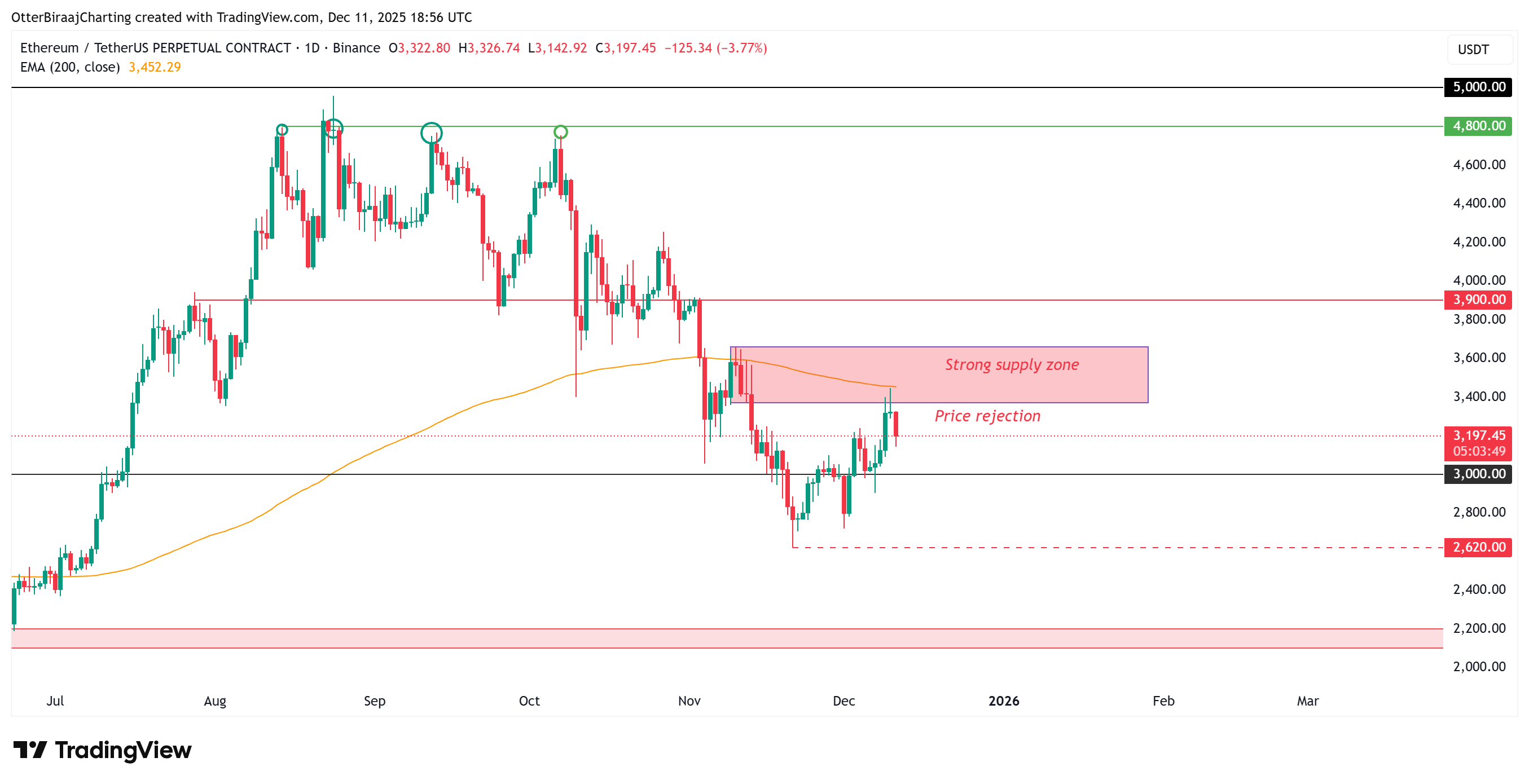
Ethereum one-day chart. Source: Cointelegraph/TradingView

ETF inflows resume, but ETH charts reflect traders’ fear

According to Glassnode, spot ETH ETFs are finally showing “the first signs of life” after several weeks of outflows. A 28% recovery since Nov. 21 in total net ETF assets hints at improving demand into year-end.

However, the rebound is still modest compared to the $32 billion peak in early October, suggesting that institutional conviction has not fully returned.
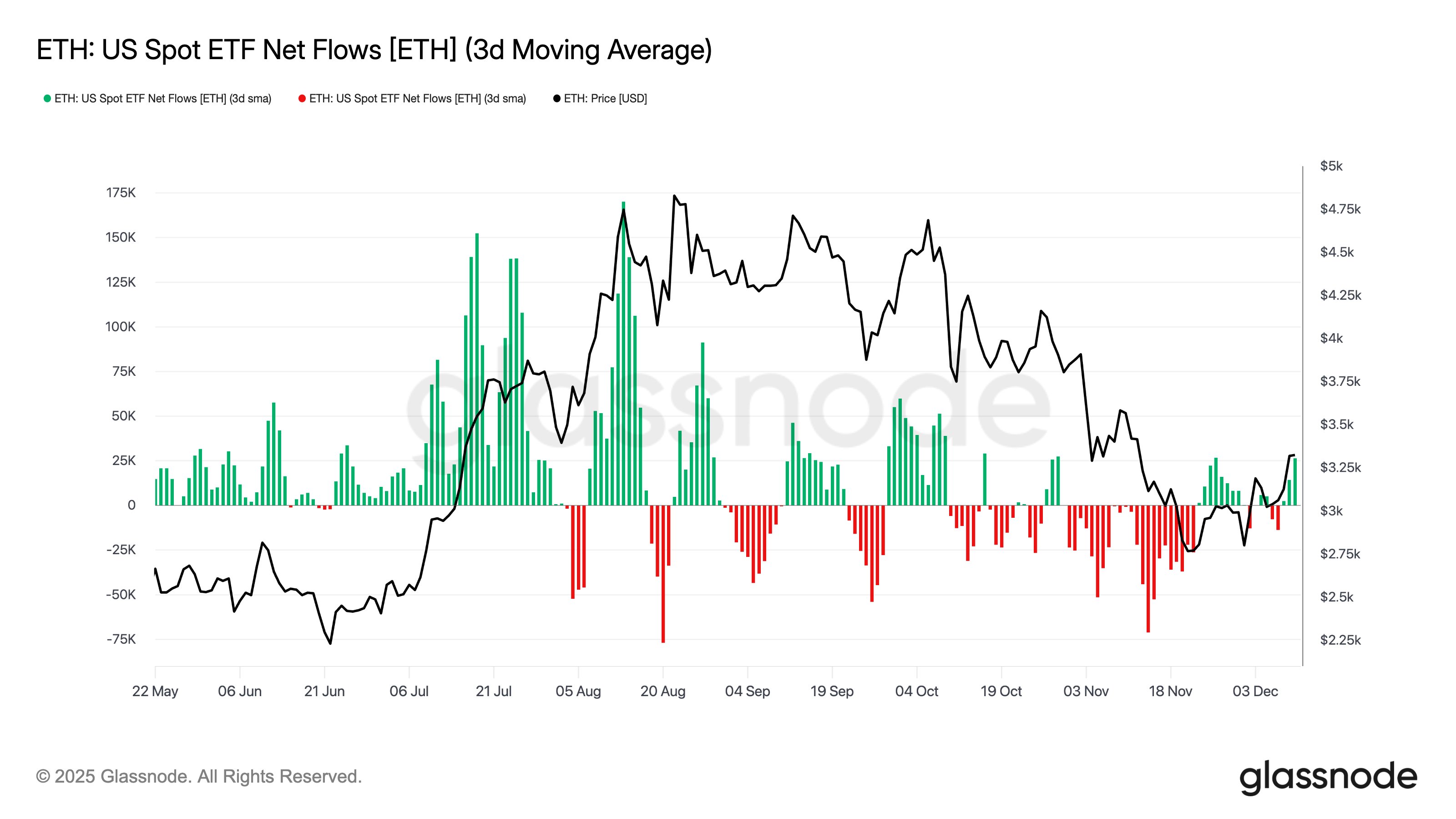
Spot ETH ETF net flows. Source: Glassnode

Data from CryptoQuant strengthened this narrative. The net taker volume remained negative at –$138 million, yet the improvement from October’s –$500 million extreme marks a structural shift. Aggressive sellers dominated the market during the September–October drawdown, but that dynamic is slowly fading.

The 30-day moving average of net taker volume also shows an ascending pattern in its lows, a structure last seen in early 2025, just before ETH launched a 3X rally and printed a new all-time high.

If the current trajectory holds, a positive flip in taker volume activity could be a high-probability trigger for another bullish breakout phase for ETH in the coming weeks.
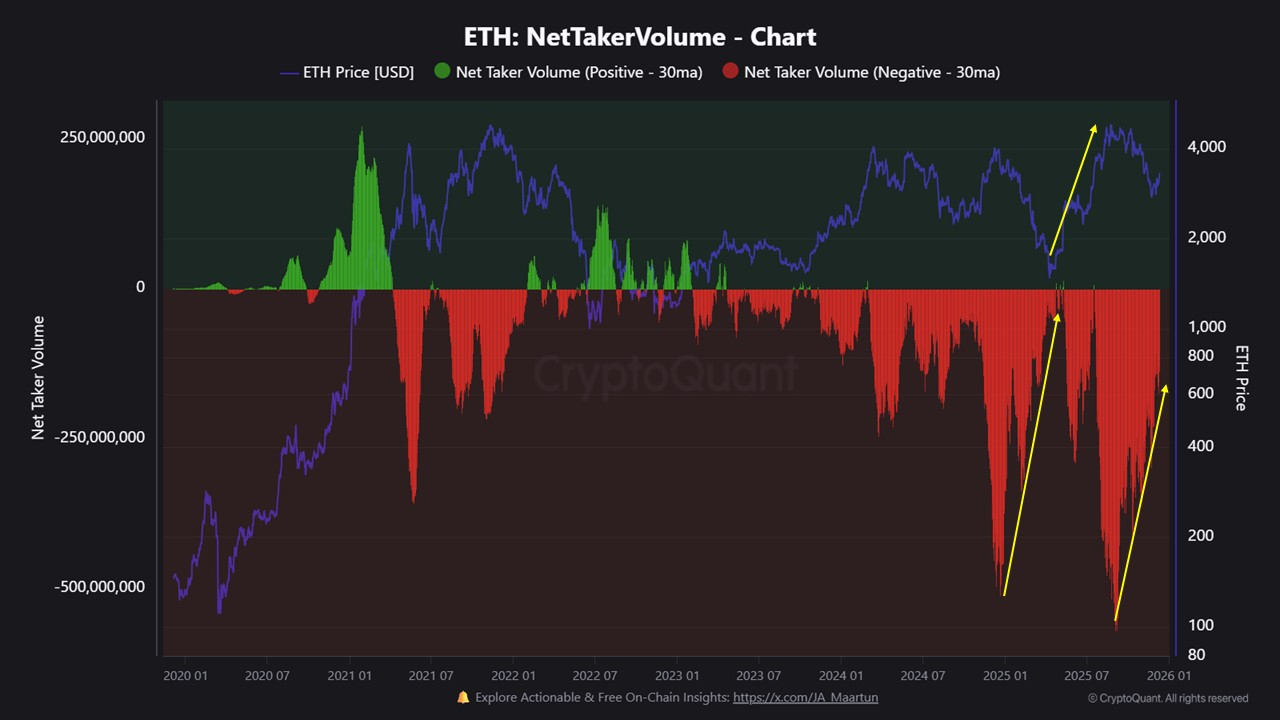
Ether Net taker volume data. Source: CryptoQuant

Related: Ether vs. Bitcoin: ETH price poised for 80% rally in 2026

ETH price compresses at support as derivatives cool off

Ether is currently testing the $3,100–$3,180 order block on the four-hour chart, a region that could serve as a demand zone. ETH price continued to respect its ascending channel, but momentum is clearly cooling. The market is now at a structural crossroads.
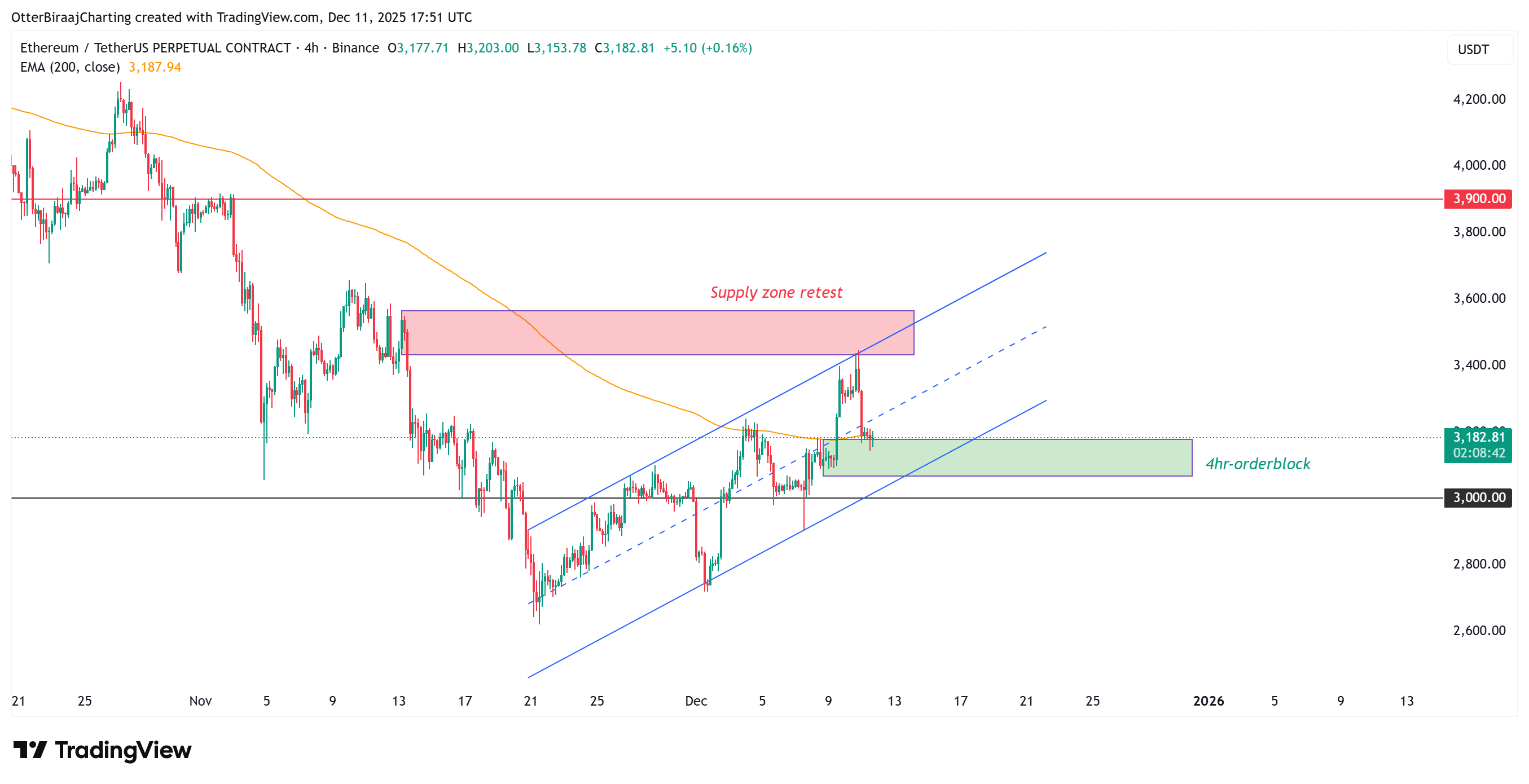
Ether four-hour chart. Source: Cointelegraph/TradingView

In a bullish scenario, holding the demand block and channel support would allow ETH to rebound toward the daily 200-EMA. A clean break above $3,450 would invalidate the rejection and reopen the path toward $3,900 resistance.

However, from a bearish standpoint, a breakdown below the ascending channel support exposes a bearish confirmation and a possible retest of $3,000, a key support level.

Data from Hyblock indicated that Ether derivatives support the neutral but fragile thesis. Aggregated open interest (OI) has unwound slightly after the rejection. The funding rate is mildly positive but not stretched, and the bid/ask ratio remains close to neutral, showing spot takers are not yet leaning aggressively bullish.
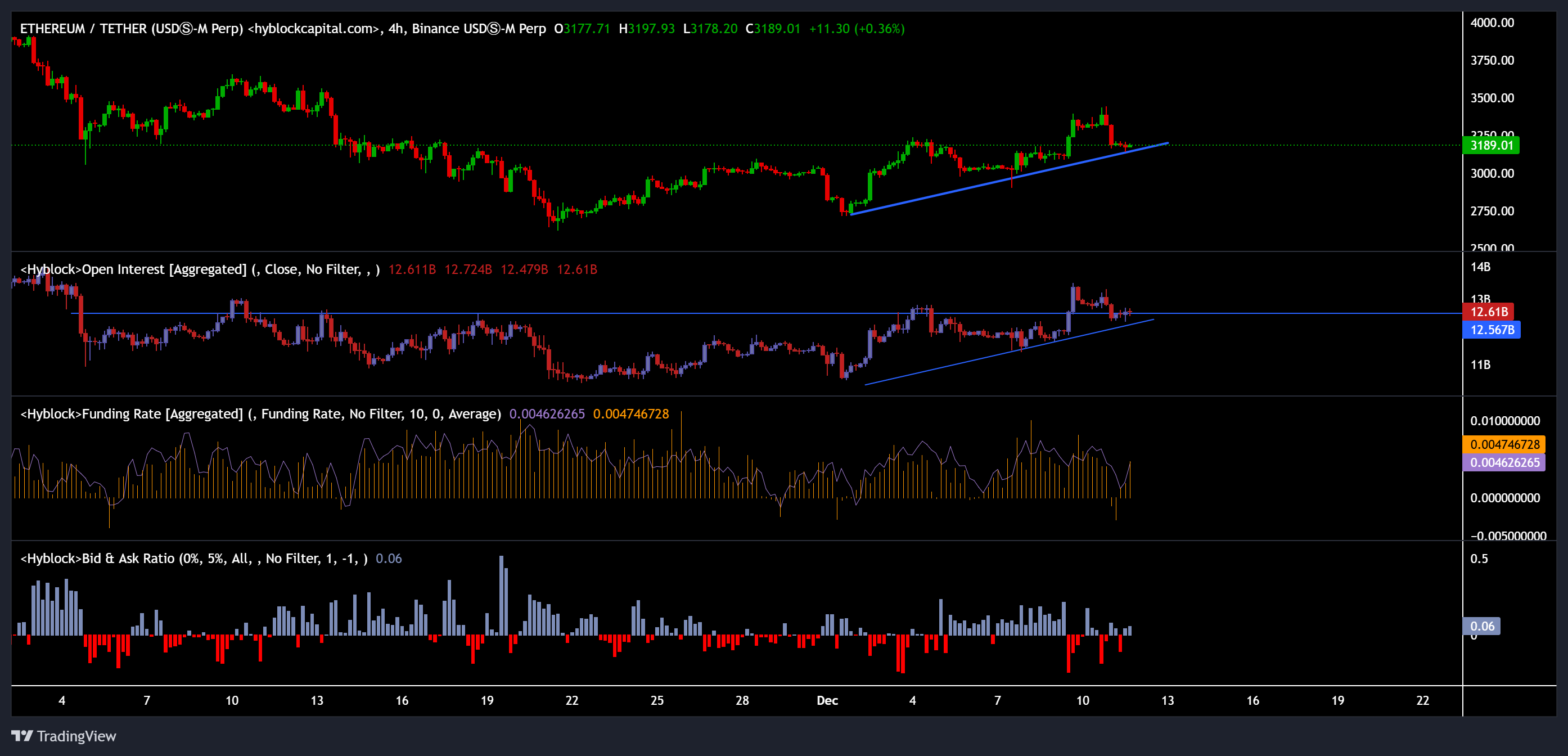
Ether futures data analysis. Source: Hyblock Capital

ETH’s next major move now depends on whether bulls can defend the demand zone long enough for improving taker flows and ETF demand to translate into sustained upside pressure.

Related: Bitcoin rallies fail at $94K despite Fed policy shift: Here’s why

This article does not contain investment advice or recommendations. Every investment and trading move involves risk, and readers should conduct their own research when making a decision. While we strive to provide accurate and timely information, Cointelegraph does not guarantee the accuracy, completeness, or reliability of any information in this article. This article may contain forward-looking statements that are subject to risks and uncertainties. Cointelegraph will not be liable for any loss or damage arising from your reliance on this information.

Похожее

The More It Rises, the More Dangerous? The Systemic Risks Behind SpaceX's Soaring Valuation

Summary: The article raises concerns about the systemic risks posed by SpaceX's skyrocketing valuation, arguing that modern market mechanics, rather than fundamentals, are driving its price discovery. Following SpaceX's market capitalization surpassing $3 trillion in after-hours trading, the author contends that the market is no longer functioning properly. The core issue is not SpaceX's business prospects but the unhealthy market structure surrounding it. With limited float and the imminent launch of options trading, the stage is set for a potential "gamma squeeze"—a feedback loop where market makers hedging call options are forced to buy shares, pushing the price higher and attracting more speculative momentum traders. This mechanism, seen previously with Tesla and meme stocks, can decouple valuation from financial reality. The danger escalates as extreme valuations force passive funds, ETFs, pensions, and major indices to hold the stock. If SpaceX grows large enough—hypothetically reaching $5 or even $10 trillion—its performance would increasingly dictate broader market indices, embedding systemic risk. The author warns that when price appreciation itself becomes the primary bullish thesis, the market transforms from a capital allocation mechanism into a self-reinforcing speculative machine, endangering the retirement savings of ordinary investors tied to passive strategies. The piece questions whether such a system can still perform its fundamental role of price discovery.

marsbit5 мин. назад

The More It Rises, the More Dangerous? The Systemic Risks Behind SpaceX's Soaring Valuation

marsbit5 мин. назад

How Much of the Subscription Fee You Pay to Claude Can Optical Module Companies Get?

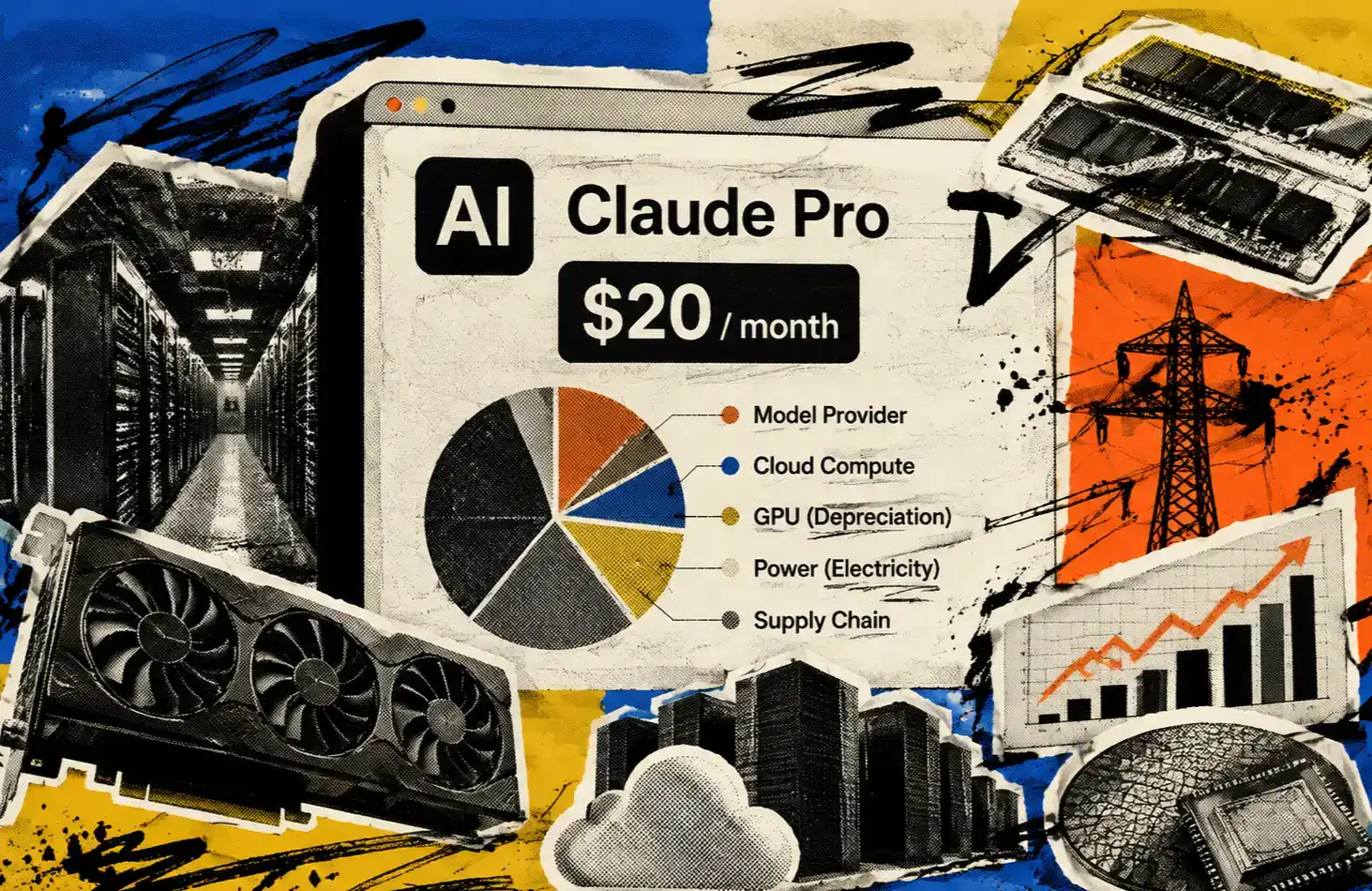
How much of your $20 Claude Pro subscription actually goes to AI model companies like Anthropic? A viral breakdown image highlights the fundamental valuation challenge for AI applications versus traditional SaaS. Unlike SaaS with high software margins, AI subscriptions face variable "inference costs": every user query consumes GPU time, power, and cloud resources. This creates a tension between fixed subscription fees and usage-driven expenses. While the specific dollar splits are illustrative, the core question is whether AI revenue can achieve SaaS-like margins as usage scales. Currently, infrastructure providers (cloud platforms, GPU makers like Nvidia, HBM suppliers, power/data centers) capture more certain revenue from growing AI usage. Their financials reflect pricing power and faster earnings validation. The bullish case hinges on efficiency improvements: model optimization, caching, smaller models, and custom chips could lower per-token costs over time. The key debate is whether cost declines can outpace increases in user workload complexity and volume. Ultimately, for AI companies to command high SaaS-like valuations, they must demonstrate not just user growth but also improving gross margins after accounting for inference costs. Investors will scrutinize not just subscriber numbers, but usage patterns, enterprise pricing tiers, and real efficiency gains.

marsbit15 мин. назад

How Much of the Subscription Fee You Pay to Claude Can Optical Module Companies Get?

marsbit15 мин. назад

OpenAI's Hyperliquid Pre-IPO Pricing Venture: Why Did It Last Only Half a Year?

The article discusses the rise and fall of Pre-IPO pricing markets on the Hyperliquid blockchain. Trade.xyz, an anonymous team, successfully built the largest pre-market for SpaceX (SPCX) by launching a contract with a clear anchor: the eventual Nasdaq listing price. This provided inherent price stability and validation. In contrast, Ventuals, a team backed by Paradigm, failed despite holding exclusive contracts for highly sought-after companies like OpenAI and Anthropic. Its key mistake was its pricing mechanism. For companies with no near-term IPO date, Ventuals' oracle relied partly on opaque private market transactions and, critically, partly on its own contract's moving average price. This created a self-referential feedback loop where prices were artificially propped up and detached from genuine supply and demand, leading to illiquid markets. Ventuals shut down after nine months, settling positions at final prices of $1,341.80 for OpenAI and $1,618.90 for Anthropic. Ironically, some employees and late-stage investors of these very companies reportedly used these flawed Ventuals prices for valuation reference, highlighting the acute demand for any price signal in illiquid private markets. The article concludes that while demand for pre-IPO trading is real and growing, with players like Coinbase now entering the space, the fundamental challenge remains: without a public listing to provide a definitive price anchor, these markets struggle to establish truly accurate and liquid pricing. The need for a transparent, self-correcting market is the critical lesson from Ventuals' failure.

marsbit31 мин. назад

OpenAI's Hyperliquid Pre-IPO Pricing Venture: Why Did It Last Only Half a Year?

marsbit31 мин. назад

With Daily Active Users Reaching 3-4 Times That of the Industry's Second Place, Which Crack in the Office Agent Market Has Tencent's WorkBuddy Torn Open?

Tencent's AI office assistant, WorkBuddy, has achieved daily active users (DAU) 3-4 times that of the industry's second-place product, primarily driven by non-technical users like HR, operations, and administrative staff. Its rapid growth, starting with a public beta in March 2026, highlights a key strategic divergence from competitors like OpenAI's Codex and Anthropic's Claude Code. Unlike those tools, which originated as developer-focused assistants (in command lines or IDEs) and are now expanding towards office scenarios, WorkBuddy was built from the ground up for non-technical office workers. Its development was user-driven, initiated after腾讯云's team observed non-technical employees using their CodeBuddy coding tool for general tasks. WorkBuddy's design is defined by three core decisions aimed at lowering barriers: 1) Using natural language instead of technical concepts, so users describe their goal without needing to understand prompts or agents. 2) Providing pre-packaged "Skill" templates for common office tasks like data processing, content creation, and research. 3) Natively integrating into existing腾讯 ecosystems like腾讯 Docs and WeChat, making the agent a seamless part of the user's workflow rather than a separate tool. This "scenario encapsulation" approach, prioritizing the shortest path for users to get work done, contrasts with the "underlying capability" focus of Codex and Claude, which offer more flexibility but require more technical setup. Analysts confirm WorkBuddy's leading market position in China by mid-2026, with massive user and request growth following its launch. Recognizing the same trend of surging non-technical adoption, OpenAI and Anthropic are now pivoting their products with features like role-based plugins (Codex) and a simplified desktop interface (Claude Cowork). However, adapting tools built for developers requires significant changes to interaction models and integrations. WorkBuddy currently holds an estimated six-month lead in delivering a complete solution for non-technical office users. Its recently launched enterprise version aims to solidify this advantage. The competition underscores two valid paths: embedding agent capabilities directly into familiar work environments versus building powerful, general-purpose agents that users must learn to access. WorkBuddy's early success demonstrates the effectiveness of the former strategy for mainstream office adoption.

marsbit40 мин. назад

With Daily Active Users Reaching 3-4 Times That of the Industry's Second Place, Which Crack in the Office Agent Market Has Tencent's WorkBuddy Torn Open?

marsbit40 мин. назад

Торговля

Спот
Фьючерсы

Популярные статьи

Manyu: восходящая мем-звезда на Ethereum, готовая открыть новую эру культуры Shiba

Manyu - это мемтокен на Ethereum, который приносит децентрализованную культурную и развлекательную ценность через вирусное влияние в соцсетях и вовлечённость сообщества.

2.0k просмотров всегоОпубликовано 2025.11.27Обновлено 2025.11.27

Manyu: восходящая мем-звезда на Ethereum, готовая открыть новую эру культуры Shiba

Неделя обучения по популярным токенам 14: Glamsterdam — самое ожидаемое обновление Ethereum в 2026 году

Ordinals/Runes по-прежнему стимулируют доходы от комиссий за блоки и активность разработчиков, рассматриваются как отправная точка «нативной эмиссии активов» в сети.

1.5k просмотров всегоОпубликовано 2026.04.29Обновлено 2026.04.29

Неделя обучения по популярным токенам 14: Glamsterdam — самое ожидаемое обновление Ethereum в 2026 году

Обсуждения

Добро пожаловать в Сообщество HTX. Здесь вы сможете быть в курсе последних новостей о развитии платформы и получить доступ к профессиональной аналитической информации о рынке. Мнения пользователей о цене на ETH (ETH) представлены ниже.

活动图片