Ethena’s USDe loses $8.3B since October crash amid ‘loss of confidence’

cointelegraphОпубликовано 2025-12-23Обновлено 2025-12-23

Введение

Ethena's synthetic dollar stablecoin, USDe, has experienced approximately $8.3 billion in net outflows since the major market crash on October 10th, driven by a significant loss of confidence. Its market capitalization fell from nearly $14.7 billion to around $6.4 billion in just over two months. The October liquidation event, which erased an estimated $1.3 trillion from the crypto market, marked a turning point, shifting the market into a deleveraging phase. Although USDe briefly lost its peg on Binance due to an internal oracle issue, its minting and redemption mechanisms reportedly functioned normally. Since the crash, broader crypto market activity has weakened, with trading volumes down roughly 50% and significant outflows from U.S. spot Bitcoin ETFs.

Ethena’s synthetic dollar USDe has shed about $8.3 billion in net outflows since the major liquidation event on Oct. 10, as confidence in leveraged and synthetic collateral structures continues to weaken.

According to a report from 10x Research, the October sell-off marked a turning point for the crypto market, flipping the bull phase into a period of deleveraging. The crash erased an estimated $1.3 trillion in crypto market value, nearly 30% of total capitalization at the time.

Ethena USDe (USDe), which relies on synthetic collateral and hedging mechanisms rather than traditional fiat reserves, faced a “sharp loss of confidence” under these conditions, the analysts wrote.

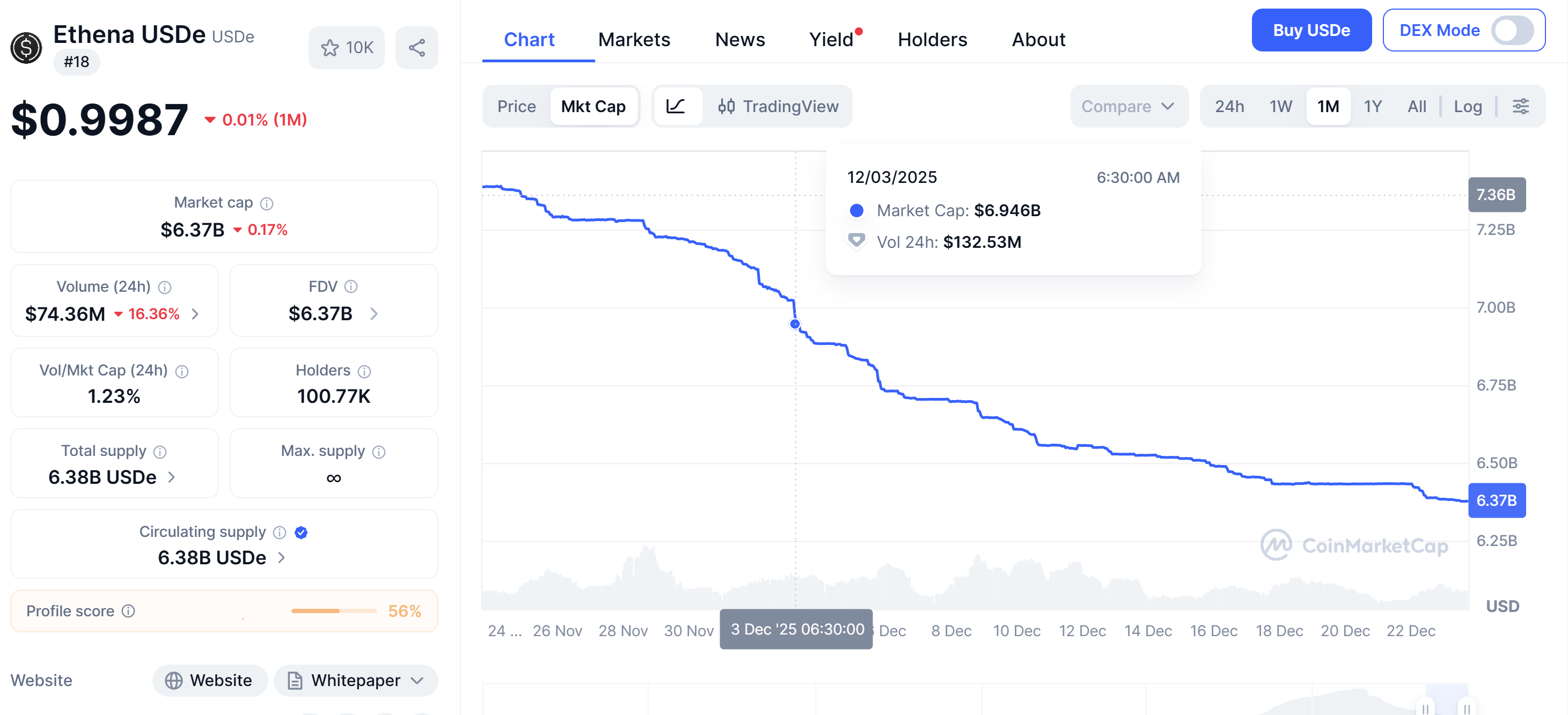
According to data from CoinMarketCap, USDe’s market cap stood at nearly $14.7 billion on Oct. 9. In just over two months, that value dropped to around $6.4 billion.

USDe’s market cap declines. Source: CoinMarketCap.

Related: $19B crypto market crash: Was it leverage, China tariffs or both?

USDe’s brief price depeg glitch

Following the Oct. 10 crash, USDe temporarily lost its peg and dropped to about $0.65 on Binance. Ethena Labs founder Guy Young said the brief depeg on the exchange was caused by an internal oracle issue at the exchange, not by problems with the stablecoin’s collateral, protocol or redemption mechanics.

He said USDe minting and redemptions functioned normally during the market crash, with about $2 billion redeemed in 24 hours across major decentralized finance (DeFi) venues and only minor price deviations elsewhere. At the time of writing, USDe is trading at $0.9987, according to data from CoinMarketCap.

The crypto market crash on Oct. 10 was the largest liquidation event in the crypto market’s history. More than $19 billion in crypto positions were liquidated, according to CoinGlass data, leading to a $65 billion decline in open interest.

Related: Crypto.com CEO Urges Probe After $20B Liquidations

Crypto market activity stalls

Since the crash, broader market activity has also thinned. Crypto trading volumes are down roughly 50%, while US-listed spot Bitcoin exchange-traded funds (ETFs) have seen about $5 billion in net outflows since late October.

10x Research said that the current weakness is less about retail capitulation and more about a deliberate pullback by regulated capital. As leverage and liquidity retreat, Bitcoin (BTC) has decoupled from both equities and gold, trading more like an isolated risk asset than a macro hedge.

Magazine: 2026 is the year of pragmatic privacy in crypto — Canton, Zcash and more

Связанные с этим вопросы

QWhat was the total amount of net outflows from Ethena's USDe since the October crash, and what was the primary reason cited for this decline?

AEthena's USDe shed about $8.3 billion in net outflows. The primary reason cited was a 'sharp loss of confidence' in leveraged and synthetic collateral structures following the market crash.

QAccording to the report from 10x Research, what was the estimated value of the crypto market that was erased during the October 10th crash?

AThe October 10th crash erased an estimated $1.3 trillion in crypto market value, which was nearly 30% of the total capitalization at the time.

QWhat did Ethena Labs founder Guy Young identify as the cause of USDe's brief price depeg on Binance?

AGuy Young stated that the brief depeg on Binance was caused by an internal oracle issue at the exchange, not by problems with the stablecoin’s collateral, protocol, or redemption mechanics.

QHow much did the open interest in the crypto market decline by, according to CoinGlass data from the October 10th liquidation event?

AAccording to CoinGlass data, the October 10th liquidation event led to a $65 billion decline in open interest.

QHow have US-listed spot Bitcoin ETFs performed in terms of flows since late October?

AUS-listed spot Bitcoin ETFs have seen about $5 billion in net outflows since late October.

Похожее

From Theft to Re-entry: How Was $292 Million "Laundered"?

A sophisticated crypto laundering operation was executed following the $292 million hack of Kelp DAO on April 18. The attack, attributed to the North Korean Lazarus group, began with anonymous infrastructure preparation using Tornado Cash to fund wallets untraceably. The hacker exploited a vulnerability in Kelp’s cross-chain bridge, stealing 116,500 rsETH. To avoid crashing the market, the attacker used Aave and Compound as laundering tools—depositing the stolen rsETH as collateral to borrow $190 million in clean, liquid ETH. This move triggered a bank run on Aave, causing an $8 billion drop in TVL. After consolidating funds, the attacker fragmented them across hundreds of wallets to evade detection. A major breakpoint was THORChain, where over $460 million in volume—30 times its usual activity—was processed in 24 hours, converting ETH into Bitcoin. This shift to Bitcoin’s UTXO model exponentially increased tracing complexity by shattering funds into countless untraceable fragments. The final destination was Tron-based USDT, the primary channel for illicit crypto flows. From there, funds were cashed out via OTC brokers in China and Southeast Asia, using unlicensed underground banks and UnionPay networks outside Western sanctions scope. Ultimately, the laundered money supports North Korea’s weapons programs, which rely heavily on crypto hacking for foreign currency. The incident underscores structural challenges in DeFi: its openness, composability, and lack of central control make such laundering not just possible, but inherently difficult to prevent.

marsbit1 ч. назад

From Theft to Re-entry: How Was $292 Million "Laundered"?

marsbit1 ч. назад

Google and Amazon Simultaneously Invest Heavily in a Competitor: The Most Absurd Business Logic of the AI Era Is Becoming Reality

In a span of four days, Amazon announced an additional $25 billion investment, and Google pledged up to $40 billion—both direct competitors pouring over $65 billion into the same AI startup, Anthropic. Rather than a typical venture capital move, this signals the latest escalation in the cloud wars. The core of the deal is not equity but compute pre-orders: Anthropic must spend the majority of these funds on AWS and Google Cloud services and chips, effectively locking in massive future compute consumption. This reflects a shift in cloud market dynamics—enterprises now choose cloud providers based on which hosts the best AI models, not just price or stability. With OpenAI deeply tied to Microsoft, Anthropic’s Claude has become the only viable strategic asset for Google and Amazon to remain competitive. Anthropic’s annualized revenue has surged to $30 billion, and it is expanding into verticals like biotech, positioning itself as a cross-industry AI infrastructure layer. However, this funding comes with constraints: Anthropic’s independence is challenged as it balances two rival investors, its safety-first narrative faces pressure from regulatory scrutiny, and its path to IPO introduces new financial pressures. Globally, this accelerates a "tri-polar" closed-loop structure in AI infrastructure, with Microsoft-OpenAI, Google-Anthropic, and Amazon-Anthropic forming exclusive model-cloud alliances. In contrast, China’s landscape differs—investments like Alibaba and Tencent backing open-source model firm DeepSeek reflect a more decoupled approach, though closed-source models from major cloud providers still dominate. The $65 billion bet is ultimately about securing a seat at the table in an AI-defined future—where missing the model layer means losing the cloud war.

marsbit7 ч. назад

Google and Amazon Simultaneously Invest Heavily in a Competitor: The Most Absurd Business Logic of the AI Era Is Becoming Reality

marsbit7 ч. назад

Торговля

Спот
Фьючерсы

Популярные статьи

Как купить S

Добро пожаловать на HTX.com! Мы сделали приобретение Sonic (S) простым и удобным. Следуйте нашему пошаговому руководству и отправляйтесь в свое крипто-путешествие.Шаг 1: Создайте аккаунт на HTXИспользуйте свой адрес электронной почты или номер телефона, чтобы зарегистрироваться и бесплатно создать аккаунт на HTX. Пройдите удобную регистрацию и откройте для себя весь функционал.Создать аккаунтШаг 2: Перейдите в Купить криптовалюту и выберите свой способ оплатыКредитная/Дебетовая Карта: Используйте свою карту Visa или Mastercard для мгновенной покупки Sonic (S).Баланс: Используйте средства с баланса вашего аккаунта HTX для простой торговли.Третьи Лица: Мы добавили популярные способы оплаты, такие как Google Pay и Apple Pay, для повышения удобства.P2P: Торгуйте напрямую с другими пользователями на HTX.Внебиржевая Торговля (OTC): Мы предлагаем индивидуальные услуги и конкурентоспособные обменные курсы для трейдеров.Шаг 3: Хранение Sonic (S)После приобретения вами Sonic (S) храните их в своем аккаунте на HTX. В качестве альтернативы вы можете отправить их куда-либо с помощью перевода в блокчейне или использовать для торговли с другими криптовалютами.Шаг 4: Торговля Sonic (S)С легкостью торгуйте Sonic (S) на спотовом рынке HTX. Просто зайдите в свой аккаунт, выберите торговую пару, совершайте сделки и следите за ними в режиме реального времени. Мы предлагаем удобный интерфейс как для начинающих, так и для опытных трейдеров.

1.2k просмотров всегоОпубликовано 2025.01.15Обновлено 2025.03.21

Как купить S

Sonic: Обновления под руководством Андре Кронье – новая звезда Layer-1 на фоне спада рынка

Он решает проблемы масштабируемости, совместимости между блокчейнами и стимулов для разработчиков с помощью технологических инноваций.

2.2k просмотров всегоОпубликовано 2025.04.09Обновлено 2025.04.09

Sonic: Обновления под руководством Андре Кронье – новая звезда Layer-1 на фоне спада рынка

HTX Learn: Пройдите обучение по "Sonic" и разделите 1000 USDT

HTX Learn — ваш проводник в мир перспективных проектов, и мы запускаем специальное мероприятие "Учитесь и Зарабатывайте", посвящённое этим проектам. Наше новое направление .

1.8k просмотров всегоОпубликовано 2025.04.10Обновлено 2025.04.10

HTX Learn: Пройдите обучение по "Sonic" и разделите 1000 USDT

Обсуждения

Добро пожаловать в Сообщество HTX. Здесь вы сможете быть в курсе последних новостей о развитии платформы и получить доступ к профессиональной аналитической информации о рынке. Мнения пользователей о цене на S (S) представлены ниже.

活动图片