ETC Olympia Development Part 1: Implementing ECIP-1111 and ECIP-1112

金色财经Опубликовано 2025-12-12Обновлено 2025-12-12

Введение

ETC Olympia Development Series Part 1: Implementing ECIP-1111 and ECIP-1112 This article introduces the first part of the Ethereum Classic Olympia development series, focusing on the implementation of ECIP-1111 and ECIP-1112. These two proposals are the only components within the broader Olympia framework that modify consensus behavior. ECIP-1111 modernizes the fee market by introducing an EIP-1559-style mechanism with a base fee and optional priority tip (miner tip). A key difference from Ethereum is that the base fee is not burned but is instead redirected to a treasury address defined by ECIP-1112. It also adds support for Type-2 transactions and the BASEFEE opcode (0x48), ensuring compatibility with modern EVM tooling and wallets. Crucially, it does not change miner rewards, monetary policy, or existing transaction types. ECIP-1112 defines an immutable, deterministic treasury smart contract that will receive the redirected base fees. This vault is designed to be receive-only upon activation, meaning it can accumulate value but cannot distribute funds until a separate, subsequent governance layer (defined in other ECIPs) is deployed and activated on the contract layer. The article emphasizes the modular architecture of Olympia. While the suite includes five ECIPs (1111-1115), only these two affect consensus. This separation ensures that the core protocol remains minimal and auditable, while future governance and funding mechanisms can evolve independently at the contra...

Ethereum Classic Core Developers - Olympia Development Series (Part 1)

Implementing ECIP-1111 and ECIP-1112: Base Fee Redirection and the Immutable Treasury

1. Introduction - From Concept to Code

This section provides an overview of the overall architecture of Olympia: its purpose, development history, and how ECIPs 1111-1115 fit into the modular, multi-layer upgrade path. This article will delve into the current engineering practices for two ECIPs, which together define the consensus boundaries of Olympia:

  • ECIP-1111 — EVM and Protocol Upgrades

  • ECIP-1112 — Immutable Treasury Contract

These two proposals are the only components in Olympia that modify consensus behavior. Other parts of the framework—governance (ECIP-1113), funding proposals (ECIP-1114), and the optional smoothing mechanism (ECIP-1115)—all operate at the contract layer and do not affect block validity or fork choice. On November 11, 2025, Ethereum Classic core developers initiated the implementation phase, preparing consensus logic and reference client infrastructure for a potential Mordor testnet deployment.

This article outlines:

  • What ECIP-1111 introduces

  • How ECIP-1112 defines the treasury target address

  • How these components work together

  • What is currently being prototyped in reference client development

This article only describes design proposals and implementation work and does not indicate that they will necessarily be activated or adopted in the future through the ECIP-1000 process. Before deploying the consensus layer changes of ECIP-1111 or ECIP-1112 to Mordor or the mainnet, ETC clients must first verify their stability and compatibility under baseline conditions.

2. ECIP-1111 — Modernizing the Fee Mechanism, Minimizing Network Disruption

ECIP-1111 integrates two widely adopted EVM improvements:

  • EIP-1559-style fee mechanism (Base Fee + optional tip) This mechanism introduces:

  • A dynamically adjusting base fee (BASEFEE),

  • An optional high-priority fee (tip) still paid directly to miners

  • And a more predictable fee market for modern tools.

2. Support for Type-2 (1559-style) transactions: This functionality has become standard for most wallets and infrastructure.

3. BASEFEE opcode (0x48): This exposes the current block's BASEFEE to contract logic (gas estimators, DEX routers, toolchains, etc.).

What changes for Ethereum Classic (ETC)?

Only one behavior differs from the Ethereum mainnet:

  • Ethereum Foundation (ETH): BASEFEE is burned.

  • Ethereum Classic (ETC): BASEFEE is redirected to the treasury defined by ECIP-1112. All other EIP-1559 semantics remain unchanged.

What remains the same?

  • Miner tips remain unchanged.

  • Block rewards remain unchanged.

  • Monetary policy (ECIP-1017) remains unchanged.

  • Traditional transaction types (Type-0 and Type-1) remain fully valid.

  • Existing contracts will not break; existing applications require no modifications.

  • No additional trust assumptions or permission mechanisms are introduced.

ECIP-1111 is additive, minimal, and strictly limited to modernizing the fee mechanism and enabling the BASEFEE redirection function.

3. ECIP-1112 — The Immutable Deterministic Treasury

ECIP-1112 defines the receiving address for the redirected base fees: a minimal, immutable smart contract deployed at a deterministic address. These definitions remain theoretical until client software demonstrates consistent behavior in a multi-client environment, a milestone requiring comprehensive testing to safely assess the Olympia components.

Core Features

  • Immutability: No upgrade key, no admin, no proxy pattern.

  • Deterministic address (e.g., via CREATE2): All clients agree on the same treasury destination.

  • Receive-only upon activation: The treasury can accumulate value but cannot release funds until subsequent governance is activated.

  • No internal governance logic: Purely a custody layer, not a decision-making layer.

Upon activation (testnet or mainnet):

  • The treasury can only receive funds.

  • No withdrawal mechanism is enabled until ECIP-1113 and ECIP-1114 are deployed, audited, and intentionally activated. This separation ensures predictability for consensus upgrades and makes them independent of the implementation of any governance scheme.

4. Clear Consensus Boundaries

Although Olympia comprises five ECIP proposals, only ECIP-1111 and ECIP-1112 change consensus behavior.

Consensus Boundary Summary

  • ECIP-1111 — Protocol layer. Introduces consensus changes: new base fee mechanism, Type-2 transactions, and the BASEFEE opcode.

  • ECIP-1112 — Protocol/Contract layer. Introduces consensus changes: defines the deterministic treasury receiving address for redirected base fees.

  • ECIP-1113 — Contract/Application layer. No consensus changes.
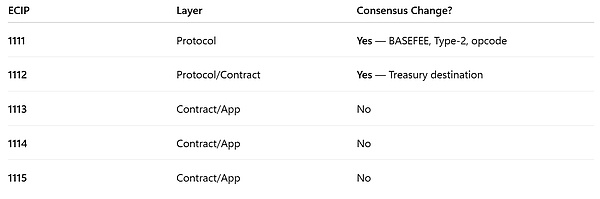
  • ECIP-1114 — Contract/Application layer. No consensus changes.

  • ECIP-1115 — Contract/Application layer. No consensus changes.

This modular structure ensures:

  • Consensus-critical logic remains lean and auditable,

  • Governance and funding mechanisms can evolve at the contract layer,

  • Improvements to ECIP-1113 to 1115 require no additional consensus changes.

If adopted, clients implementing ECIP-1111 and ECIP-1112 will maintain consensus compatibility, unaffected by subsequent governance layer deployments. Reference implementations can begin prototyping consensus logic during the draft stage, but these changes must undergo comprehensive testing (including baseline client validation such as the Gorgoroth verification described in Part II) before being merged into production clients.

5. Why Governance Activation is Delayed

If ECIP-1111 and ECIP-1112 are activated, base fees will begin flowing into the treasury—but treasury spending will remain disabled.

This phased deployment enables:

  • Independent testing of base fees

  • Comprehensive auditing of ECIP-1113 and ECIP-1114

  • Precise coordination among client implementers and infrastructure providers

  • Predictable behavior for node operators

If governance contracts are subsequently deployed and activated, the treasury will connect with authorized executors entirely at the contract layer (not the consensus layer).

6. Type-2 Transactions and Long-term EVM Interoperability

Type-2 transaction support is crucial for Ethereum Classic to maintain compatibility with:

  • Modern wallets

  • Exchanges and custody services

  • RPC infrastructure

  • Tooling frameworks (Hardhat, Foundry, etc.)

  • Block explorers

  • Cross-chain interoperability

Type-2 transactions do not alter user requirements or introduce permission mechanisms. Traditional transaction types will remain fully supported.

Type-2, as an incremental feature, ensures ETC maintains interoperability with the mainstream transaction format of the EVM ecosystem.

7. The Broader Context — Maintaining a Programmable Proof-of-Work Base Layer

Together, ECIP-1111 and ECIP-1112 constitute a foundational step for Ethereum Classic towards a sustainably funded, operational model for programmable proof-of-work—provided the community chooses to adopt these proposals.

These proposals achieve their goals without:

  • Modifying miner incentives

  • Introducing inflation

  • Changing monetary policy

  • Adding a governance layer to consensus

  • Altering Ethereum Classic's security assumptions

Their purpose is limited to:

  • Modernizing the fee market

  • Establishing a transparent protocol-level value accrual mechanism

If adopted, these changes will pave the way for the contract-layer governance and funding systems in subsequent Olympia proposals, without requiring new consensus rules.

8. Conclusion — Minimal, Secure, and Forward-Compatible

ECIP-1111 and ECIP-1112 define the consensus layer components proposed within the Olympia framework. They:

  • Add Type-2 and base fee mechanisms

  • Redirect the base fee to a deterministic treasury

  • Keep all existing user and miner behavior unchanged

  • Prepare ETC for future contract-layer components

These proposals do not introduce governance logic into the consensus mechanism, nor do they add trust assumptions on top of the existing EIP-1559/EIP-3198 semantics. Their aim is to preserve the conservatism of ETC's core protocol and EVM ecosystem compatibility, while enabling sustainable value flows at the contract layer.

9. ECIP Process Clarity

The Olympia ECIP specifications (1111–1115) are currently in the draft stage and under active discussion. Reference clients have initiated early implementation work on ECIP-1111 and ECIP-1112, which is fully consistent with the provisions of the ECIP-1000 draft stage. Reference implementations will only be considered for mainnet activation after testing on the Mordor testnet is completed. After testnet results are qualified, ECIP proposers may submit specification update proposals. Any decision to advance to "Accepted" status or schedule mainnet activation must undergo community review and the full ECIP-1000 evaluation process. This article outlines the design and implementation work being advanced during the draft stage.

10. What's Next in the Series

With the consensus design framework established, the next installment will focus on the client layer—the Fukuii alpha testing plan is about to launch, aiming to validate ETC client interoperability before Olympia integrations.

Disclaimer: The content of this article does not constitute any investment or financial advice. The content is reproduced from EthereumClassic and is for industry information reference only. If you have questions or copyright issues, please contact us for removal.


Трендовые криптовалюты

Связанные с этим вопросы

QWhat are the two ECIPs that modify consensus behavior in the Olympia upgrade series?

AECIP-1111 (EVM and Protocol Upgrades) and ECIP-1112 (Immutable Vault Contract) are the two proposals that modify consensus behavior.

QHow does the handling of the BASEFEE differ between Ethereum (ETH) and Ethereum Classic (ETC) under ECIP-1111?

AOn Ethereum (ETH), the BASEFEE is burned. On Ethereum Classic (ETC), the BASEFEE is redirected to the treasury defined by ECIP-1112.

QWhat is the core purpose of the vault defined in ECIP-1112 at the time of its initial activation?

AAt activation, the vault is receive-only; it can accumulate value but has no mechanism to withdraw or release funds until governance proposals (ECIP-1113 and ECIP-1114) are deployed, audited, and intentionally activated.

QWhich components of the Olympia series operate purely at the contract/application layer without changing consensus rules?

AECIP-1113 (Governance), ECIP-1114 (Funding Proposals), and ECIP-1115 (Optional Smoothing Mechanism) operate at the contract/application layer and do not change consensus behavior.

QWhat is the stated goal of implementing Type-2 (EIP-1559-style) transactions on Ethereum Classic?

AThe goal is to ensure interoperability with the broader EVM ecosystem, including modern wallets, exchanges, RPC infrastructure, development frameworks, and block explorers, by supporting a mainstream transaction format.

Похожее

Эмитент DRAM ETF: Samsung, SK Hynix, Micron превысили триллион, эра ИИ для чипов памяти только начинается

Три крупнейших производителя микросхем памяти — Samsung, SK Hynix и Micron — достигли капитализации в $1 трлн, что вызвало дискуссии об устойчивости их роста. Morningstar предупреждает об исторических циклах подъёма-спада в отрасли и возможном перегреве цен. Однако, по мнению Roundhill Investments (управляющая DRAM ETF), ситуация структурно изменилась. Спрос теперь определяется не потребительской электроникой, а инфраструктурой ИИ, в частности, высокопропускной памятью (HBM). Производство HBM технологически сложно и создаёт высокий барьер для входа, а ключевое оборудование (EUV от ASML) испытывает дефицит. SK Hynix прогнозирует нехватку предложения до 2030 года. Ожидается, что к 2027 году совокупная прибыль трёх компаний достигнет $704 млрд, а их рентабельность уже бьёт исторические рекорды. Несмотря на рост акций, оценка сектора остаётся относительно низкой. Roundhill полагает, что отрасль вступает в новую эру устойчивого роста, движимого фундаментальными факторами ИИ, а не прежними циклическими моделями.

marsbit16 мин. назад

Эмитент DRAM ETF: Samsung, SK Hynix, Micron превысили триллион, эра ИИ для чипов памяти только начинается

marsbit16 мин. назад

EF масштабная реорганизация: сокращение 20% персонала, урезание бюджета вдвое – Ethereum встает налегке?

Фонд Ethereum (EF) объявил о масштабной реорганизации, включающей сокращение штата на 20% (около 54 сотрудников) и разделение на кластеры: протокольный, доступ, пользователи, сообщество и институциональное взаимодействие. Соучредитель Ethereum Виталик Бутерин раскрыл долгосрочный план по сокращению бюджета фонда примерно на 40%, с постепенным снижением годовых расходов до 5% к 2030 году и переходом к модели, управляемой эндаументом. Эта реструктуризация рассматривается как ответ на накопившуюся критику в адрес EF, включая вопросы о его роли, влиянии на цену ETH и эффективности. Ключевая цель реформы — переопределение миссии фонда. EF намерен сосредоточиться на своих основных функциях: исследованиях протокола, поддержке общественных благ и координации сообщества, передав многие практические задачи по развитию экосистемы независимым командам и рыночным силам. Параллельно с сокращением роли EF в экосистеме появляются новые независимые организации, такие как Ethlabs, созданные бывшими исследователями фонда. Это свидетельствует о decentralization инициатив и растущей зрелости экосистемы Ethereum, которая больше не зависит от единого центра. Даже соучредитель Solana toly положительно оценил реформу, отметив, что более компактный и сфокусированный EF сможет действовать решительнее и быстрее.

Odaily星球日报57 мин. назад

EF масштабная реорганизация: сокращение 20% персонала, урезание бюджета вдвое – Ethereum встает налегке?

Odaily星球日报57 мин. назад

Партнёр Dragonfly Haseeb: Самые быстрорастущие компании будущего, возможно, будут застревать на 149 сотрудниках

В статье Haseeb из Dragonfly Capital обсуждается влияние ценовой политики крупных компаний ИИ, таких как Anthropic, на использование ИИ-инструментов предприятиями. Автор отмечает, что для малых компаний и стартапов действуют щедрые подписочные модели с практически нулевой предельной стоимостью токенов, что стимулирует активное экспериментирование и автоматизацию. Однако при достижении порога в 150 сотрудников компании переходят на более дорогие корпоративные тарифы, где каждый токен оплачивается с высокой наценкой (до 75%). Это создаёт «налоговый разрыв»: стартапы получают субсидию на инновации, а крупные предприятия сталкиваются с высокими затратами на использование ИИ, что сдерживает их автоматизацию. В результате, по мнению автора, наиболее быстрорастущие компании будущего могут сознательно ограничивать численность персонала около 149 человек, чтобы сохранить выгодные условия подписки. Это ведёт к формированию новой управленческой философии, ориентированной на максимальное использование ИИ-агентов при минимальном количестве сотрудников. Таким образом, ценовая политика поставщиков ИИ неявно выполняет роль «налоговой системы», определяющей структуру и поведение компаний в новой экономике.

marsbit1 ч. назад

Партнёр Dragonfly Haseeb: Самые быстрорастущие компании будущего, возможно, будут застревать на 149 сотрудниках

marsbit1 ч. назад

xBubble: Как преодолеть экономику OPC, в которую активно инвестируют венчурные капиталисты

OPC (One Person Company) превращается из привлекательной концепции в один из наиболее перспективных рынков в сфере ИИ. Ведущие компании, такие как Replit и Lovable, подтверждают растущий спрос на ИИ-инструменты для создания приложений пользователями без технического опыта. Однако текущие решения часто ограничиваются созданием демо-версий, оставляя проблему организации и поддержки реального бизнеса. В этом контексте xBubble предлагает новый подход, переходя от «Prompt-to-Code» к «SOP-to-Business». Система использует SOP (стандартные операционные процедуры) для преобразования бизнес-целей пользователя в готовые исполняемые решения, автоматизируя создание сайтов, подключение платежей и управление заказами. Платформа также интегрирует сеть сторонних сервис-провайдеров, которые помогают с развертыванием и инфраструктурой, что упрощает запуск бизнеса. xBubble ориентирована на малый бизнес и индивидуальных предпринимателей, у которых уже есть продукт или клиенты, но нет ресурсов для содержания технической команды. Поддержка криптоплатежей и глобальных транзакций добавляет ей уникальности. Таким образом, xBubble стремится стать не просто инструментом для создания приложений, а полноценной системой для запуска и ведения бизнеса в эпоху OPC.

链捕手1 ч. назад

xBubble: Как преодолеть экономику OPC, в которую активно инвестируют венчурные капиталисты

链捕手1 ч. назад

Партнер Dragonfly Haseeb: Почему самые быстрорастущие компании будущего, возможно, остановятся на 149 сотрудниках

Автор Haseeb из Dragonfly Capital анализирует уникальную динамику цен на ИИ-модели, в частности у Anthropic. Малые компании и стартапы (до 150 сотрудников) используют подписку по фиксированной цене, где предельная стоимость токенов равна нулю до лимита. Это создает мощный стимул к максимальной автоматизации и экспериментам. Крупные предприятия (от 150 человек) вынуждены переходить на модель "Enterprise" с оплатой за фактическое использование токенов и маржой около 75%, что действует как "налог" на автоматизацию. Эта разница в ценообразовании ведет к двум ключевым последствиям: 1. **Смещение замещения труда:** Высокая стоимость токенов для крупных компаний сдерживает прямое замещение сотрудников ИИ внутри них. Вместо этого автоматизация происходит в стартапах, которые могут эффективно конкурировать и отнимать рыночную долю, что косвенно ведет к сокращениям в крупных фирмах. 2. **"Обрыв в 150 человек":** Ценовой порог в 150 сотрудников действует как регуляторный разрыв (по аналогии с трудовым законодательством Франции для 50+ работников). Это создает мощный стимул для компаний оставаться маленькими, агрессивно использовать ИИ-агентов и избегать найма, чтобы сохранить выгодную подписку. В результате самые быстрорастущие компании будущего могут искусственно задерживать свой рост около отметки в 149 сотрудников. Эта "налоговая политика" через ценообразование на токены может стать одним из самых влиятельных, но непризнанных факторов, формирующих структуру бизнеса в эпоху ИИ.

链捕手1 ч. назад

Партнер Dragonfly Haseeb: Почему самые быстрорастущие компании будущего, возможно, остановятся на 149 сотрудниках

链捕手1 ч. назад

Торговля

Спот
Фьючерсы

Популярные статьи

Как купить ETC

Добро пожаловать на HTX.com! Мы сделали приобретение Ethereum Classic (ETC) простым и удобным. Следуйте нашему пошаговому руководству и отправляйтесь в свое крипто-путешествие.Шаг 1: Создайте аккаунт на HTXИспользуйте свой адрес электронной почты или номер телефона, чтобы зарегистрироваться и бесплатно создать аккаунт на HTX. Пройдите удобную регистрацию и откройте для себя весь функционал.Создать аккаунтШаг 2: Перейдите в Купить криптовалюту и выберите свой способ оплатыКредитная/Дебетовая Карта: Используйте свою карту Visa или Mastercard для мгновенной покупки Ethereum Classic (ETC).Баланс: Используйте средства с баланса вашего аккаунта HTX для простой торговли.Третьи Лица: Мы добавили популярные способы оплаты, такие как Google Pay и Apple Pay, для повышения удобства.P2P: Торгуйте напрямую с другими пользователями на HTX.Внебиржевая Торговля (OTC): Мы предлагаем индивидуальные услуги и конкурентоспособные обменные курсы для трейдеров.Шаг 3: Хранение Ethereum Classic (ETC)После приобретения вами Ethereum Classic (ETC) храните их в своем аккаунте на HTX. В качестве альтернативы вы можете отправить их куда-либо с помощью перевода в блокчейне или использовать для торговли с другими криптовалютами.Шаг 4: Торговля Ethereum Classic (ETC)С легкостью торгуйте Ethereum Classic (ETC) на спотовом рынке HTX. Просто зайдите в свой аккаунт, выберите торговую пару, совершайте сделки и следите за ними в режиме реального времени. Мы предлагаем удобный интерфейс как для начинающих, так и для опытных трейдеров.

567 просмотров всегоОпубликовано 2024.03.29Обновлено 2026.06.02

Как купить ETC

Обсуждения

Добро пожаловать в Сообщество HTX. Здесь вы сможете быть в курсе последних новостей о развитии платформы и получить доступ к профессиональной аналитической информации о рынке. Мнения пользователей о цене на ETC (ETC) представлены ниже.

活动图片