Earnings Report, CLARITY Bill, and Warsh's Arrival: CRCL Faces Three Major Tests This Week

marsbitОпубликовано 2026-05-11Обновлено 2026-05-11

Введение

Circle (CRCL) faces three major tests this week that will significantly impact its stock price and valuation. First, on May 11, it will release its Q1 2026 earnings. Key metrics to watch are overall revenue and EPS, the proportion of revenue paid to distributors like Coinbase, and growth in non-interest income. The market also awaits Circle's stance on renegotiating its revenue-sharing contract with Coinbase, which expires in August. Second, on May 14, the U.S. Senate Banking Committee will vote on the CLARITY Act. This bill aims to establish a clear federal regulatory framework for digital assets. A recent compromise proposal would ban yield on static stablecoin reserves but allow rewards for active ones. Its passage, currently seen as likely by prediction markets, would be a major positive for the industry and Circle. Finally, on May 15, Kevin Warsh will succeed Jerome Powell as Federal Reserve Chair. Warsh's proposed policy of quantitative tightening combined with interest rate cuts could pose a short-term headwind for CRCL, as lower rates reduce Circle's primary revenue from USDC reserves. However, long-term prospects may improve as Warsh, a known crypto investor who opposes a Fed CBDC, is seen as potentially favorable to regulated private stablecoins like USDC.

Author|Azuma(@azuma_eth)

The Q1 earnings report on May 11th, the CLARITY bill's Senate hurdle on May 14th, and the Federal Reserve leadership change on May 15th... Circle (CRCL) is set to face three major tests this week. Each challenge will directly impact CRCL's price movement and may even redefine its valuation logic.

In the following, Odaily Planet Daily will analyze the progress and expectations of these three key events one by one and predict their potential impact on CRCL (Odaily Note: The following content does not constitute any investment advice).

Event One: 2026 Q1 Earnings Report

Tonight at 20:00, Circle will release its 2026 first-quarter earnings report before the US stock market opens, followed by an earnings conference call.

There are three main focal points for this earnings report.

  • The first is Circle's consolidated revenue and profit data for Q1 this year. Current market expectations for Circle's Q1 revenue are $715 million, with an expected earnings per share (EPS) of $0.178.
  • The second is the proportion of Circle's distribution costs (primarily to Coinbase) relative to its overall revenue. This represents Circle's dependence on distribution platforms like Coinbase. This ratio has shown a slight downward trend over the past few quarters and is expected to continue this trend in Q1.
  • The third is the growth status of non-interest income, meaning revenue from payments, enterprise, and on-chain businesses. This is the most important long-term data for Circle, indicating whether it can find a second major revenue stream beyond US Treasury interest.

Regarding the distribution contract with Coinbase, analysts are certain to ask about this during the earnings call, and Circle's response will be crucial. In August 2023, Circle signed a three-year contract with Coinbase, stipulating that Coinbase would receive all interest income generated by USDC on its platform, with interest from off-platform USDC split 50/50 between Coinbase and Circle.

This contract expires this August. However, last week the Coinbase CFO emphasized that the contract "renews every three years and never changes." If renewed under the original terms, it would certainly be unfavorable for Circle. Nevertheless, considering the current significant financial pressure on Coinbase and its strong reliance on Circle — all contracts are negotiated — this might be a favorable factor for Circle to seek amendment of the revenue-sharing terms.

  • Odaily Note: Refer to "Q1 Net Loss of $394.1 Million, Coinbase Has No Choice But to Hold Tight to Circle's Thigh".

Personally, I am cautiously optimistic about tonight's earnings report, expecting solid performance, but the focus lies more on Circle's stance regarding the August renewal.

Event Two: CLARITY Bill's Senate Hurdle

On May 14th, US local time, the US Senate Banking Committee will hold a vote hearing on the "Clarity for Digital Assets" bill (CLARITY Act). This will be a critical step for CLARITY to subsequently pass the Senate and become formal legislation.

The CLARITY Act aims to establish a regulatory framework for digital assets, clearly distinguish the classification of digital assets, and delineate the regulatory responsibilities of the US Securities and Exchange Commission (SEC) and the Commodity Futures Trading Commission (CFTC).

On July 17th last year, CLARITY passed the US House of Representatives with an overwhelming majority (vote count approximately 294–134) but encountered resistance when subsequently transferred to the Senate due to disagreements among various parties.

Controversies primarily centered around stablecoin yields, the regulatory approach to DeFi, and the ethics of the Trump family, especially the issue of stablecoin yields. Banking and crypto industries engaged in fierce debate, with Coinbase temporarily exiting negotiations, stalling the bill's progress (Recommended reading "Why Banks Insist on Banning Stablecoin Yields?").

The situation recently took a crucial turn. Senators Tom Tillis and Angela Alsbrooks have reached a compromise proposal, intending to ban yields on static stablecoin reserves but allowing rewards for actively used stablecoins.

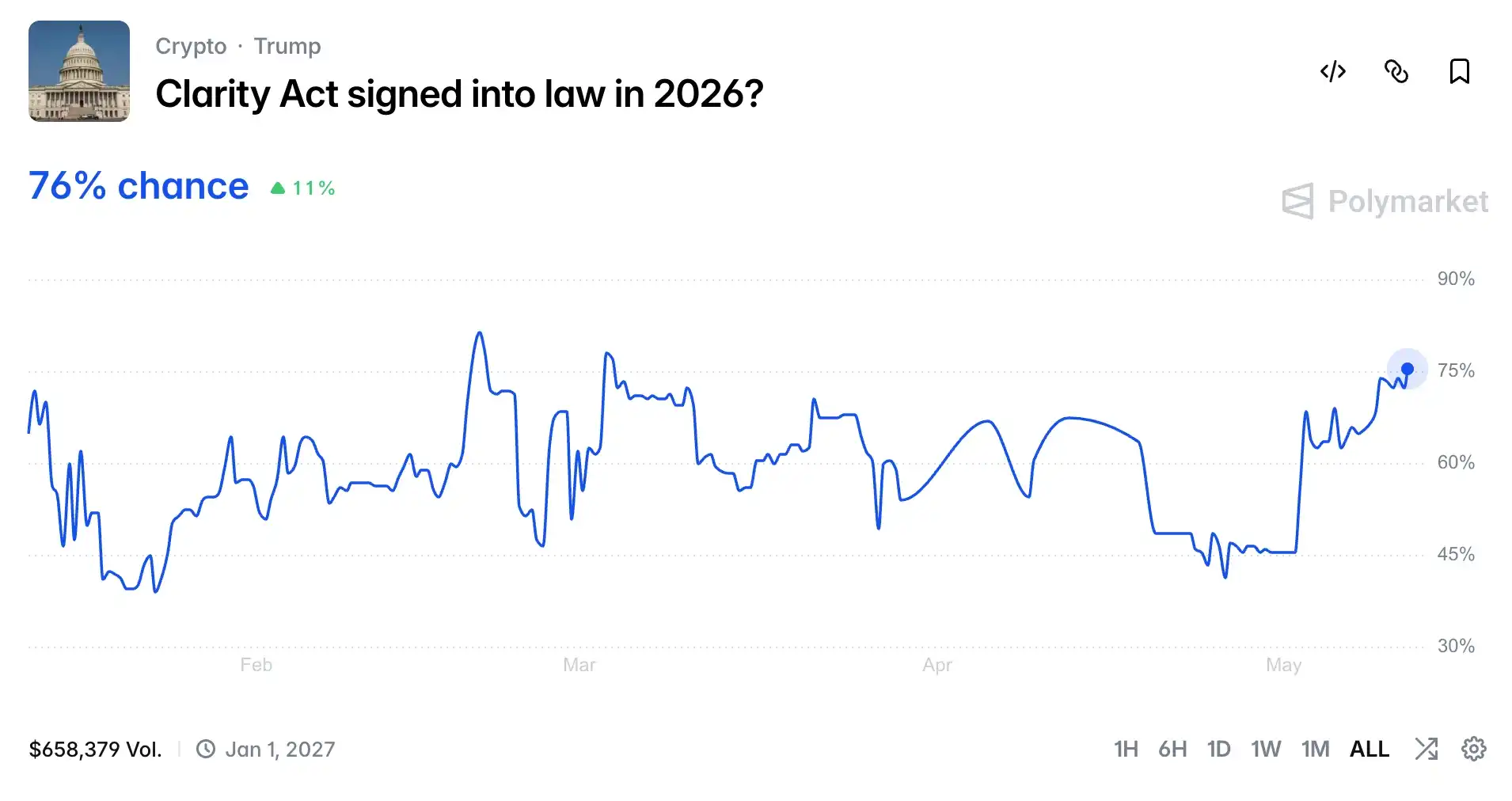
Currently, on the prediction market Polymarket, the probability of CLARITY becoming law this year is as high as 76%, indicating relatively positive market sentiment regarding the bill's future progress.

Once CLARITY becomes formal law, it will establish a clear, functional federal regulatory framework for the US digital asset market, addressing long-standing issues of regulatory ambiguity and inconsistent enforcement. This would be a significant positive for all industry participants, including Circle. My prediction on this is relatively optimistic.

Event Three: Federal Reserve Leadership Change

On May 15th, Jerome Powell's term as Federal Reserve Chairman officially ends (he will remain as a Board member until 2028), and his successor will be Kevin Warsh.

On April 29th, the US Senate Banking Committee voted to approve Warsh's nomination. Although it hasn't been confirmed by the full Senate vote yet, that is expected to happen in the coming days.

Unlike Powell, Warsh advocates for an unconventional combination of "balance sheet reduction + interest rate cuts," supporting inflation control through quantitative tightening (QT) while lowering interest rates to provide liquidity for the real economy. He believes QT targets the financial sector, while rate cuts benefit the industrial sector.

For Circle, which still relies primarily on US Treasury interest as its main income source, a market shift towards a rate-cutting cycle would be a direct bearish factor for CRCL. Simultaneously, QT could lead to tightened financial market liquidity in the short term, suppressing the stock market.

However, Warsh himself is a cryptocurrency holder. He is the first Federal Reserve Chair in history to have directly invested in the cryptocurrency field and places extreme importance on "the digital upgrade of US financial competitiveness." Warsh has also explicitly opposed the Fed issuing an official CBDC, arguing that its credit is deeply tied to national sovereignty; if the US dollar's credibility is damaged, the CBDC would also collapse. Therefore, he hopes to bring private stablecoins like USDC into the Federal Reserve's regulatory system, making them "shadow dollars."

Therefore, from a long-term perspective, Warsh taking office could potentially provide Circle with some policy tailwinds at the operational level, aiding its expansion.

So, regarding expectations, the short-term outlook may lean towards pessimism, but the long-term view could shift to neutral or optimistic.

Связанные с этим вопросы

QWhat are the three key events that Circle (CRCL) is facing this week according to the article?

AThe three key events are: 1) The Q1 2026 earnings report release on May 11. 2) The U.S. Senate Banking Committee hearing and vote on the CLARITY Act on May 14. 3) The transition of the Federal Reserve Chair from Powell to Kevin Warsh on May 15.

QWhat is the main concern regarding Circle's expiring contract with Coinbase?

AThe main concern is the terms of renewal. The current three-year contract, which gives Coinbase all interest from USDC on its platform and a 50% share of interest from off-platform USDC, expires in August 2026. The article suggests Circle may seek more favorable terms in the renewal, especially given Coinbase's current financial pressures.

QWhat is the significance of the CLARITY Act for the cryptocurrency industry, particularly for Circle?

AThe CLARITY Act aims to establish a clear federal regulatory framework for digital assets by distinguishing their classification and defining the regulatory roles of the SEC and CFTC. Its passage would be a major positive for industry participants like Circle by resolving long-standing regulatory ambiguity and inconsistent enforcement.

QAccording to the article, what is the potential market impact of Kevin Warsh's expected policy approach as the new Fed Chair?

AKevin Warsh's expected unconventional policy of 'shrinking the balance sheet (QT) + cutting interest rates' could create a short-term headwind for Circle. Rate cuts would directly reduce the interest income from its Treasury holdings (a primary revenue source), while QT could tighten financial market liquidity and pressure equity markets, including CRCL's stock price.

QWhat is the author's long-term view on Circle's prospects under a Kevin Warsh-led Federal Reserve?

AThe author holds a more optimistic long-term view. Despite potential short-term monetary policy headwinds, Kevin Warsh is described as a cryptocurrency holder who strongly supports the digital upgrade of U.S. financial competitiveness, opposes a Fed-issued CBDC, and favors bringing private stablecoins like USDC under the Fed's regulatory umbrella, which could provide favorable policy support for Circle's business expansion.

Похожее

From 'Old Guys' to 'New Favorites': How AI Is Revaluing Old Infrastructure from Dell to Nokia?

From "Vintage Tech" to "New AI Darlings": How AI Revalues Old Infrastructure One year ago, tech giants like Dell, Nokia, Cisco, and Western Data were seen as slow-growth, low-valuation stories, far from the AI spotlight dominated by players like Nvidia. Now, these legacy tech stocks are gaining market attention, sparking debate on whether this is genuine industry revaluation or a temporary narrative. As AI moves from model parameters to real-world data centers, the market is recognizing companies with proven delivery and infrastructure capabilities. This shift marks a change in the AI investment thesis: from pure model and GPU focus to the complex systems engineering required for deployment. Companies like Dell, HPE, and Corning are being revalued not for being "sexy" AI innovators, but for their decades of accumulated expertise in supply chains, enterprise delivery, and infrastructure—assets that have become critical in the AI buildout phase. The revaluation is unfolding across three key infrastructure lines: 1. **Servers & System Integration:** Dell and HPE are emerging as crucial system integrators or "general contractors" for AI data centers, translating GPU orders into complete, deployable server racks integrated with power, cooling, and networking. 2. **Networking & Connectivity:** AI's scale demands robust high-speed connections. Corning (fiber optics), Nokia (AI-RAN, 6G), and Cisco (data center switches) are gaining importance for enabling efficient data transfer within and between AI clusters. 3. **Storage:** Beyond high-speed memory (HBM/DRAM), the AI data explosion is driving demand for high-capacity hard drives (HDDs) from companies like Western Digital and Seagate to handle training data, logs, and cold storage cost-effectively. For this revaluation to be substantive and not just a narrative, three criteria are key: 1) Concrete AI-related order and revenue growth (e.g., Dell's AI server sales), 2) Upward revisions to company financial guidance, and 3) Sustainable improvements in profit quality, not just top-line revenue spikes. In essence, AI's transition to a real construction phase is re-pricing "old assets" against "new demand." The opportunity, however, is selective. Only those legacy firms that are demonstrably integrated into the capital expenditure chains of data center and enterprise AI deployment are likely to experience a true "logic re-rating" rather than just a temporary valuation bounce.

marsbit4 мин. назад

From 'Old Guys' to 'New Favorites': How AI Is Revaluing Old Infrastructure from Dell to Nokia?

marsbit4 мин. назад

The Merger of Codex and ChatGPT Marks the Beginning of a Major Reshuffle in Programming Tools

OpenAI is shifting its strategic focus from ChatGPT to Codex, merging them along with the browser tool Atlas into a unified desktop super-app. This move signals an internal belief that Codex, originally a programming tool, represents the next evolution of AI more than conversational models like ChatGPT. Over the past year, Codex's weekly active users have surged past 5 million. The key distinction is that while ChatGPT answers questions, Codex executes tasks. Enterprises increasingly value this ability to get work done over simply receiving advice. Consequently, Codex is attracting professionals beyond developers, including analysts, bankers, marketers, and product managers. OpenAI's reorganization and increased investment in Codex stem from recognizing that the future of AI competition lies in execution capabilities, not just conversation. The company is launching role-specific plugins (e.g., for data analysis, sales, design) to transform Codex into a broad knowledge work platform that automates and redefines white-collar workflows. Beyond being a tool, Codex reflects OpenAI's ambition to redefine software. New features like "Sites"—which generates interactive websites from documents—and collaborative "Annotations" aim to create a paradigm where the AI understands the goal and handles the tools and steps, functioning more like a digital colleague than traditional software. The ultimate goal is a unified experience where the user cares only about the completed task.

marsbit13 мин. назад

The Merger of Codex and ChatGPT Marks the Beginning of a Major Reshuffle in Programming Tools

marsbit13 мин. назад

Interpreting Investment Opportunities in the Age of Great Navigation, Invesco Great Wall Fund Releases '2026 Report on Chinese Enterprises Going Global'

Invesco Great Wall Fund has released its "2026 China Corporate Globalization Report," titled "The 'Great Navigation Era' of Chinese Enterprises." The report analyzes the new trends and investment opportunities as Chinese companies expand globally, moving from simple product exports to comprehensive overseas operations involving services, branding, and local production. Driven by factors like trade friction, the pursuit of higher profit margins abroad, and policy support, globalization is becoming essential for Chinese companies. The report outlines an evolution: from early product export ("Globalization 1.0") to the current "Globalization 2.0," characterized by overseas capacity, capital goods investment, consumer brand expansion, and service exports. Chinese firms' competitive advantages are highlighted, including a vast engineer talent pool, low-cost and robust infrastructure, and complete industrial clusters. Specific sectors with significant出海 potential are identified: * **Capital Goods** (e.g., engineering machinery, power equipment): Benefiting from global demand, especially in Belt & Road markets and the AI-driven power grid upgrade cycle. * **Consumer Brands**: Transitioning from cost to brand advantage, leveraging供应链 efficiency. * **Technology & Innovation**: Including AI applications, optical modules within global tech supply chains, and new energy vehicles focusing on local production. * **Pharmaceuticals**: Chinese biotech firms are becoming preferred partners for global pharma, with potential for breakthrough drugs in areas like oncology and weight loss. The report concludes that corporate globalization represents a sustained, core theme for China's capital markets, though companies must navigate challenges like geopolitics and localization.

marsbit25 мин. назад

Interpreting Investment Opportunities in the Age of Great Navigation, Invesco Great Wall Fund Releases '2026 Report on Chinese Enterprises Going Global'

marsbit25 мин. назад

GitHub, Transfixed by AI

On the night of February 9th, GitHub suffered a major outage caused by a simple configuration change—reducing a cache refresh interval from 12 to 2 hours—that triggered a cascade of failures. This was not an isolated event, but part of a broader pattern. In early 2026, GitHub experienced at least 8 major incidents, failing to meet its promised 99.9% availability. These outages stemmed from structural issues: explosive growth in load, tight service coupling, and insufficient protection against abnormal traffic. This unprecedented load is driven by AI Agents. In 2025, GitHub handled ~1 billion commits. By 2026, weekly commits reached 275 million, projecting to ~14 billion for the year—a 14x increase. AI tools like Claude Code now contribute 4.5% of all public repository commits, with weekly submissions surging 25x in just three months. AI-generated pull requests jumped from 4 million to 17 million per month in half a year. Unlike human developers, AI Agents work continuously, generating commits at a scale that overwhelms infrastructure designed for human rhythms. The surge also shattered GitHub's business model. Copilot's flat-rate pricing, based on assisting human developers, became unsustainable as Agentic AI sessions consumed resources worth hundreds of dollars for a few dollars in fees. In response, GitHub imposed usage limits and, by June 1st, shifted to a pay-per-use "AI Credits" system. Facing this new reality, GitHub realized a 10x scaling plan was insufficient. It announced a need to *redesign* its architecture for 30x current scale—decoupling services, adding fault isolation, and improving change management to prevent cascading failures. Other platforms like Stripe and AWS are facing similar challenges with AI Agents. Fundamentally, GitHub is transitioning from a human collaboration platform to an "exhaust pipe" for automated AI workflows. Its detailed post-mortem reports aim to maintain trust during this turbulent rebuild. The February outage was not just a technical glitch, but a signal of the software industry's entry into a new, AI-driven era.

marsbit1 ч. назад

GitHub, Transfixed by AI

marsbit1 ч. назад

Торговля

Спот
Фьючерсы

Популярные статьи

Как купить S

Добро пожаловать на HTX.com! Мы сделали приобретение Sonic (S) простым и удобным. Следуйте нашему пошаговому руководству и отправляйтесь в свое крипто-путешествие.Шаг 1: Создайте аккаунт на HTXИспользуйте свой адрес электронной почты или номер телефона, чтобы зарегистрироваться и бесплатно создать аккаунт на HTX. Пройдите удобную регистрацию и откройте для себя весь функционал.Создать аккаунтШаг 2: Перейдите в Купить криптовалюту и выберите свой способ оплатыКредитная/Дебетовая Карта: Используйте свою карту Visa или Mastercard для мгновенной покупки Sonic (S).Баланс: Используйте средства с баланса вашего аккаунта HTX для простой торговли.Третьи Лица: Мы добавили популярные способы оплаты, такие как Google Pay и Apple Pay, для повышения удобства.P2P: Торгуйте напрямую с другими пользователями на HTX.Внебиржевая Торговля (OTC): Мы предлагаем индивидуальные услуги и конкурентоспособные обменные курсы для трейдеров.Шаг 3: Хранение Sonic (S)После приобретения вами Sonic (S) храните их в своем аккаунте на HTX. В качестве альтернативы вы можете отправить их куда-либо с помощью перевода в блокчейне или использовать для торговли с другими криптовалютами.Шаг 4: Торговля Sonic (S)С легкостью торгуйте Sonic (S) на спотовом рынке HTX. Просто зайдите в свой аккаунт, выберите торговую пару, совершайте сделки и следите за ними в режиме реального времени. Мы предлагаем удобный интерфейс как для начинающих, так и для опытных трейдеров.

1.4k просмотров всегоОпубликовано 2025.01.15Обновлено 2026.06.02

Как купить S

Sonic: Обновления под руководством Андре Кронье – новая звезда Layer-1 на фоне спада рынка

Он решает проблемы масштабируемости, совместимости между блокчейнами и стимулов для разработчиков с помощью технологических инноваций.

2.3k просмотров всегоОпубликовано 2025.04.09Обновлено 2025.04.09

Sonic: Обновления под руководством Андре Кронье – новая звезда Layer-1 на фоне спада рынка

HTX Learn: Пройдите обучение по "Sonic" и разделите 1000 USDT

HTX Learn — ваш проводник в мир перспективных проектов, и мы запускаем специальное мероприятие "Учитесь и Зарабатывайте", посвящённое этим проектам. Наше новое направление .

1.8k просмотров всегоОпубликовано 2025.04.10Обновлено 2025.04.10

HTX Learn: Пройдите обучение по "Sonic" и разделите 1000 USDT

Обсуждения

Добро пожаловать в Сообщество HTX. Здесь вы сможете быть в курсе последних новостей о развитии платформы и получить доступ к профессиональной аналитической информации о рынке. Мнения пользователей о цене на S (S) представлены ниже.

活动图片