Don't Rush to Declare Crypto Dead, AI Is Reviving It

比推Опубликовано 2026-03-12Обновлено 2026-03-12

Введение

Summary: The article argues that AI is revitalizing the crypto space by enabling an emerging "agent economy" where AI agents autonomously conduct transactions on-chain. It notes crypto's stagnation since 2021 but highlights how AI agents could drive demand. Key projects like Bankr and Venice, alongside infrastructure from Stripe and Coinbase, are building the foundation for this shift. The piece explains why blockchains are ideal for agent economies due to standards like ERC-8004 (digital identity), x402 (micro-payments), and stablecoins (global currency). Current on-chain agent activities include deploying apps, creating content, trading DeFi, and even hiring humans. With major tech companies racing to develop agent infrastructure and AI capabilities growing exponentially, the author concludes that the agent economy—though still early—is too significant to ignore.

Author: Nick, Investment Partner at Breed.vc

Compiled and Edited by: BitpushNews


"Imagine somewhere around 2027, a real 'nation of geniuses' emerges. Picture, say, 50 million people, each more capable than any Nobel laureate, politician, or technologist. Now imagine that, because AI systems operate hundreds of times faster than humans, this 'nation' has a time advantage over all others: for every cognitive action we take, this nation can take ten." — Dario Amodei

"In our view, agents will likely soon be responsible for most internet transactions, and we will need blockchains." — Stripe

We can imagine the creativity, economic progress, and level of wealth that the agent economy will generate.

Last month, the crypto community predicted that this economy would run on-chain, and as the largest companies, capital allocators, and developers put forward this proposition, the prediction seems reasonable.

We had similar fantasies at the end of '24, but in typical crypto fashion, it was too early then, and the hype was short-lived.

Since then, the quality of AI models and blockchain infrastructure has developed to a point where we are conducting this experiment again.

In this report, we will examine the current state of the crypto economy, review the history of crypto agents, discuss why the agent economy might exist on-chain, explore what agents are doing today, and look at what comes next.

The Current State of the Crypto Economy
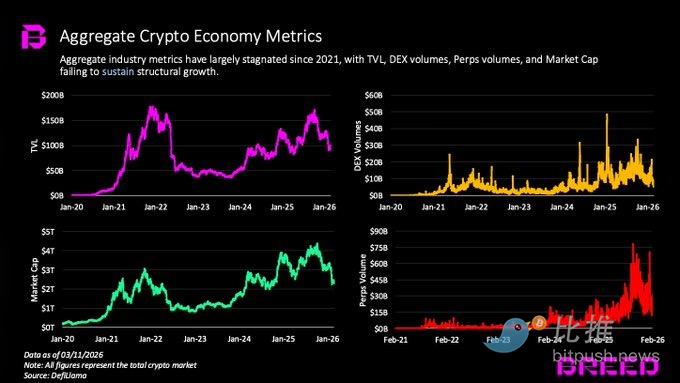
The lack of growth in the crypto asset class since the 2021 bull market has been disappointing. Most industry-wide metrics are at or below 2021 levels. Crypto world supremacy did not arrive.

AI agents provide a credible path to expanding demand.

The Seeds of the Crypto Agent Revival
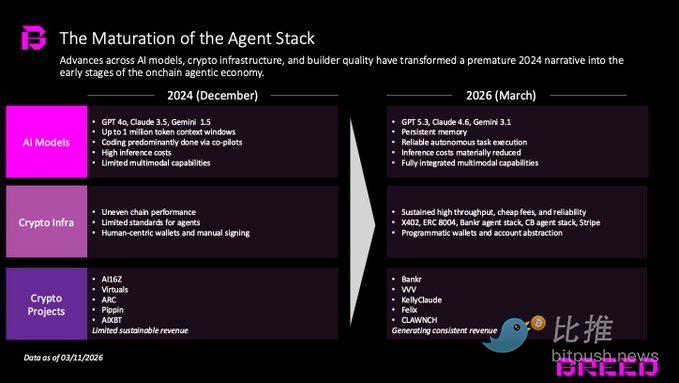
The "AI agents on blockchain" meta-narrative in 2024 was premature. The models, crypto infrastructure, and teams were not ready.

However, it wasn't all for nothing, as these lessons became the seeds of today's revival.

Projects like Bankr and Venice continued building so they could support today's models. Companies like Coinbase and Stripe recognized the potential and began developing their own supportive infrastructure.

Combine higher-quality teams with the continued building of a new generation of models, and you have the early stages of an on-chain agent economy.

Some projects are now generating recurring revenue and attracting high-quality developers—like Austen Allred, Nat Eliason, and Nik Pash—which is exactly what the crypto space desperately needs.

However, an on-chain agent economy is far from a certainty, as every payments company on Earth is racing to build this infrastructure.

Why the Agent Economy Will Run On-Chain
There is no stronger signal than Stripe explicitly stating that agents will run on blockchain rails. Their reasoning: every API call an agent makes today requires an account, an API key, and a linked credit card. This model breaks down when you have thousands of agents executing millions of microtransactions daily.

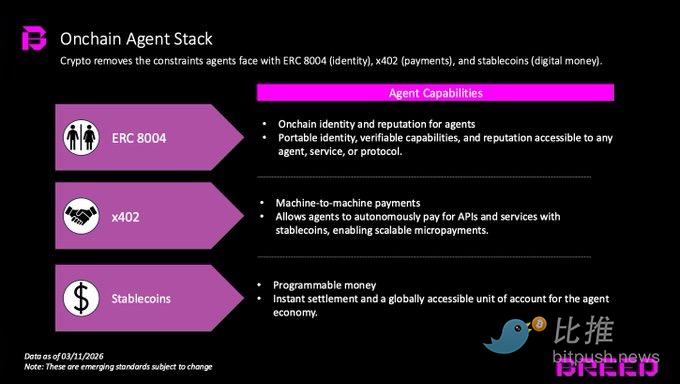
Blockchain solves these limitations by combining ERC-8004, x402, and stablecoins.

  • ERC-8004 gives each agent an on-chain identity, portable reputation, and verifiable capabilities that any other agent or service can query—the digital equivalent of identity and credit scores.

  • x402 allows agents to autonomously pay for APIs and services using stablecoins and scale micro-payments—the machine-to-machine payment layer for the internet.

  • Stablecoins give agents a globally accessible, programmable unit of account that can settle transactions instantly—the currency of the agent economy.

What Agents Are Doing Today

Today, agents are increasing their activity on-chain: launching applications, generating videos to promote these applications, contracting with other agents, handling governance matters for their users, selling NFTs, trading in DeFi, and even hiring humans.

The most exciting of these developments is the interaction with DeFi. Uniswap and Fluid are riding the agent narrative and beginning to build supportive infrastructure.

Furthermore, in the past month, OpenAI has made two agent-related announcements: Frontier, a platform designed to help businesses build, deploy, and manage AI colleagues; and EVM Bench, an evaluation framework for testing AI agents' ability to detect, patch, and exploit smart contract vulnerabilities.

Agents Are Coming

You might dismiss it as AI doom fiction, but the predictions of "AI 2027" are alarmingly accurate. If anything, AI progress is moving faster than the proposed timeline.

If this trajectory continues, we will see exponential growth in agent capabilities and intelligence over the next year.

Key parts of the stack still need to be built, but every major tech company in the world is racing against the clock to do so.

The social discussion around agents today might be frenzied, but the reality on the ground and the scale of the opportunity are too large to ignore.

Marc Andreessen (a16z partner) put it well: "Is it real? Or is it fake? It doesn't really matter. It's out there, and models are being trained on it."


Twitter:https://twitter.com/BitpushNewsCN

Bitpush TG Discussion Group:https://t.me/BitPushCommunity

Bitpush TG Subscription: https://t.me/bitpush

Original link:https://www.bitpush.news/articles/7619270

Связанные с этим вопросы

QWhat is the main argument presented in the article regarding the future of Crypto and AI?

AThe article argues that AI is revitalizing the crypto space by creating an on-chain agent economy, where AI agents will drive demand, economic activity, and innovation through blockchain infrastructure.

QAccording to the article, why might the agent economy need to operate on-chain?

AThe agent economy needs to operate on-chain because traditional payment models (requiring accounts, API keys, and credit cards) fail at scale for micro-transactions. Blockchain solutions like ERC-8004, x402, and stablecoins provide identity, micro-payments, and a global programmable currency for agents.

QWhat are some specific activities that AI agents are already performing on-chain today, as mentioned in the article?

AAI agents are currently deploying applications, generating promotional videos, contracting other agents, handling governance tasks, selling NFTs, trading in DeFi, and even hiring humans on-chain.

QWhich companies or projects are cited as recognizing the potential of on-chain AI agents and building supportive infrastructure?

ACompanies like Stripe, Coinbase, Bankr, Venice, Uniswap, and Fluid are recognized for seeing the potential and developing infrastructure to support on-chain AI agents.

QWhat key blockchain technologies are highlighted as enabling the agent economy, and what role does each play?

AERC-8004 provides on-chain identity and reputation, x402 enables autonomous micro-payments for APIs and services, and stablecoins offer a global, programmable unit of account for instant settlement in the agent economy.

Похожее

Institutional Adoption of Prediction Markets Stuck at the Third Stage

Prediction markets are transitioning from niche platforms focused on elections and sports to mainstream financial tools, as highlighted at Kalshi Research's inaugural conference. While sports still dominate trading volume (around 80%), non-sports categories like macroeconomics, politics, and entertainment are growing faster, signaling a shift from entertainment-based trading to information and risk management tools. Institutions, including Wall Street firms, are increasingly using prediction markets for data reference (Stage 1 adoption), with some progressing to system integration (Stage 2). However, full-scale trading (Stage 3) is limited due to the lack of margin trading, requiring full collateral for positions—a barrier for leverage-dependent entities. Kalshi is working with regulators to introduce margin mechanisms. Key insights from participants like Goldman Sachs and CNBC emphasize the value of real-time pricing for events (e.g., Fed decisions, tariffs), providing benchmarks previously unavailable. The path to maturity mirrors historical financial instruments like options, with expectations that prediction markets will become institutional staples within five years. Political leaders, including Trump and Schumer, now cite Kalshi odds, underscoring its growing influence. The platform rewards domain expertise over traditional finance backgrounds, attracting diverse participants from fields like music and poker. Ultimately, prediction markets are evolving into critical infrastructure for pricing uncertainty.

marsbit10 мин. назад

Institutional Adoption of Prediction Markets Stuck at the Third Stage

marsbit10 мин. назад

The First Year of Computing Power Inflation: The Cheaper DeepSeek Gets, the Harder It Is to Stop This Round of Price Hikes

The year 2026 marks the beginning of "computing power inflation." While AI inference costs have dropped by over 80% in 18 months globally, China's three major cloud providers—Alibaba Cloud, Baidu AI Cloud, and Tencent Cloud—simultaneously announced price hikes of 20–30%. This reflects a deeper structural shift driven by Jevons Paradox: as unit costs fall (e.g., via models like DeepSeek-R1), demand explodes, especially with the rise of reasoning models and AI agents that consume 10–50x more tokens per task. Although DeepSeek open-sourced its model weights, it did not release its inference optimization stack, leaving a significant engineering efficiency gap between cloud providers and smaller players. The big three are leveraging this advantage to reposition: Alibaba focuses on high-margin premium clients, Baidu filters out low-value users, and Tencent capitalizes on ecosystem lock-in. Meanwhile, ByteDance’s Volcano Engine adopts a more moderate pricing strategy to capture displaced customers. Unexpectedly, the price surge is pushing large enterprises toward self-built computing solutions once their cloud bills exceed a certain threshold. While cloud providers aim to boost profitability, they risk driving away innovative startups and accelerating competition from GPU leasing and domestic hardware providers like Huawei. The涨价 trend is expected to persist for 2–3 years, fueled by rising token consumption from reasoning models, AI agent adoption, and NVIDIA export restrictions. The inflection point depends on whether domestic chips can match NVIDIA’s efficiency, likely around 2027–2028. Until then, cloud providers will maintain pricing power, and the key for AI companies is to optimize token usage—the real moat in this era.

marsbit1 ч. назад

The First Year of Computing Power Inflation: The Cheaper DeepSeek Gets, the Harder It Is to Stop This Round of Price Hikes

marsbit1 ч. назад

Торговля

Спот
Фьючерсы
活动图片