Dogecoin Regains Memecoin Momentum as Selling Pressure Eases and New Catalysts Emerge

bitcoinistОпубликовано 2026-01-15Обновлено 2026-01-15

Введение

Dogecoin (DOGE) is showing signs of recovery after months of decline, stabilizing around the $0.14–$0.15 range with increased trading volumes and improved technical indicators. The easing of selling pressure and renewed speculative interest have contributed to its momentum, particularly as traders shift toward high-beta assets like meme coins. Broader meme token rallies, including Pepe, reflect a return of risk appetite. Key resistance lies at $0.15–$0.155, with support near $0.138–$0.140. New catalysts include potential expansion of DOGE-related initiatives in Japan and a proposed spot Dogecoin ETF from 21Shares in the U.S., which could boost regulated investment and liquidity.

After months of steady declines and fading enthusiasm, Dogecoin (DOGE) is showing signs of renewed life. The meme-based cryptocurrency has recently stabilized near the $0.14–$0.15 range, breaking out of a short-term downtrend and attracting fresh speculative interest.

Related Reading: Crypto Users Hit By 1,400% Surge In Impersonation Scams, Research Shows

While broader crypto markets remain mixed, DOGE’s price action suggests that selling pressure has eased, creating room for short-term momentum to build.

Dogecoin is trading around $0.148, supported by higher trading volumes and improving technical indicators. The move comes as traders rotate into high-beta assets, such as meme coins, particularly when Bitcoin trades sideways, and macro catalysts are limited.
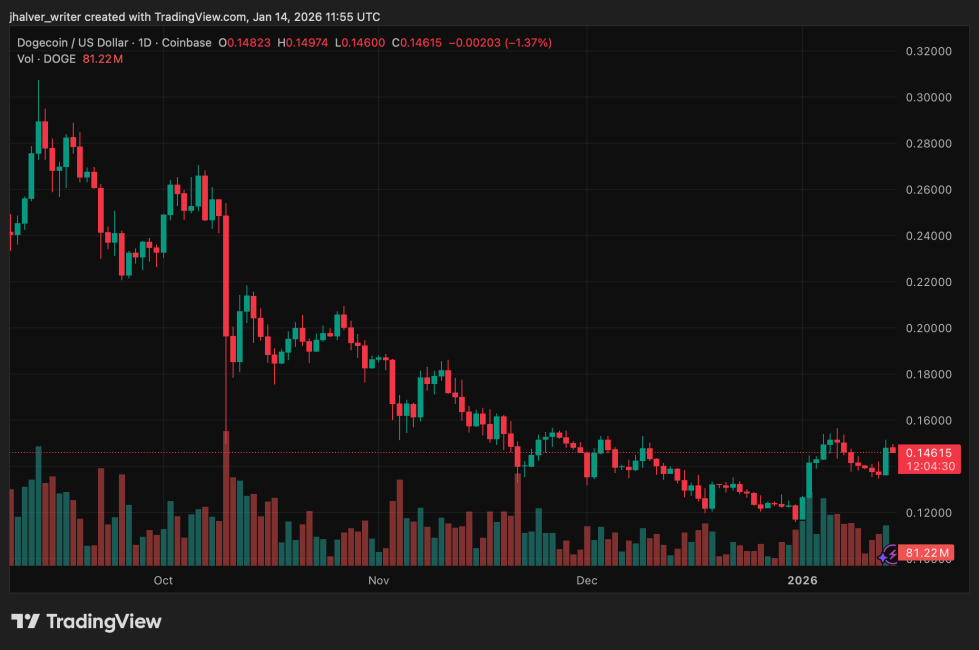
DOGE's price records some gains on the daily chart. Source: DOGEUSD on Tradingview

Selling Pressure Eases as Dogecoin Price Finds Support

Dogecoin’s recent stabilization follows a prolonged selloff from October highs, which pushed the price toward the $0.13 zone. That decline flushed out leveraged positions and cooled speculative activity.

In recent sessions, however, DOGE has reclaimed short-term support near $0.14 and briefly touched $0.147, signaling a slowdown in aggressive downside momentum.

On the daily chart, the price remains below key long-term moving averages, indicating a cautious broader trend. Still, DOGE has moved back above its 20-day and 50-day averages, levels many short-term traders watch for early signs of trend shifts.

Momentum indicators also point to stabilization. The RSI has climbed from oversold territory into neutral levels, suggesting buyers are returning without pushing the market into overheated conditions. While spot outflows continue, derivatives data show rising open interest, indicating traders are positioning for near-term volatility.

Speculative Interest Returns to Meme Coins

The recent rally is not limited to Dogecoin. Other meme tokens, including Pepe, have also posted sharp gains, reflecting a broader return of speculative appetite. CoinGecko’s GMCI Meme Index has climbed in tandem with rising trading volumes, suggesting the move is driven by active participation rather than thin liquidity.

Investors note that meme coins often outperform when Bitcoin trades within a range, and traders seek faster-moving opportunities. DOGE’s breakout above a weeks-long descending trendline has shifted short-term bias in favor of buyers.

Holding above the $0.138–$0.140 area maintains the rebound, with $0.15 serving as the next key level of resistance. A sustained move above $0.15–$0.155 could open the door to a test of the declining 50-day average near $0.16. Failure to hold current levels, however, would likely send the price back toward the $0.13 base.

New Catalysts: Japan Expansion and Spot ETF

Beyond technical factors, potential ecosystem developments are adding to Dogecoin’s visibility.

Discussions around expanding DOGE-related initiatives in Japan, focused on real-world asset tokenization and regulated Web3 applications, highlight growing interest in compliant blockchain use cases within a tightly regulated market.

Related Reading: Ripple Calls XRPL Permissioned Domains A ‘Gamechanger’ As Go-Live Nears

In the U.S., a proposed spot Dogecoin ETF from 21Shares is also drawing attention. If launched, the product would track DOGE’s spot price without leverage or derivatives, giving traditional investors a regulated way to gain exposure. While ETF inflows are not guaranteed, the listing itself could increase market participation and liquidity.

Cover image from ChatGPT, DOGEUSD chart from Tradingview

Связанные с этим вопросы

QWhat recent price range has Dogecoin stabilized in, indicating a break from its short-term downtrend?

ADogecoin has recently stabilized near the $0.14–$0.15 range.

QAccording to the article, what technical indicators suggest that selling pressure for DOGE has eased?

AThe RSI has climbed from oversold territory into neutral levels, and the price has moved back above its 20-day and 50-day moving averages.

QWhat broader market condition often leads meme coins like DOGE to outperform, as mentioned in the text?

AMeme coins often outperform when Bitcoin trades sideways within a range, and traders seek faster-moving opportunities.

QWhat are the two new catalysts mentioned that are adding to Dogecoin's visibility and potential growth?

AThe two new catalysts are discussions around expanding DOGE-related initiatives in Japan for real-world asset tokenization and a proposed spot Dogecoin ETF from 21Shares in the U.S.

QWhat is the next key level of resistance for DOGE's price, and what could a sustained move above it lead to?

AThe next key level of resistance is $0.15. A sustained move above $0.15–$0.155 could open the door to a test of the declining 50-day average near $0.16.

Похожее

UBS: The Crowdedness of A-Share Tech Stocks Is Far From Reaching Historical Peaks

UBS: A-share tech stocks still far from peak crowding levels A-shares' technology sector has seen a strong rebound, with trading activity hitting record highs, raising concerns about market crowding. However, UBS Securities argues that a key indicator of institutional positioning suggests the current crowding level remains well below historical peaks. While the large-cap tech sector's share of total A-share trading volume and market capitalization have reached historical highs, the overweight ratio of domestic mutual funds in this sector stood at 9.9% in Q1 2026. This is down from 11.6% in Q3 2025 and significantly lower than the historical peak of 14.1% in Q4 2015. It also pales in comparison to the historical peak overweight of 18.7% for the consumer sector. UBS notes that typical cycles from a low to a peak in fund overweighting last about three years, and the current outperformance of the tech/growth style has lasted less than two years since the policy pivot in September 2024. UBS expects A-share earnings recovery to accelerate, providing fundamental support. It forecasts 2026 A-share profit growth to rise to 11% from 3.9% in 2025. Non-financial A-share profits grew 11.8% YoY in Q1 2026, with gross and net profit margins at their highest since 2023. Persistent fund inflows, the expansion of thematic ETFs, and a recovery in private fund issuance are supporting market liquidity. In tactical allocation, UBS favors growth and cyclical styles under its "slow bull" base case, with overweight ratings on six sectors: Electronics (benefiting from semiconductor inventory recovery and AI innovation), Communications (driven by AI computing demand), Machinery (aided by domestic capex recovery), Non-ferrous Metals (due to rising copper/aluminum prices), Chemicals (supported by anti-involution policies), and Electrical Equipment (driven by policy support and AI data center power demand).

marsbit17 мин. назад

UBS: The Crowdedness of A-Share Tech Stocks Is Far From Reaching Historical Peaks

marsbit17 мин. назад

Торговля

Спот
Фьючерсы
活动图片