Do Stablecoins Really Count as Cash? After the Genius Act, Accounting Standards for Stablecoins May Be Adjusted

marsbitОпубликовано 2026-01-05Обновлено 2026-01-05

Введение

The U.S. Financial Accounting Standards Board (FASB) has added two crypto-related projects to its 2026 agenda: whether certain stablecoins can be classified as cash equivalents, and how to account for transfers of crypto assets. This follows the passage of the Genius Act, a regulatory framework for stablecoins, and reflects ongoing political support for the crypto industry from the Trump administration. FASB’s move aims to address accounting grey areas, such as when to derecognize crypto assets and how to treat wrapped tokens. These issues impact financial transparency, risk disclosure, and comparability for investors. Although FASB introduced fair-value accounting rules for crypto in 2023, significant gaps remain, particularly around the definition and treatment of stablecoins. Some critics argue the agenda is politically motivated rather than driven by widespread corporate adoption. However, as the Genius Act takes effect in 2027, stablecoin usage is expected to grow, increasing the urgency for clearer accounting guidance. FASB Chair Rich Jones emphasized the importance of defining what does—and does not—qualify as a cash equivalent. The SEC has also acknowledged the difficulty of applying existing accounting frameworks to crypto assets.

Editor's Note: The Financial Accounting Standards Board (FASB) has included "whether stablecoins can be considered cash equivalents" and "how to account for transfers of crypto assets" as key priorities for 2026. While these are technical accounting issues, they reflect a tug-of-war among regulation, politics, and capital markets over the legitimization of crypto assets: on one hand, the "Genius Act" is pushing stablecoins into the mainstream through institutionalization; on the other, Generally Accepted Accounting Principles (GAAP) still have many gray areas—especially regarding when assets are "derecognized" and how cross-chain and wrapped tokens are defined—leading to inconsistencies in how companies report these in their financial statements.

For investors, the real significance of this discussion is not just "whether they can be considered cash," but also risk disclosure, transparency, and comparability: as stablecoins become more like cash and more like financial products, financial statements must provide clearer boundaries.

Below is the original content:

The Financial Accounting Standards Board (FASB) has stated that it will study two crypto-related issues in 2026: whether some crypto assets can be classified as "cash equivalents," and how to account for transfers of crypto assets. These topics will be discussed against the backdrop of the Trump administration's increased support for such investments.

Over the past few months, FASB added these two crypto projects to its agenda based on public feedback. These issues are among the first of more than 70 topics that FASB will consider adding to its agenda; some of these may eventually develop into new accounting standards.

FASB expects to decide on the取舍 (selection) of these more than 70 potential topics by the end of this summer. These topics originated from an "agenda consultation," where businesses, investors, and others could submit letters indicating which issues they want FASB to prioritize.

"Many people have invested significant time and effort to help us set our agenda," said Chairman Rich Jones. "I see 2026 as the year to turn these inputs into action and deliver on our commitments."

In October of last year, FASB added the "cash equivalents" issue to its agenda, focusing particularly on certain stablecoins—assets typically pegged to a fiat currency.

This move came three months after President Trump signed a stablecoin regulatory bill into law. The bill established a regulatory framework for stablecoins, further integrating these assets into the mainstream financial system. Jones noted that the so-called "Genius Act" did not resolve the accounting question of "what can be considered a cash equivalent." He emphasized: "Telling people what does not qualify as a cash equivalent is as important as telling them what does."

President Trump himself and his family have interests in World Liberty Financial, a crypto company; he has introduced a series of policies supporting the crypto industry and halted previous regulatory crackdowns on the sector.

In November last year, FASB voted to study how businesses account for transfers of crypto assets, including "wrapped tokens"—tokens that allow crypto assets from one blockchain to be represented and used on another chain in a "mapped" form.

This project will build on requirements FASB proposed in 2023: that businesses measure Bitcoin and other crypto assets at fair value. That rule filled a gap in U.S. Generally Accepted Accounting Principles (GAAP) but did not cover non-fungible tokens (NFTs) or certain stablecoins.

Despite the crypto-related accounting requirements proposed in 2023, some believe the specific details remain unclear.

"I still think there is a huge gap in GAAP right now on a key issue: under what circumstances should we remove crypto assets from the balance sheet, i.e., derecognize them; and under what circumstances should we not?" said Scott Ehrlich, Managing Director of accounting training and consulting firm Mind the GAAP.

Both projects follow recommendations from a working group established by President Trump to support the crypto industry, while also responding to public feedback. Jones said these recommendations echo views already held by some of FASB's stakeholders.

Jones stated that he was not under pressure to adopt the working group's recommendations.

"I'm certainly happy that they believe the way to address accounting issues is to suggest these topics for FASB to evaluate," Jones said. "They did not recommend pushing legislation to handle accounting issues, nor did they suggest having the SEC speak out to set accounting treatment."

The SEC is responsible for enforcing the accounting standards set by FASB for public companies.

The securities regulator will also closely monitor any adjustments made by FASB. "The crypto space has a host of issues," said SEC Chief Accountant Kurt Hohl at a conference earlier this month. "The difficulty is that they don't fit neatly into the existing accounting standards framework."

Lawmakers and investors have occasionally expressed concerns about FASB's standard-setting approach. Recently, the agency came under scrutiny from U.S. House Republicans: they proposed freezing its funding if FASB did not withdraw upcoming tax disclosure requirements. Under the new requirements, public companies are preparing to disclose more details about taxes paid to government departments in their 2025 annual reports.

Some observers question whether the holding of crypto assets is widespread enough to warrant a place on FASB's agenda. Only a few companies, such as Tesla, Block, and MicroStrategy, include Bitcoin on their balance sheets.

"These new crypto projects don't seem to be driven by pervasiveness or other established FASB criteria for adding projects, but more by current political priorities," said Sandy Peters, head of the financial reporting policy team at the CFA Institute, which represents investment professionals.

However, as the "Genius Act" takes effect in 2027, the newly established regulatory guardrails are expected to reduce the volatility of stablecoins, and market interest in stablecoins is anticipated to heat up. Peters noted that without more adequate risk disclosures, investors are unlikely to accept stablecoins as cash equivalents.

FASB Chairman Jones also faces a "countdown." His seven-year term is expected to end in June 2027, and the search for his successor will begin in early 2026.

Jones said that in the roughly 18 months remaining, he hopes the board can initiate and complete an accounting standard on how to distinguish between "liabilities" and "equity." This determination is highly complex for certain instruments like warrants, and both businesses and auditors find it challenging.

Jones stated that this project has not yet been formally added to the agenda but could still be completed within that timeframe, as the board could opt for "targeted improvements" rather than building a completely new model. "I very much hope to get it done before I step down," he said.


Связанные с этим вопросы

QWhat are the two main crypto-related topics that the Financial Accounting Standards Board (FASB) plans to study in 2026?

AThe FASB plans to study whether certain crypto assets, particularly some stablecoins, can be classified as 'cash equivalents' and how to account for transfers of crypto assets.

QWhat significant legislation, signed by President Trump, helped bring stablecoins further into the mainstream financial system and preceded the FASB's agenda decision?

AThe significant legislation is the 'Genius Act', which established a regulatory framework for stablecoins and was signed into law by President Trump.

QAccording to the article, what is a key accounting problem that GAAP still has a major gap in, as stated by Scott Ehrlich of Mind the GAAP?

AThe key accounting problem is determining when to derecognize a crypto asset (remove it from the balance sheet) and when not to, particularly in the context of transfers and wrapped tokens.

QWhy do some observers, like Sandy Peters from the CFA Institute, question the motivation behind FASB's new crypto projects?

AThey question the motivation because the projects do not appear to be driven by the prevalence of crypto assets on corporate balance sheets, but rather by current political priorities set by the Trump administration.

QWhat is a major concern for investors regarding the treatment of stablecoins as cash equivalents, even after the Genius Act establishes regulatory guardrails?

AThe major concern is that without more robust and sufficient risk disclosures in financial statements, investors are unlikely to accept stablecoins as cash equivalents.

Похожее

ByteDance Adopts Arm CPUs, Jensen Huang: So Sad I Didn't Buy Arm

**Summary:** At Computex 2026, Arm CEO Rene Haas announced that ByteDance and Oracle have adopted Arm's self-designed Arm AGI data center CPU. The company expects significant revenue growth from this product, projecting $20 billion in demand for the 2027/2028 fiscal years. Haas noted that restricting AI-capable CPUs from the US to China is nearly impossible due to their widespread applications. Arm's stock has surged dramatically this year, notably rising 16% after NVIDIA's Arm-based Vera CPU and RTX Spark announcements. A highlight was the informal, humorous on-stage conversation between Haas and NVIDIA CEO Jensen Huang. Huang joked about NVIDIA's failed attempt to acquire Arm and playfully lamented selling his Arm shares. Both executives showed a clear sense of camaraderie and shared regret over the missed merger. Key technical topics were discussed: 1. **AI PC Design:** Huang explained NVIDIA's RTX Spark superchip (with a 20-core Arm CPU) is designed for future AI agents that will autonomously run and use tools on PCs, blending local and cloud processing. 2. **Agent vs. OS:** Huang emphasized the operating system remains crucial, as AI agents rely on its APIs and tools to function. 3. **Growth Constraints:** He identified the shift to "useful AI" that generates profitable tokens as a primary driver for immense, almost limitless, computational demand. Haas outlined Arm's strategy across PC and data centers. For PCs, Arm collaborates with partners like NVIDIA and MediaTek, offering its compute subsystem (CSS) for custom SoCs. In data centers, its Arm AGI CPU (built on TSMC's 3nm process) has gained major partners including OpenAI, Meta, and now ByteDance and Oracle. Arm presented a multi-year roadmap for its in-house CPU line. The article concludes that while GPUs dominated the AI training race, the explosion of AI agents is shifting significant focus to CPUs for inference, state management, and tool orchestration. The industry is trending towards vertical integration, with companies like cloud providers designing chips and chip/IP firms offering full solutions, all competing to deliver more efficient computing per watt.

marsbit16 мин. назад

ByteDance Adopts Arm CPUs, Jensen Huang: So Sad I Didn't Buy Arm

marsbit16 мин. назад

New Wall Street Play: Yen Shorts Still Adding, But Japan Stocks Don't Rely on Carry Trade Unwinding

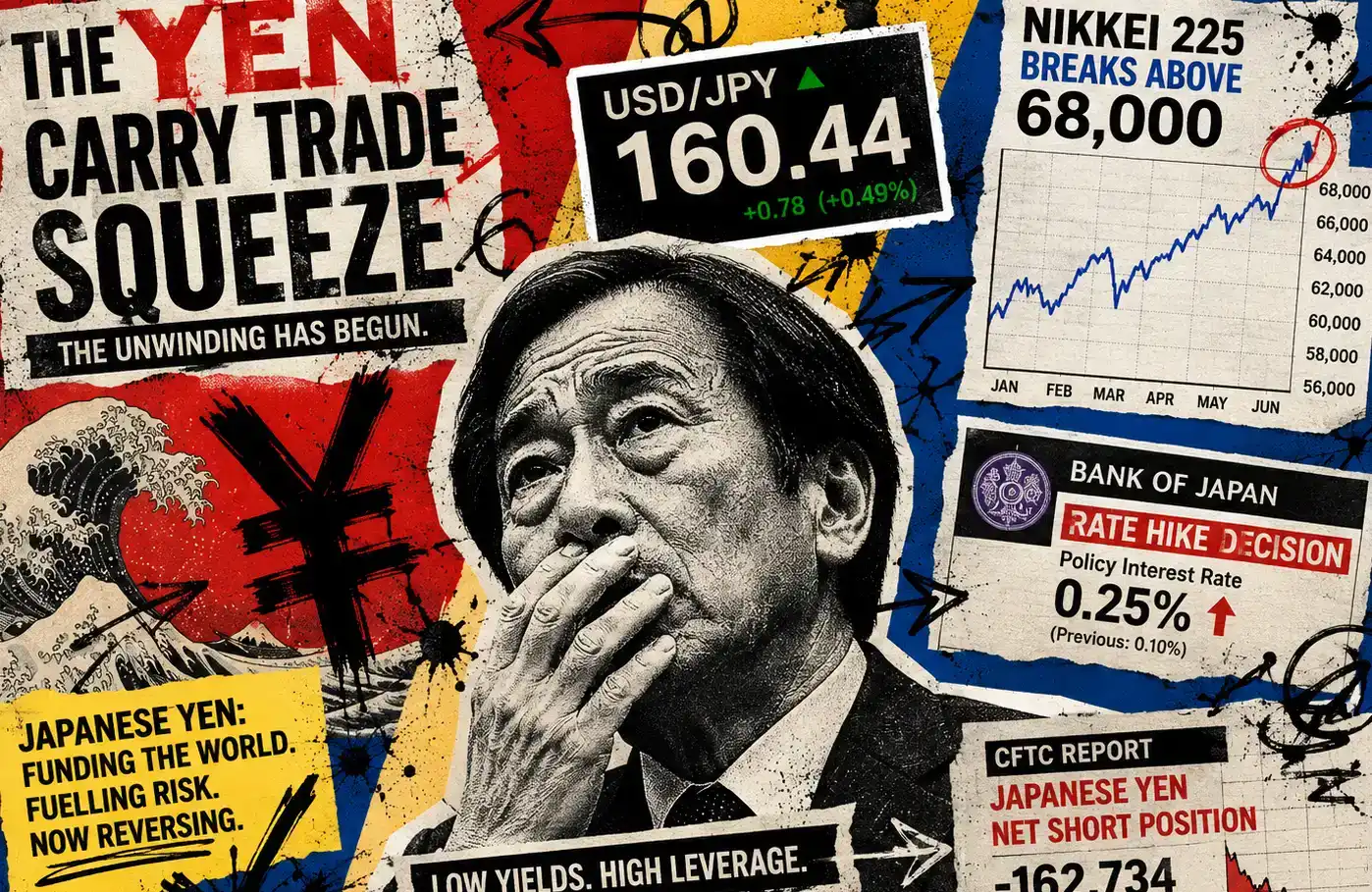
On June 3rd, USD/JPY hit 160.44, its highest level since July 2024, while the Nikkei 225 surged past 68,000 points. Contrary to popular narratives of an imminent "carry trade unwind" akin to August 2024, data reveals a more complex picture. Speculative net short positions in yen futures have actually increased, reaching -114,667 contracts by late May, suggesting traders are doubling down rather than retreating. Meanwhile, Japan's Finance Ministry conducted its largest-ever single-round FX intervention (11.73 trillion yen) in April-May but failed to hold the 160 yen line. The Nikkei's rally is not driven by carry trade dynamics. Foreign investors are aggressively buying Japanese stocks, with net purchases in 2026 running nearly 16 times higher than 2025 levels. This inflow is concentrated in AI and semiconductor-related stocks like SoftBank and Socionext, fueled by positive sector outlooks, rather than being a flight from unwinding yen shorts. Furthermore, the Nikkei has continued climbing despite the Bank of Japan's (BOJ) rate hikes to 0.75%. This disconnect exists because the current equity boom is fueled by AI-driven foreign investment, not reliant on cheap yen funding. However, this relationship remains fragile. Should the BOJ hike rates further (e.g., to 1.0%) while dollar weakness increases carry trade costs, the trajectories of the yen and Japanese stocks could reconverge, potentially triggering volatility.

marsbit21 мин. назад

New Wall Street Play: Yen Shorts Still Adding, But Japan Stocks Don't Rely on Carry Trade Unwinding

marsbit21 мин. назад

Broadcom's Q3 Guidance Misses Expectations by $12 Billion, After-Hours Trading Plummets Over 13%, AI Narrative "Cooling"?

On June 3, Broadcom released record Q2 FY26 results with revenue of $22.19B, up 48% YoY, and AI chip sales of $10.8B, up 143%. Adjusted EPS of $2.44 beat estimates. However, its Q3 AI semiconductor revenue guidance of $16B, while up over 200% YoY, fell roughly $1.2B (7%) short of analyst consensus expectations of $17.2B. This miss, coupled with slightly weaker-than-expected software revenue, triggered a severe market reaction. CEO Hock Tan maintained the FY26 AI revenue outlook of over $100B but did not raise it, disappointing investors who had priced in more robust growth. The stock plummeted over 13% in after-hours trading, erasing roughly $270B in market cap. The sell-off extended to peers like Marvell. A key concern for markets, particularly for Chinese optical module suppliers, was Tan's comment that the contribution of AI networking (e.g., Ethernet switches, optical interconnect chips) to AI revenue, currently near 40%, is expected to normalize to around 30% over time, signaling a potential peak in growth for that segment. Despite the guidance shortfall, Tan reiterated that AI demand remains "insatiable" and reaffirmed the long-term target of exceeding $100B in AI revenue by FY27. The reaction highlights the heightened sensitivity and premium valuation placed on AI-exposed stocks, where anything less than stellar guidance can prompt significant profit-taking. The broader question is whether this represents a cooling AI narrative or a correction in overstretched valuations.

marsbit21 мин. назад

Broadcom's Q3 Guidance Misses Expectations by $12 Billion, After-Hours Trading Plummets Over 13%, AI Narrative "Cooling"?

marsbit21 мин. назад

Торговля

Спот
Фьючерсы

Популярные статьи

Как купить MAY

Добро пожаловать на HTX.com! Мы сделали приобретение Mayflower (MAY) простым и удобным. Следуйте нашему пошаговому руководству и отправляйтесь в свое крипто-путешествие.Шаг 1: Создайте аккаунт на HTXИспользуйте свой адрес электронной почты или номер телефона, чтобы зарегистрироваться и бесплатно создать аккаунт на HTX. Пройдите удобную регистрацию и откройте для себя весь функционал.Создать аккаунтШаг 2: Перейдите в Купить криптовалюту и выберите свой способ оплатыКредитная/Дебетовая Карта: Используйте свою карту Visa или Mastercard для мгновенной покупки Mayflower (MAY).Баланс: Используйте средства с баланса вашего аккаунта HTX для простой торговли.Третьи Лица: Мы добавили популярные способы оплаты, такие как Google Pay и Apple Pay, для повышения удобства.P2P: Торгуйте напрямую с другими пользователями на HTX.Внебиржевая Торговля (OTC): Мы предлагаем индивидуальные услуги и конкурентоспособные обменные курсы для трейдеров.Шаг 3: Хранение Mayflower (MAY)После приобретения вами Mayflower (MAY) храните их в своем аккаунте на HTX. В качестве альтернативы вы можете отправить их куда-либо с помощью перевода в блокчейне или использовать для торговли с другими криптовалютами.Шаг 4: Торговля Mayflower (MAY)С легкостью торгуйте Mayflower (MAY) на спотовом рынке HTX. Просто зайдите в свой аккаунт, выберите торговую пару, совершайте сделки и следите за ними в режиме реального времени. Мы предлагаем удобный интерфейс как для начинающих, так и для опытных трейдеров.

314 просмотров всегоОпубликовано 2025.07.01Обновлено 2026.06.02

Как купить MAY

Обсуждения

Добро пожаловать в Сообщество HTX. Здесь вы сможете быть в курсе последних новостей о развитии платформы и получить доступ к профессиональной аналитической информации о рынке. Мнения пользователей о цене на MAY (MAY) представлены ниже.

活动图片