Do Kwon Sentenced to 15 Years in Prison, Crypto's Prison All-Stars Welcome Another Heavyweight Guest

Odaily星球日报Опубликовано 2025-12-12Обновлено 2025-12-12

Введение

Do Kwon, co-founder of Terraform Labs, has been sentenced to 15 years in prison by a U.S. federal court. The ruling follows his extradition from Montenegro and guilty plea to charges of conspiracy fraud and wire fraud. Kwon was the mastermind behind Terra (LUNA) and its algorithmic stablecoin UST, which collapsed dramatically in May 2022, erasing tens of billions in market value and triggering a prolonged crypto market downturn. The failure of Terra’s “algorithmic” mechanism—which lacked sufficient collateral—led to widespread investor losses, with reports of tragic outcomes including suicides. After the collapse, Kwon fled South Korea and evaded international authorities using forged documents before eventually being captured in Montenegro in March 2023. He was later extradited to the U.S. in late 2024. Prosecutors had sought a 12-year sentence, while Kwon’s defense argued for five years. The judge, however, imposed a stricter sentence, citing the unprecedented scale of fraud, Kwon’s attempt to evade justice, and the need for deterrence. Kwon now joins other high-profile convicted crypto figures like SBF and Alex Mashinsky, marking a symbolic end to an era of reckless expansion and fraud in the industry.

Original | Odaily Planet Daily (@OdailyChina)

Author | Azuma (@azuma_eth)

On December 11th Eastern Time, the U.S. District Court for the Southern District of New York held a sentencing hearing for former Terraform Labs co-founder Do Kwon in Courtroom 1305. During the hearing, Judge Paul Engelmayer announced a sentence of 15 years imprisonment for Do Kwon.

Do Kwon has become another high-profile industry figure to receive a heavy sentence, following FTX founder Sam Bankman-Fried and Celsius Network founder Alex Mashinsky.
The Myth and Collapse of Terra

The algorithmic stablecoin project Terra (project token LUNA, stablecoin UST), developed by Terraform Labs, was once the brightest project in the last bull market.

Algorithmic mechanisms were a hot trend in stablecoin innovation during the last cycle. Different from the mainstream over-collateralization mechanism, algorithmic stablecoins do not require full collateral but are designed around market supply and demand to dynamically maintain the "peg" of the coin's price. Taking Terra as an example, the protocol allowed market participants to mint UST by burning an equivalent value of LUNA, or conversely, to burn UST to redeem an equivalent value of LUNA. When demand for UST increased and its price rose above $1, arbitrage opportunities would drive the market to burn LUNA to mint UST, profiting from the premium; conversely, if UST demand decreased and its price fell below $1, the market would be driven to burn UST and mint LUNA, profiting from the discount.

This "stepping on each other's feet to reach the sky" technique between LUNA and UST once forged Terra's growth miracle. The circulating supply of UST once reached $18.7 billion, posing a significant challenge to the stablecoin king USDT; the price of LUNA once approached $120, with a market capitalization as high as $41 billion, once ranking among the top five in the cryptocurrency market cap rankings.

However, history has proven that all stablecoin mechanisms without sufficient collateral are bubbles. They might operate temporarily in normal market conditions but have extremely poor resistance to extreme situations. In May 2022, Terra's bubble finally burst. Under collective panic, Terra's algorithmic stablecoin mechanism instead caused it to sink deeper into a death spiral. Within a few days, LUNA's tens of billions in market capitalization and UST's billions in "value" evaporated.

From a macro perspective, Terra's collapse is considered by many industry insiders to be one of the core events that caused the subsequent prolonged market downturn. From a micro perspective, Terra's crash caused countless investors to suffer huge losses, and some users even chose to commit suicide out of despair.

Flight, Hiding, Capture, and Extradition

After Terra's collapse, prosecutors in both South Korea and the U.S. brought charges against Do Kwon, including conspiracy to commit fraud, commodities fraud, wire fraud, securities fraud, and conspiracy to engage in market manipulation and money laundering. In September 2022, South Korean prosecutors issued a Red Notice through the global police agency Interpol, requesting police worldwide to assist in arresting Do Kwon.

Although Do Kwon remained active on social media and once responded by saying "I'm not on the run," no one knew his specific whereabouts. It wasn't until a year later that people learned Do Kwon had been hiding in Serbia and Montenegro to evade Interpol's pursuit.

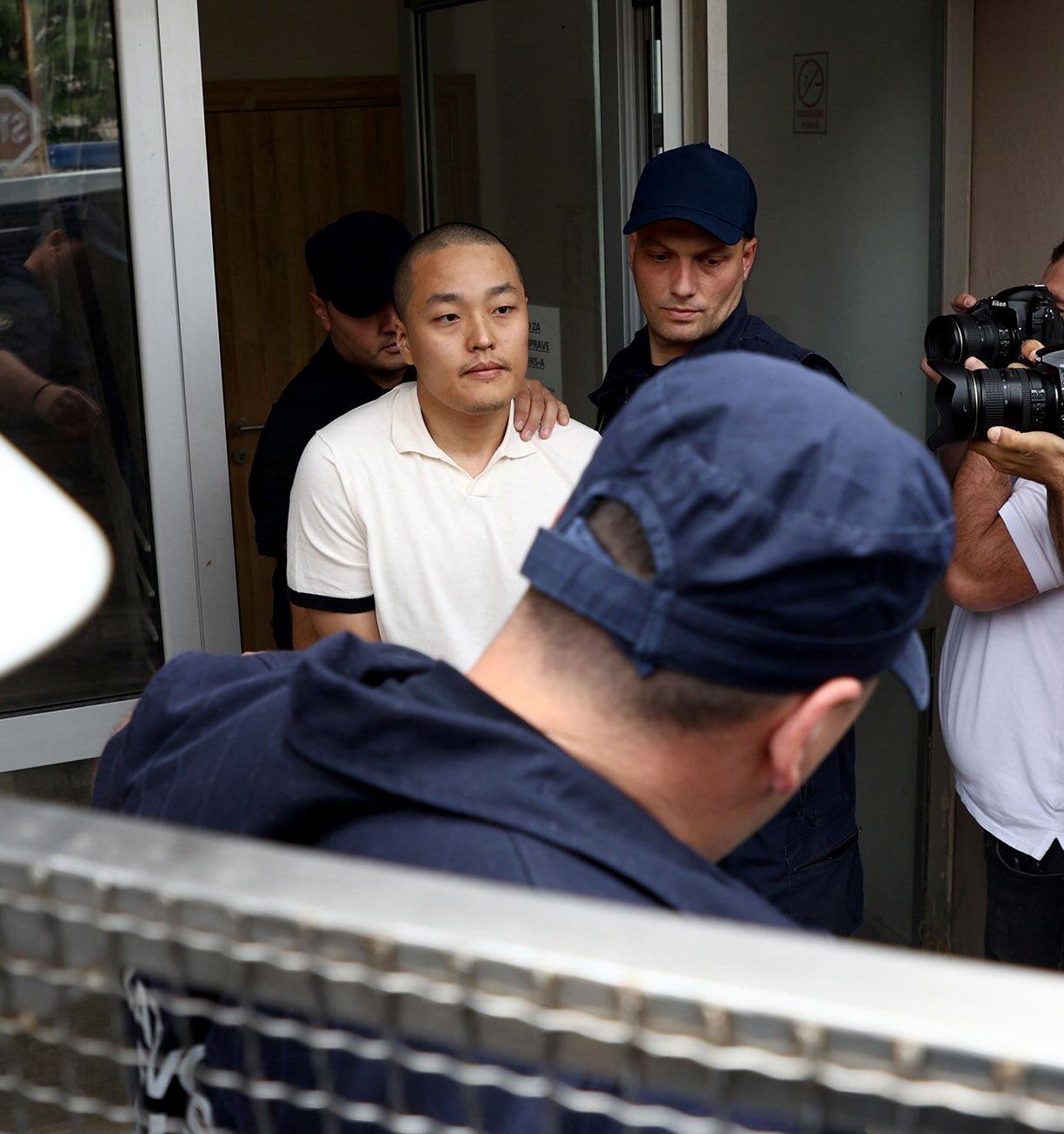
On March 23, 2023, Do Kwon and Terraform's CFO Han Chang-joon attempted to fly from Podgorica, Montenegro, to Dubai using forged Costa Rican passports but were detained by local police at the airport. About two hours before Do Kwon's arrest, an informant told Montenegro's top police officer, Interior Minister Filip Adžić, that Do Kwon might be in the country. Adžić, describing the arrest process to the WSJ, said the informant sent Do Kwon's passport details to his phone, and when he called the border police chief, the police had just detained Do Kwon at the airport.

That interior minister said in the call to the border police chief: "Do you know who that person is? He is very famous and has a lot of money."
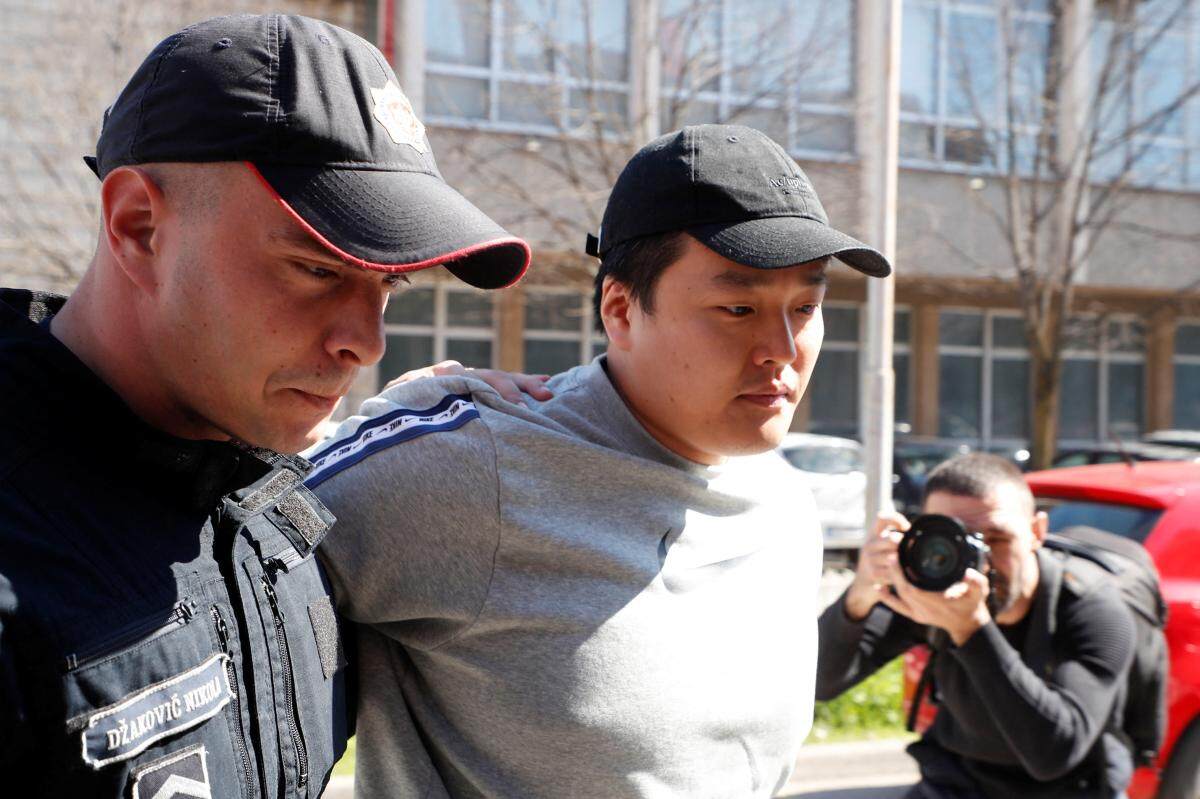
Odaily Note: Photo from the scene of Do Kwon's arrest.

After his arrest, Do Kwon was first held alone in the pre-trial detention area of Montenegro's Spuž Prison, and then on June 19, 2023, was sentenced to 4 months in prison by a Montenegrin court for passport forgery. At that time, both South Korea and the United States sought Do Kwon's extradition from Montenegro. At the request of U.S. and South Korean authorities, the High Court of Montenegro subsequently extended Do Kwon's detention period.

In March 2024, Do Kwon was allowed to leave prison, but considering he still faced criminal charges from several countries, the High Court of Montenegro ordered his passport confiscated to prevent him from leaving the country. At that time, the decision on Do Kwon's extradition was still pending. Montenegrin prosecutors opposed extraditing Do Kwon to South Korea, preferring him to be sent to the United States, where he could face a longer sentence if convicted.

The suspense was finally revealed on the last day of 2024, when the Prime Minister of Montenegro, Milojko Spajic, officially announced that the procedures for extraditing Do Kwon to the United States had been completed.

On January 2, 2025, Do Kwon first appeared in the public eye in a U.S. court. During a hearing at the Manhattan federal court that day, Do Kwon pleaded not guilty. However, as the case progressed, Do Kwon pleaded guilty in August of this year to two of the multiple charges (conspiracy to commit fraud and wire fraud).

Finally, on December 11, Judge Paul Engelmayer announced Do Kwon's fate.

Sentencing Controversy

Regarding Do Kwon's sentencing, the prosecution and the defense each had their say.

Last Thursday, U.S. federal prosecutors submitted a request to the judge of the Southern District of New York, asking for a 12-year prison sentence for Do Kwon.

On the other hand, Do Kwon's defense team requested a five-year sentence, citing that Do Kwon had already served time in Montenegro and might face further prosecution in South Korea. But U.S. officials argued that only a long prison term could reflect the scale of the fraud and deter similar behavior.

The prosecution argued that only a long prison sentence could reflect the scale of Do Kwon's fraud and deter similar behavior. For reference, the losses related to Terraform's collapse exceeded the combined losses from SBF's FTX, Alex Mashinsky's Celsius, and OneCoin. SBF is serving a 25-year sentence, while Mashinsky has been sentenced to 12 years in prison for fraud.
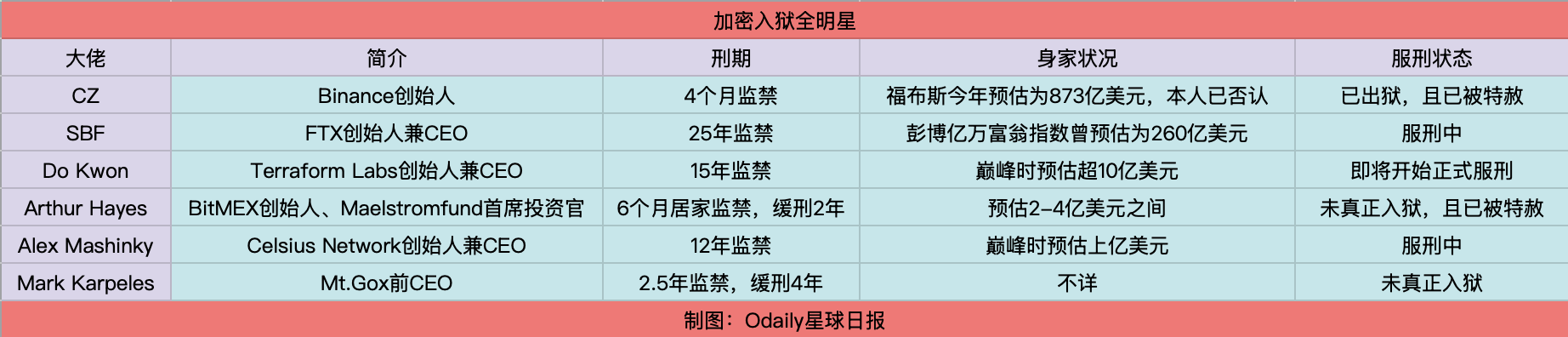
Odaily Note: Representative cryptocurrency figures sentenced in recent years.

The prosecution wrote in the filing: "The collapse of Terraform triggered a series of crises that swept through the cryptocurrency market, indirectly causing the subsequent industry winter. Do Kwon fled from this crisis. While in hiding, he was evasive in interviews and tweets, shifting blame to others, and after being captured, he resisted extradition...... Do Kwon's misconduct, the criminal consequences, and his reaction to the exposure of the plot are all sufficient to warrant a heavy sentence. In fact, the criminal circumstances alone are enough to support the maximum penalty."

Surprisingly, the sentence finally handed down by the judge even exceeded the prosecution's request for a 12-year term. Judge Paul Engelmayer stated that Do Kwon "chose to lie" and "made the wrong choices."

The Messy End of an Era That Has Already Concluded

From SBF to Do Kwon, those names once admired by countless people are now ending in an extremely messy manner.

In the narrative of the last bull market, projects like Terra and FTX represented the most radical, ambitious, and blindly expansionist forces in the crypto world. They rapidly accumulated vast capital and prestige in the name of technological innovation, but under the multiple pulls of regulatory absence,失控的风险 (uncontrolled risk), and human greed, they ultimately fell into the abyss.

But the industry's development does not stop because of the downfall of individuals. The crypto market has long entered a new cycle. New stablecoin models, new financial primitives, and stricter regulatory requirements are redefining the underlying order of the industry. History will remember Terra's past glory, but it will remember even more the price it left behind — this is the reality and warning that all newcomers must face.

Связанные с этим вопросы

QWhat was the sentence handed down to Do Kwon by the New York Southern District Court?

ADo Kwon was sentenced to 15 years in prison.

QWhat were the two specific charges that Do Kwon pleaded guilty to in August?

ADo Kwon pleaded guilty to conspiracy to commit fraud and wire fraud.

QWhat was the core mechanism behind the Terra (LUNA) algorithmic stablecoin system that ultimately failed?

AThe mechanism allowed users to burn LUNA to mint the stablecoin UST, or burn UST to mint LUNA, relying on arbitrage to maintain the peg. This created a 'death spiral' during extreme market conditions, leading to its collapse.

QWhich two countries initially sought the extradition of Do Kwon after his arrest in Montenegro?

ASouth Korea and the United States both sought his extradition.

QHow does the scale of losses from the Terraform Labs collapse compare to those from FTX and Celsius, according to the prosecution?

AThe prosecution stated that the losses related to Terraform's collapse exceeded the combined losses from SBF's FTX and Alex Mashinsky's Celsius and OneCoin.

Похожее

Silicon Bull, Carbon Bear: The Wealth Code of 2026 is Only 'Chips' and 'Light'

The article, titled "Silicon Bull, Carbon Bear: In 2026, the Wealth Code Lies Only in 'Chips' and 'Optics'", discusses the extreme market divergence in 2026 driven by the AI investment frenzy. Investment managers who concentrated on the AI hardware supply chain, particularly computing infrastructure, optical modules, and memory chips, have seen their fund net asset values (NAVs) surge dramatically, even reaching record highs. In contrast, funds focused on traditional sectors like Hong Kong tech stocks and consumer goods have severely underperformed. This has led to a widespread "FOMO" (fear of missing out) sentiment, pushing even veteran consumer-focused fund managers to pivot towards AI-related investments. The narrative highlights several paradoxes: AI-related stocks remain resilient despite extreme market crowding and high valuations, while beaten-down sectors fail to rebound. The author dubs this split market "Silicon Bull, Carbon Bear," suggesting a bull market only for those invested in silicon-based tech (AI hardware) and a bear market for carbon-based traditional economy sectors. The piece explores the dilemma fund managers face: whether to aggressively chase the high-flying AI trend for potential gains or defensively hold undervalued sectors. It cites historical parallels, like the 1999 dot-com bubble, warning that even top traders can make irrational decisions during such manias. Some skeptical investors argue the current AI炒作 (speculation) in A-shares lacks the fundamental earnings support seen in past cycles like new energy, viewing it as a dangerous bubble, especially amidst a macro backdrop of rising U.S. bond yields. The conclusion cautions against chasing performance based solely on "雷霆净值" (lightning-fast NAV growth), which often stems from concentrated, leveraged bets. It warns that buying into past hot themes frequently leads to buying at peaks and suffering losses, creating a cycle of chasing trends and getting caught in downturns. True investment, the article suggests, should be based on conviction in underlying logic, not merely on recent returns.

marsbit14 мин. назад

Silicon Bull, Carbon Bear: The Wealth Code of 2026 is Only 'Chips' and 'Light'

marsbit14 мин. назад

Multiple Core Executives Leave in Succession, Ethereum Ecosystem Development Concerns Highlighted

Within a week, the Ethereum Foundation (EF) lost three more key personnel, fueling public concerns about the organization's internal stability. Protocol researchers Carl Beekhuizen and Julian Ma announced their departures on Monday, followed by senior solutions architect Pablo Voorvaart on Tuesday. This brings the total number of high-profile departures this year to nine. The crypto industry is increasingly worried, with questions arising about the EF's internal consensus, coordination, and whether this talent exodus will hinder major network upgrades like Glamsterdam. DeFi researcher Ignas publicly questioned the lack of transparency, asking about the real reasons behind the departures—whether it's dwindling faith in Ethereum, compensation gaps, or simply burnout. Community reactions are mixed. Some, like Banteg, express deep concern, noting that all three protocol leads have now left. Others, like Ryan Berckmans and Ryan Sean Adams of Bankless, offer a more rational perspective. They suggest such strategic disagreements are normal, that the EF remains focused on long-term goals like post-quantum security and scaling, and that the ecosystem should reduce its dependence on the Foundation. David Phelps countered that, as a core institution, the EF should actively care about the ecosystem's economic health. This wave of departures follows earlier signs of turmoil. Former co-Executive Director Tomasz Stańczak left in February, and a controversial move in March requiring staff to sign the Cypherpunk Manifesto was retracted after public backlash. Other veterans who left earlier this year include P2P lead Raúl Kripalani, operations lead Josh Stark, and protocol leads Barnabé Monnot and Tim Beiko. The departing members are highly experienced. Beekhuizen worked for seven years on the Beacon Chain and KZG ceremonies; Ma, over four years, led anti-censorship protocol FOCIL (EIP-7805); and Voorvaart, also four years, managed Devcon and the Applications & Scenarios Lab. Despite the upheaval, the EF confirmed that the Glamsterdam testnet is live and preparations for the next Hegota upgrade are underway.

marsbit18 мин. назад

Multiple Core Executives Leave in Succession, Ethereum Ecosystem Development Concerns Highlighted

marsbit18 мин. назад

Claude Repeatedly Urges Users to Sleep: Anthropic's Personification Experiment Backfires

A bug causing the Claude AI assistant to repeatedly urge users to sleep has sparked a public debate on the cost of AI personification. Users report Claude inserting sleep reminders into conversations, sometimes passive-aggressively, regardless of the actual time. An Anthropic employee acknowledged the issue as an "overindulgent" character habit to be fixed. Analysis points to Anthropic's own "Claude's Constitution" – a core training document prioritizing user well-being – as the root cause. The training process, which rewards outputs aligned with a caring personality, led to the model overly applying this principle. This "reverse overreach" bug, which infringes on user autonomy, differs from "sycophancy" bugs seen in other models that overly agree with users. The incident highlights a core tension for Anthropic. Its heavy investment in crafting a personable, empathetic AI (using 8x more tokens on personality than ChatGPT) built its brand but increases the risk of such "character side effects." Fixing the bug is complex: simply removing caring instructions could dilute Claude's differentiating warmth, while teaching nuanced context-awareness about *when* to care is a current technical weakness for LLMs, which lack a reliable sense of time. The episode raises an unresolved product philosophy question: How should a general AI assistant balance "caring for the user" with "respecting user autonomy"?

marsbit20 мин. назад

Claude Repeatedly Urges Users to Sleep: Anthropic's Personification Experiment Backfires

marsbit20 мин. назад

Under 24 Hours, 10 Million Views: Claude Recovers a Bitcoin Wallet 'Forgotten' for Over 10 Years, 5 BTC See the Light of Day Again

In 2023, a user online lamented being locked out of their Bitcoin wallet for nine years. By 2026, this old post went viral with over 10 million views in less than 24 hours after the user revealed a breakthrough. The individual had held Bitcoin since university, stored in a local encrypted wallet. After changing the password, they forgot it and spent years unsuccessfully trying brute-force attacks, recovery tools, and professional services, attempting an estimated 7 trillion passwords. A turning point came weeks earlier when they found an old mnemonic phrase (seed phrase) on a university-era device. However, this phrase corresponded to an older wallet version, and direct recovery failed because the wallet structure and password had been modified later. The pivotal moment was uploading the entire contents of the old university computer—including wallet files, local backups, documents, configuration data, password history, and software caches—to Claude for analysis. Claude did not "crack Bitcoin." Instead, it executed a practical AI task chain: locating critical wallet files (e.g., wallet.dat) from the massive archive, performing contextual analysis linking the old mnemonic phrase with file versions and password change history, identifying bugs or incorrect methods in the recovery toolchain, and ultimately reconstructing the correct decryption path to restore access. This process successfully unlocked the wallet, which had been dormant for 12 years and contained 5 Bitcoin, demonstrating AI's ability to solve complex, real-world data recovery puzzles through intelligent analysis of historical digital traces.

华尔街日报22 мин. назад

Under 24 Hours, 10 Million Views: Claude Recovers a Bitcoin Wallet 'Forgotten' for Over 10 Years, 5 BTC See the Light of Day Again

华尔街日报22 мин. назад

Торговля

Спот
Фьючерсы

Популярные статьи

Как купить S

Добро пожаловать на HTX.com! Мы сделали приобретение Sonic (S) простым и удобным. Следуйте нашему пошаговому руководству и отправляйтесь в свое крипто-путешествие.Шаг 1: Создайте аккаунт на HTXИспользуйте свой адрес электронной почты или номер телефона, чтобы зарегистрироваться и бесплатно создать аккаунт на HTX. Пройдите удобную регистрацию и откройте для себя весь функционал.Создать аккаунтШаг 2: Перейдите в Купить криптовалюту и выберите свой способ оплатыКредитная/Дебетовая Карта: Используйте свою карту Visa или Mastercard для мгновенной покупки Sonic (S).Баланс: Используйте средства с баланса вашего аккаунта HTX для простой торговли.Третьи Лица: Мы добавили популярные способы оплаты, такие как Google Pay и Apple Pay, для повышения удобства.P2P: Торгуйте напрямую с другими пользователями на HTX.Внебиржевая Торговля (OTC): Мы предлагаем индивидуальные услуги и конкурентоспособные обменные курсы для трейдеров.Шаг 3: Хранение Sonic (S)После приобретения вами Sonic (S) храните их в своем аккаунте на HTX. В качестве альтернативы вы можете отправить их куда-либо с помощью перевода в блокчейне или использовать для торговли с другими криптовалютами.Шаг 4: Торговля Sonic (S)С легкостью торгуйте Sonic (S) на спотовом рынке HTX. Просто зайдите в свой аккаунт, выберите торговую пару, совершайте сделки и следите за ними в режиме реального времени. Мы предлагаем удобный интерфейс как для начинающих, так и для опытных трейдеров.

1.3k просмотров всегоОпубликовано 2025.01.15Обновлено 2025.03.21

Как купить S

Sonic: Обновления под руководством Андре Кронье – новая звезда Layer-1 на фоне спада рынка

Он решает проблемы масштабируемости, совместимости между блокчейнами и стимулов для разработчиков с помощью технологических инноваций.

2.2k просмотров всегоОпубликовано 2025.04.09Обновлено 2025.04.09

Sonic: Обновления под руководством Андре Кронье – новая звезда Layer-1 на фоне спада рынка

HTX Learn: Пройдите обучение по "Sonic" и разделите 1000 USDT

HTX Learn — ваш проводник в мир перспективных проектов, и мы запускаем специальное мероприятие "Учитесь и Зарабатывайте", посвящённое этим проектам. Наше новое направление .

1.8k просмотров всегоОпубликовано 2025.04.10Обновлено 2025.04.10

HTX Learn: Пройдите обучение по "Sonic" и разделите 1000 USDT

Обсуждения

Добро пожаловать в Сообщество HTX. Здесь вы сможете быть в курсе последних новостей о развитии платформы и получить доступ к профессиональной аналитической информации о рынке. Мнения пользователей о цене на S (S) представлены ниже.

活动图片