Distinguishing Types of Drawdowns Is More Important Than Blindly Buying the Dip

marsbitОпубликовано 2026-02-15Обновлено 2026-02-15

Введение

Distinguishing between types of drawdowns is more important than blindly buying the dip. Academic finance categorizes risk into systemic (market-wide, unavoidable) and idiosyncratic (company-specific). Similarly, drawdowns can be market-driven (systemic, like the 2008 crisis) or company-specific (idiosyncratic, like the recent AI-driven selloff in software stocks). Using FactSet (FDS) as an example, the article illustrates that a systemic drawdown, such as in 2008/09, was a test of the market's durability, not FactSet's economic moat. In these cases, investors can leverage a behavioral advantage—patience and a long-term view—as history shows markets tend to recover. Conversely, the current 2025/26 drawdown in software stocks is largely idiosyncratic, driven by specific fears that AI could disrupt industry pricing power and erode moats. To capitalize on such a drawdown, an investor needs an analytical advantage: a more accurate vision of the company's future a decade from now than the market's pessimistic price implies. This requires understanding why informed sellers are wrong, a fine line between conviction and arrogance. The key takeaway is not to apply a blunt behavioral solution (like simply buying the dip) to a problem that requires nuanced, fundamental analysis.

Original Author: Todd Wenning

Original Compilation: Deep Tide TechFlow

Guide: Academic finance theory categorizes risk into systematic risk and idiosyncratic risk. Similarly, stock drawdowns can also be divided into two types: market-driven systematic drawdowns (such as the 2008 financial crisis) and company-specific idiosyncratic drawdowns (such as the current software stock crash driven by AI concerns).

Using FactSet as an example, Todd Wenning points out: during a systematic drawdown, you can leverage a behavioral advantage (patiently waiting for the market to recover); but during an idiosyncratic drawdown, you need an analytical advantage—having a more accurate vision of what the company will look like in ten years than the market does.

Amid the current AI impact on software stocks, investors must distinguish: is this a temporary market panic, or is the moat truly crumbling?

class="ql-align-justify">Do not use a blunt behavioral solution to solve a problem that requires nuanced analysis.

Full Text Below:

Academic finance theory posits two types of risk: systematic and idiosyncratic.

  • Systematic risk is unavoidable market risk. It cannot be eliminated through diversification, and it is the only type of risk for which you are compensated.
  • On the other hand, idiosyncratic risk is company-specific risk. Because you can cheaply purchase a diversified portfolio of uncorrelated businesses, you are not compensated for taking on this risk.

We can debate Modern Portfolio Theory another day, but the systematic-idiosyncratic framework is helpful for understanding different types of drawdowns (the percentage decline from peak to trough of an investment) and how we, as investors, should evaluate opportunities.

From the moment we picked up our first value investing book, we were taught to take advantage of a despondent Mr. Market when stocks are sold off. If we remain calm while he loses his senses, we will prove ourselves to be stoic value investors.

But not all drawdowns are the same. Some are market-driven (systematic), while others are company-specific (idiosyncratic). Before you make a move, you need to know which type you're looking at.

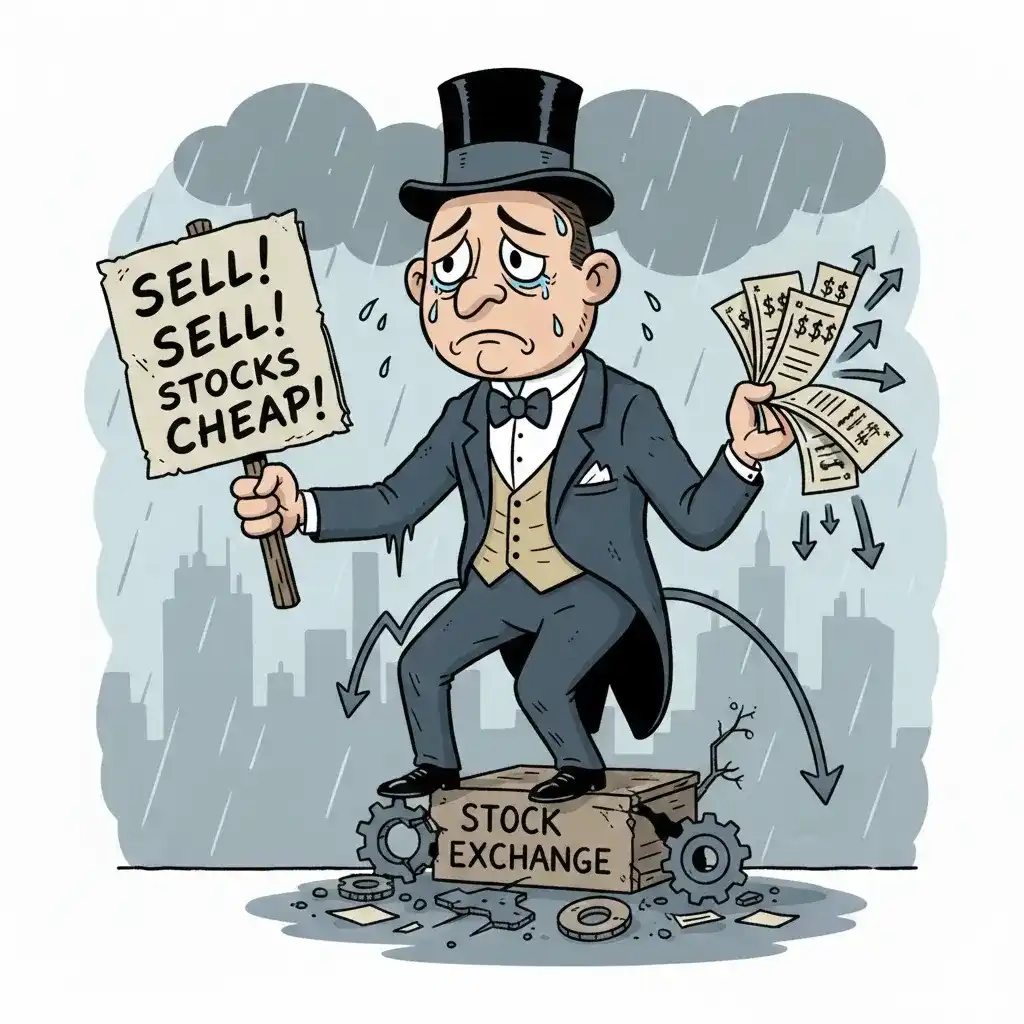
Generated by Gemini

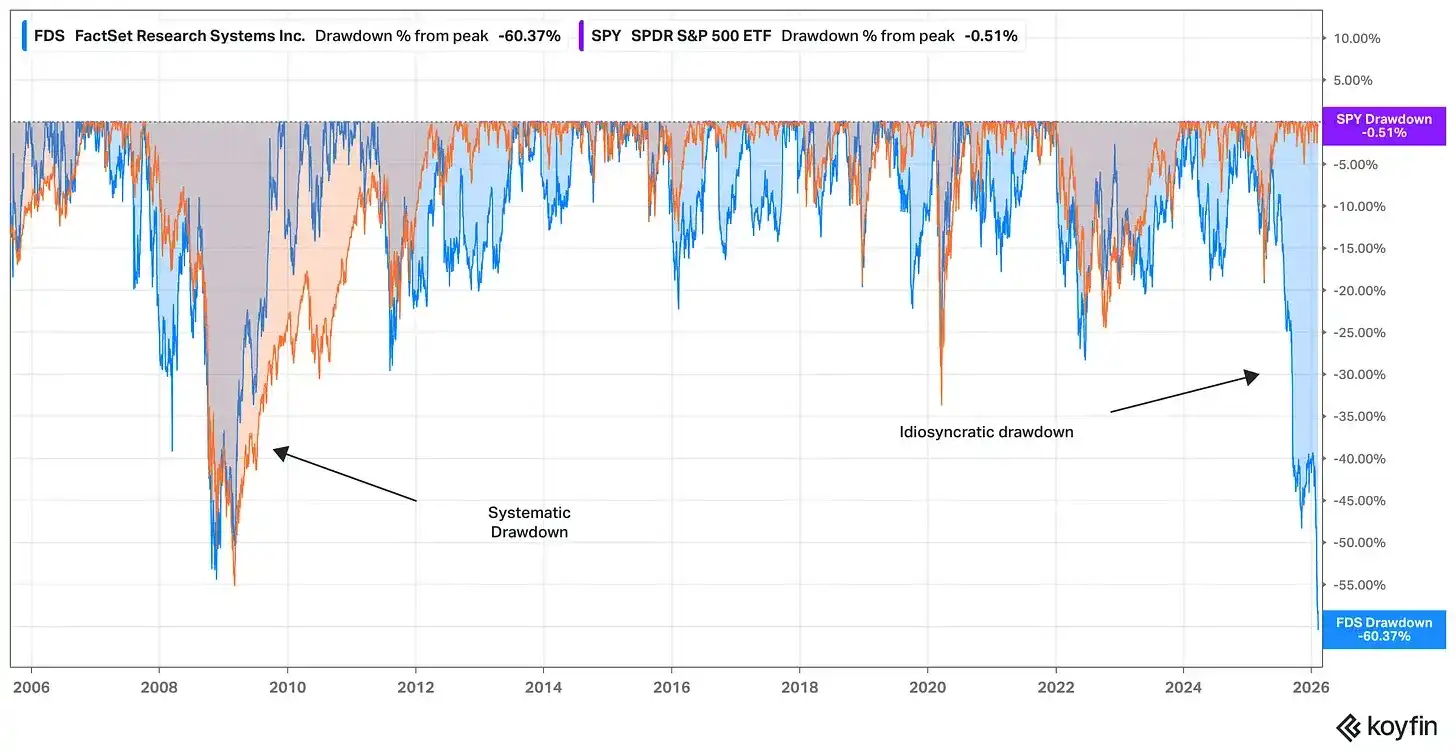
The recent sell-off in software stocks due to AI concerns illustrates this point. Let's look at the 20-year history of drawdowns between FactSet (FDS, blue) and the S&P 500 (measured via the SPY ETF, orange).

Source: Koyfin, as of February 12, 2026

FactSet's drawdown during the financial crisis was primarily systematic. In 2008/09, the entire market was worried about the durability of the financial system, and FactSet could not be immune to these concerns, especially since it sells products to financial professionals.

At that time, the stock's drawdown had less to do with FactSet's economic moat and more about whether FactSet's moat would matter if the financial system collapsed.

The 2025/26 FactSet drawdown is the opposite case. Here, the concerns are almost entirely focused on FactSet's moat and growth runway, alongside broader fears about accelerating AI capabilities disrupting pricing power in the software industry.

In a systematic drawdown, you can more reasonably make a time arbitrage bet. History shows that markets tend to rebound, and companies with intact moats may emerge even stronger than before, so if you are willing and able to remain patient while others panic, you can leverage a strong stomach to exploit a behavioral advantage.

Photo by Walker Fenton on Unsplash

However, in an idiosyncratic drawdown, the market is telling you that something is wrong with the business itself. Specifically, it suggests increasing uncertainty about the business's terminal value.

Therefore, if you hope to take advantage of an idiosyncratic drawdown, you need to possess an analytical advantage in addition to a behavioral one.

To succeed, you need to have a more accurate vision of what the company will look like in ten years than the current market price implies.

Even if you know a company well, this is not easy to do. Stocks don't typically fall 50% relative to the market for no reason. A lot of once-steadfast holders—even investors you might respect for their deep research—had to capitulate for this to happen.

If you are going to step in as a buyer during an idiosyncratic drawdown, you need to have an answer for why these otherwise informed and thoughtful investors were wrong to sell and why your vision is correct.

There's a fine line between conviction and arrogance.

Whether you are holding a stock in a drawdown or looking to initiate a new position in one, it's important that you understand what type of bet you are making.

Idiosyncratic drawdowns can tempt value investors to start looking for opportunities. Before you take the plunge, make sure you aren't using a blunt behavioral solution to solve a problem that requires nuanced analysis.

Stay patient, stay focused.

Todd

Связанные с этим вопросы

QAccording to the article, what are the two main types of risk in academic financial theory?

ASystematic risk and idiosyncratic risk.

QWhat is the key difference in the type of advantage an investor needs to exploit a systematic drawdown versus an idiosyncratic one?

AAn investor can exploit a systematic drawdown with a behavioral advantage (patience), but to exploit an idiosyncratic drawdown, they need an analytical advantage (a more accurate vision of the company's future).

QUsing the example from the article, what was the primary cause of FactSet's drawdown during the 2008/09 financial crisis?

AFactSet's drawdown during the 2008/09 crisis was primarily systematic, driven by market-wide fears about the durability of the financial system.

QWhat does the article suggest is the market implying about a business during an idiosyncratic drawdown?

ADuring an idiosyncratic drawdown, the market is implying that there is a problem with the business itself and that its terminal value is becoming increasingly uncertain.

QWhat is the 'fine line' the article warns investors about when considering a purchase during an idiosyncratic drawdown?

AThe fine line is between conviction and arrogance. An investor must be able to explain why the sellers were wrong and their own vision is correct, without being overconfident.

Похожее

a16z: AI's 'Amnesia', Can Continuous Learning Cure It?

The article "a16z: AI's 'Amnesia' – Can Continual Learning Cure It?" explores the limitations of current large language models (LLMs), which, like the protagonist in the film *Memento*, are trapped in a perpetual present—unable to form new memories after training. While methods like in-context learning (ICL), retrieval-augmented generation (RAG), and external scaffolding (e.g., chat history, prompts) provide temporary solutions, they fail to enable true internalization of new knowledge. The authors argue that compression—the core of learning during training—is halted at deployment, preventing models from generalizing, discovering novel solutions (e.g., mathematical proofs), or handling adversarial scenarios. The piece introduces *continual learning* as a critical research direction to address this, categorizing approaches into three paths: 1. **Context**: Scaling external memory via longer context windows, multi-agent systems, and smarter retrieval. 2. **Modules**: Using pluggable adapters or external memory layers for specialization without full retraining. 3. **Weights**: Enabling parameter updates through sparse training, test-time training, meta-learning, distillation, and reinforcement learning from feedback. Challenges include catastrophic forgetting, safety risks, and auditability, but overcoming these could unlock models that learn iteratively from experience. The conclusion emphasizes that while context-based methods are effective, true breakthroughs require models to compress new information into weights post-deployment, moving from mere retrieval to genuine learning.

marsbit50 мин. назад

a16z: AI's 'Amnesia', Can Continuous Learning Cure It?

marsbit50 мин. назад

Can a Hair Dryer Earn $34,000? Deciphering the Reflexivity Paradox in Prediction Markets

An individual manipulated a weather sensor at Paris Charles de Gaulle Airport with a portable heat source, causing a Polymarket weather market to settle at 22°C and earning $34,000. This incident highlights a fundamental issue in prediction markets: when a market aims to reflect reality, it also incentivizes participants to influence that reality. Prediction markets operate on two layers: platform rules (what outcome counts as a win) and data sources (what actually happened). While most focus on rules, the real vulnerability lies in the data source. If reality is recorded through a specific source, influencing that source directly affects market settlement. The article categorizes markets by their vulnerability: 1. **Single-point physical data sources** (e.g., weather stations): Easily manipulated through physical interference. 2. **Insider information markets** (e.g., MrBeast video details): Insiders like team members use non-public information to trade. Kalshi fined a剪辑师 $20,000 for insider trading. 3. **Actor-manipulated markets** (e.g., Andrew Tate’s tweet counts): The subject of the market can control the outcome. Evidence suggests Tate’sociated accounts coordinated to profit. 4. **Individual-action markets** (e.g., WNBA disruptions): A single person can execute an event to profit from their pre-placed bets. Kalshi and Polymarket handle these issues differently. Kalshi enforces strict KYC, publicly penalizes insider trading, and reports to regulators. Polymarket, with its anonymous wallet-based system, has historically been more permissive, arguing that insider information improves market accuracy. However, it cooperated with authorities in the "Van Dyke case," where a user traded on classified government information. The core paradox is reflexivity: prediction markets are designed to discover truth, but their financial incentives can distort reality. The more valuable a prediction becomes, the more likely participants are to influence the event itself. The market ceases to be a mirror of reality and instead shapes it.

marsbit1 ч. назад

Can a Hair Dryer Earn $34,000? Deciphering the Reflexivity Paradox in Prediction Markets

marsbit1 ч. назад

Торговля

Спот
Фьючерсы
活动图片