Did 'Unlimited Minting' Actually Happen? Zcash Founder Responds to Four Major Market Concerns

marsbitОпубликовано 2026-06-15Обновлено 2026-06-15

Введение

The Orchard shielding pool in the privacy cryptocurrency Zcash was recently found to have contained a critical counterfeiting vulnerability that existed for four years. This discovery caused significant market panic and a sharp drop in the price of ZEC, though it has since recovered partially. Zcash founder Zooko Wilcox addressed four key questions raised by the vulnerability. First, while it's unknown if the bug was exploited, he believes it likely was not, citing advanced, targeted discovery methods, a rapid response to freeze the pool, and the typical "smash-and-grab" nature of past crypto exploits. Second, he states that if no exploitation occurred, all legitimate user funds in Orchard are recoverable. However, cautious users moving funds should be aware of privacy trade-offs and other risks involved in transferring to transparent or Sapling pools. Third, users currently cannot independently verify that the total ZEC supply hasn't been inflated due to this bug. However, the proposed "Ironwood" network upgrade will restore this ability by permanently sealing the Orchard pool. This will prevent any counterfeit funds from circulating and allow anyone running a node to cryptographically verify that the supply cap has not been breached. Finally, regarding other undiscovered vulnerabilities, Wilcox notes that intensive ongoing audits by multiple teams, including using advanced AI-assisted tools, have so far found no other counterfeiting bugs. This provides increased, though ...

Editor's Note: On June 5th Beijing time, privacy project Zcash was exposed to have had a critical forgery vulnerability in its new-generation privacy pool Orchard. The price of Zcash's token ZEC plunged, at one point halving to a low near $250.

After about 10 days of development, market panic has somewhat subsided, and the price of ZEC has also recovered somewhat, climbing back to $500 today. (Recommended reading: "'Unlimited Money Printing' Vulnerability Lay Dormant for Four Years, Privacy Coin ZEC Halved in a Day")

This morning, Zcash founder Zooko Wilcox released another lengthy article in response to the market's key concerns.

He stated that it is likely the Orchard vulnerability was not previously exploited, and legitimate Orchard funds can be recovered. Currently, users cannot independently verify whether the Zcash supply exceeds the limit, but the Ironwood upgrade will seal the Orchard pool, restoring this verification capability. Ongoing audits have not revealed other forgery vulnerabilities, but complete certainty requires more work.

The recent Orchard vulnerability has raised important questions about Zcash's supply and user fund security. The discussion has mixed several different issues, making it difficult to understand the actual impact of this vulnerability on users. This article attempts to separate these issues and explain what they each mean for users.

The Orchard vulnerability raises four important questions:

1. Was the Orchard vulnerability ever exploited?

2. Can legitimate Orchard funds be recovered?

3. Can users verify that the Zcash supply has not been inflated?

4. How do we know there are no other forgery vulnerabilities?

Was the Orchard Vulnerability Ever Exploited?

Unknown. We believe it's unlikely to have been exploited previously, though it cannot be completely ruled out. We think the vulnerability likely remained unexploited for three reasons:

Despite continuous review over the years by many of the world's top cryptographers and security researchers, this vulnerability was not previously discovered. Its final discovery was not accidental; it was found by Taylor Hornby of Shielded Labs, whose goal was to proactively identify such security vulnerabilities before malicious attackers could.

Taylor used advanced AI-assisted security research techniques and custom-built tools specifically designed to find subtle flaws others missed. Doing this would be more difficult for someone not deeply familiar with the Zcash codebase.

Once discovered, Zcash developers (led by the Zcash Open Development Labs team) quickly coordinated with mining pools to temporarily freeze the Orchard pool and deploy a fix, thereby limiting any attacker's window of opportunity.

Cryptocurrency exploits are common, and attackers typically try to cash out as quickly as possible, especially after a vulnerability is made public. To profit from this vulnerability, an attacker would need to exchange forged ZEC for valuable assets, which typically requires the ZEC to leave the Orchard pool via the turnstile mechanism.

If the vulnerability had been exploited before the fix, we would expect evidence to have surfaced by now. Historically, cryptocurrency exploits are typically "smash-and-grab" operations, not strategies like "4D chess" hidden for months or even years.

Can Legitimate Orchard Funds Be Recovered?

We believe so, because we believe the vulnerability was never exploited. If this assessment is correct, all legitimate Orchard funds remain fully recoverable.
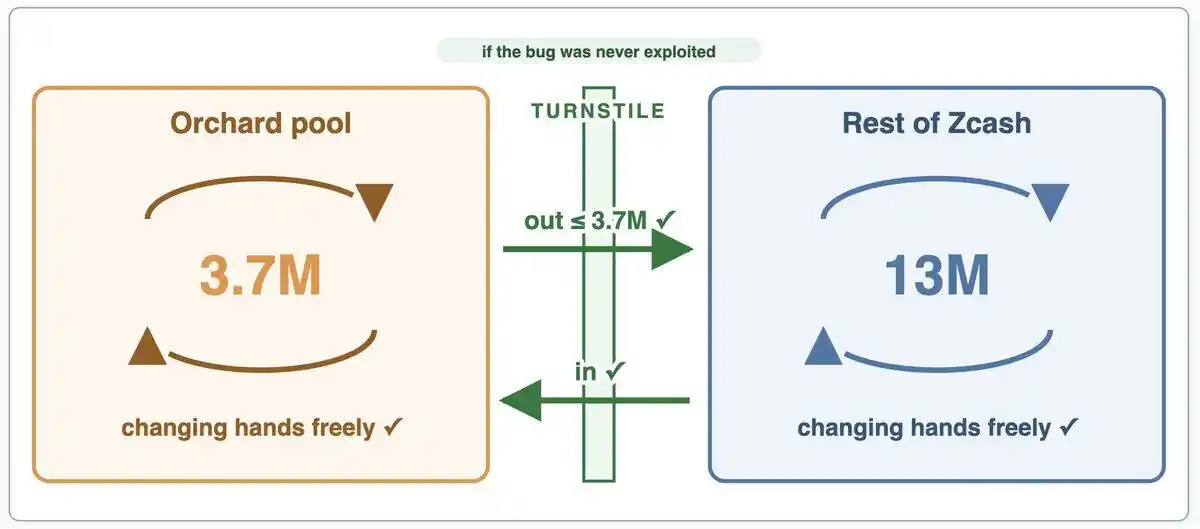
On the other hand, if forgery did occur in Orchard, the existing turnstile mechanism would limit the total migrated amount to the number of ZEC that legitimately entered the pool.

Therefore, if forged funds were migrated ahead of legitimate funds, users would be unable to recover some or all of their legitimate Orchard funds.
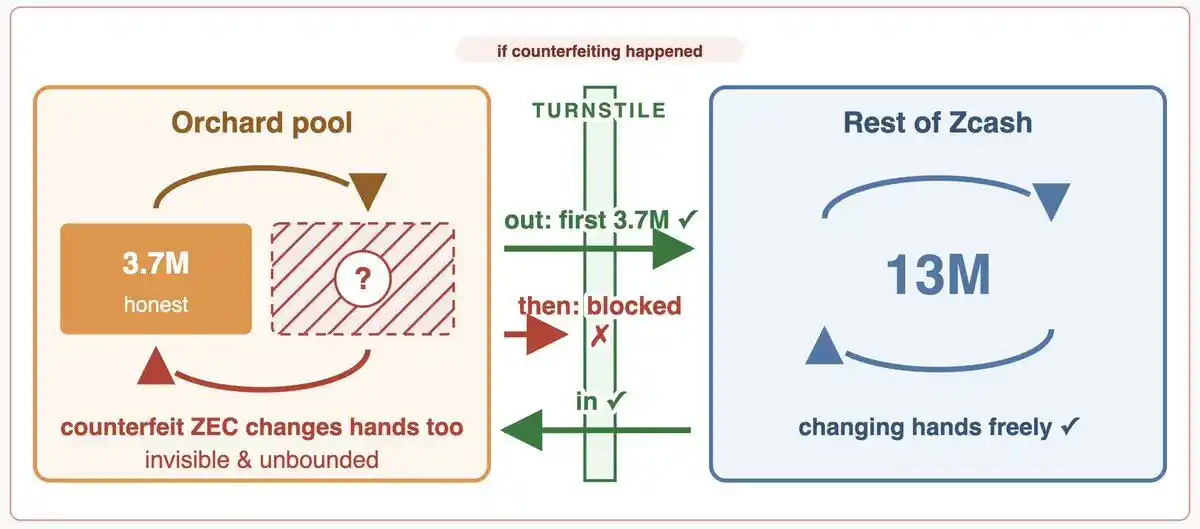
We consider this scenario unlikely. However, for more cautious users, it is still recommended to move their ZEC out of Orchard.

But before doing this, they should understand the following:

· Moving funds to a transparent pool (i.e., to a t-address) will reveal both the transfer amount and time, and these funds will also become publicly linked to that t-address.

· Moving funds from the Orchard pool to the Sapling pool reveals the transfer amount and time, but unlike moving to a t-address, it does not link these funds to a specific address or transaction history.

· The Sapling pool relies on a trusted setup ceremony performed in 2018. Relying on the security of that trusted setup is an additional risk users should be aware of.

· To our knowledge, YWallet and Zkool are currently the only widely used self-custody Zcash wallets that support the Sapling pool.

· Moving funds to a new wallet or custodian service introduces additional risks, including user error, software bugs, custodian risk, or other unforeseen problems.

Overall, we consider the above risks moderate.

If your funds are currently in a shielded self-custody wallet, leaving them there is a reasonable choice, given our assessment that previous forgery is unlikely. If you have a safe way to move them elsewhere, that might also be reasonable. Users may reach different conclusions based on their own circumstances.

Can Users Verify That the Zcash Supply Has Not Been Inflated?

Currently, no. The previous existence of this vulnerability meant that users cannot independently verify whether the ZEC currently circulating in the shielded pools does not exceed the correct amount.
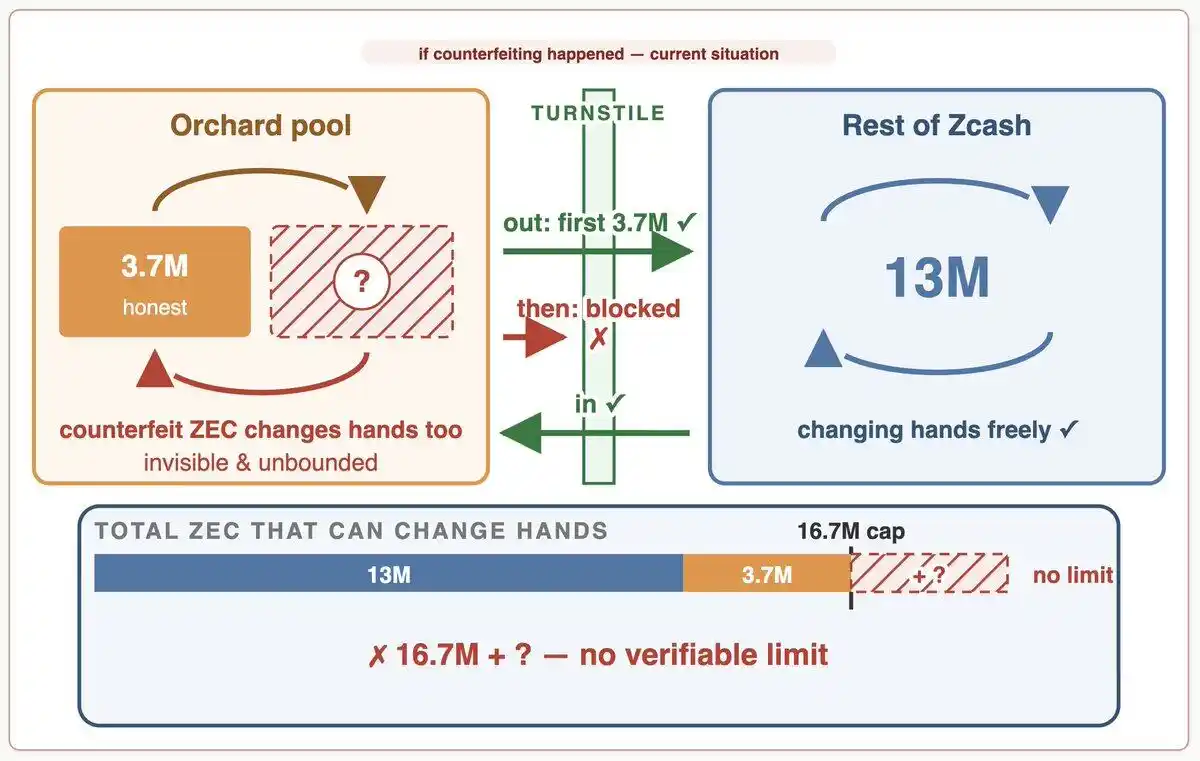
However, as we noted in a previous post, the Ironwood upgrade restores this ability. The following diagram illustrates why.
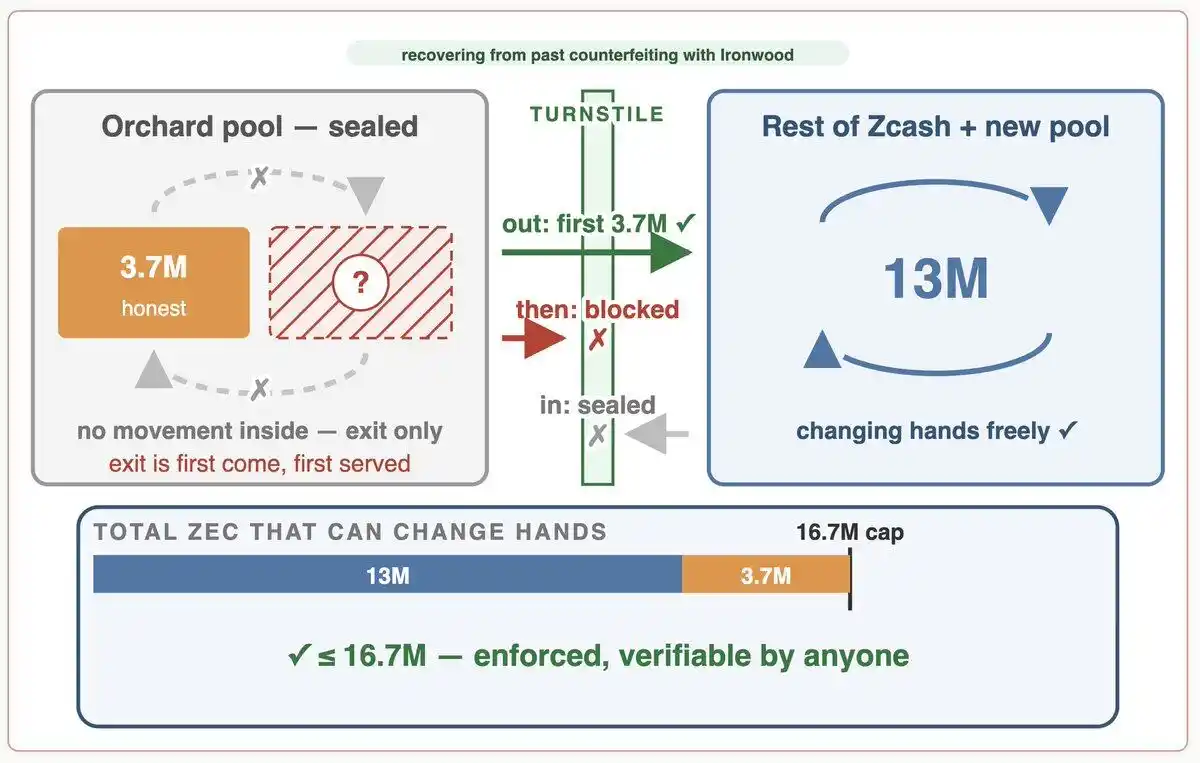
The proposed network upgrade addresses this by adding the guarantee that "no more unknown forgery vulnerabilities exist" and by sealing the Orchard pool. New funds cannot enter, and funds within the pool can no longer circulate.

The only remaining path out is via the existing turnstile mechanism, which ensures that no more ZEC can leave the Orchard pool than legitimately entered it.

This change restores the ability to verify the soundness of the Zcash supply.

Currently, if forged funds exist in the Orchard pool, they can continue circulating within it. After the upgrade, this is no longer possible. Regardless of whether forgery occurred, anyone running a node can verify that the circulating ZEC does not exceed the correct amount.

Users do not need to wait for funds to migrate out of Orchard or infer the behavior of attackers or other users. The protocol itself provides a verifiable guarantee: excess ZEC cannot continue circulating within Orchard and inflating the supply.

This is important because Zcash's long-term credibility depends on users' ability to verify the soundness of its supply themselves. Ironwood restores users' ability to independently verify that the protocol's supply limits are being enforced.

How Do We Know There Are No Other Forgery Vulnerabilities?

We cannot be completely certain yet, but we have reasons to believe there are none. Shielded Labs and several other teams have been carefully reviewing the Zcash protocol for other forgery vulnerabilities.

This includes using a not-yet-released Mythos AI model, with help from Anthropic, to search for additional vulnerabilities shortly before Mythos was paused. We plan to share more details about this review and its findings in a follow-up blog post.

So far, no other forgery vulnerabilities have been found. The high level of expertise, effort, and advanced AI-assisted analysis involved in this search gives us greater confidence that no similar vulnerabilities remain undiscovered.

Furthermore, we are working with projects like the Tachyon Project to provide additional assurances that no more forgery vulnerabilities exist in Zcash. We will elaborate on this further in future blog posts as well.

Conclusion

The Orchard vulnerability presents four important questions: Was the vulnerability exploited? Can legitimate Orchard funds be recovered? Can users verify the Zcash supply hasn't been inflated? And are there other undiscovered forgery vulnerabilities?

We believe it's unlikely to have been exploited, so legitimate Orchard funds are recoverable, and the current Zcash supply is safe. Based on ongoing reviews by multiple independent researchers and teams, we are also growing more confident that no other undiscovered forgery vulnerabilities exist.

However, users currently cannot verify the security of the Zcash supply, and they should not have to rely on our assessment—or anyone else's.

The proposed network upgrade solves this problem. By sealing the Orchard pool, it restores users' ability to independently verify the security of the Zcash supply. Users no longer need to judge whether forgery occurred to verify that the protocol's supply limits are being honored.
Похожее

2029 Finale Prediction: When Cryptocurrency Completely "Vanishes", Who Can Remain in This Financial Upheaval?

By 2029, the crypto industry will have transformed into a largely invisible but foundational layer for traditional finance. This timeline outlines the key shifts from now until then. By mid-2026, the most sought-after assets on-chain will not be traditional tokens, but synthetic perpetual contracts for private, high-growth companies (like SpaceX, OpenAI). These become primary price discovery tools, highlighting the market's craving for real-world asset value. Most altcoins enter a sustained bear market as their fundamental lack of asset-backed value is exposed. In late 2026, the "AI + Crypto" narrative largely fades as AI giants prove they don't need crypto infrastructure, except for prediction markets betting on model performance. Simultaneously, a quiet but significant wave of tokenization for institutional assets (money market funds, private credit) begins. The industry splits into a noisy speculative economy and a silent institutional one. Throughout 2027, major public blockchain foundations pivot decisively to serve institutional clients, building compliance toolkits and sales teams. However, key sectors hit growth ceilings: private perpetual contracts are legally restricted from public promotion, stable币 growth is capped by looming political uncertainty, and tokenization projects remain cautious. In 2028, following a U.S. election assumed to maintain a regulatory (not prohibitive) stance, a pivotal change occurs. After a major liquidation crisis exposes the flaws of synthetic contracts lacking a real-asset anchor, new regulations allow the *public solicitation* of private security sales (secondary market shares) to accredited investors. This creates a legitimate, direct on-ramp for retail capital into previously illiquid private equity. By 2029, the resulting bull market is driven by trading in real, innovative company shares (biotech, robotics, AI labs), not speculative tokens. "Crypto" as a distinct asset class recedes; it becomes the mundane, unseen plumbing for this new global private markets infrastructure. Tokens that survive are those capturing real cash flows from this infrastructure. Speculation persists but is marginalized. The core questions posed at the start are answered: token value is tied to legally enforceable claims on real assets, frontier tech adoption happens via private market channels, and crypto's absorption into traditional finance is marked by its becoming boring and invisible. The key validation for this entire thesis is whether, by late 2028, a legal pathway exists for ordinary accredited investors to access private assets directly.

marsbit28 мин. назад

2029 Finale Prediction: When Cryptocurrency Completely "Vanishes", Who Can Remain in This Financial Upheaval?

marsbit28 мин. назад

After the U.S. Banned Fable 5, Zhipu's Stock Soared 47%

On June 15, Chinese AI company Zhipu's stock surged up to 47.6% in Hong Kong, closing with a 32.82% gain. This sharp rise followed two key industry events. On June 12, Anthropic was compelled by a U.S. government export control order to suspend global access to its latest flagship models, Claude Fable 5 and Claude Mythos 5, impacting developers and businesses reliant on them. The next day, Zhipu announced it was opening access to its new open-source flagship model, GLM-5.2, for all Coding Plan users, with API and model weights (under the MIT license) to follow. The Anthropic incident highlighted a critical shift in the AI industry: beyond raw capability, the stability, continuous accessibility, and control over AI models are becoming equally vital, especially as AI integrates deeper into business workflows. Zhipu's move, emphasizing that "frontier intelligence should not belong to a few nor be subject to arbitrary revocation," positioned its open, accessible model as an alternative. GLM-5.2 focuses on "Long Horizon Tasks" with a 1M context window, aiming for consistency in complex, extended projects. Market analysts suggest this event exposes the risk of dependency on closed-source models subject to single jurisdiction policies, potentially accelerating a shift toward domestic base models and localized deployments. The investment response indicates a new valuation metric is emerging—prioritizing which companies can provide AI capabilities that are not only advanced but also reliably and sustainably accessible.

marsbit29 мин. назад

After the U.S. Banned Fable 5, Zhipu's Stock Soared 47%

marsbit29 мин. назад

PANews Column Registration and Article Submission Guide

"PANews Column Registration and Submission Guide" provides instructions for users to register as columnists and publish articles on the PANews platform. Key application requirements are emphasized: content should focus on in-depth analysis within Crypto, Web3, blockchain, data, and viewpoints. Content primarily for brand/product introductions will not be approved, and heavily AI-generated content will be rejected. Promotional (PR/soft) content is directed to the business channel. **Registration Process:** * **Web:** Go to the official website footer, click "Apply for Column," and register with a phone number or email (login via verification code, no password). Fill in the column name, description, upload an avatar, and submit links to previously published work. * **Mobile:** Navigate to "My" -> "Contribute & Create" and complete the form. **Article Submission Tutorial:** 1. Log in to the PANews website. 2. Access the "Creator Center" from your personal homepage. 3. Use the editor to create and publish articles. **Video Upload:** The platform supports embedding videos from third-party sites (e.g., Bilibili). Copy the embed code from the source video, use the editor's "Insert/Edit media" button, paste the code under the "Embed" tab, and adjust the display size (recommended: width 100%, height 560px). **PANews Skills (AI Agent Tool):** PANews offers an official AI Agent skill set called PANews Skills, enabling AI tools to query platform content, track trends, and publish column articles directly. It includes three main skills: 1. `panews`: For tracking daily must-read lists, popular articles, and funding news. 2. `panews-creator`: For managing columns, publishing articles, and uploading images. 3. `panews-web-viewer`: For parsing PANews webpages into Markdown. These skills are compatible with various AI Agent tools (OpenClaw, Cursor, Claude Code, ChatGPT, Gemini, etc.). To use the `panews-creator` skill, users must obtain a specific authentication value from the PANews website after logging into their columnist account.

marsbit40 мин. назад

PANews Column Registration and Article Submission Guide

marsbit40 мин. назад

I Built Myself an Investment Workbench Using AI

For the past two weeks, I've been immersed in Vibe Coding—using AI to write code from natural language descriptions. This process has enabled me to quickly build functional tools that address long-standing personal ideas. Previously, I had many concepts but found execution too cumbersome. Key ideas included a unified dashboard for assets across US stocks, Crypto, HK stocks, and A-shares; a real-time alert system for price movements; an investment map visualizing sector relationships; and a tool to correlate prediction market bets with news and market data. Traditional development hurdles meant these often remained unrealized. Using AI (Codex, Claude Code, and DeepSeek API), I built four initial tools: 1. A **Cross-Market Asset Dashboard** showing total assets, daily P&L, and holdings by market, with added features for alerts and sector mapping. It's deployed locally for privacy. 2. A **Prediction Market (PM) Monitor** tracking bets on events (e.g., company valuations) and correlating probability shifts with news and market movements. I categorize bets by conviction to filter noise. 3. A **Simple Operations Backend** for managing my writing workflow (topics, progress, publishing). It's cloud-deployed for mobile access. 4. A **One-Click Formatting Tool** that automates converting drafts into various platform-specific formats, saving manual effort. While these tools are basic, they represent a significant shift: AI lowers the barrier to creating personalized systems. I believe individual investors can now feasibly build core systems for: * **Asset Observation** (tracking holdings and changes) * **Signal Monitoring** (watching for key market shifts) * **Sector Mapping** (understanding network relationships within a sector) * **Performance Review** (documenting rationale and outcomes) The power of Vibe Coding is its fast feedback loop. Ideas can be implemented, tested, and iterated on rapidly, turning "want-to-do" into "done." This marks the start of my new phase, where I'll share investment thoughts, tool tests, on-chain operations, and educational Web3 content.

marsbit56 мин. назад

I Built Myself an Investment Workbench Using AI

marsbit56 мин. назад

Торговля

Спот
Фьючерсы
活动图片