Delphi Labs Founder: Two Weeks Deep in China's AI, Shenzhen Hardware Shocks Me, Software Valuations Scare Me

marsbitОпубликовано 2026-03-26Обновлено 2026-03-26

Введение

Delphi Labs co-founder José Maria Macedo spent two weeks in China meeting AI founders, VCs, and public company CEOs. His key takeaways: - **Hardware ecosystem in Shenzhen is impressive**, with systematic reverse-engineering of Western products and rapid iteration cycles. Companies like Bambu Lab are highly profitable and scaling fast. - **Software ecosystem is weaker than expected**. Chinese open-source models are strong, but closed-source models lag behind Western counterparts. GPU access remains constrained, and revenue gaps are significant (e.g., Anthropic’s $6B ARR vs. Chinese model companies at tens of millions). - **Founder profiles are highly accomplished** (top universities, Big Tech experience) but often lack rebellious, original vision. The education and VC systems favor execution over true innovation. - **Valuation bubbles exist** at both early and late stages. Some private AI companies are valued at 400x ARR, far exceeding Western multiples. Humanoid robotics is also overheating, with many pre-revenue companies targeting high-valuation IPOs. - **Information asymmetry favors Chinese founders**, who are highly informed about Western markets and tech trends. Many are building globally first, combining Chinese engineering with Western go-to-market strategies. Macedo believes the real alpha lies in finding non-traditional founders who break the "resume template" optimized by local VCs.

Author: José Maria Macedo, Delphi Labs Cofounder

Compiled by: Deep Tide TechFlow

Deep Tide Guide: The founder of Delphi Labs spent two weeks intensively visiting China's AI ecosystem, meeting a large number of founders, investors, and CEOs of listed companies.

His conclusion was unexpected: more optimistic about hardware than expected, more pessimistic about software than expected, and his views on Chinese founders overturned his previous perceptions.

The article also covers hot topics such as valuation bubbles, the humanoid robotics sector, and information asymmetry between China and the West.

Full text as follows:

I spent two weeks in China, meeting a large number of founders, VCs, and CEOs of listed companies within the AI ecosystem. Before going, I was bullish on this ecosystem, expecting to see world-class AI talent working at valuations far lower than in the West.

My perspective changed when I left—it became more specific: hardware is stronger than I imagined, software is weaker than I imagined, and some observations about Chinese founders also surprised me.

The Founder Problem

The exceptional founders I've invested in share a common trait: independent thinking, rebelliousness, extreme focus, and obsession. They don't follow the rules. They constantly ask "why" and refuse to accept second-hand wisdom. The decisions they make seem inexplicable to outsiders but feel obvious to them. They possess an intrinsic, unstoppable intensity, often manifested as a long-term obsession and excellence. As a VC who meets many smart people daily, this type of person stands out instantly in a crowd because their life trajectory has a distinct "sharpness."

Many founders I met in China were of another type, which surprised me.

They are extremely outstanding—top university degrees, resumes from ByteDance or DJI, Nature papers, multiple patents. In the West, these achievements are only for the top technical talents; in China, they are the entry ticket. They also work harder than almost anyone I've met. We had meetings at all hours, non-stop even on weekends, rushing between cities. One founder met with us on the day his wife gave birth.

But independent thinking, rebellious spirit, and a vision from 0 to 1—these were harder to find. The founders' backgrounds are highly similar, pitches are more conservative, and many ideas are upgrades of existing products (impressive V2) rather than truly original bets. Given the massive scale of technical talent China produces, I expected to encounter more people "showing up with ideas I've never heard of."

My interpretation: China's education system cultivates excellence but doesn't leave enough room for deviation. It produces top executors skilled at solving known problems, not the type who "show up with a problem nobody knew existed."

VCs Are Reinforcing This Model

More interestingly, local investors are exacerbating this trend.

The investment logic of most Chinese funds is based on one premise: invest in the best people coming out of ByteDance or DJI. They look at resumes, not edge; background, not conviction. The VCs' own profiles are similar—coming from big companies, consulting, or investment banking, much like European VCs a decade ago.

Ironically, historically, the Chinese founders who truly built great companies mostly never worked in big companies. Jack Ma was an English teacher who took the college entrance exam twice. Ren Zhengfei founded Huawei at 43, previously being in the military. Liu Qiangdong started by selling goods at a market stall. Wang Xing dropped out of his PhD to start a business. More recently, Liang Wenfeng, who created DeepSeek, never worked anywhere outside his own company. These people are outliers, those without "standard resumes"—precisely the ones the current investment system would miss.

Finding these people offers real alpha, but currently, few seem to be looking there.

Shenzhen and the Hardware Ecosystem

The most shocking thing I saw in China wasn't some startup's pitch.

It was Shenzhen's hardware underground workshops—engineers systematically obtaining high-end Western products, disassembling them part by part, and reverse-engineering everything in an extremely rigorous way. Walking out, I was genuinely unsure if most Western hardware founders understand what they're competing against. The network effects here aren't theoretical; they are physical, dense, and built up over decades.

The entrepreneurs we met confirmed this with data: over 70% of hardware investment comes from the Greater Bay Area, close to 100% from within China—this means iteration cycles are something Western hardware companies simply cannot match.

Most founders I met are using DJI's playbook: make consumer hardware in a niche—electric wheelchairs, lawn mowing robots, new-generation fitness equipment—grow revenue to 8 or 9 figures (USD), then leverage the customer base or underlying technology to move into adjacent categories. Some companies are already much larger than you think. The strongest company I saw on this trip was Bambu Lab, a 3D printing company most Westerners haven't heard of, reportedly with annual profits of $500 million, doubling every year.

Bearish on Chinese Software

I left more skeptical about Chinese software opportunities than when I arrived.

At the model level, China's open source is indeed strong, but closed-source models still have a noticeable gap compared to the best in the West, and the gap might be widening. The capital expenditure gap is huge. GPU access is still restricted. Western labs are increasingly cracking down on distillation. The revenue numbers say it all: Anthropic reportedly did $6 billion ARR in February alone. The best Chinese model companies have ARR in the tens of millions of dollars.

On the software startup side, the mainstream profile is PMs and researchers from ByteDance, making agentic or ambient consumer software for Western markets. The talent is indeed strong, but many of these products fall right within the feature set that big labs will natively release—one update could render them obsolete. Another thing that surprised me: China lacks large, fast-growing private software companies. In the West, besides model companies, there is a batch of startups already doing 9-figure or even 10-figure ARR with astonishing growth—Cursor, Loveable, ElevenLabs, Harvey, Glean. This tier of breakthrough private software companies basically doesn't exist in China—exceptions like HeyGen, Manus, GenSpark, who left after succeeding.

Valuation Bubble

Despite the weak software side, the bubble is real—both early and late stage.

Early on, the very top talent from ByteDance, DeepSeek, and Moonshot AI is indeed significantly cheaper than equivalent US talent, but median valuations have converged. Pre-product consumer startups valued at $100-200 million are common. Pre-seed rounds over $30 million are not unheard of.

The late-stage numbers are harder to justify. MiniMax is valued at around $40 billion on the public market, with ARR under $100 million—roughly 400x revenue. Zhipu is around $25 billion for $50 million revenue. For comparison: OpenAI's highest valuation round was roughly 66x ARR, Anthropic around 61x.
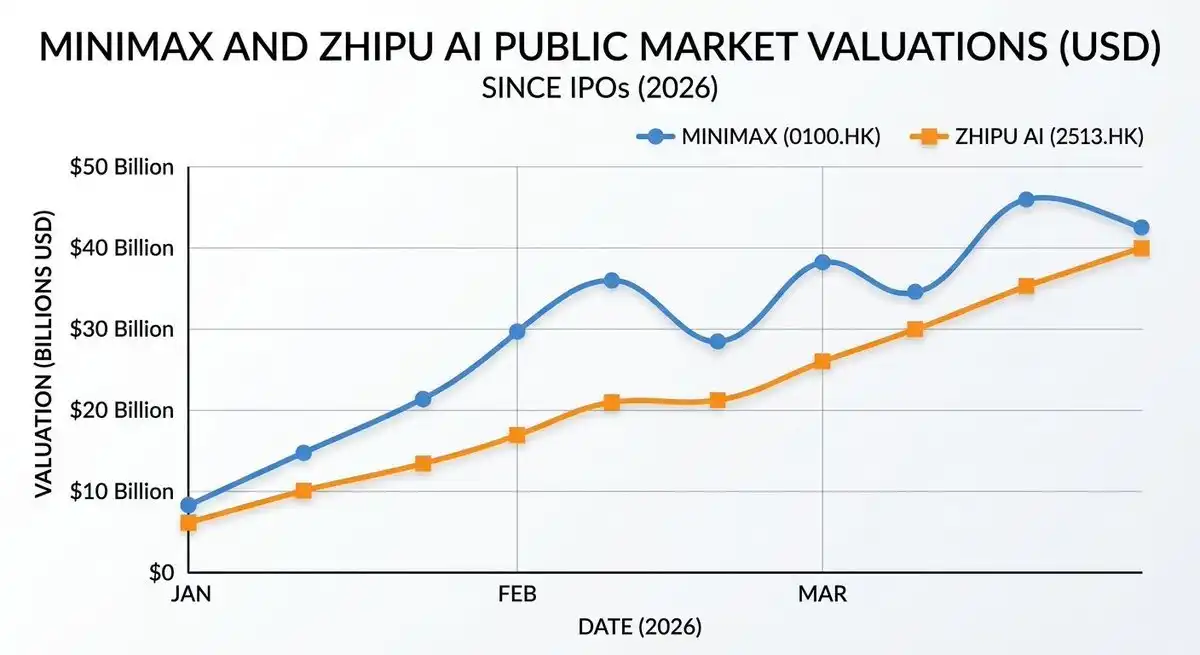
Private model companies like Moonshot AI use these public market comps to fundraise—jumping from $6 billion to $10 billion to $18 billion within months. Friends in crypto will be familiar with this playbook: investors compare private valuations to a public market price "pre-unlock." Furthermore, Zhipu and MiniMax can maintain these levels partly because they are currently the only way to get exposure to the "China AI narrative," which itself carries a premium. But as more companies list, this premium will dilute. Finally, IPO windows have a characteristic—they slam shut without warning. No one can guarantee you'll close this arbitrage before the comps move.

The humanoid robotics sector is in a similar situation. China has about 200 humanoid robotics companies, around 20 have raised over $100 million, several are valued in the billions—almost all with no revenue, most planning HK IPOs in 2026 or 2027. If this market is real, China's hardware advantage makes the long-term landscape relatively clear. But commercialization might be much slower than the current funding pace suggests, and I doubt the HK market can support the dozens of multi-billion dollar humanoid robotics companies currently queuing for IPO. I'm staying away for now.

Notable Information Asymmetry

One thing took me by surprise: almost every founder I met is targeting the global market first, then China. They use Claude Code, listen to Dwarkesh's podcasts, and know the San Francisco startup ecosystem inside out—often more than Western investors who haven't been keeping up.

Western hostility towards China is noticeably greater than Chinese hostility towards the West. Chinese founders see no contradiction in combining China's engineering execution and hardware depth with Western go-to-market and product thinking. When this combination comes together in the right founding team, it can birth some truly remarkable companies.

Finding these founders—those who don't fit the "standard resume template" optimized by the local VC system—is what we are doing now.

Special thanks to @woutergort for opening up his excellent Chinese network, @PonderingDurian for organizing the trip, and Claude for patiently editing my ramblings on the plane.


Связанные с этим вопросы

QWhat were the author's main observations about Chinese AI hardware and software ecosystems after his two-week visit?

AThe author became more bullish on Chinese hardware than expected, impressed by Shenzhen's hardware ecosystem and reverse engineering capabilities, but more pessimistic about Chinese software due to significant gaps in closed-source AI models compared to the West and lack of large, fast-growing private software companies.

QHow did the author describe the typical profile of Chinese founders he met, and what was missing?

AThe author found Chinese founders highly accomplished with elite educations and work experience at companies like ByteDance or DJI, but noted a lack of independent thinking, rebellious spirit, and original vision compared to Western founders who often pursue unconventional ideas.

QWhat role do Chinese VCs play in shaping the founder landscape according to the author?

AChinese VCs reinforce a pattern of investing in founders with impressive resumes from top companies like ByteDance or DJI, rather than seeking out unconventional thinkers with unique visions, potentially missing innovative outliers like many historically great Chinese entrepreneurs.

QWhat did the author identify as major valuation bubbles in China's AI sector?

AThe author highlighted massive valuation bubbles in both early and late-stage AI companies, with examples like MiniMax valued at ~$40B (400x ARR) and Zhipu at ~$25B (500x ARR), far exceeding Western multiples, and similar bubbles in humanoid robotics companies with high valuations despite no revenue.

QWhat surprising observation did the author make about information asymmetry between Chinese and Western ecosystems?

AThe author found that Chinese founders were highly knowledgeable about Western ecosystems (using Claude Code, following Silicon Valley trends), while Western counterparts showed greater hostility toward China, creating an asymmetry where Chinese founders better understand Western markets than Westerners understand Chinese capabilities.

Похожее

a16z: AI's 'Amnesia', Can Continuous Learning Cure It?

The article "a16z: AI's 'Amnesia' – Can Continual Learning Cure It?" explores the limitations of current large language models (LLMs), which, like the protagonist in the film *Memento*, are trapped in a perpetual present—unable to form new memories after training. While methods like in-context learning (ICL), retrieval-augmented generation (RAG), and external scaffolding (e.g., chat history, prompts) provide temporary solutions, they fail to enable true internalization of new knowledge. The authors argue that compression—the core of learning during training—is halted at deployment, preventing models from generalizing, discovering novel solutions (e.g., mathematical proofs), or handling adversarial scenarios. The piece introduces *continual learning* as a critical research direction to address this, categorizing approaches into three paths: 1. **Context**: Scaling external memory via longer context windows, multi-agent systems, and smarter retrieval. 2. **Modules**: Using pluggable adapters or external memory layers for specialization without full retraining. 3. **Weights**: Enabling parameter updates through sparse training, test-time training, meta-learning, distillation, and reinforcement learning from feedback. Challenges include catastrophic forgetting, safety risks, and auditability, but overcoming these could unlock models that learn iteratively from experience. The conclusion emphasizes that while context-based methods are effective, true breakthroughs require models to compress new information into weights post-deployment, moving from mere retrieval to genuine learning.

marsbit2 ч. назад

a16z: AI's 'Amnesia', Can Continuous Learning Cure It?

marsbit2 ч. назад

Can a Hair Dryer Earn $34,000? Deciphering the Reflexivity Paradox in Prediction Markets

An individual manipulated a weather sensor at Paris Charles de Gaulle Airport with a portable heat source, causing a Polymarket weather market to settle at 22°C and earning $34,000. This incident highlights a fundamental issue in prediction markets: when a market aims to reflect reality, it also incentivizes participants to influence that reality. Prediction markets operate on two layers: platform rules (what outcome counts as a win) and data sources (what actually happened). While most focus on rules, the real vulnerability lies in the data source. If reality is recorded through a specific source, influencing that source directly affects market settlement. The article categorizes markets by their vulnerability: 1. **Single-point physical data sources** (e.g., weather stations): Easily manipulated through physical interference. 2. **Insider information markets** (e.g., MrBeast video details): Insiders like team members use non-public information to trade. Kalshi fined a剪辑师 $20,000 for insider trading. 3. **Actor-manipulated markets** (e.g., Andrew Tate’s tweet counts): The subject of the market can control the outcome. Evidence suggests Tate’sociated accounts coordinated to profit. 4. **Individual-action markets** (e.g., WNBA disruptions): A single person can execute an event to profit from their pre-placed bets. Kalshi and Polymarket handle these issues differently. Kalshi enforces strict KYC, publicly penalizes insider trading, and reports to regulators. Polymarket, with its anonymous wallet-based system, has historically been more permissive, arguing that insider information improves market accuracy. However, it cooperated with authorities in the "Van Dyke case," where a user traded on classified government information. The core paradox is reflexivity: prediction markets are designed to discover truth, but their financial incentives can distort reality. The more valuable a prediction becomes, the more likely participants are to influence the event itself. The market ceases to be a mirror of reality and instead shapes it.

marsbit3 ч. назад

Can a Hair Dryer Earn $34,000? Deciphering the Reflexivity Paradox in Prediction Markets

marsbit3 ч. назад

Торговля

Спот
Фьючерсы

Популярные статьи

Как купить S

Добро пожаловать на HTX.com! Мы сделали приобретение Sonic (S) простым и удобным. Следуйте нашему пошаговому руководству и отправляйтесь в свое крипто-путешествие.Шаг 1: Создайте аккаунт на HTXИспользуйте свой адрес электронной почты или номер телефона, чтобы зарегистрироваться и бесплатно создать аккаунт на HTX. Пройдите удобную регистрацию и откройте для себя весь функционал.Создать аккаунтШаг 2: Перейдите в Купить криптовалюту и выберите свой способ оплатыКредитная/Дебетовая Карта: Используйте свою карту Visa или Mastercard для мгновенной покупки Sonic (S).Баланс: Используйте средства с баланса вашего аккаунта HTX для простой торговли.Третьи Лица: Мы добавили популярные способы оплаты, такие как Google Pay и Apple Pay, для повышения удобства.P2P: Торгуйте напрямую с другими пользователями на HTX.Внебиржевая Торговля (OTC): Мы предлагаем индивидуальные услуги и конкурентоспособные обменные курсы для трейдеров.Шаг 3: Хранение Sonic (S)После приобретения вами Sonic (S) храните их в своем аккаунте на HTX. В качестве альтернативы вы можете отправить их куда-либо с помощью перевода в блокчейне или использовать для торговли с другими криптовалютами.Шаг 4: Торговля Sonic (S)С легкостью торгуйте Sonic (S) на спотовом рынке HTX. Просто зайдите в свой аккаунт, выберите торговую пару, совершайте сделки и следите за ними в режиме реального времени. Мы предлагаем удобный интерфейс как для начинающих, так и для опытных трейдеров.

1.2k просмотров всегоОпубликовано 2025.01.15Обновлено 2025.03.21

Как купить S

Sonic: Обновления под руководством Андре Кронье – новая звезда Layer-1 на фоне спада рынка

Он решает проблемы масштабируемости, совместимости между блокчейнами и стимулов для разработчиков с помощью технологических инноваций.

2.2k просмотров всегоОпубликовано 2025.04.09Обновлено 2025.04.09

Sonic: Обновления под руководством Андре Кронье – новая звезда Layer-1 на фоне спада рынка

HTX Learn: Пройдите обучение по "Sonic" и разделите 1000 USDT

HTX Learn — ваш проводник в мир перспективных проектов, и мы запускаем специальное мероприятие "Учитесь и Зарабатывайте", посвящённое этим проектам. Наше новое направление .

1.8k просмотров всегоОпубликовано 2025.04.10Обновлено 2025.04.10

HTX Learn: Пройдите обучение по "Sonic" и разделите 1000 USDT

Обсуждения

Добро пожаловать в Сообщество HTX. Здесь вы сможете быть в курсе последних новостей о развитии платформы и получить доступ к профессиональной аналитической информации о рынке. Мнения пользователей о цене на S (S) представлены ниже.

活动图片