Crypto Trader's Account: Friends Are Leaving, What's Left to Do in This Industry?

marsbitОпубликовано 2026-04-22Обновлено 2026-04-22

Введение

Crypto trader Donn reflects on the declining state of the cryptocurrency industry, noting that many peers are leaving due to three core challenges: lack of innovation in the past 2-3 years, the threat of quantum computing to Bitcoin by 2029, and increased DeFi attacks exacerbated by AI models like Claude Mythos. VC activity has stagnated, with few quality token projects generating over $50M in annual income. Liquidity and investor interest have dwindled, shifting focus to traditional markets. For traders, event-based strategies remain viable but are increasingly competitive and low-yield due to reduced open interest and retail participation. Systematic and basis traders are exploring alternative strategies as traditional methods become less profitable. DeFi yield farming is increasingly unattractive due to rising hack risks and insufficient returns, pushing farmers toward off-chain options. On-chain gem hunters still chase high-risk, high-reward opportunities, but success rates are low, and most tokens crash shortly after peaking. Personally, the author is scaling down crypto trading, maintaining a small arbitrage strategy on Polymarket, and exploring AI automation for analytical tasks. He is also researching AI model fine-tuning and broader AI applications beyond crypto, seeking new focus areas as the industry wanes.

Author: donn (@tzedonn)

Compiled by: Deep Tide TechFlow

Deep Tide Introduction: When only 12 projects have annual revenues exceeding $50 million, when DeFi is attacked by AI and becomes a pit of fire, when on-chain gold diggers are still trapped in a battlefield that has already ended—every crypto practitioner should ask themselves the same question: What can I still do here?

Many of my friends have left or are considering leaving the crypto industry, so I want to share some broader thoughts about the market and discuss what is left to do in cryptocurrency?

The core of the problem is that cryptocurrency is stuck in three key areas: (i) a lack of innovation, with nothing new emerging in the past 2-3 years; (ii) the advancement of quantum technology threatening Bitcoin's survival by 2029; (iii) large language models like Claude Mythos increasing the number of attacks, making the risk/reward of DeFi unattractive.

This leads to the question: What is left to do in cryptocurrency?

VCs and Liquid Token Investors

Due to this innovation drought, the VC industry has been quite quiet, especially in token trading. Every crypto VC will tell you how boring it is, unless they are doing larger Series B+ funding or backing stablecoin payment startups.

The few good VCs I interact with are investing in contrarian verticals, such as quantum startups (e.g., Project Eleven, Oratomic) or novel ideas (e.g., Shift Foundation, PostFiat, Ambient).

I think this is normal because we have basically figured out what works and what infrastructure is needed, so there are fewer and fewer exciting new things. Now we are in the adoption phase of payments and remittances. The endgame and institutions have arrived.

Similarly, for those working in crypto, it only makes sense to work at stablecoin fintech companies (e.g., Circle, OpenFX, Tempo, Arc, Plasma), trading platforms (e.g., Polymarket, Kalshi, Hyperliquid), or novel contrarian startups (as mentioned above). Working at an L1 foundation is a well-paid dead-end job that does you no good in the long run.

The lack of "cool new things" on the VC side means fewer quality tokens will come to market, and less VC capital will flow into the liquid market.

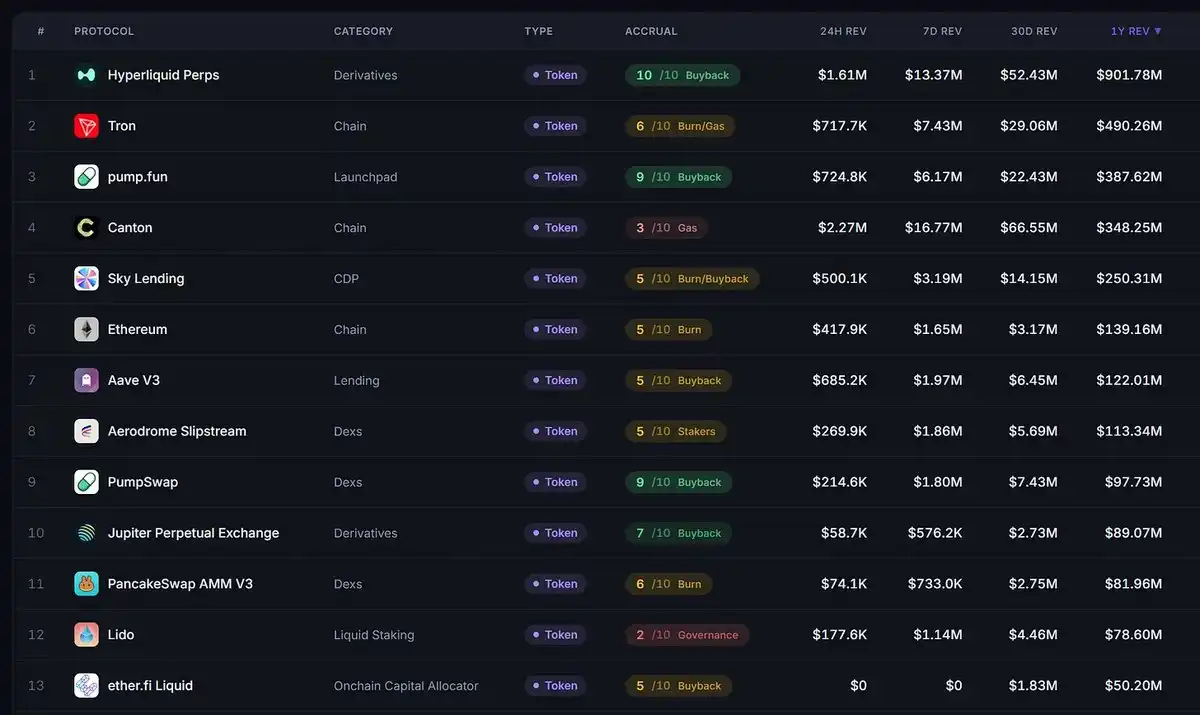
Therefore, long-term liquid token investors who evaluate tokens based on growth, fundamentals, and value accumulation probably have fewer than 10 quality targets now, and this number seems unlikely to increase in the short term.

Only 12 token projects have annual revenues exceeding $50 million. Only three of them have a value accumulation score >=7 (HYPE, PUMP, JUP). Even if you evaluate based on "growth" and teams improving token value accumulation, you might add another 5-10 tokens to the list below (e.g., MORPHO, SYRUP).

The market cap of OTHERS has also dropped from about $450 billion to about $180 billion, while the stock market is experiencing speculative frenzies in areas like high-bandwidth memory, photonics, quantum, polypeptides, etc.
Subjective and Systematic Traders

You might say cryptocurrency is mostly narrative trading and momentum trading, so it suits subjective traders who go long/short, trade narratives, or catalysts/news. This is the area I am in and know best.

In the depths of the bear market, trading catalysts has been more profitable, although many require you to stay alert and react quickly. There is a lot of edge and decent trading opportunities here.

Still, there have been quite a few event-driven trades in the past 3 months, such as...

Shorting TAO when the Templar subnet left, dropping from $330 to $260 in 5 hours (April 9)... Going long TAO on Chamath and Jason Cal's shills (with varying success)

No trade here, but interestingly, WLD didn't even rise on the Tinder and Zoom partnership announcement (down 8% in two days)

Shorting AAVE on the KelpDAO hack, which happened around 1730 UTC but was first reported on Twitter about an hour later at 1830 UTC (April 19)

Shorting AAVE on Marc Zeller's ACI departure (March 3)

Shorting the pullback in TRUMP after the Trump dinner announcement (March 12)

Shorting ACX to the "conversion price" after the spike from the token-to-equity conversion announcement (March 11)

Shorting DRIFT on the exploit, down 40% in 1 hour (April 1)

Shorting RESOLV on the exploit, down about 10% (March 22)

Going long ALGO on the Google quantum breakthrough (March 31)

Going long LDO on the buyback announcement, up about 17% in about 5 days (March 27)

Going long/short on pump-and-dump scams like RAVE, SIREN, STO, PIPPIN, POWER (things I prefer not to participate in)

Still, open interest has dropped about 60% since October 10th, and reactions to news are often small. You need to be selective about what news to trade and whether others care about it, because retail trading interest is scarce (usually the slowest to react to headlines), so you are mainly PVPing with other news traders.

I increasingly see subjective traders spending more time on prediction markets and trading stocks/commodities, and Hyperliquid makes this transition much easier.

As for systematic traders and basis traders. As trading volume and funding rates decline, traditional strategies are becoming less profitable. To keep themselves interested, they are doing HIP-3 markets, arbitraging prediction markets, trading Pendle PT/Boros, or arbitraging new perpetual DEXs (with limited liquidity).

Yield Farmers

The increasing number of hacks in DeFi has also put yield farmers (or TVL trading on the institutional side) into hibernation or completely exiting this year, as the last few good trades were Plasma and USDai. FlyingTulip might work in a bull cycle, but it didn't get much attention at launch.

Usually, "yield trading" makes sense because you can sell the governance tokens rewarded to you (as I highlighted here), but this assumes someone buys it from you. If liquid investors/subjective traders aren't there to add fuel, it's hard to make the risk/reward worthwhile.

This was true in the past (OHM), is true now (XPL, ENA), and will likely be true in the future (CHIP for USDai). The threshold for on-chain DeFi yield used to be 15-25% APY to account for treasury rates around 0% and a hack probability of about 10-15%.

The reason OHM was worth it back then wasn't because the risk was lower, but because the returns were much higher.

Now the threshold is probably closer to 50-60% APY, due to the increasing number of hacks ($795 million hacked in DeFi in the first four months of 2026) plus Claude Mythos potentially leading to more hacks and rising quantum risk. Since no one is buying the emitted tokens, it's hard to achieve a reasonable risk/reward.

Most rational farmers have almost entirely moved off-chain, because even an 11.5% STRC TradFi fixed note yield offers better risk-adjusted returns (15-20%).
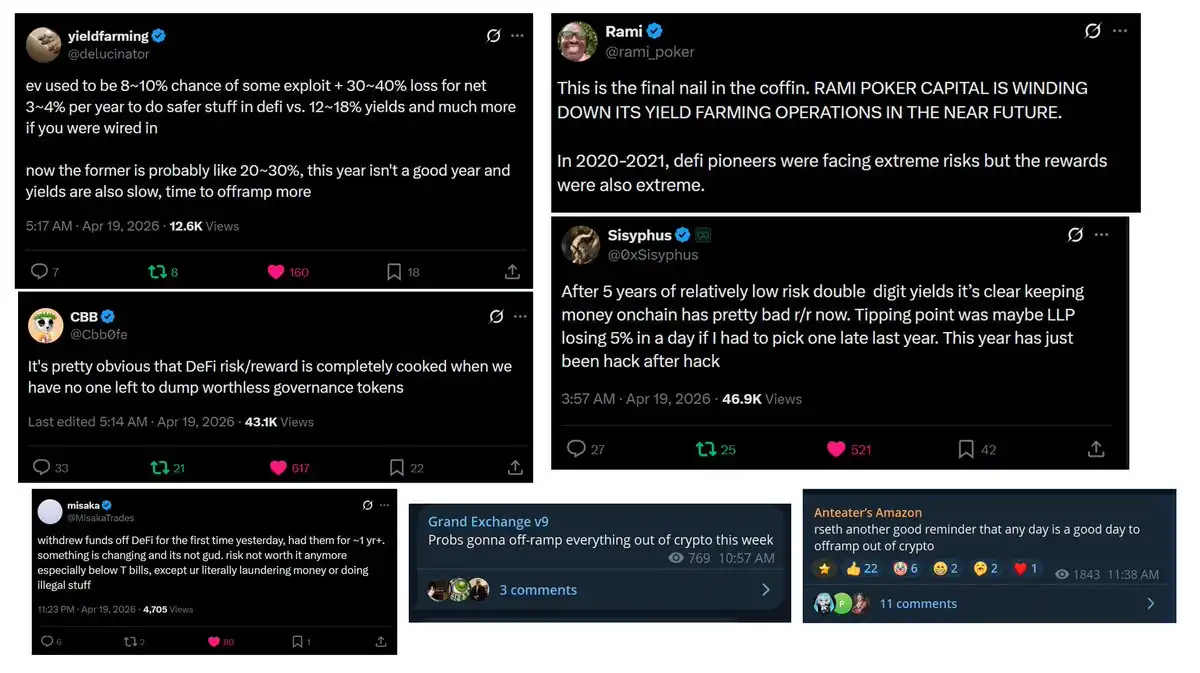
See: Rami poker, CBB, Sisyphus, delucinator, misaka

On-Chain Prospectors

Last but not least... the infamous on-chain prospectors: those who buy at $1 million market cap and sell at $100 million. I think these people will still exist, because the trenches are still the only place where you can pull off 100x.

On-chain prospectors also feel like WWII soldiers trapped in a cave, unaware that the gold rush era is basically over.

Needless to say, meme coins peaked when our dear President and First Lady launched their coins. We are nearing the end of the euthanasia coaster, things don't pump like they used to, and there are too many value extractors everywhere ("FNF groups", "LA vape groups", serial rug factories, and extractive transaction fees).

Still, I don't think this segment will die completely; a glimmer of hope keeps people in the trenches. In the past few months, we've seen...

$GAS: GasTown went from $100k market cap to $60 million in 3 days, then back to $1 million in 3 days, now at $50k market cap. (Jan 15)

$RALPH: RalphWiggum went from $500k to $55 million in 2 weeks, then dropped to $3 million (-93%) in 12 hours when the dev abandoned it, now trading at $50k market cap. (Jan 21)

$PENGUIN: Nietzschean Penguin pumped to $170 million in three days (Jan 24), but now trades at $3 million.

$MOLT hit $120 million in one day (Jan 31), but now trades at $1 million

$WHITEWHALE hit $200 million (Jan 10), but now trades at $7 million

$ASTEROID hit $200 million yesterday (April 19) after Musk tweeted it could be a SpaceX mascot. It will probably trend to zero in a few days.

While these show that pumps do happen from time to time, your odds of hitting them are probably <10%, and the absolute maximum potential is maybe a net 10x ($10m → $100m), because things don't pump past $100m anymore. Now you only have a few hours to sell it after the peak, because things drop >90% in a few hours.

So... What Am I Doing?

I am maintaining my arbitrage strategies on Polymarket, generating about 15% APY, with a max capacity of about $250k. Fully deployed, it only makes about $3500 per month. Arbitrage opportunities have also decreased since Polymarket introduced trading fees, and with the recent npm package poisoning, I increasingly feel the risk/reward isn't there (especially post-airdrop). The current plan is to kill it after the airdrop.

I continue to trade crypto, but not as actively as before. I had the idea of "starting an AI hedge fund," but my exploration led me to conclude that AI isn't creative enough for subjective trading (e.g., for idea generation), but it's great if you give it a task or methodology you've used before that requires a bit of logical reasoning.

So, I am spending time automating certain "hedge fund analyst" tasks, like automating the on-chain reconnaissance I used to do for internal wallets on Polymarket, which is quite process-based but requires a bit of logical thinking. It's a perfect task for Claude.

I am also increasingly looking into the fine-tuning aspect of AI models, especially from a crypto and financial data perspective. I've been reading outside of crypto, and I find topics like the AI stack (social impact and stocks across the stack), physical AI (world action models, vision language models, and data issues), and the idea of "AI roll-ups" (PE roll-ups but with AI) intellectually very stimulating, but haven't found a problem interesting enough to dedicate my life to solving yet.

If you have anything interesting to discuss, feel free to reach out!

Связанные с этим вопросы

QAccording to the author, what are the three main reasons why the cryptocurrency industry is in trouble?

AThe three main reasons are: (i) lack of innovation with nothing new in the past 2-3 years, (ii) the threat of quantum computing advancements to Bitcoin's survival by 2029, and (iii) the increase in attacks from large language models like Claude Mythos, which makes DeFi's risk/reward unattractive.

QHow has the lack of innovation impacted Venture Capital (VC) activity in the crypto space?

AThe lack of innovation has made the VC industry quite quiet, especially in token deals. VCs find it boring unless they are working on larger Series B+ rounds or funding stablecoin payment startups. Fewer 'cool new things' mean fewer quality tokens are coming to market, and less VC capital is flowing into the liquid markets.

QWhat challenge do 'yield farmers' face in the current DeFi landscape according to the article?

AYield farmers face the challenge of increasingly frequent hacks in DeFi, making the risk/reward unattractive. The required annualized yield to justify the risk has risen to an estimated 50-60% due to the high probability of hacks and the fact that no one is buying the governance tokens they farm, making it hard to achieve a reasonable return.

QWhat does the author say about the current state and prospects for 'on-chain gold rushers'?

AThe author states that on-chain gold rushers feel like soldiers trapped in a cave, unaware that the gold rush era is essentially over. While occasional pumps still happen (e.g., tokens reaching $100M-$200M market cap), the odds of success are low (<10%), the maximum potential is a net 10x return, and tokens often crash by over 90% within hours of peaking.

QWhat personal projects is the author currently working on, as mentioned at the end of the article?

AThe author is maintaining an arbitrage strategy on Polymarket (yielding ~15% APY but with reduced opportunities), exploring the automation of 'hedge fund analyst' tasks using AI (e.g., automating on-chain sleuthing for internal wallets), researching the fine-tuning of AI models for crypto/financial data, and reading about topics outside of crypto like the AI stack and physical AI.

Похожее

After the Passage of the GENIUS Act and the CLARITY Act, What Is the Correct Architecture for On-Chain Yield?

The article discusses the evolution of on-chain credit, distinguishing three markets: overcollateralized crypto lending, unsecured lending (largely unsuccessful), and asset-backed credit (ABC). ABC, backed by identifiable real-world collateral with legal recourse, is identified as the fastest-growing category and the only one credibly addressing adverse selection—the core problem in credit where the riskiest borrowers self-select. Current growth in on-chain Real World Assets (RWAs), particularly tokenized private credit funds (e.g., Maple Finance, Centrifuge), is substantial but often merely "wraps" existing fund structures, inheriting their risks rather than solving adverse selection at the protocol level. The regulatory landscape is a key driver, with the US GENIUS Act (prohibiting stablecoin issuers from paying yield) and the proposed CLARITY Act (closing loopholes on indirect yield) set to redefine permissible yield-bearing products. This makes vaults (like ERC-4626) the critical architecture—they become the primary compliant vehicle for delivering yield, functioning as issuance, disclosure, distribution, and recovery mechanisms. The author's thesis is that the correct post-GENIUS/CLARITY architecture involves building ABC solutions where credit assessment, structure, and recovery are encoded directly into the smart contract vault layer, moving beyond mere tokenized fund wrappers to solve adverse selection fundamentally and ensure regulatory compliance.

Foresight News22 мин. назад

After the Passage of the GENIUS Act and the CLARITY Act, What Is the Correct Architecture for On-Chain Yield?

Foresight News22 мин. назад

TechFlow Intelligence Bureau: Anthropic's New Model Fable Sparks Controversy by Restricting Biosafety Research, US CPI Soars to 4.2%, a Three-Year High

**Summary of TechFlow Intelligence Report:** The newsletter covers several key tech and finance developments. In AI, Anthropic's new Fable model faced backlash for secretly limiting biomedical research capabilities and enforcing a 30-day data retention policy, prompting the company to promise more transparent adjustments. In a related story, Anthropic's founder revealed his departure from OpenAI was due to dishonesty from Sam Altman, not safety concerns. Meanwhile, OpenAI is considering significant price cuts to compete with Anthropic, potentially sparking a price war. In crypto/Web3, BlackRock filed a new amendment for a yield-generating Bitcoin ETF, while Bank of America's CEO warned that stablecoin yields could drain trillions from traditional banks. U.S. Senator Cynthia Lummis advocated for the U.S. to officially accumulate Bitcoin reserves. In hardware, Nvidia released the DiffusionGemma-2-6B image model optimized for efficient inference, and AMD promoted its unified memory architecture to challenge Nvidia's dominance. TSMC's CFO hinted at possible price increases due to soaring AI chip demand. A major legal ruling in Germany held Google legally responsible for inaccurate information generated by its AI Overviews feature. Google Chrome also moved to fully block ad-blocker workarounds like uBlock Origin. Macroeconomic headlines included U.S. CPI rising to 4.2% (a 3-year high) and Iran's complete closure of the Strait of Hormuz, raising oil price and inflation fears. South Korean markets saw continued volatility with massive foreign capital outflow. Other notable stories: Microsoft expanded its Copilot AI assistant "Mico" globally; a study found r/wallstreetbets users' stock picks outperformed Wall Street; a fully autonomous drone killed a human soldier for the first time, raising AI ethics concerns; and a Chinese hospital used brain-computer interface technology to help a blind person "see." The overarching theme connects debates over AI boundaries and responsibility (Anthropic's restrictions, Google's liability, lethal autonomous drones) with real-world economic and geopolitical turmoil (inflation, Strait of Hormuz closure, market instability), highlighting the tense interplay between technological advancement and global chaos.

marsbit35 мин. назад

TechFlow Intelligence Bureau: Anthropic's New Model Fable Sparks Controversy by Restricting Biosafety Research, US CPI Soars to 4.2%, a Three-Year High

marsbit35 мин. назад

Alibaba's Yet Another New Business Division: What Signal Does It Send?

Alibaba has established a new "Token Foundry" business unit, merging its Tongyi large model division and Future Life Lab. Led directly by Group CEO Wu Yongming, this marks the company's third significant AI organizational reshuffle in 2026, following the creation of the Alibaba Token Hub (ATH) and a Group Technology Committee. The move signals a strategic shift from consolidating AI resources to accelerating productization and commercialization. The "Token Foundry" name reflects Alibaba's ambition to become a foundational supplier in the AI era, focusing on model development and commercial application. Key teams, including those behind the high-performing HappyHorse video generation model, have been integrated into the new unit. Concurrently, Zhou Jingren, architect of the Qwen model series, has been appointed Group Chief Scientist to lead a new AI Future Research Institute, focusing on long-term technological breakthroughs like Agent capabilities. This restructuring creates a clear four-layer AI architecture within Alibaba: the research institute for frontier exploration, Token Foundry for core models and commercialization, MaaS for platform services, and business units like Qianwen (C端) and Wukong (B端) for end-user applications. The adjustments align with a global trend among tech giants like Google and Microsoft to centralize AI leadership under the CEO and deeply integrate research with business units. The urgency is driven by a narrowing competitive window. Alibaba has announced its AI business is now entering a commercialization phase, with AI-related revenue seeing triple-digit growth for eleven consecutive quarters. The company faces intense competition in the MaaS (Model-as-a-Service) sector from rivals like ByteDance and Tencent. The Token Foundry initiative represents Alibaba's effort to streamline execution and enhance competitiveness in this critical, fast-evolving landscape.

marsbit59 мин. назад

Alibaba's Yet Another New Business Division: What Signal Does It Send?

marsbit59 мин. назад

From Return to Resignation: Chen Hang's 437 Days at DingTalk

The 437-Day Return and Departure of Chen Hang at DingTalk This article chronicles the 437-day period from March 31, 2025, to June 11, 2026, when Chen Hang (also known as "No Move") returned as CEO of DingTalk, the enterprise communication platform he originally founded, only to later step down. Chen Hang, the creator of DingTalk in 2015, was brought back by Alibaba in 2025 after the company acquired his subsequent startup, HHO. His return was driven by Alibaba's renewed focus on AI and DingTalk's strategic role as its key to-B AI application. However, his aggressive management style, marked by strict work policies like mandatory clock-ins and extended hours, quickly caused internal friction and was criticized as being at odds with Alibaba's culture. Despite the internal turmoil, Chen Hang drove significant product launches. In August 2025, he unveiled "AI DingTalk 1.0," featuring new products like the AI-native entry point "DingTalk ONE." By March 2026, he announced "Wukong," touted as the world's first enterprise-grade AI-native work platform, representing a fundamental rebuild of DingTalk's architecture. The turning point came in early June 2026. A detailed internal post criticizing DingTalk's work culture went viral, followed by a public critique from a former executive. This prompted an unprecedented public rebuke from the Alibaba Partners Committee, which stated such management was not aligned with company values. One day later, on June 11, Alibaba announced Chen Hang's departure. He was succeeded by Chen Yusen, a 32-year-old technical expert known for founding cybersecurity firm Changting Technology. While Chen Hang's tenure laid the technical foundation for DingTalk's AI transformation with "Wukong," his leadership style ultimately led to his replacement as the company seeks a new direction under younger leadership.

marsbit1 ч. назад

From Return to Resignation: Chen Hang's 437 Days at DingTalk

marsbit1 ч. назад

Торговля

Спот
Фьючерсы

Популярные статьи

Как купить S

Добро пожаловать на HTX.com! Мы сделали приобретение Sonic (S) простым и удобным. Следуйте нашему пошаговому руководству и отправляйтесь в свое крипто-путешествие.Шаг 1: Создайте аккаунт на HTXИспользуйте свой адрес электронной почты или номер телефона, чтобы зарегистрироваться и бесплатно создать аккаунт на HTX. Пройдите удобную регистрацию и откройте для себя весь функционал.Создать аккаунтШаг 2: Перейдите в Купить криптовалюту и выберите свой способ оплатыКредитная/Дебетовая Карта: Используйте свою карту Visa или Mastercard для мгновенной покупки Sonic (S).Баланс: Используйте средства с баланса вашего аккаунта HTX для простой торговли.Третьи Лица: Мы добавили популярные способы оплаты, такие как Google Pay и Apple Pay, для повышения удобства.P2P: Торгуйте напрямую с другими пользователями на HTX.Внебиржевая Торговля (OTC): Мы предлагаем индивидуальные услуги и конкурентоспособные обменные курсы для трейдеров.Шаг 3: Хранение Sonic (S)После приобретения вами Sonic (S) храните их в своем аккаунте на HTX. В качестве альтернативы вы можете отправить их куда-либо с помощью перевода в блокчейне или использовать для торговли с другими криптовалютами.Шаг 4: Торговля Sonic (S)С легкостью торгуйте Sonic (S) на спотовом рынке HTX. Просто зайдите в свой аккаунт, выберите торговую пару, совершайте сделки и следите за ними в режиме реального времени. Мы предлагаем удобный интерфейс как для начинающих, так и для опытных трейдеров.

1.4k просмотров всегоОпубликовано 2025.01.15Обновлено 2026.06.02

Как купить S

Sonic: Обновления под руководством Андре Кронье – новая звезда Layer-1 на фоне спада рынка

Он решает проблемы масштабируемости, совместимости между блокчейнами и стимулов для разработчиков с помощью технологических инноваций.

2.3k просмотров всегоОпубликовано 2025.04.09Обновлено 2025.04.09

Sonic: Обновления под руководством Андре Кронье – новая звезда Layer-1 на фоне спада рынка

HTX Learn: Пройдите обучение по "Sonic" и разделите 1000 USDT

HTX Learn — ваш проводник в мир перспективных проектов, и мы запускаем специальное мероприятие "Учитесь и Зарабатывайте", посвящённое этим проектам. Наше новое направление .

1.8k просмотров всегоОпубликовано 2025.04.10Обновлено 2025.04.10

HTX Learn: Пройдите обучение по "Sonic" и разделите 1000 USDT

Обсуждения

Добро пожаловать в Сообщество HTX. Здесь вы сможете быть в курсе последних новостей о развитии платформы и получить доступ к профессиональной аналитической информации о рынке. Мнения пользователей о цене на S (S) представлены ниже.

活动图片