Crypto Stablecoin Liquidity Shifts As Bear Market Deepens – What The Data Reveal

bitcoinistОпубликовано 2026-02-18Обновлено 2026-02-18

Введение

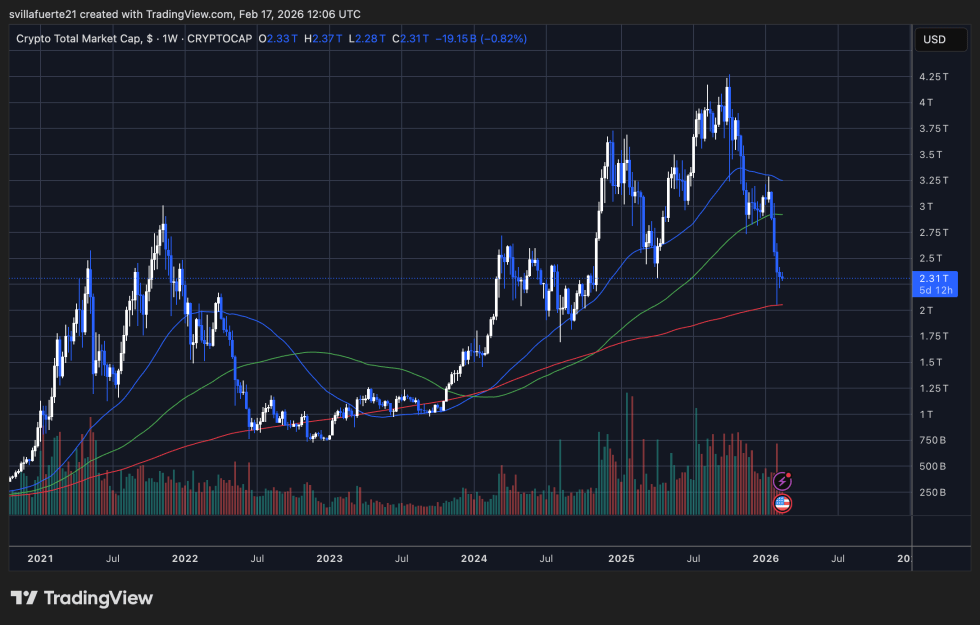
The crypto market faces intense selling pressure as Bitcoin and Ethereum struggle to reclaim key levels, with on-chain data revealing significant shifts in stablecoin liquidity. Stablecoin reserves grew by $11.4 billion in the 30 days before November 5, 2025, but fell $8.4 billion by December 23 as bearish conditions intensified. Outflows have recently slowed to about $2 billion, suggesting potential stabilization, though recovery remains uncertain. Binance dominates stablecoin liquidity, holding $47.5 billion in USDT and USDC—a 31% annual increase—accounting for 65% of all exchange reserves. USDT represents $42.3 billion of Binance’s holdings, while USDC reserves remain flat at $5.2 billion. Other exchanges like OKX ($9.5 billion) and Coinbase ($5.9 billion) lag significantly. The total crypto market cap has retraced from late-2025 peaks near $4 trillion, testing support around $2.3 trillion. Trend indicators show a shift from expansion to consolidation, with subdued buying pressure and elevated selling volume indicating ongoing distribution. The broader uptrend depends on holding long-term support, with a breakdown risking a deeper correction.

Trusted Editorial content, reviewed by leading industry experts and seasoned editors. Ad Disclosure

The crypto market continues to face intense selling pressure as both Bitcoin and Ethereum struggle to reclaim key psychological levels. Repeated rejection near resistance zones has reinforced cautious sentiment across the sector, with investors increasingly defensive after months of declining liquidity and volatile price action. While corrective phases are typical following strong bull market advances, the persistence of downside pressure suggests a more prolonged adjustment period may be unfolding.

On-chain data provides additional context for this shift in market dynamics. According to recent analysis, stablecoin reserve growth peaked shortly before the late-2025 price decline. In the 30 days leading up to November 5, reserves expanded by approximately $11.4 billion, reflecting strong liquidity availability and risk appetite at the time. However, this trend reversed quickly as market conditions deteriorated, with reserves falling roughly $8.4 billion by December 23 as the bear phase began to take shape.

More recently, the pace of outflows has moderated, with reserves declining by about $2 billion over the past month. This slowdown may indicate stabilization in liquidity conditions, though it does not yet confirm a sustained recovery. For now, the market remains sensitive to macro conditions, capital flows, and investor confidence.

Stablecoin Liquidity Concentration Highlights Binance’s Dominant Market Role

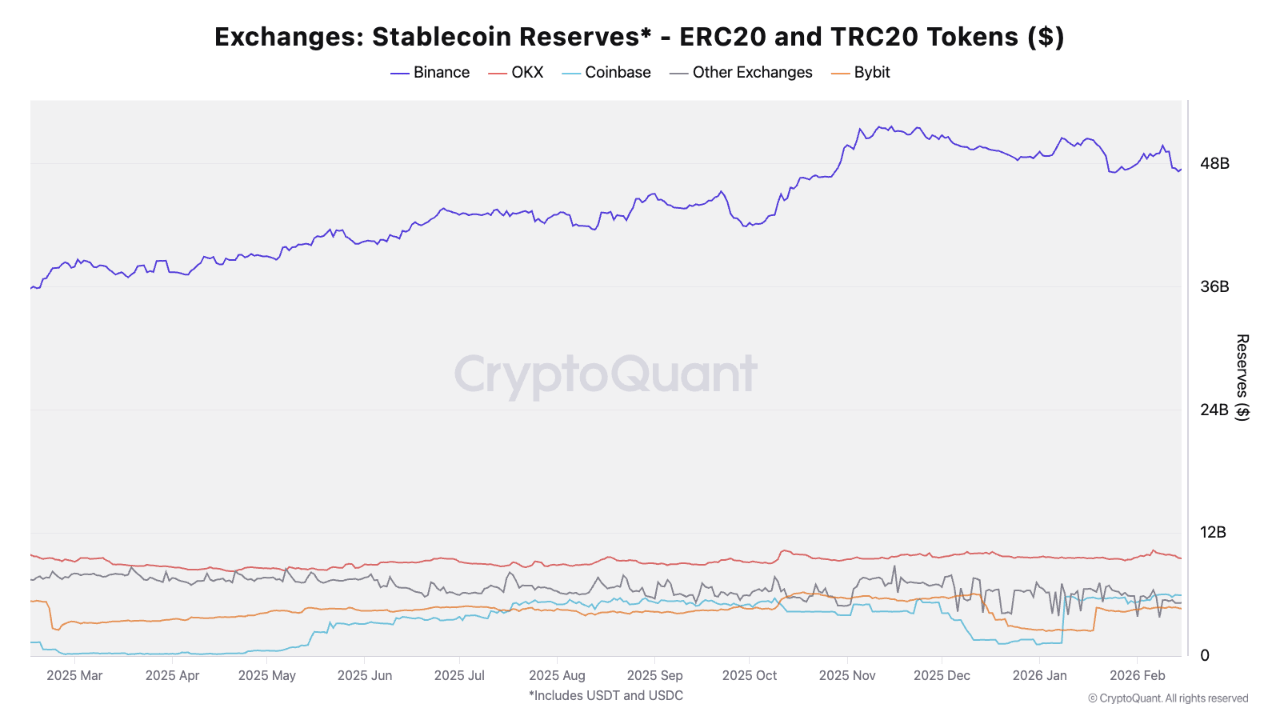
The data further shows that stablecoin liquidity remains heavily concentrated on Binance, reinforcing its role as the primary hub for crypto market liquidity. Current figures indicate the exchange holds roughly $47.5 billion in combined USDT and USDC reserves, marking a 31% year-over-year increase from about $35.9 billion. This concentration is significant, as Binance alone accounts for approximately 65% of all USDT and USDC held across centralized exchanges, highlighting its dominant position in facilitating trading flows and liquidity provisioning.
Crypto Exchanges Stablecoin Reserves | Source: CryptoQuant

Other major exchanges lag considerably behind in stablecoin reserves. OKX holds around $9.5 billion, representing roughly a 13% share, while Coinbase maintains approximately $5.9 billion, or about 8%. Bybit follows with close to $4 billion, equivalent to roughly 6% of exchange stablecoin liquidity. These balances are distributed mainly across Ethereum and TRON networks, which continue to serve as the primary infrastructure layers for stablecoin settlement.

Within Binance itself, liquidity remains overwhelmingly USDT-driven. About $42.3 billion of its reserves are held in USDT, reflecting a 36% year-over-year increase from approximately $31 billion. In contrast, USDC reserves stand near $5.2 billion and have remained broadly flat over the same period, suggesting stable but limited growth compared with USDT dominance.

Editorial Process for bitcoinist is centered on delivering thoroughly researched, accurate, and unbiased content. We uphold strict sourcing standards, and each page undergoes diligent review by our team of top technology experts and seasoned editors. This process ensures the integrity, relevance, and value of our content for our readers.

Sebastian Villafuerte

Follow

Sebastian's journey into the world of crypto began four years ago, driven by a fascination with the potential of blockchain technology to revolutionize financial systems. His initial exploration focused on understanding the intricacies of various crypto projects, particularly those focused on building innovative financial solutions. Through countless hours of research and learning, Sebastian developed a deep understanding of the underlying technologies, market dynamics, and potential applications of cryptocurrencies. As his knowledge grew, Sebastian felt compelled to share his insights with others. He began actively contributing to online discussions on platforms like X and LinkedIn, focusing on fintech and crypto-related content. His goal was to expose valuable trends and insights to a wider audience, fostering a deeper understanding of the rapidly evolving crypto landscape. Sebastian's contributions quickly gained recognition, and he became a trusted voice in the online crypto community. To further enhance his expertise, Sebastian pursued a UC Berkeley Fintech: Frameworks, Applications, and Strategies certification. This rigorous program equipped him with valuable skills and knowledge regarding Financial Technology, bridging the gap between traditional finance (TradFi) and decentralized finance (DeFi). The certification deepened his understanding of the broader financial landscape and its intersection with blockchain technology. Sebastian's passion for finance and writing is evident in his work. He enjoys delving into financial research, analyzing market trends, and exploring the latest developments in the crypto space. In his spare time, Sebastian can often be found immersed in charts, studying 10-K forms, or engaging in thought-provoking discussions about the future of finance. Sebastian's journey as a crypto analyst and investor has been marked by a relentless pursuit of knowledge and a dedication to sharing his insights. His ability to navigate the complex world of crypto, combined with his passion for financial research and communication, makes him a valuable asset to the industry. As the crypto landscape continues to evolve, Sebastian remains at the forefront, providing valuable insights and contributing to the growth of this revolutionary technology.

Full Profile

Related Posts

CFTC Chair Says Crypto Market Structure Bill Nears Final Approval

Why Kraken Is Backing Wyoming ‘Trump Accounts’, A Crypto Policy Gamble?

Polygon supera a Ethereum en tarifas diarias: la señal definitiva del auge de las L2

Zashi Becomes Zodl: Zcash Wallet Rebrands Following Internal Split

Kraken Backs Trump Accounts, Points To Shared Crypto Vision

Crypto And The 2026 Elections: By The Numbers And What Lies Ahead

Связанные с этим вопросы

QWhat does the data reveal about the shift in stablecoin reserves leading up to and during the crypto bear market?

AThe data shows that stablecoin reserve growth peaked shortly before the late-2025 price decline, expanding by approximately $11.4 billion in the 30 days leading up to November 5. However, this trend reversed as the bear market took hold, with reserves falling roughly $8.4 billion by December 23. More recently, the pace of outflows has moderated, declining by about $2 billion over the past month, which may indicate a stabilization in liquidity conditions.

QWhich exchange holds the dominant share of stablecoin liquidity, and what are the specific figures?

ABinance holds the dominant share of stablecoin liquidity, with approximately $47.5 billion in combined USDT and USDC reserves. This represents a 31% year-over-year increase and accounts for roughly 65% of all USDT and USDC held across centralized exchanges.

QHow does the distribution of stablecoin reserves on Binance compare between USDT and USDC?

AOn Binance, liquidity is overwhelmingly dominated by USDT. About $42.3 billion of its reserves are held in USDT, reflecting a 36% year-over-year increase. In contrast, USDC reserves stand near $5.2 billion and have remained broadly flat over the same period.

QWhat is the current state of the total crypto market capitalization and its key support level?

AThe total crypto market capitalization has retraced significantly from its late-2025 peak near $4 trillion and has recently stabilized around the $2.3 trillion level. This area is functioning as an interim key support zone, though price action remains fragile with reduced upside momentum.

QWhat do the volume dynamics during the market decline indicate about investor behavior?

AThe volume dynamics indicate that elevated selling volume accompanied the most recent decline, which suggests active distribution by sellers rather than a passive price drift. However, the subsequent moderation in volume hints that panic selling may be easing, even though conviction buying has not yet returned decisively.

Похожее

Jensen Huang's CMU Speech: In the AI Era, Don't Just Watch, Build

Jensen Huang, CEO of NVIDIA and a first-generation immigrant, delivered the commencement address to Carnegie Mellon University's class of 2026. He shared his personal journey from a humble background to founding NVIDIA, emphasizing resilience, learning from failure, and the responsibility that comes with leadership. Huang framed the present moment as the dawn of the AI revolution, a shift he believes is more profound than previous computing waves. He described AI as fundamentally resetting computing—moving from human-written software to machines that understand, reason, and use tools. This will create a new industry for generating intelligence and transform every sector. While acknowledging AI's potential to automate tasks and displace some jobs, Huang distinguished between the *tasks* of a job and its core *purpose*. He argued AI will augment human capability, not replace humans. The real risk, he stated, is not AI itself, but people being left behind by those who effectively use AI. He presented AI as a generational opportunity for massive infrastructure investment—in chip factories, data centers, energy grids, and advanced manufacturing—that could re-industrialize nations like the U.S. and bridge the digital divide by making computing and intelligent tools accessible to all. Huang called for a balanced approach: advancing AI safely and responsibly, establishing prudent policies, ensuring broad access, and encouraging universal participation. He urged the graduates not to fear the future but to engage with optimism and ambition, reminding them of CMU's motto, "My heart is in the work." His core message was clear: this is their moment to actively build and shape the AI-powered future, not merely observe it.

marsbit23 мин. назад

Jensen Huang's CMU Speech: In the AI Era, Don't Just Watch, Build

marsbit23 мин. назад

The Era Has Arrived Where Human Writers Must Prove They Are Not Machines

The article describes an era where AI-generated content is flooding the market, forcing human authors to prove they are not machines. It begins with the example of dozens of AI-written, error-ridden biographies of Henry Kissinger appearing on Amazon within hours of his death, a pattern repeated for other deceased celebrities and even living experts who find fraudulent books under their names. This spam content has exploded, with monthly new book releases on platforms like Amazon reaching 300,000 by late 2025. The issue spans genres, from suspiciously high proportions of AI-written teen romance and self-help books to dangerous, AI-generated foraging guides containing lethal advice. The platforms' automated review systems, designed to catch plagiarism and banned words, are ill-equipped to detect AI-generated text that avoids these pitfalls while being nonsensical or fraudulent. The problem has infiltrated traditional publishing. A major publisher, Hachette, had to recall a bestselling horror novel after AI detection tools suggested 78% of its content was machine-generated. An acclaimed European philosophy book was later revealed to be entirely written by AI under a fake author persona. In response, authors are fighting back. At the 2026 London Book Fair, 10,000 writers published a blank book titled "Don't Steal This Book" containing only their signatures—using emptiness as a protest weapon in an age of AI overproduction. Initiatives like the "Human Author Certification" program have emerged, ironically placing the burden on humans to prove their work is not machine-made. The article warns of a vicious cycle: AI-generated low-quality books pollute the data used to train future AI models, leading to "model collapse" and an ever-worsening flood of digital waste, eroding trust in publishing and devaluing human creativity.

marsbit49 мин. назад

The Era Has Arrived Where Human Writers Must Prove They Are Not Machines

marsbit49 мин. назад

Торговля

Спот
Фьючерсы
活动图片