Crypto Prices Drop On The Weekend As Iran Shuts Strait Of Hormuz Again

bitcoinistОпубликовано 2026-04-20Обновлено 2026-04-20

Введение

Cryptocurrency prices declined over the weekend following Iran's decision to reclose the Strait of Hormuz, reversing the positive market reaction to its brief reopening. Bitcoin fell below $76,000 after reaching a 10-week high of $77,500, while Ethereum dropped to around $2,350. The global crypto market cap decreased by more than 2%, with major altcoins like XRP and Solana also experiencing losses. The renewed geopolitical tension has reintroduced volatility and uncertainty, casting doubt on earlier optimism about a market recovery. Further price fluctuations are expected if diplomatic tensions between the U.S. and Iran continue.

The crypto market suffered a slight dip on Saturday, April 18th, after the tensions in the Middle East took an interesting turn over the weekend. On Friday, United States President Donald Trump announced that Iran fully reopened the Strait of Hormuz (for the first time since March) for the free passage of oil vessels, with the global financial markets and crypto reacting positively to the news. However, Iran announced on Saturday that it has closed the Strait again, with digital asset prices dropping on the back of the fresh development.

Bitcoin Falls Below $76k As Iran Closes Strait Again

On Saturday, Iran’s military announced the closure of the Strait of Hormuz again, with reports suggesting at least three attacks on commercial ships along the waterway. After President Trump’s several announcements going into the weekend, the Iranian Speaker of the Parliament, Mohammad Ghalibaf, said the US president made “seven claims in one hour, all seven of which were false.”

What’s interesting is that the crypto and global financial markets have been seeing a return of bullish momentum after a ceasefire agreement was reached between the United States and Iran in recent weeks. However, with the ceasefire agreement set to expire in a couple of days and negotiations looking broken down, volatility and uncertainty seem set to return to the markets in the coming days.

According to data from CoinGecko, the global cryptocurrency market capitalization is down by more than 2%, with the Bitcoin and Ethereum prices showing dips of 2% and 3%, respectively. Specifically, the premier cryptocurrency, which ran up to a 10-week high of around $77,500 on Friday, is now back below $76,000.

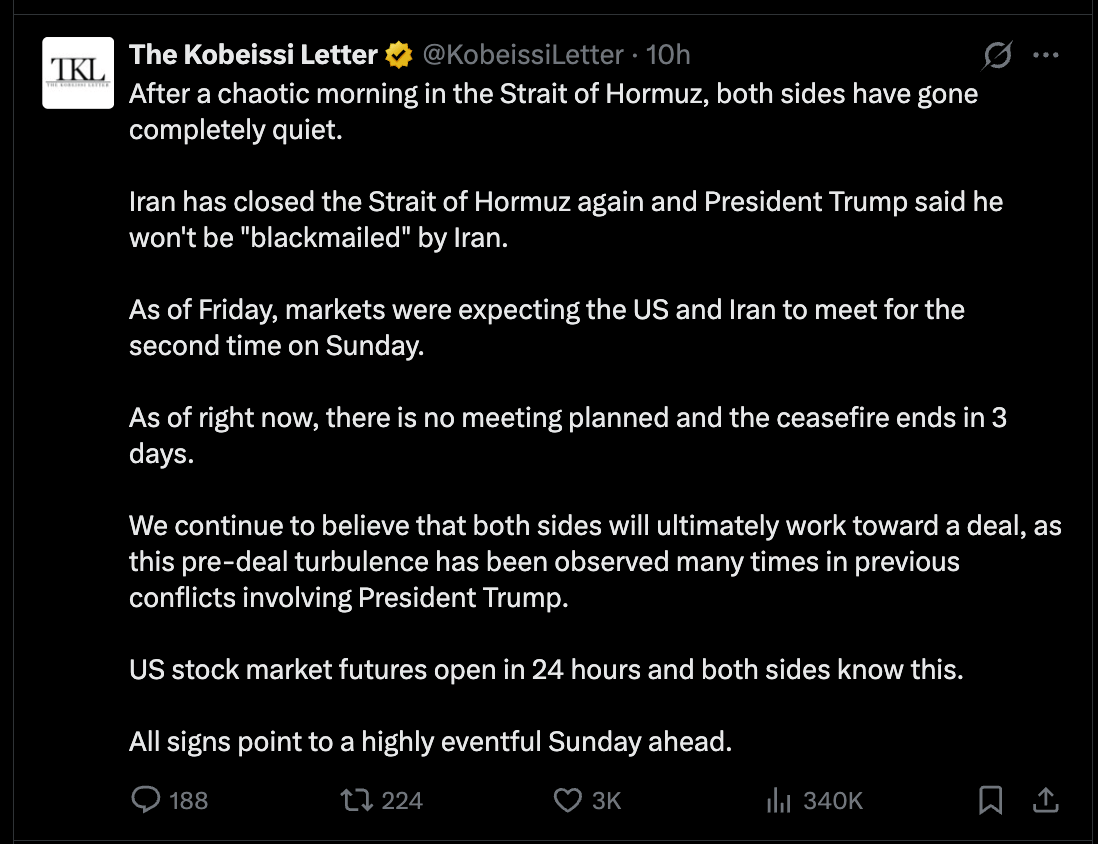
Source: @KobeissiLetter on X

Despite the crypto market gaining notoriety for slow price actions during the weekends, it’s interesting to see asset prices move in line with the latest developments in the Gulf. With no clear resolution in sight, the next few days could come with some degree of volatility.

Crypto Market Back To Point Zero?

Following these recent developments in the Middle East, conversations around the potential formation of a bottom in this current bear market now appear premature. Bitcoin, for instance, seems to have formed a local top around $77,500, with its current value at around $75,760.

Meanwhile, Ethereum, the second-largest cryptocurrency by market cap, sits at around $2,350, as of this writing. Other large-cap cryptocurrencies that have faced significant declines over the weekend include XRP and Solana, each falling by at leaast 3% in the past 24 hours.

The total crypto market cap on the daily timeframe | Source: TOTAL chart on TradingView

Связанные с этим вопросы

QWhat event triggered the drop in cryptocurrency prices over the weekend?

AIran's announcement that it has closed the Strait of Hormuz again, with reports of attacks on commercial ships.

QHow did the global cryptocurrency market capitalization and the prices of Bitcoin and Ethereum change according to CoinGecko?

AThe global cryptocurrency market capitalization dropped by more than 2%, with Bitcoin and Ethereum prices falling by 2% and 3%, respectively.

QWhat had initially caused a positive reaction in the global financial and crypto markets on Friday?

AUnited States President Donald Trump's announcement that Iran fully reopened the Strait of Hormuz for the free passage of oil vessels.

QWhat is the current status of the ceasefire agreement between the United States and Iran mentioned in the article?

AThe ceasefire agreement is set to expire in a couple of days, and negotiations appear to have broken down, leading to increased volatility and uncertainty.

QWhat price levels did Bitcoin reach on Friday and where did it fall to after the news on Saturday?

ABitcoin reached a 10-week high of around $77,500 on Friday and fell back below $76,000 after the news on Saturday.

Похожее

Will the Next Crypto Bull Run Start with On-Chain Trading of SpaceX?

This article presents a scenario-based forecast for the crypto industry from 2026 to 2029, arguing that the next major cycle will be driven not by technological narratives but by legal access to real-world assets. The author predicts that by mid-2026, pre-IPO perpetual contracts for top private companies like SpaceX, OpenAI, and Anthropic on platforms like Hyperliquid will become the primary gateway for accessing quality assets, as most crypto-native tokens fail to capture real value. The much-hyped AI x Crypto intersection largely fails except for prediction markets, which thrive on betting on AI model supremacy. By 2027, public blockchain foundations are forced to choose between catering to retail speculation or building compliant infrastructure for institutions, with many opting for the latter. Growth in stablecoins and tokenized private credit/equity hits a "triple ceiling" due to regulatory and political uncertainty rather than market demand. The pivotal shift is forecast for 2028. A major liquidation event in pre-IPO perpetuals exposes the structural flaw of synthetic markets lacking a real underlying asset anchor. In response, regulatory changes finally allow the public solicitation of private securities resales to verified accredited investors. This creates a legitimate secondary market for real company equity, which then becomes the core asset class of the new bull market, relegating synthetic perps to a niche role. By 2029, the industry becomes "boring" but foundational. Tokens without claims on real cash flows or assets cease trading. Stablecoin growth is steady but politically capped. Crypto infrastructure fades from view as it gets absorbed into traditional finance backends. The article's central thesis is that the key bottleneck for crypto's next phase is legal and regulatory channels for real asset ownership, not technology.

marsbit1 ч. назад

Will the Next Crypto Bull Run Start with On-Chain Trading of SpaceX?

marsbit1 ч. назад

The Value Distribution of Stablecoins

**Summary: The Value Distribution of Stablecoins** The article argues that stablecoins are evolving from mere trading tools into broader channels for dollar access. It divides the stablecoin ecosystem into four layers to analyze how value is distributed: 1. **Issuance Layer:** Mints stablecoins, holds reserve assets, and captures the spread between reserve yield and user costs (e.g., Tether, Circle). This layer currently earns the largest profit margin. 2. **Infrastructure Layer:** Connects stablecoins to the traditional financial system, handling fiat on/off-ramps, banking integration, compliance (KYC/AML), and asset management (e.g., Bridge, BVNK). This is the "unglamorous" but critical work, building the essential bridges between crypto and real-world finance. 3. **Acquiring/Distribution Layer:** Integrates stablecoins into merchant systems, manages payment flows, and provides enterprise financial software (e.g., Stripe, Coinbase). They act as the access point for businesses. 4. **Application Layer:** The end-users and businesses that ultimately use stablecoins for payments, settlements, or as a store of value. They benefit from convenience but have little pricing power. The core thesis is that while the issuance layer currently dominates profits, the often-overlooked **infrastructure layer holds significant long-term potential**. The real challenge and barrier to mass adoption is not the on-chain transfer of stablecoins (which is simple), but the complex "last mile" integration into existing business workflows, banking systems, and regulatory frameworks across different countries. Companies in this layer are currently in a "land grab" phase, investing heavily to build networks, secure bank partnerships, and establish compliance pathways. While their position is currently pressured by the profitable issuers above and distribution platforms below, the article suggests that if stablecoins become a default financial rail for businesses, the infrastructure providers who have done the hard work of integration will ultimately gain strong pricing power and become entrenched, essential players.

marsbit8 ч. назад

The Value Distribution of Stablecoins

marsbit8 ч. назад

The Value Distribution of Stablecoins

The Value Distribution of Stablecoins The article argues that stablecoins are evolving from a mere trading tool into a broad "dollar channel." It analyzes the industry's value chain through four layers: 1. **Issuance Layer (e.g., Tether, Circle):** The top layer that mints stablecoins, holds reserve assets, and captures the thickest interest rate spread. 2. **Infrastructure Layer (e.g., Bridge, BVNK):** Connects stablecoins to the traditional financial system, handling critical but complex "dirty work" like fiat on/off-ramps, banking integration, compliance (KYC/AML), and cross-border settlement. 3. **Acquiring/Distribution Layer (e.g., Stripe, Coinbase):** Embeds stablecoins into merchant systems, manages payment flows, and integrates with enterprise software. 4. **Application Layer:** End-users and businesses that ultimately use stablecoins for payments, settlement, or storing value. The author posits that while the issuance layer currently captures the most profit, the most overlooked and potentially critical layer is infrastructure. The core challenge for stablecoin adoption isn't the on-chain transfer (which is simple), but bridging the gap between blockchain and the real-world financial system. This involves solving practical problems for businesses: fiat conversion, reconciliation, tax handling, and user onboarding. Infrastructure companies are currently in a difficult "land-grab" phase—building networks, securing banking relationships, and achieving compliance country-by-country. They face pressure from both the profitable issuance layer above and distribution platforms below. However, the author suggests this layer is building a crucial moat. Once stablecoins become a default business rail, the infrastructure players who have done the hard work of integration may gain significant, durable value and pricing power.

链捕手8 ч. назад

The Value Distribution of Stablecoins

链捕手8 ч. назад

Торговля

Спот
Фьючерсы
活动图片