Crypto Exchange Backpack Targets Token Launch Soon, as BMIC Fires Up Quantum Defense

bitcoinistОпубликовано 2026-02-10Обновлено 2026-02-10

Введение

Crypto exchange Backpack is signaling an imminent token launch, leveraging growing activity and trading on the Solana ecosystem. The platform, known for its points-based rewards system, is positioning itself as a regulated "super app" combining a non-custodial wallet with exchange services. Meanwhile, a growing security threat is emerging: the risk posed by quantum computing to current encryption standards. Hackers are already using a "Harvest Now, Decrypt Later" strategy, collecting encrypted blockchain data to decrypt later when quantum computers become powerful enough. In response, BMIC is developing a quantum-secure financial infrastructure, featuring a wallet with post-quantum cryptography that avoids public-key exposure and integrates AI-driven threat detection. Its ongoing presale has raised over $445K, reflecting investor interest in long-term security solutions. The trend highlights a market split between short-term speculative trading on platforms like Backpack and long-term investments in infrastructure aimed at mitigating future technological risks.

Trusted Editorial content, reviewed by leading industry experts and seasoned editors. Ad Disclosure

Quick Facts:

  • ➡️ Backpack exchange is signaling an imminent token launch, capitalizing on increased Solana ecosystem activity and trading volume.
  • ➡️ The ‘Harvest Now, Decrypt Later’ strategy by hackers necessitates an urgent upgrade to blockchain encryption standards before quantum computing matures.
  • ➡️ BMIC provides a necessary solution with its quantum-secure wallet and AI-driven threat detection, aiming to protect assets from future decryption threats.
  • ➡️ The industry is seeing a bifurcated trend: immediate speculative trading on exchanges versus long-term infrastructure hedging against existential tech risks.

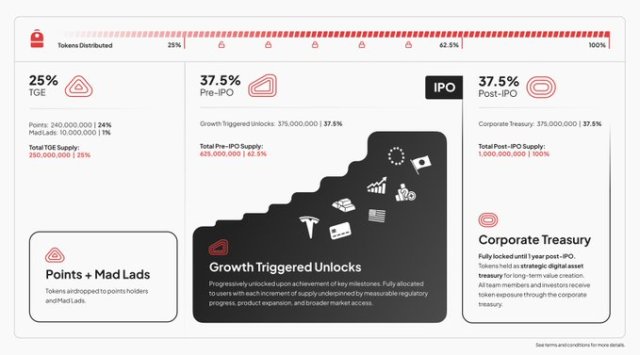
The Solana ecosystem is bracing for another liquidity injection as the highly anticipated Backpack exchange token launch moves closer to reality. For months, the platform, founded by the creators of the Mad Lads NFT collection, has run a points program rewarding volume.

Traders know the drill: points usually mean a native token generation event (TGE) is just around the corner. It’s a strategy that has successfully siphoned volume from established giants, positioning Backpack not just as a centralized exchange (CEX), but as a regulated ‘super app’ blending a non-custodial wallet with a trading venue.

The timing is impeccable. With Bitcoin hovering near all-time highs and liquidity rotating back into high-performance chains like Solana, the appetite for infrastructure plays is peaking. Smart money isn’t just chasing speculative fervor anymore; it’s positioning itself in protocols with tangible utility.

Backpack’s potential launch represents a shift toward platforms that actually blend a compliant user experience with a decentralized ethos.

But while capital floods into these next-gen exchanges, the security architecture supporting them faces a quieter, darker threat. The looming arrival of quantum computing poses a severe risk to the standard encryption protecting nearly every digital asset in circulation.

While traders focus on the immediate upside of a Backpack airdrop, forward-thinking investors are asking a harder question: what protects those gains five years from now? This search for longevity has directed significant attention toward BMIC ($BMIC), a project engineering the first quantum-secure financial stack designed to survive the post-quantum era.

Learn more about BMIC here.

Post-Quantum Cryptography Redefines Wallet Security

The crypto industry faces a ‘Harvest Now, Decrypt Later’ threat vector that most retail participants overlook. Nation-states and malicious actors are currently scraping encrypted blockchain data, which is immutable and public, to store it until quantum computers are powerful enough to break the RSA and Elliptic Curve Cryptography (ECC) standards securing Bitcoin and Ethereum.

BMIC addresses this inevitability by deploying a quantum-secure wallet infrastructure utilizing post-quantum cryptography (PQC). Unlike legacy wallets that leave public keys exposed after transactions, this protocol ensures zero public-key exposure.

And it doesn’t stop at encryption. The project integrates an AI-enhanced threat detection system directly into its Quantum Meta-Cloud.

This creates a dual-layer defense: cryptographic hardness against brute force attacks and active, algorithmic monitoring for anomalous transaction patterns. For enterprises and high-net-worth holders, this distinction is critical. Current security solutions focus on phishing and seed phrase management, but they remain fundamentally vulnerable to the mathematical breakthroughs quantum computing will bring.

This project’s approach to ERC-4337 Smart Accounts further modernizes the user experience, allowing for abstracting gas fees and social recovery without compromising the quantum-proof shield.

$BMIC is available here.

Early Investors Target BMIC Presale for Future-Proof Gains

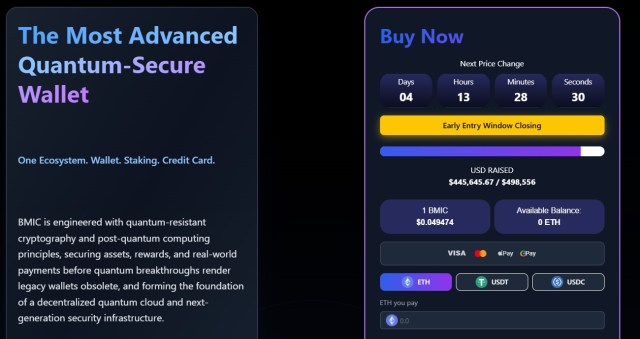
As the narrative shifts from speed to security, capital is beginning to flow into the BMIC presale, which has already raised $445K+. The project is currently offering tokens at $0.049474, a price point reflecting an early-stage valuation for infrastructure that aims to become an industry standard.

The utility of the token extends beyond simple governance; it functions as ecosystem fuel for the entire stack, including the ‘Burn-to-Compute’ mechanism and access to quantum-secure payment layers.

The robust raise indicates the market is waking up to the necessity of PQC. While exchanges like Backpack capture the current trading zeitgeist, infrastructure protocols like this are hedging against the technological obsolescence of current blockchain security.

The integration of staking and governance within a quantum-secure environment solves the dilemma of having to choose between earning yield and maintaining maximum security. With the presale ongoing, participants are effectively betting that the transition to quantum-resistant ledgers isn’t a matter of ‘if,’ but ‘when.’

Buy your $BMIC here.

Disclaimer: The information provided in this article is for educational purposes only and does not constitute financial advice. Cryptocurrency investments carry high risk, including the potential loss of all invested capital. Always conduct independent research.

Editorial Process for bitcoinist is centered on delivering thoroughly researched, accurate, and unbiased content. We uphold strict sourcing standards, and each page undergoes diligent review by our team of top technology experts and seasoned editors. This process ensures the integrity, relevance, and value of our content for our readers.

patrubogdan

Follow

Full Profile

Related Posts

US Debt Spiral Eyes $39T: Why Bitcoin Hyper ($HYPER) Is The Hedge to Watch

Ethereum Foundation Backs SEAL Initiative as LiquidChain L3 Protocol Gains Traction

Vitalik Buterin Outlines Ethereum’s AI Future, While SUBBD Token Targets the Creator Economy

Binance Dominates Trump’s USD1 Supply as Bitcoin Hyper Breaks Records

Cathie Wood’s Ark Invest Buys More Bullish Assets Just Days After Last Purchase, While LiquidChain Turns Heads

Polymarket Sues Massachusetts Over Prediction Market Regulation – SUBBD Token Takes Advantage

Связанные с этим вопросы

QWhat is the main purpose of the Backpack exchange's points program, and what event does it typically signal?

AThe Backpack exchange's points program rewards trading volume and typically signals an imminent native token generation event (TGE).

QWhat is the 'Harvest Now, Decrypt Later' threat mentioned in the article, and why is it a concern for blockchain security?

AThe 'Harvest Now, Decrypt Later' threat is a strategy where hackers scrape and store encrypted blockchain data now, with the intention of decrypting it later when quantum computers become powerful enough to break current encryption standards like RSA and Elliptic Curve Cryptography (ECC).

QHow does the BMIC project propose to protect digital assets from the threat of quantum computing?

ABMIC proposes a quantum-secure wallet infrastructure that utilizes post-quantum cryptography (PQC) to ensure zero public-key exposure, and an AI-enhanced threat detection system within its Quantum Meta-Cloud for a dual-layer defense.

QWhat are the two distinct investment trends the article identifies in the current crypto market?

AThe article identifies a bifurcated trend: immediate speculative trading on exchanges (e.g., anticipating a Backpack token) versus long-term infrastructure investments hedging against existential technological risks (e.g., investing in quantum-secure protocols like BMIC).

QWhat is the current status of the BMIC token presale and its price, according to the article?

AThe BMIC token presale has raised over $445,000 and is currently offering tokens at a price of $0.049474.

Похожее

Trend in US Stocks: Jensen Huang's One Sentence Triggers $47 Billion Surge; Google Raises Funds for First Time in 20 Years

U.S. markets reached record highs on June 2nd, but the real story was the intensifying AI arms race, now pivoting from chip supremacy to a scramble for capital to fund compute infrastructure. The day highlighted two stark realities: Nvidia CEO Jensen Huang's endorsement of Marvell Technology as the "next trillion-dollar company" at Computex fueled a historic 32.5% surge, adding $47 billion to its value. Conversely, Alphabet announced its first equity raise in two decades—an $80 billion plan—signaling that even its massive cash flow can't keep pace with soaring AI capital expenditures, forecast to exceed $180 billion in 2026. While the S&P 500 closed above 7,600 for the first time, led by tech and semiconductor stocks (SOXX +5.79%), sector performance was mixed. Alphabet's 4% drop dragged down communications services, illustrating market anxiety over the unsustainable cost of the AI buildout. Hewlett Packard Enterprise soared 25% on stellar earnings, proving AI's benefits extend beyond chip designers to infrastructure providers. Beneath the index highs, concerns linger over extreme concentration in a few AI stocks and geopolitical tensions. The focus now shifts to upcoming economic data, particularly Friday's nonfarm payrolls, which could challenge the market's current "ignore rates, chase AI" mentality.

marsbit11 мин. назад

Trend in US Stocks: Jensen Huang's One Sentence Triggers $47 Billion Surge; Google Raises Funds for First Time in 20 Years

marsbit11 мин. назад

Can DeepSeek Save China One Trillion Dollars?

"DeepSeek and the $1 Trillion Infrastructure Question" The article examines whether DeepSeek's AI optimization breakthroughs could potentially save China $1 trillion in future AI infrastructure costs. The analysis begins with Nvidia's upcoming Vera Rubin AI platform, costing ~$7.8 million, where memory (HBM4/LPDDR5X) constitutes $2 million—a 435% cost increase in one year, highlighting how AI hardware spending is shifting toward expensive memory components. DeepSeek's approach works in the opposite direction. Through three key technical innovations showcased in DeepSeek V4, the company dramatically improves hardware efficiency: 1. **Memory Compression (MLA)**: Re-engineers the attention mechanism to compress long-context memory (KV Cache) by over 90%, drastically reducing expensive HBM usage. 2. **Selective Activation (MoE)**: Employs Mixture-of-Experts architecture where only a small fraction of parameters (e.g., 49B out of 1.6T in V4-Pro) are activated per token, allowing most parameters to reside in cheaper memory/SSD. 3. **Computation Caching**: Reuses previously computed results via cache hits, replacing expensive GPU computations with cheap memory reads. Combined, these optimizations allow the same hardware to produce approximately 4x more tokens, effectively reducing required hardware investment by 75%. DeepSeek's pricing reflects this: a 10-billion token workload costs ~$522 monthly versus ~$9,000-$10,000 for competitors. The $1 trillion savings projection stems from McKinsey's estimate that global AI infrastructure will require ~$5.2 trillion investment by 2030. As China's daily token consumption grows toward quadrillions, even marginal efficiency gains scale massively. With a conservative 4x throughput improvement, China could avoid building tens of thousands of AI data centers equivalent to ~7 trillion RMB ($1 trillion) in saved investment. Critically, this strategy shifts dependency from scarce, expensive GPU/HBM—where China lags—toward more accessible storage, caching, and systems engineering where domestic suppliers like CXMT are gaining strength. Rather than "replacing Nvidia," DeepSeek rebalances AI's value chain away from monolithic hardware dependency. Ultimately, DeepSeek's technical breakthroughs could lower the barrier to AI adoption across Chinese industries by making advanced capabilities affordable at scale—transforming who can access next-generation AI.

marsbit54 мин. назад

Can DeepSeek Save China One Trillion Dollars?

marsbit54 мин. назад

Overturning the Mainstream Approach to Hallucinations: Metacognition is the New Solution for Large Models to Break the Hallucination Barrier

This paper, "Hallucinations Undermine Trust; Metacognition is a Way Forward," proposes a paradigm shift in combating AI hallucination. It argues that the current mainstream approaches—striving for omniscience by scaling data/models or having AI abstain from uncertain answers—are fundamentally flawed. The former has inevitable knowledge gaps, while the latter imposes a crippling "utility tax," requiring the rejection of many correct answers to achieve high accuracy, due to models' poor "discrimination" (the ability to distinguish correct from incorrect answers internally). The core contribution is redefining hallucination not as "being wrong," but as "expressing false information with unwarranted certainty." The proposed solution is **Faithful Uncertainty** or **Metacognition**: enabling AI to accurately perceive its internal uncertainty and honestly express it in its language (e.g., using hedging phrases when unsure). This creates a more reliable assistant that provides useful information while signaling its confidence, minimizing harm from errors. The paper emphasizes that metacognition is critical for the era of AI Agents. Without it, Agents cannot intelligently decide when to use tools like search engines, leading to inefficiency and misuse. Key implementation challenges are highlighted: the "bootstrapping paradox" of training with static uncertainty data, the "alignment distortion signal" where human preference training suppresses internal uncertainty cues, and the difficulty of causally evaluating true metacognition vs. its superficial imitation. The paper concludes that the goal should not be an infallible AI, but one that is honest about the limits of its knowledge, thereby building user trust through transparent communication of its certainty.

marsbit58 мин. назад

Overturning the Mainstream Approach to Hallucinations: Metacognition is the New Solution for Large Models to Break the Hallucination Barrier

marsbit58 мин. назад

Hedge by Buying Gold and Oil, Chase Soaring Returns with AI. ‘Dated’ Bitcoin Enters a Bear Market

Bitcoin has recently declined, hitting a two-month low near $66,123, while Ethereum fell to a three-month low around $1,837. Analysts suggest the drop is not merely due to factors like ETF outflows or MicroStrategy's selling but reflects a deeper issue: Bitcoin is losing a broader asset competition. In a near-zero interest rate environment, Bitcoin previously thrived as an outlet for investor dissatisfaction with inflation and limited options. However, the market landscape has shifted. Bitcoin now occupies an "awkward middle ground," facing competition on three fronts. For inflation hedging, investors prefer gold, energy stocks, and commodity producers—assets with tangible backing and clearer pricing power. For growth exposure, AI-related companies with actual revenues and profits are more attractive. Even within crypto, investors can choose stablecoins, exchanges, or infrastructure firms tied directly to adoption, offering clearer business models and leverage. Thus, Bitcoin is no longer the top choice for hedging, growth, or crypto exposure. This shift is evident in market reactions: despite recent warnings about persistent inflation from a Fed official, Bitcoin did not rally as it might have in the past. Instead, capital flowed to assets with direct commodity or energy exposure. The recent ETF outflows and MicroStrategy sales are symptoms, not causes, of this new reality. Investors are becoming more selective, demanding clearer value propositions beyond mere scarcity. The emerging bear case for Bitcoin is not about it being a bubble or failed technology, but that scarcity alone is no longer sufficient.

华尔街日报1 ч. назад

Hedge by Buying Gold and Oil, Chase Soaring Returns with AI. ‘Dated’ Bitcoin Enters a Bear Market

华尔街日报1 ч. назад

Торговля

Спот
Фьючерсы
活动图片