Crypto Crime Hit Hard: $700 Million Frozen By DOJ Strike Force

bitcoinistОпубликовано 2026-04-25Обновлено 2026-04-25

Введение

A US law enforcement task force has frozen over $700 million in cryptocurrency linked to investment scams targeting Americans. The operation, which involved cooperation from crypto exchanges and legal processes, also took down more than 500 fraudulent websites and a Telegram channel used to recruit victims. Two Chinese nationals were named in arrest warrants for operating a scam compound in Burma. In a related move, the US State Department announced a $10 million reward for information disrupting scam centers in Burma. Singaporean authorities, alongside major crypto exchanges and analytics firms, also prevented nearly $3 million in losses through a parallel operation. The scale of cybercrime remains vast, with the FBI reporting over $20 billion in losses in 2025.

A US law enforcement task force seized hundreds of fake investment websites and unsealed warrants against two suspects tied to a Burmese crypto scam compound.

US Reward For Scam Center Tips

The US State Department is offering $10 million to anyone who helps disrupt the Tai Chang scam centers in Burma — a bounty that signals just how seriously Washington is taking the problem of industrialized fraud in Southeast Asia.

That announcement came alongside a sweeping action Thursday by the US Scam Center Strike Force, which said it had frozen more than $700 million in crypto connected to investment scams targeting American victims.

The funds were restrained through a combination of voluntary cooperation from crypto exchanges and formal legal processes.

Fake Sites, A Seized Telegram Channel, And Two Arrest Warrants

The operation’s reach went beyond asset freezes. Authorities pulled down over 500 fraudulent investment websites that had been used to lure victims into depositing cryptocurrency. Visitors who try to access those domains now see a government seizure notice.

A Telegram channel was also seized. Reports say it had been used to recruit unsuspecting job seekers into a crypto scam center operating in Cambodia — a common tactic in Southeast Asia, where traffickers pose as employers to lure workers into forced labor at fraud compounds.
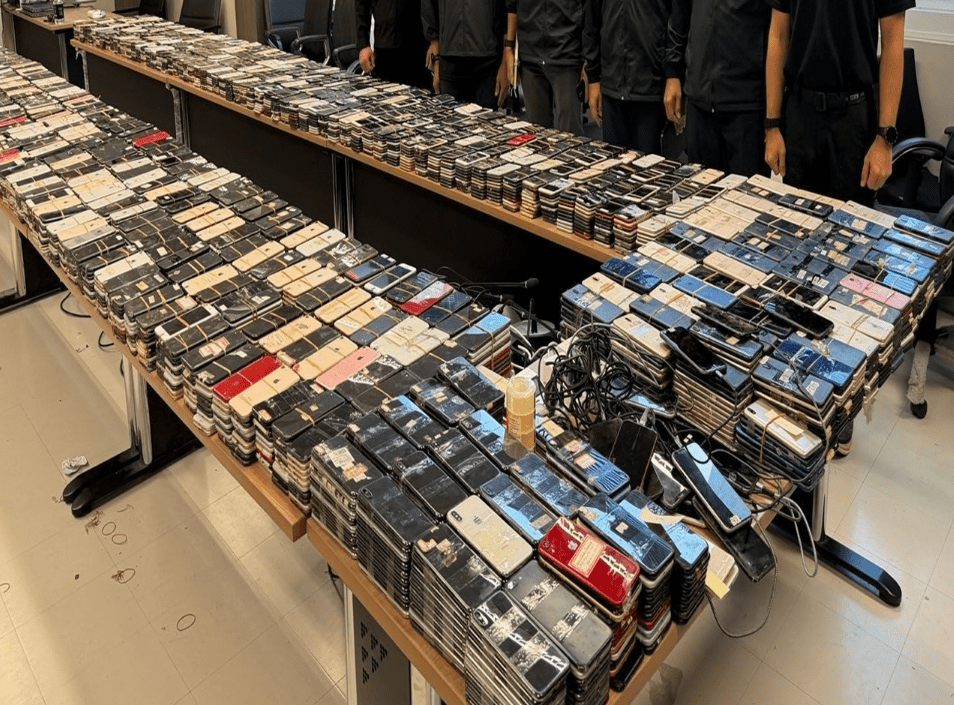
Source: US DOJ

Two Chinese nationals, Huang Xingshan and Jiang Wen Jie, were named in criminal complaints and arrest warrants unsealed as part of the operation. The pair is accused of running a crypto investment fraud scheme at the Shunda compound in Burma. That facility was seized by the Karen National Liberation Army in November 2025.

Exchanges And Blockchain Firms Join The Fight

The US was not alone in acting Thursday. Singapore’s police force ran a parallel month-long operation from mid-March through mid-April, working alongside Coinbase, Gemini, Coinhako, Independent Reserve, and blockchain analytics companies TRM Labs and Chainalysis.

BTCUSD currently trading at $78,076. Chart: TradingView

That effort stopped more than $2.86 million in potential losses and included over 90 direct interventions with scam victims — some by phone, others in person.

The willingness of major crypto platforms to cooperate with law enforcement marks a shift in how these cases are being handled. Blockchain transactions are traceable, and that transparency is increasingly being used against the very criminals who rely on crypto for speed and anonymity.

Losses Running Into The Billions

The scale of the problem is hard to overstate. The FBI received more than a million cybercrime complaints in 2025 alone, with total reported losses hitting more than $20 billion.

The $701 million frozen Thursday, while a significant number, represents a fraction of what has already been lost.

Featured image from Meta, chart from TradingView

Связанные с этим вопросы

QWhat was the total amount of cryptocurrency frozen by the US Scam Center Strike Force?

AThe US Scam Center Strike Force froze more than $700 million in cryptocurrency connected to investment scams.

QWhat reward is the US State Department offering for information on the Tai Chang scam centers in Burma?

AThe US State Department is offering a $10 million reward for information that helps disrupt the Tai Chang scam centers in Burma.

QHow many fraudulent investment websites were taken down as part of the operation?

AAuthorities pulled down over 500 fraudulent investment websites used to lure victims.

QWho were the two individuals named in the criminal complaints and arrest warrants?

AThe two individuals named were Chinese nationals Huang Xingshan and Jiang Wen Jie, accused of running a crypto investment fraud scheme.

QWhich organizations did Singapore's police force collaborate with in their parallel operation?

ASingapore's police force worked with Coinbase, Gemini, Coinhako, Independent Reserve, and blockchain analytics companies TRM Labs and Chainalysis.

Похожее

Telegram Takes Direct Control of TON, Social Traffic Reshapes Public Chain Narrative

Telegram's founder, Pavel Durov, has announced a major shift in the development of The Open Network (TON). Telegram will now become the core driver of TON, replacing the TON Foundation and becoming its largest validator. The focus will be on technical upgrades over the next few weeks, including slashing network fees by six times to near-zero and improving finality time to 0.6 seconds. This move signifies a deeper integration between Telegram and TON, moving beyond just providing a user base. The goal is to transform Telegram's vast social traffic and built-in features—like Mini Apps, payments, and bots—into sustainable, on-chain usage scenarios. The reduced fees and faster speeds are crucial for enabling the small, frequent transactions typical of social interactions. While this promises stronger execution and product alignment, it raises questions about centralization. Durov argues Telegram's involvement will attract more validators, enhancing decentralization, but the outcome remains to be seen. Additionally, TON's high annual staking reward of 18.8% aims to retain capital within the ecosystem. The key challenge for TON is no longer just leveraging Telegram's entry point, but becoming an invisible, seamless infrastructure layer within Telegram's daily use. Its success hinges on converting viral attention into lasting, embedded utility.

Odaily星球日报3 мин. назад

Telegram Takes Direct Control of TON, Social Traffic Reshapes Public Chain Narrative

Odaily星球日报3 мин. назад

OpenAI Post-Training Engineer Weng Jiayi Proposes a New Paradigm Hypothesis for Agentic AI

OpenAI engineer Weng Jiayi's "Heuristic Learning" experiments propose a new paradigm for Agentic AI, suggesting that intelligent agents can improve not just by training neural networks, but also by autonomously writing and refining code based on environmental feedback. In the experiment, a coding agent (powered by Codex) was tasked with developing and maintaining a programmatic strategy for the Atari game Breakout. Starting from a basic prompt, the agent iteratively wrote code, ran the game, analyzed logs and video replays to identify failures, and then modified the code. Through this engineering loop of "code-run-debug-update," it evolved a pure Python heuristic strategy that achieved a perfect score of 864 in Breakout and performed competitively with deep reinforcement learning (RL) algorithms in MuJoCo control tasks like Ant and HalfCheetah. This approach, termed Heuristic Learning (HL), contrasts with Deep RL. In HL, experience is captured in readable, modifiable code, tests, logs, and configurations—a software system—rather than being encoded solely into opaque neural network weights. This offers potential advantages in explainability, auditability for safety-critical applications, easier integration of regression tests to combat catastrophic forgetting, and more efficient sample use in early learning stages, as demonstrated in broader tests on 57 Atari games. However, the blog acknowledges clear limitations. Programmatic strategies struggle with tasks requiring long-horizon planning or complex perception (e.g., Montezuma's Revenge), areas where neural networks excel. The future vision is a hybrid architecture: specialized neural networks for fast perception (System 1), HL systems for rules, safety, and local recovery (also System 1), and LLM agents providing high-level feedback and learning from the HL system's data (System 2). The core proposition is that in the era of capable coding agents, a significant portion of an AI's learned experience could be maintained as an auditable, evolving software system.

marsbit1 ч. назад

OpenAI Post-Training Engineer Weng Jiayi Proposes a New Paradigm Hypothesis for Agentic AI

marsbit1 ч. назад

Your Claude Will Dream Tonight, Don't Disturb It

This article explores the recent phenomenon of AI companies increasingly using anthropomorphic language—like "thinking," "memory," "hallucination," and now "dreaming"—to describe machine learning processes. Focusing on Anthropic's newly announced "Dreaming" feature for its Claude Agent platform, the piece explains that this function is essentially an automated, offline batch processing of an agent's operational logs. It analyzes past task sessions to identify patterns, optimize future actions, and consolidate learnings into a persistent memory system, akin to a form of reinforcement learning and self-correction. The article draws parallels to similar features in other AI agent systems like Hermes Agent and OpenClaw, which also implement mechanisms for reviewing historical data, extracting reusable "skills," and strengthening long-term memory. It notes a key difference from human dreaming: these AI "dreams" still consume computational resources and user tokens. Further context is provided by discussing the technical challenges of managing AI "memory" or context, highlighting the computational expense of large context windows and innovations like Subquadratic's new model claiming drastically longer contexts. The core critique argues that this strategic use of human-centric vocabulary does more than market products; it subtly reshapes user perception. By framing algorithms with terms associated with consciousness, companies blur the line between tool and autonomous entity. This linguistic shift can influence user expectations, tolerance for errors, and even perceptions of responsibility when systems fail, potentially diverting scrutiny from the companies and engineers behind the technology. The article concludes by speculating that terms like "daydreaming" for predictive task simulation might be next, continuing this trend of embedding the idea of an "inner life" into computational processes.

marsbit1 ч. назад

Your Claude Will Dream Tonight, Don't Disturb It

marsbit1 ч. назад

Торговля

Спот
Фьючерсы
活动图片