Crypto Credit Crisis Deepens As BlockFills Files For Bankruptcy

bitcoinistОпубликовано 2026-03-16Обновлено 2026-03-16

Введение

Crypto lender BlockFills and three related entities under parent firm Reliz LTD have filed for Chapter 11 bankruptcy protection. The filing comes after the company halted customer withdrawals last month, citing a sharp Bitcoin selloff as the reason. Prior to the bankruptcy, a Delaware court had already ordered 71 Bitcoin frozen due to a customer fund dispute. Chapter 11 allows the company to continue operating while it restructures its finances and negotiates a repayment plan with creditors. Customers with balances on the platform are considered unsecured creditors, meaning they will be last in line for repayment. The amount and timing of any recovery depend on the company's assets and may take months or years to resolve. This situation mirrors previous crypto lending failures, such as Celsius and Voyager, where customers faced long waits for partial repayments. BlockFills has not disclosed its total liabilities or the number of affected customers.

A Delaware court had already ordered 71 Bitcoin frozen over a customer fund dispute before crypto lender BlockFills formally declared it could no longer operate.

That freeze — tied to a legal battle with creditors over how client money was handled — cast a shadow over the company well before it filed for Chapter 11 protection this week.

Customers Locked Out As Withdrawals Halt

BlockFills stopped letting customers move their money last month. The company pointed to a sharp Bitcoin selloff — the coin dropped from above $97,000 to below $64,000 between mid-January and early February — as the reason it needed to protect both itself and its clients.

Deposits and withdrawals went dark. No timeline for restoration was given.

Now the company and three related entities, all operating under parent firm Reliz LTD, have taken their case to federal bankruptcy court in Delaware.

The filing seeks a Chapter 11 restructuring, which allows a company to keep running while it works out a repayment plan with the people it owes money to.

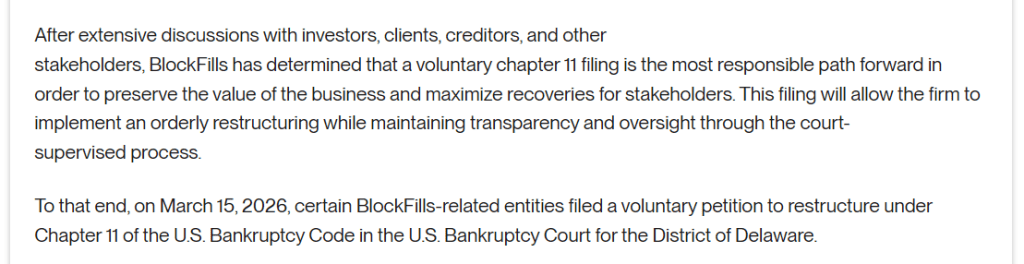
BlockFills' statement on company updates and Chapter 11 bankruptcy filing.

In a statement, BlockFills said the decision came after talks with investors, clients, and creditors. The company said it believes the court process will give it the time and structure needed to stabilize operations, find additional sources of cash, and look at possible deals with outside parties.

Officials said the goal is a consensual restructuring — meaning one that creditors agree to rather than one forced on them by a judge.

What Chapter 11 Means For Those Owed Money

Chapter 11 is not a wind-down. It is a legal system that provides a company with a moratorium to restructure its finances during which an automatic stay prevents creditors from collecting their debts.

BTCUSD now trading at $73,450. Chart: TradingView

As for customers who have balances on the platform, the situation is not so straightforward. They would be considered unsecured creditors in a bankruptcy case, which means they would be last in line after secured creditors and expenses approved by the court.

The amount they will get back and when that will happen is dependent on what assets BlockFills actually owns. That process can take months or, in complex cases, years.

BTCUSD trading at $73,240 on the 24-hour chart: TradingView

Bankruptcy Filing Caps A Difficult Period For The Firm

BlockFills has been under pressure from multiple directions. The frozen Bitcoin order involving Dominion Capital pointed to deeper disputes over whether customer funds were properly segregated — a question that goes beyond market timing.

Reports indicate the company had been in talks with stakeholders for an extended period before concluding that a court-supervised restructuring was the only viable path forward.

The collapse follows a pattern seen in earlier crypto lending failures. Companies including Celsius, Voyager, and BlockFi all suspended withdrawals before filing for bankruptcy during the 2022 market downturn. In each case, customers waited — sometimes years — for partial repayment.

BlockFills has not disclosed total liabilities, the number of affected customers, or the full value of assets under its control. This is a developing situation, and more details are expected to emerge as court documents become public.

Featured image from Unsplash, chart from TradingView

Связанные с этим вопросы

QWhat was the primary reason cited by BlockFills for halting customer withdrawals last month?

ABlockFills cited a sharp Bitcoin selloff, where the coin dropped from above $97,000 to below $64,000 between mid-January and early February, as the reason it needed to protect both itself and its clients.

QWhat type of bankruptcy protection did BlockFills and its related entities file for?

ABlockFills and three related entities filed for Chapter 11 bankruptcy protection, which allows a company to continue operating while it works out a repayment plan with its creditors.

QHow are customers with balances on the BlockFills platform classified in the bankruptcy case?

ACustomers with balances on the platform are considered unsecured creditors, meaning they are last in line for repayment after secured creditors and court-approved expenses.

QWhat significant event involving customer funds occurred before the formal bankruptcy filing?

AA Delaware court had already ordered 71 Bitcoin to be frozen due to a customer fund dispute, which was tied to a legal battle with creditors over how client money was handled.

QWhich other crypto companies does the article mention as having followed a similar pattern of suspending withdrawals before filing for bankruptcy in 2022?

AThe article mentions Celsius, Voyager, and BlockFi as companies that suspended withdrawals before filing for bankruptcy during the 2022 market downturn.

Похожее

OpenAI Post-Training Engineer Weng Jiayi Proposes a New Paradigm Hypothesis for Agentic AI

OpenAI engineer Weng Jiayi's "Heuristic Learning" experiments propose a new paradigm for Agentic AI, suggesting that intelligent agents can improve not just by training neural networks, but also by autonomously writing and refining code based on environmental feedback. In the experiment, a coding agent (powered by Codex) was tasked with developing and maintaining a programmatic strategy for the Atari game Breakout. Starting from a basic prompt, the agent iteratively wrote code, ran the game, analyzed logs and video replays to identify failures, and then modified the code. Through this engineering loop of "code-run-debug-update," it evolved a pure Python heuristic strategy that achieved a perfect score of 864 in Breakout and performed competitively with deep reinforcement learning (RL) algorithms in MuJoCo control tasks like Ant and HalfCheetah. This approach, termed Heuristic Learning (HL), contrasts with Deep RL. In HL, experience is captured in readable, modifiable code, tests, logs, and configurations—a software system—rather than being encoded solely into opaque neural network weights. This offers potential advantages in explainability, auditability for safety-critical applications, easier integration of regression tests to combat catastrophic forgetting, and more efficient sample use in early learning stages, as demonstrated in broader tests on 57 Atari games. However, the blog acknowledges clear limitations. Programmatic strategies struggle with tasks requiring long-horizon planning or complex perception (e.g., Montezuma's Revenge), areas where neural networks excel. The future vision is a hybrid architecture: specialized neural networks for fast perception (System 1), HL systems for rules, safety, and local recovery (also System 1), and LLM agents providing high-level feedback and learning from the HL system's data (System 2). The core proposition is that in the era of capable coding agents, a significant portion of an AI's learned experience could be maintained as an auditable, evolving software system.

marsbit25 мин. назад

OpenAI Post-Training Engineer Weng Jiayi Proposes a New Paradigm Hypothesis for Agentic AI

marsbit25 мин. назад

Your Claude Will Dream Tonight, Don't Disturb It

This article explores the recent phenomenon of AI companies increasingly using anthropomorphic language—like "thinking," "memory," "hallucination," and now "dreaming"—to describe machine learning processes. Focusing on Anthropic's newly announced "Dreaming" feature for its Claude Agent platform, the piece explains that this function is essentially an automated, offline batch processing of an agent's operational logs. It analyzes past task sessions to identify patterns, optimize future actions, and consolidate learnings into a persistent memory system, akin to a form of reinforcement learning and self-correction. The article draws parallels to similar features in other AI agent systems like Hermes Agent and OpenClaw, which also implement mechanisms for reviewing historical data, extracting reusable "skills," and strengthening long-term memory. It notes a key difference from human dreaming: these AI "dreams" still consume computational resources and user tokens. Further context is provided by discussing the technical challenges of managing AI "memory" or context, highlighting the computational expense of large context windows and innovations like Subquadratic's new model claiming drastically longer contexts. The core critique argues that this strategic use of human-centric vocabulary does more than market products; it subtly reshapes user perception. By framing algorithms with terms associated with consciousness, companies blur the line between tool and autonomous entity. This linguistic shift can influence user expectations, tolerance for errors, and even perceptions of responsibility when systems fail, potentially diverting scrutiny from the companies and engineers behind the technology. The article concludes by speculating that terms like "daydreaming" for predictive task simulation might be next, continuing this trend of embedding the idea of an "inner life" into computational processes.

marsbit27 мин. назад

Your Claude Will Dream Tonight, Don't Disturb It

marsbit27 мин. назад

Торговля

Спот
Фьючерсы
活动图片