Crypto Biz: Bank stablecoins get a rulebook; Bitcoin gets a land grab

cointelegraphОпубликовано 2025-12-19Обновлено 2025-12-19

Введение

Washington is advancing regulatory clarity for bank-issued stablecoins, with the FDIC proposing a framework under the GENIUS Act. This outlines how insured banks can seek approval to issue payment stablecoins via subsidiaries, subject to public consultation. Meanwhile, corporate Bitcoin accumulation continues, as American Bitcoin surpasses ProCap, now holding over 5,000 BTC. Anchorage Digital expands its institutional services by acquiring Securitize’s advisory platform. Bhutan, a major national Bitcoin holder, plans to use part of its 11,000 BTC reserves to fund the Gelephu Mindfulness City project, balancing economic development with long-term capital preservation.

Washington is inching closer to putting bank-issued stablecoins on a clearer regulatory track.

This week, the Federal Deposit Insurance Corp. (FDIC), the US agency that oversees bank safety and insures deposits, laid out a proposed framework for how insured banks, via subsidiaries, could seek approval to issue payment stablecoins under the GENIUS Act, a move that could reshape who gets to mint digital dollars and under what rules.

That same push toward institutionalization is also evident elsewhere in the crypto business landscape. Despite Bitcoin’s (BTC) lackluster performance, corporate treasuries are still in accumulation mode, with American Bitcoin vaulting past ProCap in the race to stack BTC.

On Wall Street’s doorstep, Anchorage Digital is tightening its grip on the adviser channel by acquiring Securitize’s RIA platform, bringing custody and advisory tools under one roof.

On the sovereign end of the spectrum, Bhutan says it will tap a portion of its sizable Bitcoin holdings to help finance Gelephu Mindfulness City, an ambitious bid to build a new economic hub without compromising long-term capital preservation.

This week’s Crypto Biz dives into regulatory, corporate and economic developments shaping the global crypto industry.

FDIC proposes framework for bank-issued payment stablecoins

The FDIC is moving forward with proposed rulemaking in the wake of the landmark GENIUS Act, signaling that the agency is preparing to offer clear guidance to banking institutions seeking to issue payment stablecoins.

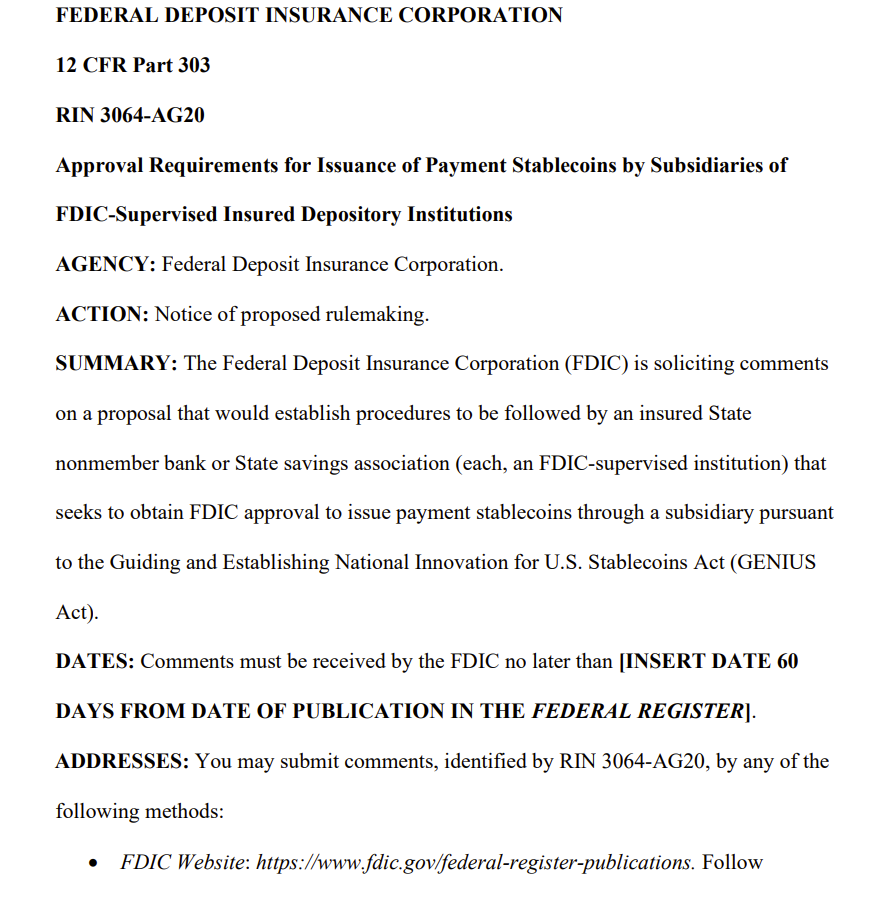
In a 38-page document published on the FDIC’s website, the agency outlined proposed approval requirements governing how bank subsidiaries could issue payment stablecoins in accordance with the GENIUS Act. The proposal is subject to a public consultation process before any rules are finalized.

Under the proposed framework, financial institutions would be required to apply to issue a stablecoin through a subsidiary, with the FDIC evaluating both the parent company and the issuing entity. Applicants would also need to comply with the GENIUS Act’s provisions related to issuance standards, reserve backing and redemption policies.

Excerpts from the FDIC’s proposal detailing the approval process for bank-issued payment stablecoins. Source: FDIC

American Bitcoin overtakes ProCap in corporate Bitcoin treasury race

American Bitcoin, the digital asset mining and holding company associated with the Trump family, entered the ranks of the top 20 corporate Bitcoin holders this week, surpassing ProCap Financial, a company founded by entrepreneur Anthony Pompliano. The shift highlights the growing competition among companies to accumulate Bitcoin.

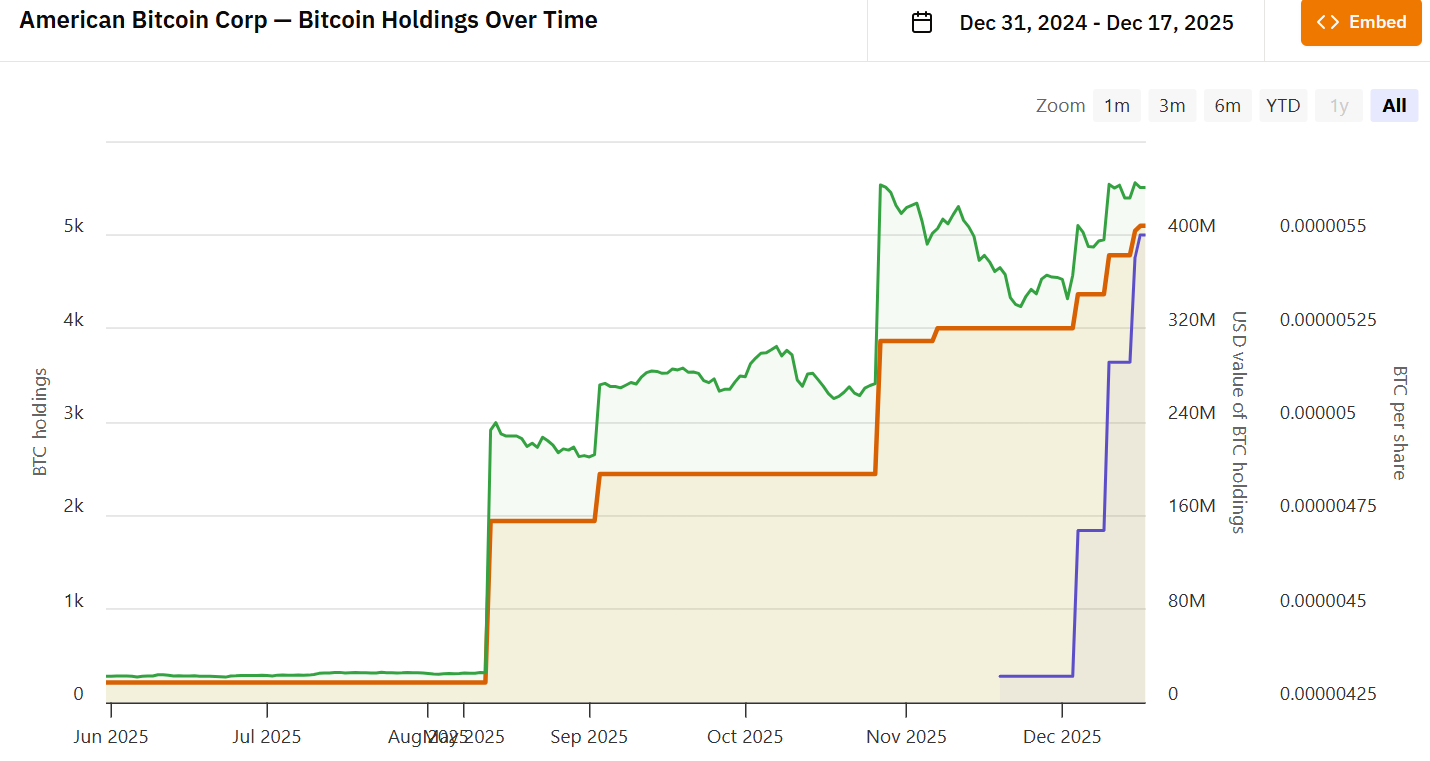
American Bitcoin has added more than 1,000 BTC to its reserves since the beginning of December. Its total Bitcoin holdings now stand at 5,098 BTC, valued at approximately $452 million, according to industry data.

The company trades on the Nasdaq, having gone public through a reverse merger with Gryphon Digital Mining. Its shares, however, have experienced sharp volatility, reflecting the broader price swings typical of Bitcoin proxy stocks tied to the performance of Bitcoin.

American Bitcoin’s BTC acquisitions over time. Source: BitcoinTreasuries.NET

Anchorage Digital acquires Securitize advisory unit to expand institutional offerings

Anchorage Digital has acquired Securitize’s investment adviser platform as part of a strategy to consolidate and expand its institutional investment services for registered investment advisers (RIAs).

Anchorage announced that it acquired Securitize For Advisors (SFA) for an undisclosed amount. The platform is designed to serve RIAs and had already been using Anchorage for digital asset custody. By bringing SFA in-house, Anchorage aims to integrate custody services with adviser-facing tools under a single platform.

Anchorage Digital provides institutional digital asset services and operates a federally chartered bank in the United States. In March, the company selected Cantor Fitzgerald to custody clients’ Bitcoin.

Bhutan to tap Bitcoin holdings to finance special administrative region

The Kingdom of Bhutan, one of the world’s largest state holders of Bitcoin, said it will use a portion of its digital asset reserves to help finance the Gelephu Mindfulness City (GMC), a planned special administrative region aimed at driving long-term economic growth.

The project is designed to serve as a new economic hub, focusing on sustainability and innovation, to curb Bhutan’s brain drain while creating high-quality local jobs and attracting international investment.

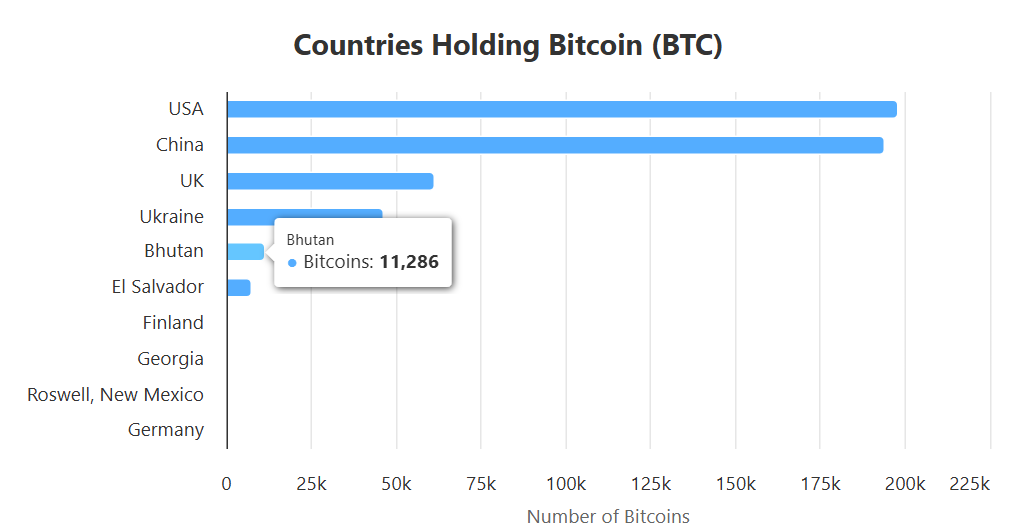
Bhutan currently holds more than 11,000 BTC, and officials have indicated that multiple strategies are being considered for deploying the reserves. Any use of the country’s Bitcoin, however, will be balanced against the objective of preserving its long-term value.

“Any use of Bitcoin will be guided by strong governance and prudence, with an emphasis on capital preservation, appropriate oversight, and transparency,” the government said.

Bhutan’s ranking among countries that hold Bitcoin. Source: Bitbo

Crypto Biz is your weekly pulse on the business behind blockchain and crypto, delivered directly to your inbox every Thursday.

Связанные с этим вопросы

QWhat is the FDIC's proposed framework for bank-issued stablecoins and what act does it relate to?

AThe FDIC has proposed a framework outlining approval requirements for how bank subsidiaries can issue payment stablecoins in accordance with the GENIUS Act. This framework requires financial institutions to apply through a subsidiary, with the FDIC evaluating both the parent company and the issuing entity, and mandates compliance with the act's provisions on issuance standards, reserve backing, and redemption policies.

QWhich company surpassed ProCap Financial in corporate Bitcoin holdings this week, and what is its current BTC reserve?

AAmerican Bitcoin surpassed ProCap Financial in corporate Bitcoin holdings. It has added over 1,000 BTC since the beginning of December, bringing its total holdings to 5,098 BTC, valued at approximately $452 million.

QWhat strategic move did Anchorage Digital make to expand its institutional offerings for registered investment advisers (RIAs)?

AAnchorage Digital acquired Securitize's investment adviser platform, Securitize For Advisors (SFA), to consolidate and expand its institutional investment services. This move integrates custody services with adviser-facing tools under a single platform.

QHow does the Kingdom of Bhutan plan to use a portion of its Bitcoin reserves, and what is the project called?

AThe Kingdom of Bhutan plans to use a portion of its Bitcoin reserves to help finance the Gelephu Mindfulness City (GMC), a special administrative region project aimed at driving long-term economic growth, focusing on sustainability and innovation.

QWhat is the primary regulatory focus of the FDIC's new proposal for stablecoins issued by banks?

AThe primary regulatory focus of the FDIC's proposal is to provide clear guidance and establish a framework for insured banks to issue payment stablecoins through subsidiaries, ensuring compliance with the GENIUS Act's standards for issuance, redemption, and reserve backing.

Похожее

What Are Some Good Paths for Chinese Web3 Entrepreneurship? (Part 5)

This article explores pathways for Chinese Web3 teams to pivot toward AI, building on a previous discussion. It focuses on two specific team profiles: **Security & Risk Control Teams:** These teams, skilled in smart contract auditing, wallet security, and on-chain monitoring, can transition to providing **Agent behavior auditing and AI security governance**. As AI Agents automate tasks, access data, and trigger payments, enterprises will need solutions to monitor permissions, audit logs, control data access, and prevent anomalies—creating a strong B2B demand. **Application & Community-Focused Teams:** Instead of completely rebranding as AI companies, these teams should use AI to **enhance their existing products**. For example, research platforms can use AI to summarize information and identify signals; community tools can automate user support and analysis; and educational products can create personalized learning paths. The key is integrating AI to solve existing user pain points, like information overload or high operational costs. The article also advises against certain AI directions for Chinese Web3 teams, such as building general-purpose large language models (too resource-intensive), creating overly broad Agent platforms (hard to monetize), developing AI traders/automated yield products (high regulatory and risk sensitivity), or simply adding superficial AI features without genuine value. The core conclusion: Successful migration depends not on chasing AI hype, but on **identifying how a team's existing Web3 capabilities—be it in data, payments, security, or user operations—can address real needs in new AI application scenarios.**

marsbit2 ч. назад

What Are Some Good Paths for Chinese Web3 Entrepreneurship? (Part 5)

marsbit2 ч. назад

Торговля

Спот
Фьючерсы

Популярные статьи

Что такое ZEST

I. Введение в проект1. Что такое Zest Protocol?Zest Protocol — это кредитный протокол, основанный на Bitcoin, построенный на Stacks Layer 2, который позволяет пользователям зарабатывать доход с помощью BTC или занимать активы, закладывая BTC. Умные контракты протокола написаны на языке Clarity, полностью работают в цепочке и являются открытым исходным кодом, с дизайном, вдохновленным Aave v3. Zest в настоящее время является крупнейшим DeFi-протоколом на Stacks, с более чем 800 BTC, внесенными в депозит, и пиковым TVL, превышающим 100 миллионов долларов. В мае 2026 года протокол дополнительно представил Bitcoin Collateral Vaults, расширив кредитные возможности с Stacks на основную сеть Bitcoin. Это позволяет пользователям занимать стейблкоины, не перемещая BTC с сети Bitcoin, что обеспечивает кредитование с самоуправлением.2. Как работает Zest Protocol?Zest Protocol состоит из двух рынков. Рынок Stacks построен на Aave v3, позволяя пользователям вносить такие активы, как sBTC, STX и USDC, чтобы зарабатывать доход или брать кредиты с избыточным обеспечением. Максимальное LTV по умолчанию составляет 50% (70% для sBTC). Рынок Bitcoin работает через недавно запущенные Bitcoin Collateral Vaults. Пользователи занимают стейблкоины, блокируя BTC в самоуправляемых хранилищах на цепочке Bitcoin. Обеспечение остается на основной сети Bitcoin на протяжении всего процесса, и пользователи сохраняют право собственности, если позиция не ликвидирована.3. Кто основал Zest Protocol?Tycho Onnasch (Соучредитель): Выпускник Оксфордского университета. Участвовал в исследованиях и грантах для Фонда открытого интернета Stacks. Бывший менеджер в Trust Machines и основатель Deedmob. Профиль LinkedIn: https://www.linkedin.com/in/tychokoonnasch/.Fernando Foy (Соучредитель): Ранее работал в IT-консалтинге в Objectif Emploi. Профиль LinkedIn: https://www.linkedin.com/in/fernando-foy/.Emil E. (Соучредитель): Имеет степень магистра физики из Университета Уорика. Бывший инженерный партнер в Trust Machines, Full-Stack разработчик для проектов Web3 и дата-ученый в HSBC. Профиль LinkedIn: https://www.linkedin.com/in/emil-e-49771a145/.Детали финансирования: В мае 2024 года Zest Protocol объявил о завершении раунда начального финансирования в размере 3,5 миллиона долларов, возглавляемого Тимом Дрейпером, с участием Binance Labs, Flow Traders, Trust Machines и других.4. Токеномика $ZEST$ZEST — это нативный токен Zest Protocol с фиксированным общим предложением в 1 миллиард токенов и без инфляционного механизма.Сообщество (27,83%): Используется для аирдропов и стимулов для пользователей;Развитие экосистемы (24,82%): Используется для ликвидности, партнерств, маркетинга, листинга на биржах и т. д.;Инвесторы (22,35%): Поддержка инвестиционных сторон, которые поддержали раннее развитие Zest Protocol;Команда (25%): Выделено для основных участников.График вестинга: Токены команды и инвесторов подлежат 1-летнему периоду блокировки, за которым следует 3 года линейного разблокирования.5. Хронология ключевых этапов2022: Официальное основание Zest Protocol.Март 2024: Завершен аудит безопасности и запущен рынок кредитования Stacks на основной сети.В феврале 2026 года запускается Stacks Market V2, вводящий группы риска.В мае 2026 года были представлены Bitcoin Collateral Vaults, и теперь доступен рабочий прототип основной сети. Это позволяет пользователям использовать самоуправляемый BTC на Bitcoin L1 в качестве обеспечения для займа стейблкоинов на EVM-цепочках, заканчивая мосты, обертки и стороннее хранение. Этот запуск разделен на два этапа. Этап 1: Использует заранее подписанные транзакции для ограничения движения BTC; Этап 2: Использует BitVM для проверки. II. Информация о токенеНазвание токена: ZEST (Zest Protocol)III. Связанные ссылкиВебсайт: https://www.zestprotocol.com/Эксплореры: https://bscscan.com/token/0x5506599c722389a60580b5213ea1da60d64754a1Твиттер: https://twitter.com/ZestProtocolПримечание: Введение в проект основано на материалах, опубликованных или предоставленных официальной командой проекта, и предназначено только для справки и не является инвестиционным советом. HTX не несет ответственности за любые прямые или косвенные убытки, возникшие в результате.

248 просмотров всегоОпубликовано 2026.05.19Обновлено 2026.06.02

Что такое ZEST

Как купить ZEST

Добро пожаловать на HTX.com! Мы сделали приобретение Zest Protocol (ZEST) простым и удобным. Следуйте нашему пошаговому руководству и отправляйтесь в свое крипто-путешествие.Шаг 1: Создайте аккаунт на HTXИспользуйте свой адрес электронной почты или номер телефона, чтобы зарегистрироваться и бесплатно создать аккаунт на HTX. Пройдите удобную регистрацию и откройте для себя весь функционал.Создать аккаунтШаг 2: Перейдите в Купить криптовалюту и выберите свой способ оплатыКредитная/Дебетовая Карта: Используйте свою карту Visa или Mastercard для мгновенной покупки Zest Protocol (ZEST).Баланс: Используйте средства с баланса вашего аккаунта HTX для простой торговли.Третьи Лица: Мы добавили популярные способы оплаты, такие как Google Pay и Apple Pay, для повышения удобства.P2P: Торгуйте напрямую с другими пользователями на HTX.Внебиржевая Торговля (OTC): Мы предлагаем индивидуальные услуги и конкурентоспособные обменные курсы для трейдеров.Шаг 3: Хранение Zest Protocol (ZEST)После приобретения вами Zest Protocol (ZEST) храните их в своем аккаунте на HTX. В качестве альтернативы вы можете отправить их куда-либо с помощью перевода в блокчейне или использовать для торговли с другими криптовалютами.Шаг 4: Торговля Zest Protocol (ZEST)С легкостью торгуйте Zest Protocol (ZEST) на спотовом рынке HTX. Просто зайдите в свой аккаунт, выберите торговую пару, совершайте сделки и следите за ними в режиме реального времени. Мы предлагаем удобный интерфейс как для начинающих, так и для опытных трейдеров.

259 просмотров всегоОпубликовано 2026.05.19Обновлено 2026.06.02

Как купить ZEST

Обсуждения

Добро пожаловать в Сообщество HTX. Здесь вы сможете быть в курсе последних новостей о развитии платформы и получить доступ к профессиональной аналитической информации о рынке. Мнения пользователей о цене на A (A) представлены ниже.

活动图片