Coinbase to Launch Stock Futures, Why This Is Big For Crypto

bitcoinistОпубликовано 2026-03-21Обновлено 2026-03-21

Введение

Coinbase, a major US cryptocurrency exchange, has announced the launch of stock perpetual futures for non-US traders. This expansion is a significant step in its "Everything Exchange" strategy, moving beyond crypto into traditional assets like stocks and ETFs. The new derivatives allow eligible traders to speculate on the price of major tech stocks (Apple, Microsoft, etc.) and index ETFs (SPY, QQQ) with up to 10x and 20x leverage, respectively, all settled in USDC. These contracts never expire, enabling 24/7 trading. This launch integrates traditional assets with crypto on a single platform, offering new trading and hedging opportunities but also introducing higher risks of volatility and liquidations.

Coinbase, one of the largest cryptocurrency centralized exchanges (CEX) in the United States, has just announced the launching of stock perpetual futures for non-US traders.

Coinbase Expands Beyond All Borders

The CEX’s expansion, announced today in a blog post on its official website, isn’t just about stepping beyond U.S. borders to give global traders ongoing leveraged exposure via perpetual futures. It also marks Coinbase’s push beyond crypto into traditional assets, turning this rollout into a fresh bet on the growing trend toward tokenized stocks and 24/7 markets, driven by both TradFi and DeFi players. Recently, Europe’s largest asset manager Amundi announced the launching of a tokenized fund on Ethereum and Stellar, as covered by Bitcoinist just today.

Coinbase frames this launch as part of its broader “Everything Exchange” strategy, aiming to bring crypto, traditional assets, and new tokenized products into one venue.

Today, Coinbase expands its global derivatives offering with the launch of stock perpetual futures, becoming one of the first major centralized venues to offer this product. This launch strengthens Coinbase’s position in international derivatives and advances our long-term strategy of building the Everything Exchange where traders can access crypto, traditional, and emerging assets side by side.

Over the past year, Coinbase has laid the regulatory and product runway for this leap. It first rolled out crypto perpetual futures to U.S. retail traders under CFTC oversight in mid‐2025, then pushed derivatives into Europe via a MiFID II license obtained through its Bux acquisition, reaching 26 countries in an earlier March 2026 expansion that landed alongside its stock index futures debut.

A 24/7 US stock market

The CEX itself describes perpetual futures as “a type of derivative contract that enables traders to speculate on the price of an asset (...) without needing to buy or own the underlying asset itself.” Unlike standard futures, never expire, so traders can keep positions open indefinitely as long as they meet the margin requirements.

At launch, contracts cover the “Magnificent Seven” tech stocks: Apple, Microsoft, Alphabet, Amazon, NVIDIA, Meta Platforms, and Tesla. In certain permitted jurisdictions, perpetual futures on benchmark ETFs tracking, the S&P 500 (SPY) and the tech‐heavy Nasdaq‐100 (QQQ), are also available.

Leverage goes up to 10x on individual stock perpetuals and up to 20x on ETF perpetuals. All contracts are settled in USDC, Coinbase’s preferred stablecoin. The platform uses unified margin across perpetual and spot positions, allowing more capital-efficient portfolio management and risk offsets.

What This Means For Traders

Coinbase is methodically weaving spot, futures, and now stock‐linked perpetuals into a single, always‐on risk platform that changes how both retail and institutions express views across markets. For traders, that unlocks new basis trades between spot stocks and perpetuals, tighter cross‐asset plays between crypto and U.S. equities, and more complex hedging around macro events and earnings.

The flip side is obvious: deeper leverage stacks mean a higher risk of cascading liquidations and sharper, event‐driven volatility when the Fed speaks, data prints hit, or Big Tech reports.

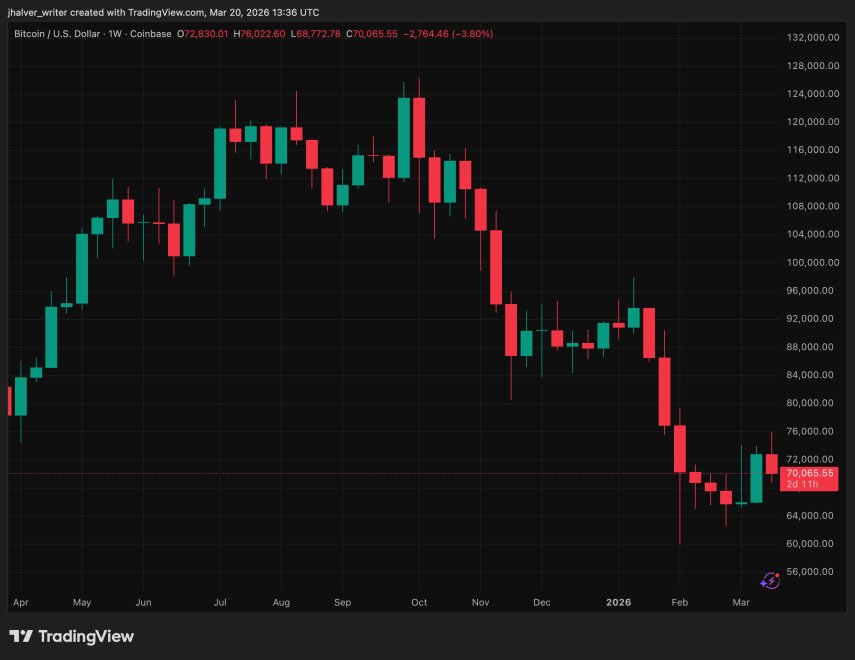
At the moment of writing, BTC trades barely above the $70k level on the daily chart, marking a downside trend. Source: BTCUSD on Tradingview

Cover image from Perplexity, BTCUSD chart from Tradingview

Связанные с этим вопросы

QWhat new product has Coinbase announced for non-US traders?

ACoinbase has announced the launch of stock perpetual futures for non-US traders.

QWhich major tech stocks are covered by the new perpetual futures contracts?

AThe contracts cover the 'Magnificent Seven' tech stocks: Apple, Microsoft, Alphabet, Amazon, NVIDIA, Meta Platforms, and Tesla.

QWhat is the maximum leverage offered on individual stock perpetual futures?

ALeverage goes up to 10x on individual stock perpetual futures.

QIn what currency are all the new perpetual futures contracts settled?

AAll contracts are settled in USDC, which is Coinbase's preferred stablecoin.

QHow does Coinbase describe the broader strategy that this launch is a part of?

ACoinbase frames this launch as part of its broader 'Everything Exchange' strategy, aiming to bring crypto, traditional assets, and new tokenized products into one venue.

Похожее

The King of Blind Date Attire in Korea: How SK Hynix Made a Comeback Against Samsung?

In South Korea's dating scene, SK Hynix employees are now highly sought after, a status shift fueled by the company's astronomical profits and employee bonuses, projected to reach up to 6.1 million RMB per person by 2027. This marks a dramatic reversal for the long-time second-place player in memory semiconductors, which has now surpassed its rival Samsung in annual operating profit. The turnaround story began in 2008 when a struggling Hynix, emerging from bankruptcy restructuring, took a risky bet by agreeing to develop High Bandwidth Memory (HBM) with AMD. At the time, HBM had no clear market beyond high-end graphics cards and was a costly, complex technology. Major players like Samsung, pursuing its own HMC technology, declined. For Hynix, with only memory as its core business, it was a gamble born of necessity. The pivotal moment came in 2012 when SK Group Chairman Chey Tae-won acquired Hynix. Defying industry downturns, he invested heavily in R&D and fabrication, sustaining the HBM project through over a decade of commercial uncertainty and internal challenges. A key break occurred around 2016-2017 when Samsung faced production issues supplying HBM2 for Google's TPU, allowing SK Hynix to gain a crucial foothold in the data center market. The AI explosion post-ChatGPT in 2022 was the catalyst, turning HBM into a critical bottleneck for AI accelerators like NVIDIA's GPUs. By 2025, SK Hynix captured 62% of the global HBM market, leaving Samsung at 17%. For the first time, its annual operating profit exceeded Samsung's. Analysts point to the "innovator's dilemma" to explain Samsung's miss: its vast, successful business portfolio made it risk-averse, preventing an all-in bet on the initially niche HBM technology. In contrast, SK Hynix, as a challenger with its back against the wall, had no choice but to commit fully. The story highlights how Korea's chaebol system allows for ultra-long-term bets beyond quarterly pressures. However, SK Hynix's lead isn't guaranteed. Samsung is aggressively catching up on HBM4, and challenges like customer concentration (heavy reliance on NVIDIA) and technical hurdles in advanced packaging remain. The narrative underscores a market truth: the greatest alpha often comes from betting on uncertain, long-term directions others dismiss, much like HBM in 2008.

marsbit10 мин. назад

The King of Blind Date Attire in Korea: How SK Hynix Made a Comeback Against Samsung?

marsbit10 мин. назад

Understanding Hash in One Article: The "Browser Miner" on Ethereum

Hash is an Ethereum-based ERC-20 token described as a "browser-minable post-quantum token." Its key features include enabling browser-based GPU mining without specialized hardware, a fixed supply cap of 21 million tokens, immutable and permissionless smart contracts with no team allocation or pre-mining, and an emphasis on post-quantum security using Keccak256 hashing. The mining mechanism is a simplified on-chain proof-of-work where miners solve unique challenges tied to their wallet address. Key design elements prevent answer theft, with epochs resetting every 100 blocks (~20 minutes) and a per-block minting limit. Emission follows a Bitcoin-like halving schedule every 100,000 mints, starting at 100 tokens per mint. Projections suggest all tokens could be mined within approximately 294 days if a target rate of one mint per minute is sustained. Hash emphasizes "post-quantum" security by leveraging hash-based primitives like Keccak256, which are considered more resistant to quantum attacks compared to elliptic-curve cryptography. While not a fully post-quantum asset, it aligns with Ethereum's broader post-quantum research narrative. The project completed its Genesis sale at $0.03 and began trading on Uniswap, with its price reaching around $0.19. The initial circulating supply is small, with 5% sold in Genesis and 5% allocated to liquidity. The majority (47.6% of total supply) is allocated to early-stage mining, leading to a front-loaded emission schedule. This structure, combined with low initial liquidity, makes Hash a high-volatility, high-risk project dependent on sustained miner participation and market demand to absorb new supply.

marsbit23 мин. назад

Understanding Hash in One Article: The "Browser Miner" on Ethereum

marsbit23 мин. назад

OpenAI's Largest Internal Wealth Creation: 600 People Cash Out a Total of $6.6 Billion, 75 Take Home the Maximum $30 Million Each

A Wall Street Journal report reveals OpenAI's unprecedented pre-IPO wealth creation. In a single employee stock sale last October, over 600 current and former employees sold shares, collectively cashing out approximately $6.6 billion. Due to high investor demand, the company tripled the individual sale cap to $30 million, with about 75 employees selling the maximum amount. This event represents the largest such transaction in tech industry history for a private company. OpenAI's valuation was $500 billion for this tender offer. Employees with over two years of tenure were eligible, allowing many post-ChatGPT hires their first liquidity event. The company's stock has reportedly grown over 100-fold in seven years. Following a restructuring, employees collectively hold about 26% of OpenAI. The scale of executive wealth is also staggering. In court testimony related to Elon Musk's lawsuit, President and co-founder Greg Brockman confirmed his OpenAI stake is worth around $30 billion. Analysis indicates about 165 current and former employees hold a combined ~$164.9 billion in equity, averaging nearly $1 billion per person in paper wealth. OpenAI's per-employee stock-based compensation is estimated to be 34 times the average of major tech firms before their IPOs. OpenAI continues its rapid ascent, closing a $122 billion funding round at an $852 billion valuation in March. With monthly revenue hitting $2 billion, over 900 million weekly ChatGPT users, and plans for a potential trillion-dollar IPO in late 2026, this wealth-creation engine shows no signs of stopping.

链捕手46 мин. назад

OpenAI's Largest Internal Wealth Creation: 600 People Cash Out a Total of $6.6 Billion, 75 Take Home the Maximum $30 Million Each

链捕手46 мин. назад

Торговля

Спот
Фьючерсы

Популярные статьи

Как купить ONE

Добро пожаловать на HTX.com! Мы сделали приобретение Harmony (ONE) простым и удобным. Следуйте нашему пошаговому руководству и отправляйтесь в свое крипто-путешествие.Шаг 1: Создайте аккаунт на HTXИспользуйте свой адрес электронной почты или номер телефона, чтобы зарегистрироваться и бесплатно создать аккаунт на HTX. Пройдите удобную регистрацию и откройте для себя весь функционал.Создать аккаунтШаг 2: Перейдите в Купить криптовалюту и выберите свой способ оплатыКредитная/Дебетовая Карта: Используйте свою карту Visa или Mastercard для мгновенной покупки Harmony (ONE).Баланс: Используйте средства с баланса вашего аккаунта HTX для простой торговли.Третьи Лица: Мы добавили популярные способы оплаты, такие как Google Pay и Apple Pay, для повышения удобства.P2P: Торгуйте напрямую с другими пользователями на HTX.Внебиржевая Торговля (OTC): Мы предлагаем индивидуальные услуги и конкурентоспособные обменные курсы для трейдеров.Шаг 3: Хранение Harmony (ONE)После приобретения вами Harmony (ONE) храните их в своем аккаунте на HTX. В качестве альтернативы вы можете отправить их куда-либо с помощью перевода в блокчейне или использовать для торговли с другими криптовалютами.Шаг 4: Торговля Harmony (ONE)С легкостью торгуйте Harmony (ONE) на спотовом рынке HTX. Просто зайдите в свой аккаунт, выберите торговую пару, совершайте сделки и следите за ними в режиме реального времени. Мы предлагаем удобный интерфейс как для начинающих, так и для опытных трейдеров.

656 просмотров всегоОпубликовано 2024.04.12Обновлено 2025.06.06

Как купить ONE

Обсуждения

Добро пожаловать в Сообщество HTX. Здесь вы сможете быть в курсе последних новостей о развитии платформы и получить доступ к профессиональной аналитической информации о рынке. Мнения пользователей о цене на ONE (ONE) представлены ниже.

活动图片