Claude Bill Skyrockets by 5 Billion, Surges 60-Fold Overnight—Can Your Token Budget Keep Up?

marsbitОпубликовано 2026-06-01Обновлено 2026-06-01

Введение

An enterprise reportedly ran up a staggering $500 million bill on Anthropic's Claude AI in just one month due to a simple oversight: failing to set usage limits for employee accounts. This incident highlights a growing trend of runaway AI costs. Other examples include a Google Cloud user hit with an unexpected $18,000 bill from API key abuse, and an OpenAI internal experiment that consumed 603 billion tokens, costing $1.3 million in 30 days. Major AI providers like OpenAI and GitHub are shifting from flat monthly fees to granular, usage-based pricing (per input/output/cached token), causing shock for some users whose costs skyrocketed by orders of magnitude. The root causes extend beyond pricing. The rise of autonomous AI agents executing long, complex tasks has drastically increased token consumption. Furthermore, misaligned incentives, like internal "leaderboards" ranking employees by AI usage, can encourage wasteful "tokenmaxxing"—using powerful models for trivial tasks just to inflate metrics. This has sparked a new industry focused on cost optimization. Solutions include providing AI with better context (reducing redundant searches) and intelligent model routing (matching tasks to the most cost-effective model). Research indicates token consumption for agentic tasks can vary wildly (up to 30x for the same job) without guaranteeing better results, and models often underestimate their own costs. As AI expenses begin to rival or even surpass human labor costs for some t...

A $500 Million Bill in Just 1 Month!

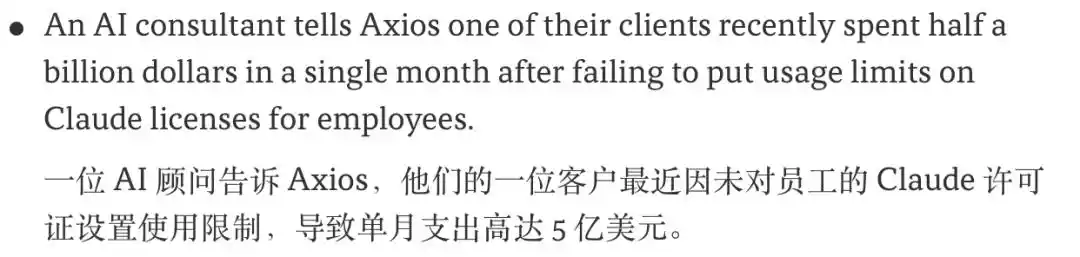
Recently, a shocking blunder erupted in the tech world. According to Axios, a company actually managed to rack up a $500 million bill on Claude in just one month!

The reason is laughable: management forgot to set usage limits when granting employees access to Claude accounts.
In fact, this isn't the only case of AI bills exploding.

In April, a Google Cloud user, whose publicly accessible API key was misused, received a bill for $18,000 overnight, despite having only a $7 budget set.

The unlucky user, Jesse Davies, is an Australian AI consultant and founder of Agentic Labs. He had set up two safeguards for his Google Cloud account: a A$10 (about $7) budget alert and a hard spending cap of $1,400.

As reported by Tom's Hardware, attackers discovered a Cloud Run service he had deployed months earlier from AI Studio, sending over 60,000 requests. Both safeguards failed: there was a delay in billing calculations, and by the time the system reacted, the amount had skyrocketed to $18,000.

In mid-May, Peter Steinberger, founder of the open-source project OpenClaw, posted a screenshot on X: a $1.3 million OpenAI API bill for 30 days.
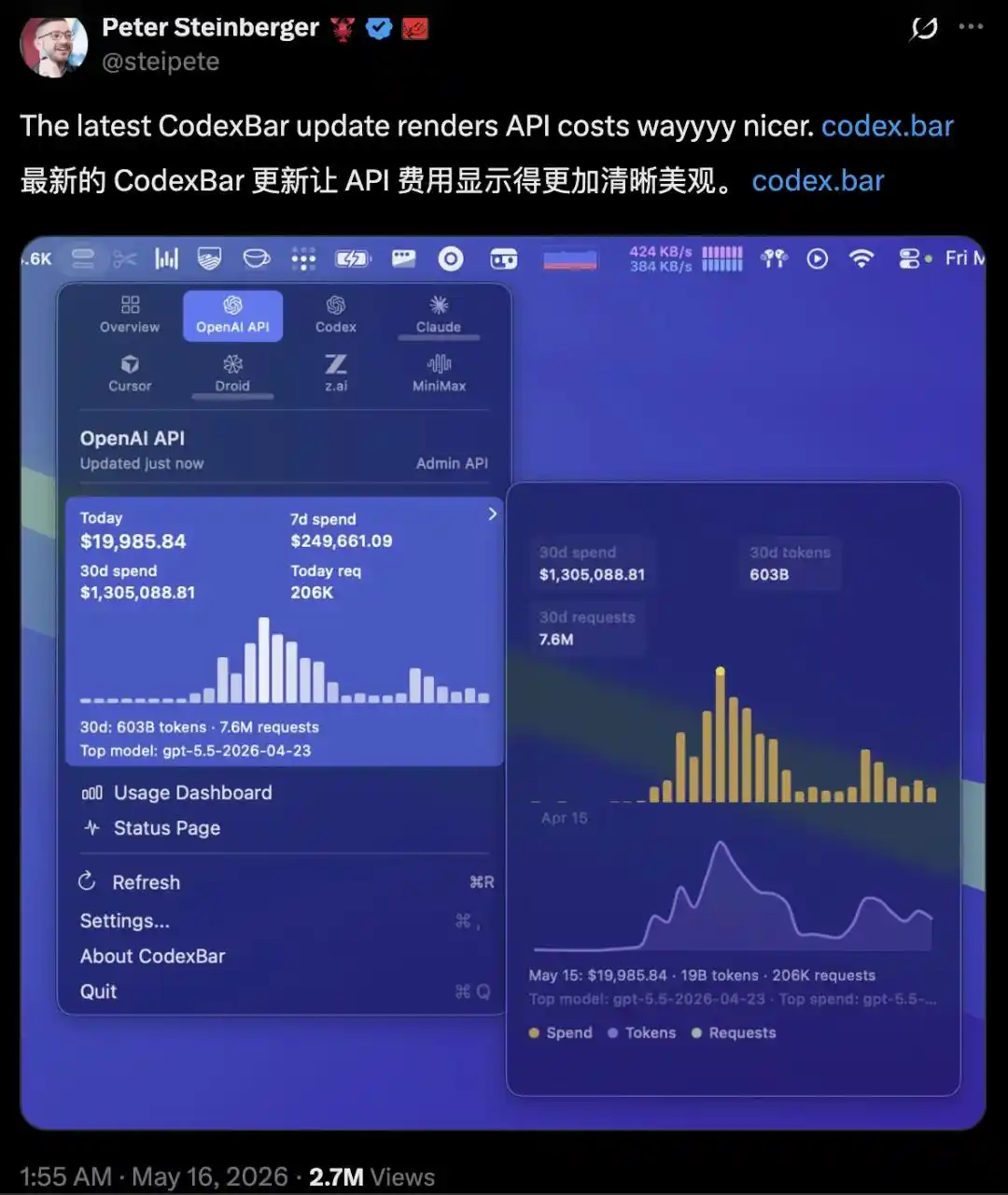
His team has only three people, but they orchestrated 100 Codex agents running in parallel: burning through 603 billion Tokens and making 7.6 million requests in 30 days. Fortunately, he didn't have to foot this $1.3 million bill himself.

Steinberger joined OpenAI this past February, and this $1.3 million was treated as an internal experiment:

to test the absolute limits of AI programming when token cost is not a consideration. He added that this was the result of Codex's "Fast Mode" (higher-tier billing); turning it off reduced the cost to about $300,000.

Even earlier, Uber's CTO Praveen Neppalli Naga had admitted to The Information that the company had exhausted its annual Claude Code budget by April, and their COO also publicly stated that AI costs were becoming increasingly "hard to justify."

$500 million, $1.3 million, $18,000—though these figures differ by orders of magnitude, they point to the same reality:

In the age of agents, any one of these—a compromised key, an army of agents running 24/7, or an account with forgotten limits—can blow up your token bill overnight.

Why Do AI Bills Explode?

The answer lies mainly in the shift in billing methods.

Starting April this year, OpenAI began transitioning from monthly flat fees to usage-based billing by Token.

On April 2, Codex billing shifted from per-message estimates to alignment with actual Token usage: Input, Cached Input, and Output Tokens are billed separately. On April 23, this rule was extended to all Enterprise, Edu, Health, and Gov plans: the invisible discount within the monthly fee was removed.

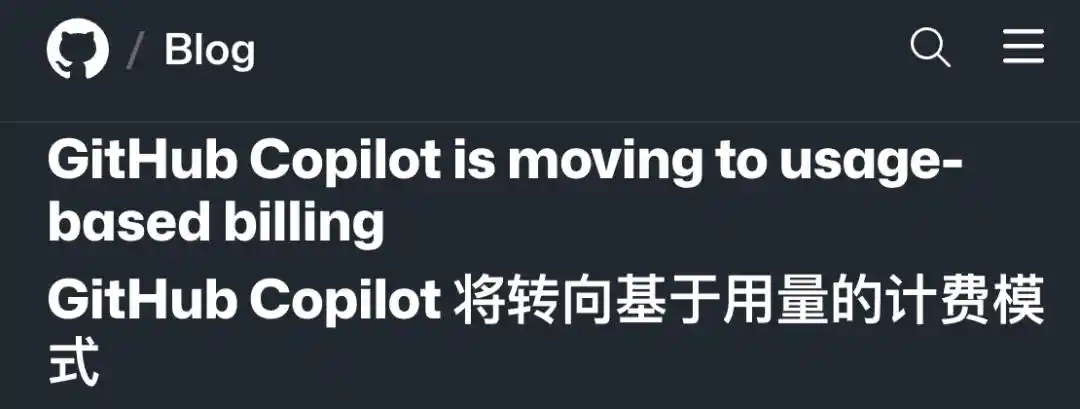
GitHub followed closely, just announcing: all Copilot plans will switch to usage-based billing effective June 1, 2026. The old premium request logic is scrapped, replaced with AI credits, settled based on actual consumption of Input, Output, and Cached Tokens against each model's API rate.
GitHub officially explained the reason for this change:

Currently, a quick chat question and a multi-hour autonomous coding task cost the user the same amount. GitHub has been subsidizing the heavy users, but this model is no longer sustainable.

Before the rise of AI agents, the costs of chat and completions were similar, and monthly fees could cover them.

After agents rose, a single task could run for hours and modify entire codebases, creating a cost difference of orders of magnitude between heavy and light users. The flat monthly fee model collapses in the face of such disparity.

The news sparked an uproar on Reddit and X.

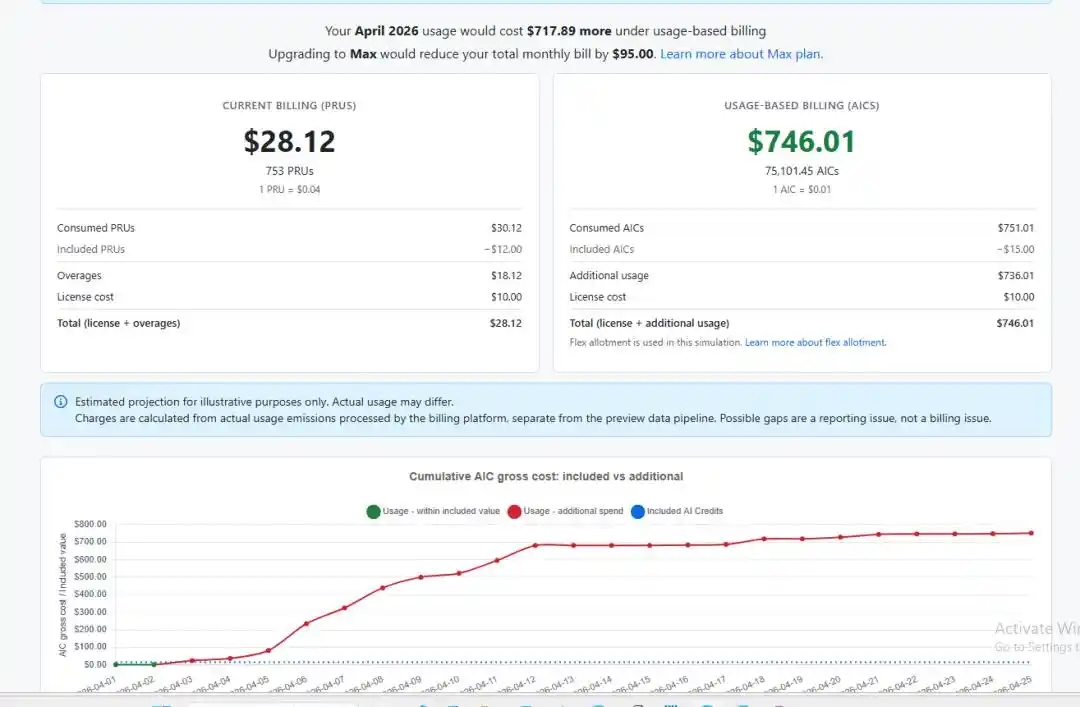
A developer with the ID JBusu shared a screenshot of their bill, bluntly calling the new pricing "a joke." Their previous monthly cost of $28.12 would become $746.01 under the new system. They've decided to cancel, "At this price, I could rent a cloud server myself and it would be cheaper."

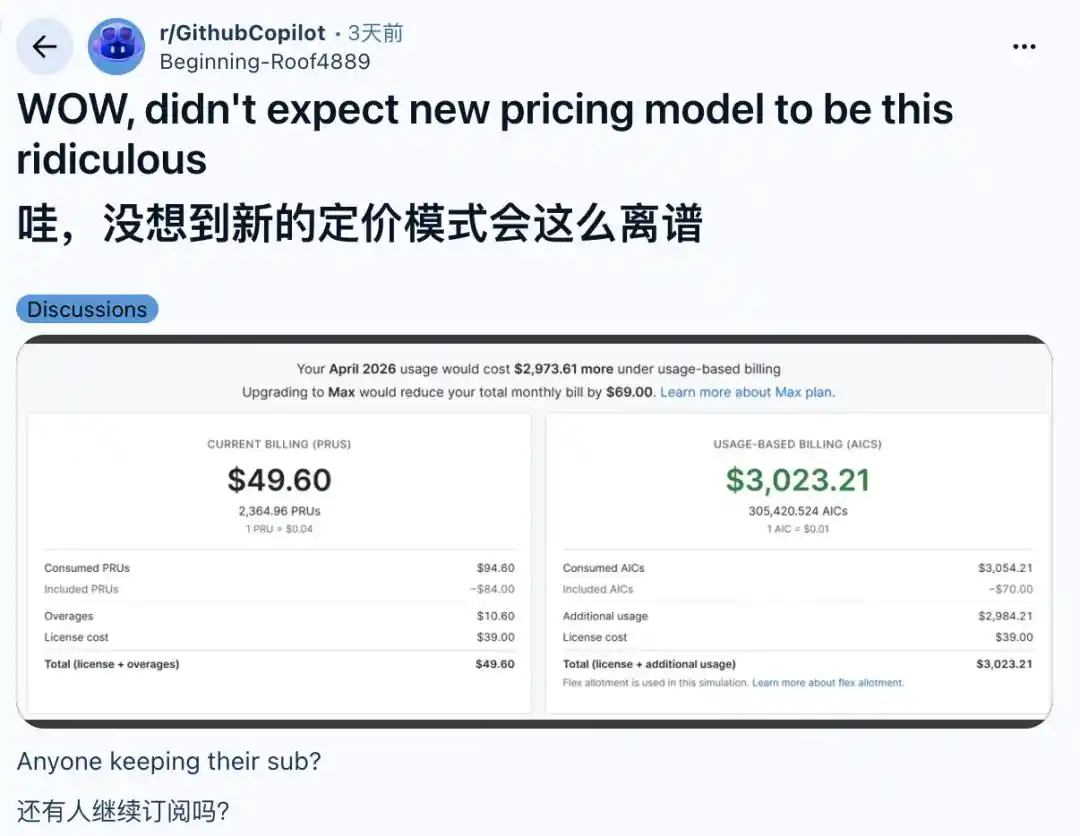
Another user shared an even more extreme screenshot, showing costs soaring from $50 to $3,000. They said they never expected pricing to be this outrageous, "Is anyone still subscribing?"
However, some veteran Copilot users countered: these extreme bills are likely burned by "vibe-coders" who aren't mindful of token usage and may not represent normal use.

One veteran user commented: "I use it all day long and rarely exceed limits by month-end. It's hard to believe this is due to differences in task complexity." Another was more direct: "It's people wanting fully automated YOLO-mode development, letting AI run wild. Culling this waste is actually good for everyone else."

One thing is clear: GitHub hasn't abolished monthly fees; the base subscription price remains unchanged. What has changed is that extra usage, agent tasks, and calls to more expensive models now fall under usage-based billing.

The hardest hit are those heavy agent users who rely on Copilot for long-chain tasks.

The Leaderboard Gamed by Its Own Users

The collapse of flat fees is partly due to platforms changing their billing rules, and partly because AI users themselves are burning through tokens.

In May, Business Insider reported that Amazon took down an internal AI usage leaderboard called KiroRank.

The report cited insiders saying the leaderboard quietly encouraged a strange work style: some employees, to climb the ranks, would burn tokens on tasks that didn't solve actual problems, purely for ranking.
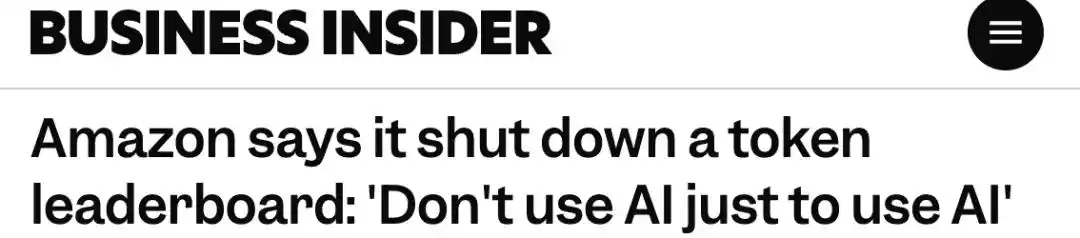
After the story broke, Amazon SVP Dave Treadwell directly addressed all employees: "Don't use AI for the sake of using AI. Use it to solve customer problems, business problems, to innovate."

Though absurd, this is hardly surprising. When "burning tokens" gets you on a leaderboard, employees will naturally burn tokens.

Silicon Valley has coined a term for this phenomenon: Tokenmaxxing—treating consumption volume as productivity.

Axios's report also mentioned CTOs discovering employees using cutting-edge AI models to check the weather or write routine emails—trivial tasks that, when run on the most expensive frontier models, can silently send bills soaring.

KiroRank wasn't part of Amazon's official evaluation system but an informal tool built by employees. Yet it clearly exposes a classic management principle: when KPIs are set wrong, people will use the cleverest ways to game the system.

Equating "how much was used" with "how well it was done"—this is the systemic root of this wave of AI waste.

Those Who Count Tokens Are Already Making Money

On the flip side of token bill anxiety, some are quietly turning it into a business.

First approach: Feed the AI with context.

Glean is actually Arvind Jain's own company. It builds an enterprise AI work assistant: unifying knowledge scattered across a company, giving employees' AI direct context so they don't have to dig around. The AI takes fewer detours, naturally burning fewer tokens.

This mechanism helped Glean's annual revenue triple in 15 months, crossing $300 million, with clients including Databricks, Reddit, and Samsung.

Second approach: Delegate tasks to the right model.

This is what model routing startup Factory AI does: automatically routing each task to the most suitable model, cheap ones for simple tasks, top-tier for complex ones. Arvind also noted: Do routing right, and you can save 10x.

Both paths lead to the same destination: Let AI work, but don't let it burn money indiscriminately.

Academic research is also laying the groundwork for this shift.
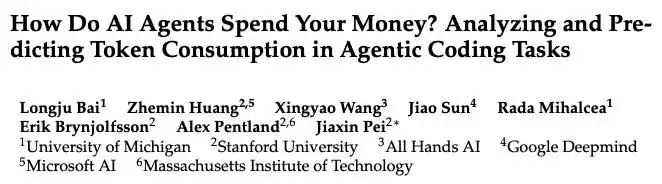
https://arxiv.org/pdf/2604.22750

An arXiv paper from April 2026 systematically broke down how agent coding tasks actually burn money for the first time.

Conclusion One: Token consumption for agent tasks can be thousands of times higher than ordinary code reasoning or code chat, with Input Tokens being the main cost driver.

Conclusion Two: Running the same task multiple times can result in a 30x difference in Token consumption.

Conclusion Three: Higher Token consumption does not necessarily lead to higher accuracy. Accuracy often peaks at medium cost—burning more beyond that spends money without yielding better results.

The paper also found that even frontier models can't reliably predict their own token consumption, generally underestimating the real cost.

You think spending more gets more done. In reality, money is spent, the work isn't necessarily better, and the budget is still unpredictable.

When AI Bills Start Rivaling Labor Costs

"This is the first time in my memory that technology costs are starting to be on par with human costs."

On May 29, Glean CEO Arvind Jain said this in an interview with CNBC's Deirdre Bosa.
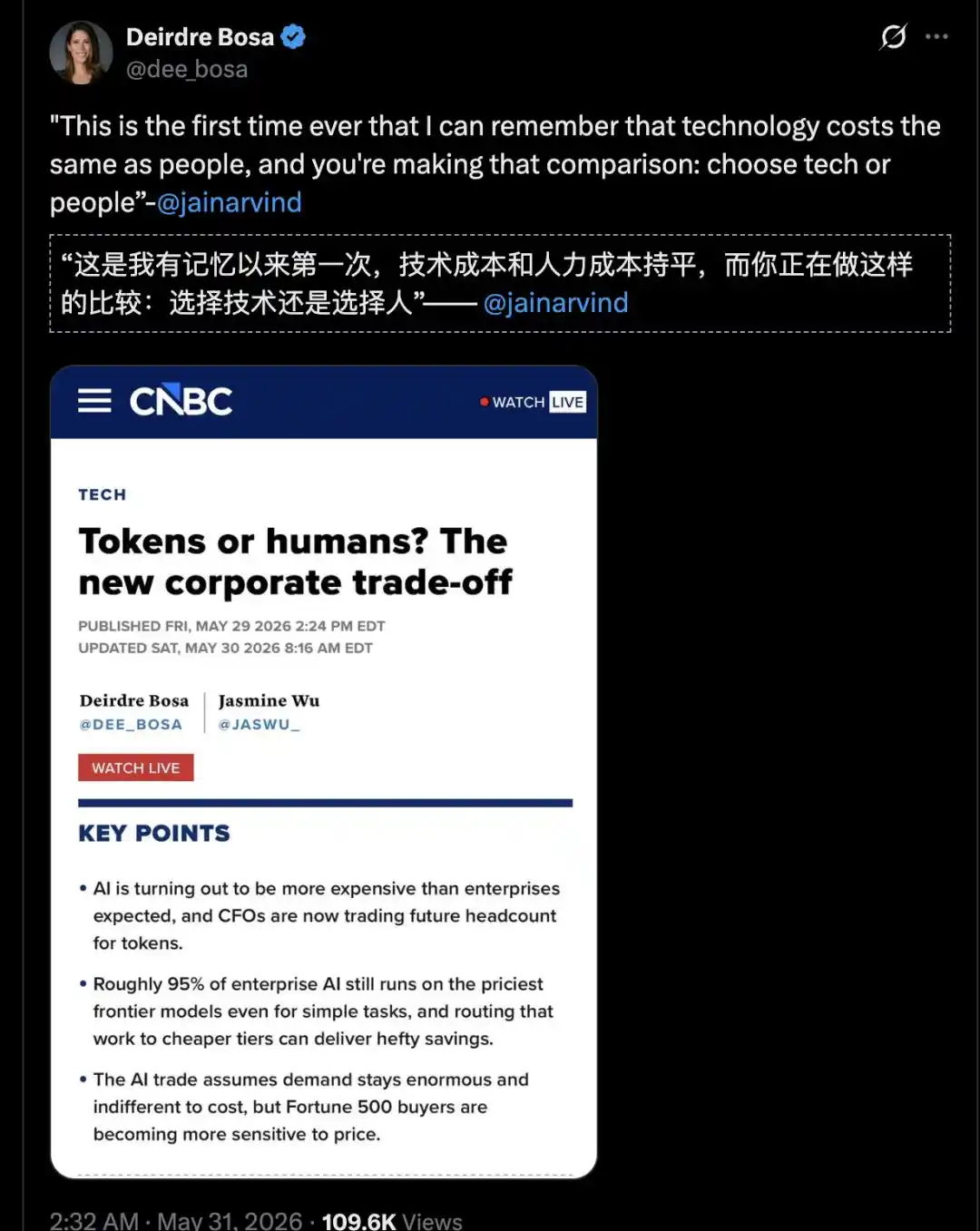
Observations from Nvidia's Vice President of Applied Deep Learning, Bryan Catanzaro, corroborate this.

He mentioned in an Axios interview that for his team, compute costs far exceed employee salaries.

Similar trends are emerging across multiple companies: from enterprise AI player Glean, to AI compute seller Nvidia, to AI user Uber—all are re-evaluating this equation.

In Arvind's view, historically, technology was just a small slice of overall corporate costs. But now, AI costs are catching up to payrolls. Many companies' annual AI budgets are often burned through in just one or two months.

Over the past year, AI usage rate was a worshipped metric: more usage meant being advanced, burning tokens meant embracing the future. Now, many companies are reflecting on that simple question: What exactly did all those burned tokens buy?

The window of free or flat-rate unlimited usage is precisely closing at this moment.

Going forward, the question facing all developers is this: How to budget meticulously and maximize the value of every single Token.

Undoubtedly, the true winners of the future will be those who learn to count tokens first.

References:

https://x.com/dee_bosa/status/2060791500049613306%20

https://www.cnbc.com/2026/05/29/-tokens-or-humans-the-new-corporate-trade-off.html%20

https://www.axios.com/2026/05/28/ai-spending-roi-enterprise-costs%20

https://www.businessinsider.com/amazon-ai-leaderboard-tokenmaxxing-2026-5

This article is from the WeChat public account "AI Era Insights", author: ASI启示录

Связанные с этим вопросы

QWhat is the main reason behind the dramatic increase in AI usage costs as discussed in the article?

AThe primary reason is the shift from flat-rate monthly subscription models to consumption-based pricing (charging per Token used). This change, implemented by companies like OpenAI and GitHub, means that intensive AI agent tasks, which can consume orders of magnitude more tokens than simple chats or completions, now incur significantly higher costs.

QWhat incident involving a leaked API key led to a massive unexpected bill, and how much was it?

AAn Australian AI consultant named Jesse Davies had a Google Cloud API key exposed from a public service. Attackers used it to make over 60,000 requests, resulting in a bill of $18,000, despite him having set a budget alert and a hard spending limit.

QWhat does the term 'Token maxxing' refer to in the context of corporate AI use?

A'Token maxxing' refers to the practice of employees excessively consuming AI tokens, not to solve real problems, but to climb internal usage leaderboards (like Amazon's KiroRank) or meet misguided productivity KPIs that equate high token usage with good performance.

QWhat was the key finding of the April 2026 arXiv paper regarding AI agent coding tasks and cost?

AThe key finding was that AI agent tasks can consume up to a thousand times more tokens than standard code reasoning/dialogue, primarily due to input tokens. Crucially, higher token consumption does not necessarily lead to higher accuracy, with performance often plateauing at a medium cost level.

QAccording to the article, what are the two main business approaches emerging to help manage and reduce AI token costs?

A1. Providing context to AI: Companies like Glean build systems that give AI assistants direct access to relevant company knowledge, reducing the need for lengthy searches and context-building, thus saving tokens. 2. Model routing: Startups like Factory AI automatically route tasks to the most cost-appropriate AI model (e.g., simple tasks to cheaper models, complex ones to top-tier models), potentially saving up to 10x in costs.

Похожее

Blocked Its Own Treasure, WeChat AI Steps Up

Tencent's stock surged over 10% on June 2nd amid reports that WeChat, with 1.43 billion monthly users, is finalizing tests for a native AI Agent. The reported feature, accessible by swiping right from the main interface, allows users to issue commands in natural language. The AI then decomposes tasks and automatically calls upon relevant Mini Programs within WeChat to complete actions like ordering food, booking tickets, or making payments, creating a closed-loop service execution system. This strategic shift follows the internal conflict and subsequent "blocking" of Tencent's standalone AI app, Yuanbao, by WeChat for violating sharing rules during a 2026 Spring Festival promotion. The incident highlighted a lack of internal consensus and exposed the weakness of competing in the standalone AI assistant arena against rivals like ByteDance's Doubao (345M MAU) and Alibaba's Qianwen. The new WeChat AI Agent aims to leverage WeChat's unique assets—its massive user base, standardized Mini Program APIs, WeChat Pay, and identity system—to move from simple content generation to actual task execution. Analysts note this changes the competitive landscape from model benchmarks to which AI can connect to more real-world services. However, success depends on key variables: the capability of Tencent's underlying Hunyuan model, managing massive inference costs, and redesigning incentives for Mini Program developers whose traffic might be bypassed. The move is seen as an attempt to keep user service intent within WeChat's ecosystem as AI begins to redefine how users access services.

marsbit49 мин. назад

Blocked Its Own Treasure, WeChat AI Steps Up

marsbit49 мин. назад

ByteDance Adopts Arm CPUs, Jensen Huang: So Sad I Didn't Buy Arm

**Summary:** At Computex 2026, Arm CEO Rene Haas announced that ByteDance and Oracle have adopted Arm's self-designed Arm AGI data center CPU. The company expects significant revenue growth from this product, projecting $20 billion in demand for the 2027/2028 fiscal years. Haas noted that restricting AI-capable CPUs from the US to China is nearly impossible due to their widespread applications. Arm's stock has surged dramatically this year, notably rising 16% after NVIDIA's Arm-based Vera CPU and RTX Spark announcements. A highlight was the informal, humorous on-stage conversation between Haas and NVIDIA CEO Jensen Huang. Huang joked about NVIDIA's failed attempt to acquire Arm and playfully lamented selling his Arm shares. Both executives showed a clear sense of camaraderie and shared regret over the missed merger. Key technical topics were discussed: 1. **AI PC Design:** Huang explained NVIDIA's RTX Spark superchip (with a 20-core Arm CPU) is designed for future AI agents that will autonomously run and use tools on PCs, blending local and cloud processing. 2. **Agent vs. OS:** Huang emphasized the operating system remains crucial, as AI agents rely on its APIs and tools to function. 3. **Growth Constraints:** He identified the shift to "useful AI" that generates profitable tokens as a primary driver for immense, almost limitless, computational demand. Haas outlined Arm's strategy across PC and data centers. For PCs, Arm collaborates with partners like NVIDIA and MediaTek, offering its compute subsystem (CSS) for custom SoCs. In data centers, its Arm AGI CPU (built on TSMC's 3nm process) has gained major partners including OpenAI, Meta, and now ByteDance and Oracle. Arm presented a multi-year roadmap for its in-house CPU line. The article concludes that while GPUs dominated the AI training race, the explosion of AI agents is shifting significant focus to CPUs for inference, state management, and tool orchestration. The industry is trending towards vertical integration, with companies like cloud providers designing chips and chip/IP firms offering full solutions, all competing to deliver more efficient computing per watt.

marsbit1 ч. назад

ByteDance Adopts Arm CPUs, Jensen Huang: So Sad I Didn't Buy Arm

marsbit1 ч. назад

New Wall Street Play: Yen Shorts Still Adding, But Japan Stocks Don't Rely on Carry Trade Unwinding

On June 3rd, USD/JPY hit 160.44, its highest level since July 2024, while the Nikkei 225 surged past 68,000 points. Contrary to popular narratives of an imminent "carry trade unwind" akin to August 2024, data reveals a more complex picture. Speculative net short positions in yen futures have actually increased, reaching -114,667 contracts by late May, suggesting traders are doubling down rather than retreating. Meanwhile, Japan's Finance Ministry conducted its largest-ever single-round FX intervention (11.73 trillion yen) in April-May but failed to hold the 160 yen line. The Nikkei's rally is not driven by carry trade dynamics. Foreign investors are aggressively buying Japanese stocks, with net purchases in 2026 running nearly 16 times higher than 2025 levels. This inflow is concentrated in AI and semiconductor-related stocks like SoftBank and Socionext, fueled by positive sector outlooks, rather than being a flight from unwinding yen shorts. Furthermore, the Nikkei has continued climbing despite the Bank of Japan's (BOJ) rate hikes to 0.75%. This disconnect exists because the current equity boom is fueled by AI-driven foreign investment, not reliant on cheap yen funding. However, this relationship remains fragile. Should the BOJ hike rates further (e.g., to 1.0%) while dollar weakness increases carry trade costs, the trajectories of the yen and Japanese stocks could reconverge, potentially triggering volatility.

marsbit1 ч. назад

New Wall Street Play: Yen Shorts Still Adding, But Japan Stocks Don't Rely on Carry Trade Unwinding

marsbit1 ч. назад

Broadcom's Q3 Guidance Misses Expectations by $12 Billion, After-Hours Trading Plummets Over 13%, AI Narrative "Cooling"?

On June 3, Broadcom released record Q2 FY26 results with revenue of $22.19B, up 48% YoY, and AI chip sales of $10.8B, up 143%. Adjusted EPS of $2.44 beat estimates. However, its Q3 AI semiconductor revenue guidance of $16B, while up over 200% YoY, fell roughly $1.2B (7%) short of analyst consensus expectations of $17.2B. This miss, coupled with slightly weaker-than-expected software revenue, triggered a severe market reaction. CEO Hock Tan maintained the FY26 AI revenue outlook of over $100B but did not raise it, disappointing investors who had priced in more robust growth. The stock plummeted over 13% in after-hours trading, erasing roughly $270B in market cap. The sell-off extended to peers like Marvell. A key concern for markets, particularly for Chinese optical module suppliers, was Tan's comment that the contribution of AI networking (e.g., Ethernet switches, optical interconnect chips) to AI revenue, currently near 40%, is expected to normalize to around 30% over time, signaling a potential peak in growth for that segment. Despite the guidance shortfall, Tan reiterated that AI demand remains "insatiable" and reaffirmed the long-term target of exceeding $100B in AI revenue by FY27. The reaction highlights the heightened sensitivity and premium valuation placed on AI-exposed stocks, where anything less than stellar guidance can prompt significant profit-taking. The broader question is whether this represents a cooling AI narrative or a correction in overstretched valuations.

marsbit1 ч. назад

Broadcom's Q3 Guidance Misses Expectations by $12 Billion, After-Hours Trading Plummets Over 13%, AI Narrative "Cooling"?

marsbit1 ч. назад

Торговля

Спот
Фьючерсы

Популярные статьи

Как купить BILL

Добро пожаловать на HTX.com! Мы сделали приобретение Billions Network (BILL) простым и удобным. Следуйте нашему пошаговому руководству и отправляйтесь в свое крипто-путешествие.Шаг 1: Создайте аккаунт на HTXИспользуйте свой адрес электронной почты или номер телефона, чтобы зарегистрироваться и бесплатно создать аккаунт на HTX. Пройдите удобную регистрацию и откройте для себя весь функционал.Создать аккаунтШаг 2: Перейдите в Купить криптовалюту и выберите свой способ оплатыКредитная/Дебетовая Карта: Используйте свою карту Visa или Mastercard для мгновенной покупки Billions Network (BILL).Баланс: Используйте средства с баланса вашего аккаунта HTX для простой торговли.Третьи Лица: Мы добавили популярные способы оплаты, такие как Google Pay и Apple Pay, для повышения удобства.P2P: Торгуйте напрямую с другими пользователями на HTX.Внебиржевая Торговля (OTC): Мы предлагаем индивидуальные услуги и конкурентоспособные обменные курсы для трейдеров.Шаг 3: Хранение Billions Network (BILL)После приобретения вами Billions Network (BILL) храните их в своем аккаунте на HTX. В качестве альтернативы вы можете отправить их куда-либо с помощью перевода в блокчейне или использовать для торговли с другими криптовалютами.Шаг 4: Торговля Billions Network (BILL)С легкостью торгуйте Billions Network (BILL) на спотовом рынке HTX. Просто зайдите в свой аккаунт, выберите торговую пару, совершайте сделки и следите за ними в режиме реального времени. Мы предлагаем удобный интерфейс как для начинающих, так и для опытных трейдеров.

275 просмотров всегоОпубликовано 2026.05.07Обновлено 2026.06.02

Как купить BILL

Обсуждения

Добро пожаловать в Сообщество HTX. Здесь вы сможете быть в курсе последних новостей о развитии платформы и получить доступ к профессиональной аналитической информации о рынке. Мнения пользователей о цене на BILL (BILL) представлены ниже.

活动图片