CertiK Releases Skynet Report: 'Wrench Attacks' Surge 75% in 2025, Physical Violence Becomes Major Threat in Crypto Space

marsbitОпубликовано 2026-03-31Обновлено 2026-03-31

Введение

CertiK's Skynet Report reveals a 75% surge in "wrench attacks" in 2025, where physical violence, kidnapping, or intimidation is used to force cryptocurrency holders to surrender private keys or passwords. These attacks, which bypass technical defenses to target individuals directly, resulted in over $40.9 million in confirmed losses—a 44% year-on-year increase. Europe emerged as the highest-risk region, accounting for over 40% of incidents, with France recording the most cases. The report highlights a trend toward increased violence, with physical assaults rising by 250%, and notes that attacks are becoming more organized, often executed by transnational criminal groups using OSINT, signal jammers, and Faraday bags. Targets have broadened from high-value individuals like executives to ordinary holders and their families. CertiK warns that the actual scale of such attacks is likely underestimated due to low reporting rates. Recommendations include using decoy wallets, geographic separation of seed phrases, multisig mechanisms, and comprehensive security training for individuals and organizations. The study underscores that protecting people, not just assets, is critical as wrench attacks become a structured threat in the crypto ecosystem.

On February 2, CertiK, the world's largest Web3 security company, released the "Skynet Wrench Attack Report," pointing out that physical violence against cryptocurrency holders has evolved from extreme isolated cases into a structural risk. As the security protection of crypto assets continues to strengthen, this method of attack, which bypasses technical defenses and directly targets the "person," is spreading rapidly.

The report shows that in 2025, a total of 72 verified wrench attack incidents were recorded globally, an increase of 75% compared to 2024. So-called "wrench attacks" refer to attackers using physical means such as violence, intimidation, or kidnapping to force victims to hand over private keys or passwords. These attacks do not rely on technical vulnerabilities but directly target the individuals behind the crypto assets.

Significant Escalation in Violence, Europe Becomes High-Risk Region
In terms of attack patterns, wrench attacks in 2025 showed a clear trend of escalating violence. The report notes that kidnapping remains the primary attack method, with 25 incidents occurring throughout the year; direct physical assault incidents increased by 250% year-on-year, becoming one of the most noteworthy changes.

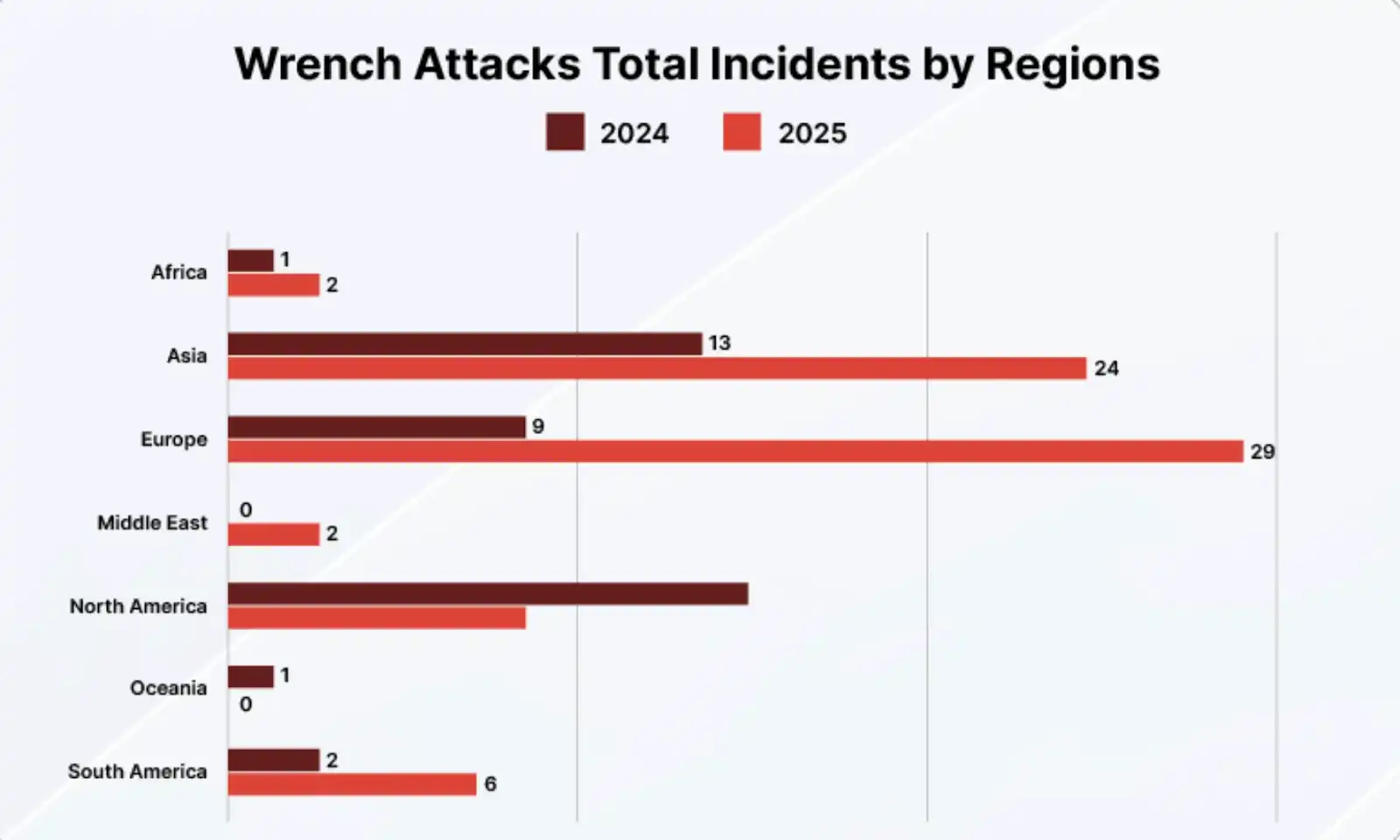
Geographically, Europe became the highest-risk region globally for the first time. In 2025, Europe accounted for over 40% of known global incidents, with France recording the highest number of attacks worldwide, surpassing the United States. CertiK noted in the report that this change does not mean that risks in North America have disappeared but reflects that such crimes are spreading to more regions with complex judicial environments and higher cross-border collaboration costs.

Losses Exceed $40 Million, True Scale Likely Severely Underestimated
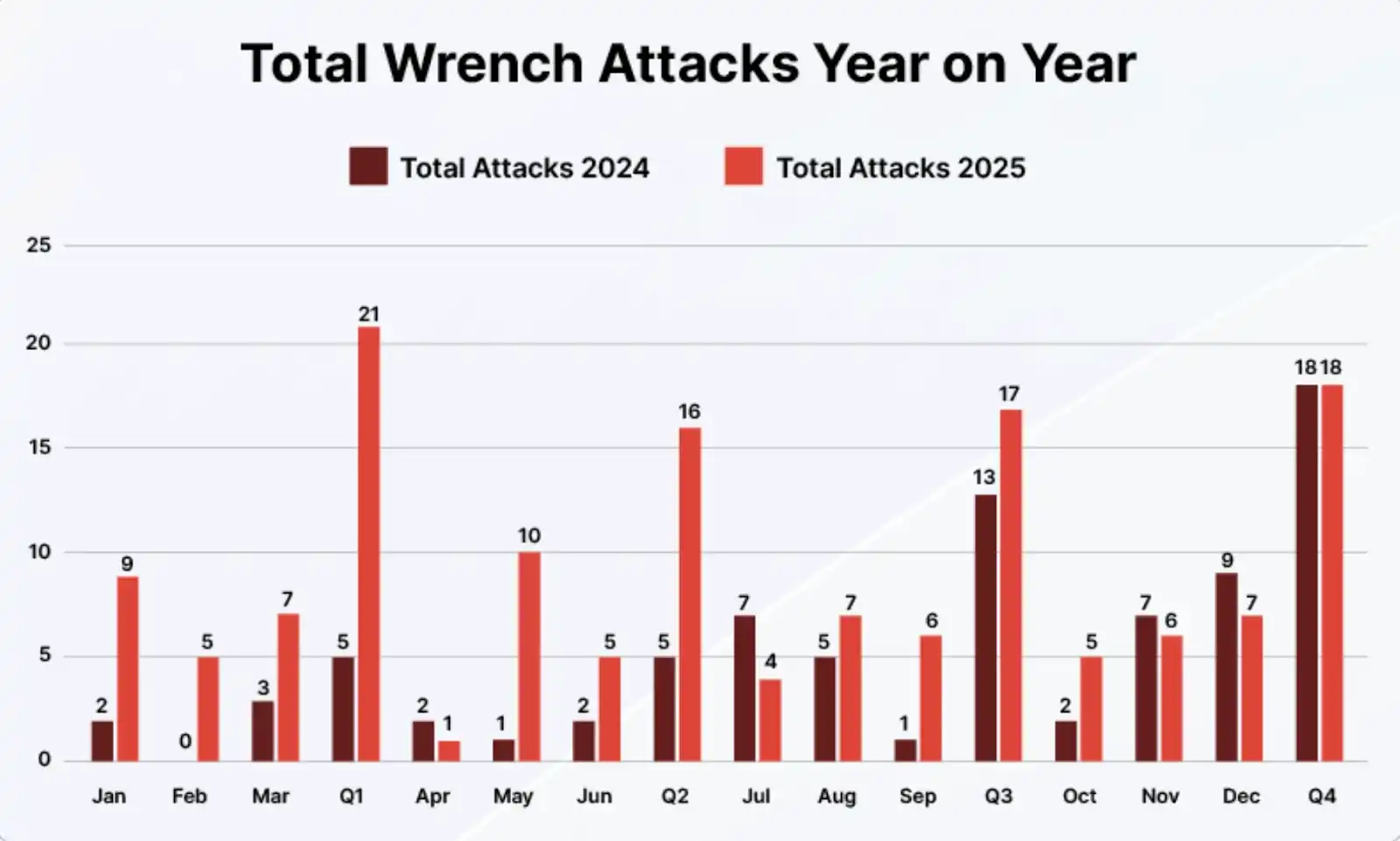
In terms of financial impact, confirmed losses related to wrench attacks in 2025 exceeded $40.9 million, a 44% increase year-on-year. However, the report warns that this figure is only the "tip of the iceberg" due to factors such as victims' low willingness to report incidents, fear of retaliation, and some assets being involved in tax evasion or gray areas.

By comparing attack patterns, the report found that wrench attacks in 2025 have completely moved away from the early opportunistic and fragmented characteristics and entered a stage of professionalized and industrialized operation. Attackers mostly exist as transnational criminal groups, often preparing for weeks before an attack, using open-source intelligence (OSINT) to analyze the target's digital traces, identify weak defense periods, and even deploy professional equipment such as signal jammers and Faraday bags to cut off the victim's contact with the outside world.

Notably, the targets of attackers are broadening. Although industry executives and project founders remain high-value targets, attackers are now also targeting individuals with smaller holdings. Additionally, attackers are increasingly leveraging "associated targets," applying psychological pressure by threatening the victim's spouse, children, or parents.

How to Respond to Physical Threats? Security Recommendations for Individuals and Institutions

As technical security standards continue to improve, "cracking the system" is becoming increasingly difficult, while "coercing the individual" is cheaper and more efficient. This paradox makes personal safety the weakest and most overlooked link in the current crypto ecosystem.

The report proposes a series of security recommendations for individuals and institutions: At the individual level, it is recommended to reduce coercion losses through "decoy wallets," geographically isolate seed phrase storage, and remove encryption applications from daily devices to minimize risk; at the institutional level, it emphasizes the use of technical measures such as multi-signature mechanisms, time-lock contracts, and transaction friction mechanisms, while extending security training to family members and employees.

CertiK emphasized in the report's conclusion that the situation in 5 indicates that wrench attacks have become an independent type of crime within the crypto ecosystem, and the security model relying solely on seed phrases can no longer cope with the risks. How to upgrade from "protecting assets" to "protecting people" and reduce the feasibility of coercive behavior through institutional design may become a key proposition for the industry's future development.

Report link: https://indd.adobe.com/view/6399f4eb-e37c-485d-a225-a7a1fc68914f

Связанные с этим вопросы

QWhat is the main finding of CertiK's 'Skynet Wrench Attack Report' regarding physical violence in the crypto space?

AThe report found that physical violence against cryptocurrency holders has evolved from isolated extreme cases into a structural risk, with a 75% increase in verified wrench attacks globally in 2025 compared to 2024.

QWhat is a 'wrench attack' as defined in the CertiK report?

AA 'wrench attack' is an attack where perpetrators use physical means such as violence, intimidation, or kidnapping to force victims to hand over their private keys or passwords, bypassing technical defenses to target the individual directly.

QWhich region became the highest-risk area for wrench attacks in 2025, and what was a key reason for this shift?

AEurope became the highest-risk area, accounting for over 40% of global known incidents, with France recording the highest number of attacks. This shift reflects that such crimes are spreading to regions with more complex judicial environments and higher cross-border collaboration costs.

QWhat was the total confirmed financial loss from wrench attacks in 2025, and why does the report suggest this figure is a significant underestimate?

AThe total confirmed financial loss was over $40.9 million, a 44% year-on-year increase. However, the report warns this is likely a severe underestimate' due to low victim reporting rates, fear of retaliation, and some assets being involved in tax evasion or gray areas.

QWhat are some of the key security recommendations provided in the report for individuals to protect against wrench attacks?

AKey recommendations for individuals include using 'decoy wallets' to minimize losses during coercion, geographically isolating the storage of seed phrases, and removing encryption applications from daily devices to reduce risk.

Похожее

AI "Transfer Station" Earning Millions Monthly? Five Questions Uncover the Truth of Token Arbitrage

The article "AI 'Transfer Station' Earns Millions Monthly? Five Questions Uncover the Truth of Token Arbitrage" explores the emerging business of API token transfer stations, which profit from global AI service price disparities and access barriers. These intermediaries purchase low-cost tokens from overseas AI providers (e.g., OpenAI, Claude) through grey-market methods—such as exploiting enterprise credits, bulk accounts, or subscription benefits—and resell them to Chinese users at a markup. Key drivers include the high cost of using top AI models (e.g., Claude Code costs ~$5 per million tokens), the performance gap between domestic and foreign models, and mismatches between subscription and API pricing. However, the practice carries significant risks: upstream token sources may be unstable or illegal; user data passing through intermediaries can be harvested or injected with hidden prompts; and models might be downgraded without disclosure. The market is evolving, with some operators now exporting cheaper Chinese models (e.g., Qwen3.5 at ~$0.11 per million tokens) to overseas users, leveraging price gaps. Yet, sustainability is low due to compliance crackdowns, instability, and reputational risks. Users are advised to employ detection methods (e.g., prompt adherence tests) and avoid sensitive data usage. The authors caution that while transfer stations offer short-term arbitrage, they lack long-term reliability and security compared to official APIs.

marsbit30 мин. назад

AI "Transfer Station" Earning Millions Monthly? Five Questions Uncover the Truth of Token Arbitrage

marsbit30 мин. назад

The Cost of an 11.5% Annualized Return: Will MicroStrategy's STRC Face a Moment of Reckoning?

This article analyzes the potential risks associated with MicroStrategy's (MSTR) use of structured financial products like STRC to leverage its BTC exposure. While these tools have enabled impressive returns (e.g., 11.5% annualized) and fueled significant capital inflows ($13.5B outstanding), they also create substantial annual dividend obligations (~$400M). The author argues that this structure, while effective in a bull market, could become a liability if BTC price stagnates or declines. The core risk is a potential negative feedback loop: the growing dividend burden from continued STRC issuance may eventually outweigh the benefits of increased BTC holdings. To meet these obligations, MicroStrategy might need to use new issuance proceeds for dividends instead of buying more BTC, which could disappoint equity investors. If the market capitalization (mNAV) falls below the value of its BTC holdings, the company could be forced to sell BTC instead of issuing new shares, potentially triggering a panic. The author estimates a potential inflection point in 6 months, where annual dividend costs reach $3-4B. At that stage, CEO Michael Saylor might face a difficult choice: sell BTC to meet obligations or sacrifice the credibility of the preferred shares by halting dividends. The article concludes that this financial engineering, while powerful, could ultimately "backfire" on MicroStrategy if market conditions turn.

marsbit1 ч. назад

The Cost of an 11.5% Annualized Return: Will MicroStrategy's STRC Face a Moment of Reckoning?

marsbit1 ч. назад

Торговля

Спот
Фьючерсы

Популярные статьи

Как купить S

Добро пожаловать на HTX.com! Мы сделали приобретение Sonic (S) простым и удобным. Следуйте нашему пошаговому руководству и отправляйтесь в свое крипто-путешествие.Шаг 1: Создайте аккаунт на HTXИспользуйте свой адрес электронной почты или номер телефона, чтобы зарегистрироваться и бесплатно создать аккаунт на HTX. Пройдите удобную регистрацию и откройте для себя весь функционал.Создать аккаунтШаг 2: Перейдите в Купить криптовалюту и выберите свой способ оплатыКредитная/Дебетовая Карта: Используйте свою карту Visa или Mastercard для мгновенной покупки Sonic (S).Баланс: Используйте средства с баланса вашего аккаунта HTX для простой торговли.Третьи Лица: Мы добавили популярные способы оплаты, такие как Google Pay и Apple Pay, для повышения удобства.P2P: Торгуйте напрямую с другими пользователями на HTX.Внебиржевая Торговля (OTC): Мы предлагаем индивидуальные услуги и конкурентоспособные обменные курсы для трейдеров.Шаг 3: Хранение Sonic (S)После приобретения вами Sonic (S) храните их в своем аккаунте на HTX. В качестве альтернативы вы можете отправить их куда-либо с помощью перевода в блокчейне или использовать для торговли с другими криптовалютами.Шаг 4: Торговля Sonic (S)С легкостью торгуйте Sonic (S) на спотовом рынке HTX. Просто зайдите в свой аккаунт, выберите торговую пару, совершайте сделки и следите за ними в режиме реального времени. Мы предлагаем удобный интерфейс как для начинающих, так и для опытных трейдеров.

1.2k просмотров всегоОпубликовано 2025.01.15Обновлено 2025.03.21

Как купить S

Sonic: Обновления под руководством Андре Кронье – новая звезда Layer-1 на фоне спада рынка

Он решает проблемы масштабируемости, совместимости между блокчейнами и стимулов для разработчиков с помощью технологических инноваций.

2.2k просмотров всегоОпубликовано 2025.04.09Обновлено 2025.04.09

Sonic: Обновления под руководством Андре Кронье – новая звезда Layer-1 на фоне спада рынка

HTX Learn: Пройдите обучение по "Sonic" и разделите 1000 USDT

HTX Learn — ваш проводник в мир перспективных проектов, и мы запускаем специальное мероприятие "Учитесь и Зарабатывайте", посвящённое этим проектам. Наше новое направление .

1.8k просмотров всегоОпубликовано 2025.04.10Обновлено 2025.04.10

HTX Learn: Пройдите обучение по "Sonic" и разделите 1000 USDT

Обсуждения

Добро пожаловать в Сообщество HTX. Здесь вы сможете быть в курсе последних новостей о развитии платформы и получить доступ к профессиональной аналитической информации о рынке. Мнения пользователей о цене на S (S) представлены ниже.

活动图片