Cardano Founder Says ‘Leios Is Coming’ As Proposal Heads To DReps

bitcoinistОпубликовано 2026-05-15Обновлено 2026-05-15

Введение

Cardano founder Charles Hoskinson announced progress on the Leios consensus upgrade as a ₳27.7 million funding proposal moves toward DRep approval. The proposal seeks to advance Leios from a public testnet prototype to a mainnet-ready release candidate, aiming to increase Cardano's transaction capacity by 10–65x to support its 2030 scaling goals of handling over 27 million monthly transactions. The upgrade enhances, rather than replaces, the existing Ouroboros Praos protocol. The six to nine-month project is structured around development, rigorous testing, and hard-fork enablement, with funding managed via milestone-based disbursements. The proposal acknowledges risks including community readiness, governance dependencies, and potential operational impacts on stake pool operators.

Cardano founder Charles Hoskinson signaled renewed momentum behind Leios, the network’s next major consensus upgrade, as Input Output moved a ₳27.7 million funding proposal toward DRep approval. The proposal seeks to mature Leios from an early public testnet prototype into a mainnet-ready release candidate, positioning the upgrade as a central piece of Cardano’s 2030 scaling strategy.

“Leios is coming,” Hoskinson wrote on X, quoting Sebastian Nagel, who said: “Cardano, if your governance permits, we’ll ship Leios.” The short exchange framed the next phase of Cardano’s scaling roadmap as both a technical delivery question and a governance decision.

Cardano’s Biggest Scaling Bet

The proposal, authored by Carlos Lopez de Lara and Nagel, asks DReps to approve a treasury withdrawal of ₳27,714,342 to fund six to nine months of development. The work is intended to move Leios from its current prototype and testnet phase toward a release candidate suitable for mainnet integration. According to the proposal, each milestone would be independently assured, while undisbursed ada would be returned to the treasury.

Leios is designed to enhance, rather than replace, Ouroboros Praos, Cardano’s existing consensus protocol. The proposal says the upgrade introduces endorser blocks and committee-based validation to increase transaction capacity while preserving Praos’s security model. IO frames the design as a way to scale Cardano without undermining decentralization or making stake pool operations economically unviable.

“Cardano needs a step change in throughput to meet its 2030 ambitions, and Leios is how it gets there. This proposal funds the path from public testnet to a mainnet-ready release candidate — delivering a 10–65x increase in transaction capacity,” the proposal states. “Why this scale matters: Cardano’s 2030 strategy targets growth from roughly 800,000 monthly transactions to over 27 million.”

That 2030 target is a key justification for the funding request. The proposal argues that sustainable utilization at that level would require at least 6x current capacity, while Leios is expected to deliver 10x or more under validated parameter settings. Elsewhere, the accompanying IO article says Leios could support a phased throughput increase from 2x to 30x current capacity on mainnet, with full capacity demonstrated on testnet before broader rollout.

The work is organized around three objectives. The first is a release candidate, including a substantial rewrite of consensus components, implementation of the Leios block structure for the Dijkstra era, conformance testing against the Agda formal specification, and integration into the primary node by the fourth quarter of 2026.

The second is “high confidence,” built through parameter exploration, continuous load testing, adversarial testing, red-team exercises, and an updated threat model. The third is hard-fork enablement, covering client interfaces, technical documentation, SPO and developer workshops, support for adjacent infrastructure such as DB-Sync, Mithril and Blockfrost, testnet hard forks, governance artifacts and contingency procedures.

The proposal is careful to separate work within IO’s control from external dependencies. A mainnet hard fork would still depend on broader ecosystem readiness, governance action submission and a community vote. The document explicitly describes those as risks rather than promises.

Funding would be administered through Intersect’s treasury reserve smart contract framework, with milestone-based disbursements and third-party assurance. The budget allocates ₳23.83 million, or 86%, to development, with smaller portions assigned to infrastructure, security and audits, legal and compliance, ecosystem support, operations, governance and other costs.

The risk section is direct. It identifies community readiness, hard-fork timing, final cardano-node integration and possible governance constraints as factors that could delay or limit activation. It also notes technical limitations, including potential higher operational costs for SPOs, greater chain growth, and high-throughput assumptions tied to adversarial stake conditions.

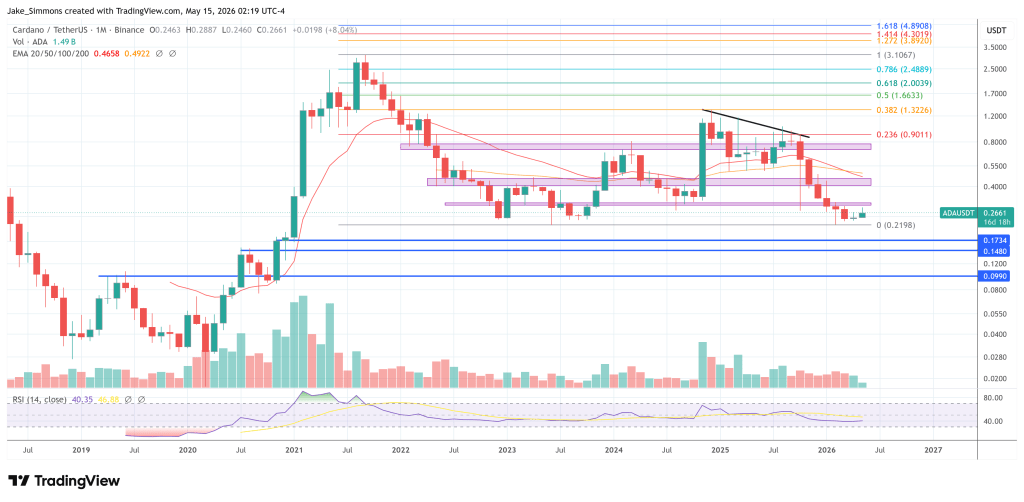
At press time, ADA traded at $0.2661.

ADA remains below key resistance, 1-monthly chart | Source: ADAUSDT on TradingView.com

Связанные с этим вопросы

QWhat is the purpose of the 27.7 million ADA funding proposal submitted to the DReps for Leios?

AThe purpose of the 27.7 million ADA funding proposal is to mature Leios from an early public testnet prototype into a mainnet-ready release candidate, funding six to nine months of development work to achieve this goal.

QHow does the Leios upgrade aim to improve Cardano's transaction capacity according to the proposal?

AThe Leios upgrade aims to increase Cardano's transaction capacity by 10x to 65x, introducing endorser blocks and committee-based validation to enhance throughput while preserving the security model of the existing Ouroboros Praos consensus protocol.

QWhat are the three main objectives of the Leios development work outlined in the proposal?

AThe three main objectives are: 1) Delivering a release candidate with a rewritten consensus, 2) Building high confidence through extensive testing and security exercises, and 3) Enabling the hard fork through client interfaces, documentation, workshops, and ecosystem support.

QWhat are some of the key risks associated with the Leios activation mentioned in the proposal?

AKey risks include community readiness, hard-fork timing dependencies, final node integration, potential governance constraints, higher operational costs for SPOs, increased chain growth, and high-throughput assumptions tied to adversarial stake conditions.

QWhat is the target for Cardano's monthly transactions by 2030 as cited in the article, and why does it necessitate the Leios upgrade?

ACardano's 2030 strategy targets growth from roughly 800,000 to over 27 million monthly transactions. This necessitates the Leios upgrade because sustainable utilization at that level requires at least a 6x increase in capacity, which Leios is designed to provide (10x or more).

Похожее

AI Trading Cools, South Korean Stocks Plunge 1.8%, Spot Gold Rises 1%, Bitcoin Dives

A sell-off in AI-related stocks, triggered by Broadcom's disappointing earnings forecast, sent shockwaves through global markets. South Korea's KOSPI led Asia's decline, plunging 1.8% as the risks from concentrated chip stock gains and surging leveraged investments came to the fore. The tech-heavy Nasdaq 100 futures fell 0.5% following Broadcom's 14% after-hours plunge, which signaled a slower-than-expected transition to AI clients. This pullback extended Wall Street's weakness, halting the S&P 500's nine-day rally amid hawkish Fed signals and renewed Middle East tensions. South Korean authorities convened an emergency meeting, pledging "immediate measures" against market volatility and warning of record-high stock margin debt. The adjustment rippled across assets: Bitcoin fell to around $64,000, its lowest since February, while safe-haven gold rose 1% on bargain hunting. Oil prices dipped on Middle East ceasefire news. Market analysts noted the sell-off was driven by profit-taking after massive gains, particularly in chip stocks like Samsung and SK Hynix, which now dominate the KOSPI. Wall Street banks are divided on Korea's outlook, with Goldman Sachs raising its target while Citigroup and others warn of overvaluation and a potential bubble. Bridgewater's Ray Dalio noted that great technological shifts often create bubbles. Meanwhile, Fed officials' hints at potential future rate hikes added to the cautious mood ahead of key U.S. jobs data.

华尔街日报11 мин. назад

AI Trading Cools, South Korean Stocks Plunge 1.8%, Spot Gold Rises 1%, Bitcoin Dives

华尔街日报11 мин. назад

Seeking Alpha's Hot Article: Why Might the U.S. Stock Market Crash in June?

In a recent Seeking Alpha article, financial professor and analyst Damir Tokic argues that the US stock market may be poised for a significant crash in June 2026. The core thesis centers on a "mega-bubble" in equities, particularly within the technology sector, which has driven the S&P 500 to near-record valuations, with a Shiller P/E ratio exceeding 40—a level comparable to the 2000 dot-com bubble. Tokic identifies two primary catalysts for a potential collapse. First, he points to unsustainable market exuberance fueled by what he terms the "Trump Stimulus"—massive AI capital expenditure by tech giants, which he believes is politically driven and cannot last. Second, and more urgently, he highlights the escalating Iran war as a critical threat. The ongoing closure of the Strait of Hormuz has created a severe global energy supply crunch. Strategic petroleum reserves are projected to hit critically low operational levels by June, potentially causing oil prices to spike above $200 per barrel and triggering a severe, supply-driven inflationary shock. This scenario, Tokic warns, would force the Federal Reserve's hand. Despite currently maintaining a dovish bias, the Fed would likely be compelled to officially pivot to a hawkish stance at its June FOMC meeting to combat soaring inflation and bond yields. He contends that such a shift—or even a failure to act, which would destroy Fed credibility—could be the trigger that punctures the market bubble. The resulting downturn, he concludes, could rival the bear markets of 2000 and 2008, advising investors to prepare for a major correction.

marsbit34 мин. назад

Seeking Alpha's Hot Article: Why Might the U.S. Stock Market Crash in June?

marsbit34 мин. назад

AI PC Battle: Bet on the Toll Booth, Not the Camp

**Title:** The AI PC Battle: Don't Bet on Sides, Bet on the Tollbooth **Summary:** The AI PC competition is moving beyond simple "x86 vs. Arm" narratives. The core investment thesis should focus on identifying which players can sustain margins, cash flow, and pricing power throughout the upgrade cycle, rather than backing a particular architecture. The opportunity is analyzed in three layers: 1. **The Advanced Foundry Tollbooth:** TSMC is positioned to collect "tolls" regardless of which chip designer wins, due to its dominant ~70% share in advanced semiconductor manufacturing, which is essential for high-end AI PC chips. 2. **Compute & Platform Spillover:** AMD represents an offensive in the x86 CPU+GPU space, while NVIDIA leverages its GPU and CUDA software stack dominance. Both benefit from the demand for increased local AI compute. 3. **Architecture Diffusion & Turnaround Plays:** ARM and Intel offer potential for significant upside (elasticity), but investments here require stricter discipline due to higher execution risks and competitive challenges. The industry is transitioning from concept to shipment validation. While short-term forecasts for AI PC adoption have been revised down slightly due to tariffs and procurement delays, the long-term trend towards AI becoming a standard PC feature remains intact. The key driver for upgrade cycles will be whether compelling enterprise applications (e.g., privacy-sensitive computing, low-latency inference) emerge beyond consumer-focused features like meeting summarization. Investment strategy should prioritize companies with platform-level advantages and recurring revenue streams. TSMC offers high certainty as the foundational tollbooth. AMD presents a strong offensive play within the established ecosystem. ARM and Intel are higher-risk, higher-potential-reward turnaround bets. The report cautions against chasing short-term hype and emphasizes a disciplined, long-term approach focused on buying ecosystem strength and cash-flow certainty after market enthusiasm subsides. **Key Risks:** Underwhelming AI PC applications slowing upgrade cycles; slow improvement in Windows on Arm compatibility; macro/tariff impacts on PC demand; potential advanced node supply-demand mismatches affecting TSMC; high overall AI sector valuations making stocks vulnerable to a risk-off shift in markets.

marsbit48 мин. назад

AI PC Battle: Bet on the Toll Booth, Not the Camp

marsbit48 мин. назад

Ten-Thousand-Word Analysis: From $10 to $290, MRVL Wins the Entire AI Era by 'Not Making GPUs'

Marvell Technology's stock price surged from under $10 in 2016 to a record $290 in June 2026, fueled not by making GPUs, but by dominating AI infrastructure connectivity. This analysis argues the market misvalues MRVL as merely a smaller Broadcom in custom AI chips, overlooking its true, unique position. Marvell's core strength lies in enabling high-speed data flow for AI clusters through three interconnected businesses. First, it holds a commanding ~70% market share in high-speed optical DSPs (essential for data center light modules), a deep-moat business with accelerating growth. Second, its custom AI chip design business serves hyperscalers like AWS, Microsoft, and Google, with a significant revenue pipeline despite lower margins. Third, stable cash flows come from Ethernet switch chips and enterprise storage controllers. Together, they form a full-stack "AI data movement" platform. CEO Matt Murphy's transformative leadership since 2016, involving strategic divestments, key acquisitions (like Inphi for optical DSPs), and securing long-term agreements with major cloud providers, repositioned the company. A pivotal $2 billion strategic investment from NVIDIA in 2026 underscored Marvell's critical role in the AI ecosystem, particularly through collaborations like NVLink Fusion. While Marvell faces risks—including client concentration (losing the Amazon Trainium3 design), lower-margin business mix, competitive threats, insider selling, and complex supply chains—its fundamentals remain strong. The optical interconnect moat is widening with the acquisition of Celestial AI (photonics fabric), and financial metrics show accelerating revenue growth and operating leverage. With a PEG ratio suggesting undervaluation relative to its growth, the thesis is that the market undervalues Marvell's monopolistic position in AI "plumbing" while overemphasizing its competitive custom chip segment. The story transcends investing, symbolizing how in any complex system—from the internet to AI—the value of "connection" ultimately surpasses that of individual "nodes."

marsbit1 ч. назад

Ten-Thousand-Word Analysis: From $10 to $290, MRVL Wins the Entire AI Era by 'Not Making GPUs'

marsbit1 ч. назад

Торговля

Спот
Фьючерсы

Популярные статьи

Как купить ADA

Добро пожаловать на HTX.com! Мы сделали приобретение Cardano (ADA) простым и удобным. Следуйте нашему пошаговому руководству и отправляйтесь в свое крипто-путешествие.Шаг 1: Создайте аккаунт на HTXИспользуйте свой адрес электронной почты или номер телефона, чтобы зарегистрироваться и бесплатно создать аккаунт на HTX. Пройдите удобную регистрацию и откройте для себя весь функционал.Создать аккаунтШаг 2: Перейдите в Купить криптовалюту и выберите свой способ оплатыКредитная/Дебетовая Карта: Используйте свою карту Visa или Mastercard для мгновенной покупки Cardano (ADA).Баланс: Используйте средства с баланса вашего аккаунта HTX для простой торговли.Третьи Лица: Мы добавили популярные способы оплаты, такие как Google Pay и Apple Pay, для повышения удобства.P2P: Торгуйте напрямую с другими пользователями на HTX.Внебиржевая Торговля (OTC): Мы предлагаем индивидуальные услуги и конкурентоспособные обменные курсы для трейдеров.Шаг 3: Хранение Cardano (ADA)После приобретения вами Cardano (ADA) храните их в своем аккаунте на HTX. В качестве альтернативы вы можете отправить их куда-либо с помощью перевода в блокчейне или использовать для торговли с другими криптовалютами.Шаг 4: Торговля Cardano (ADA)С легкостью торгуйте Cardano (ADA) на спотовом рынке HTX. Просто зайдите в свой аккаунт, выберите торговую пару, совершайте сделки и следите за ними в режиме реального времени. Мы предлагаем удобный интерфейс как для начинающих, так и для опытных трейдеров.

2.2k просмотров всегоОпубликовано 2024.03.29Обновлено 2026.06.02

Как купить ADA

SNEK: ведущий мемкоин на блокчейне Cardano, открывающий новую эпоху для экосистемы Cardano

SNEK - это дефляционный мемкоин, выпущенный на блокчейне Cardano. Он создаёт децентрализованную культурную и развлекательную ценность за счёт участия глобального сообщества.

2.1k просмотров всегоОпубликовано 2025.10.15Обновлено 2025.10.15

SNEK: ведущий мемкоин на блокчейне Cardano, открывающий новую эпоху для экосистемы Cardano

Неделя обучения по популярным токенам 8: запуск основной сети Ouroboros Leios для ADA ожидается в 2026 году

Основная сеть Ouroboros Leios для ADA, как ожидается, будет запущена в 2026 году, а хардфорк до версии протокола 11 запланирован на I квартал 2026 года.

2.0k просмотров всегоОпубликовано 2026.02.10Обновлено 2026.02.12

Неделя обучения по популярным токенам 8: запуск основной сети Ouroboros Leios для ADA ожидается в 2026 году

Обсуждения

Добро пожаловать в Сообщество HTX. Здесь вы сможете быть в курсе последних новостей о развитии платформы и получить доступ к профессиональной аналитической информации о рынке. Мнения пользователей о цене на ADA (ADA) представлены ниже.

活动图片