Cardano Founder Blasts Ripple For Playing Dirty With New CLARITY Act, Here’s What He Said

bitcoinistОпубликовано 2026-04-01Обновлено 2026-04-01

Введение

Cardano founder Charles Hoskinson has launched a direct attack against Ripple and its CEO Brad Garlinghouse, accusing them of engineering the CLARITY Act to shield Ripple’s interests while harming the broader crypto ecosystem. Hoskinson claims the bill, in its current form, would classify most digital assets as securities by default, forcing projects into a difficult regulatory process. He warns this could expose open-source developers to legal risks and remove protections for DeFi builders. He also criticized the XRP community, alleging years of propaganda have eroded critical thinking. Hoskinson has consistently opposed the bill, suggesting it unfairly benefits XRP. The probability of the CLARITY Act being signed into law has fallen to 51%, down from 78% in early March.

Cardano founder Charles Hoskinson has launched one of his most direct attacks yet on Ripple and its CEO Brad Garlinghouse, accusing the payments company of engineering the CLARITY Act to eliminate competition while shielding its own interests.

The remarks were delivered during Hoskinson’s most recent weekly rollup on YouTube, where he laid out what he believes is a deeper issue surrounding the bill and how it could change competition across the crypto sector.

Hoskinson Accuses Ripple Of Playing Dirty

According to Charles Hoskinson, the CLARITY Act, in its current form, was crafted with Ripple’s fingerprints on it. He is of the notion that the bill’s structure would classify most digital assets as securities by default, forcing projects to fight their way out of that designation through a regulatory process he warned the SEC could easily weaponize. “They’re trying to pass a bill that hurts the entire ecosystem while they get protected,” he said.

As noted by Hoskinson, if the CLARITY Act is passed, projects would need to prove otherwise, effectively placing the burden of defense on developers and startups from the outset.

Open-source contributors could face legal risks even when they are not directly responsible for how their code is used. He pointed to the legal exposure faced by developers connected to Tornado Cash as an example of what could become standard practice if the CLARITY Act passes in its current form.

He also flagged the removal of existing protections for DeFi developers as a provision that would send a chilling signal across the entire community of crypto developers.

Cardano Founder Says XRP Community Is Incapable Of Critical Thinking

Hoskinson also reserved some of his remarks for members of the XRP community. He accused Ripple directly of conducting a sustained campaign of layer after layer of marketing and propaganda. Furthermore, years of social media consumption, cable news, and yellow journalism have left segments of the XRP community with an inability to think critically.

Hoskinson has been building this argument over several months, and his recent statements tie into a broader pattern of criticism against Ripple and the CLARITY Act.

Back in early March, he noted that the CLARITY Act’s structure effectively labels everything as a security first, creating a system where only a few projects will be spared. He suggested that XRP could be among the assets that receive more favorable treatment under the framework proposed by the CLARITY Act.

His criticism against Brad Garlinghouse has also been very persistent. A notable example is during a January 2026 livestream where he questioned why the Ripple CEO is supportive of advancing the bill despite its perceived flaws.

Polymarket odds of the CLARITY Act being signed into law in 2026 have now fallen to 51%, down from above 78% in early March, following Coinbase’s opposition to a stablecoin yield compromise and the departure of crypto czar David Sacks from his role.

ADA trading at $0.24 on the 1D chart | Source: ADAUSDT on Tradingview.com

Связанные с этим вопросы

QWhat is the main accusation Charles Hoskinson makes against Ripple regarding the CLARITY Act?

ACharles Hoskinson accuses Ripple of engineering the CLARITY Act to eliminate competition while shielding its own interests, claiming the bill is crafted with Ripple's fingerprints on it.

QAccording to Hoskinson, what would be the default classification for most digital assets under the CLARITY Act?

AAccording to Hoskinson, the CLARITY Act's structure would classify most digital assets as securities by default.

QWhat potential legal risk does Hoskinson highlight for open-source contributors if the CLARITY Act passes?

AHoskinson warns that open-source contributors could face legal risks even when not directly responsible for how their code is used, citing the legal exposure faced by Tornado Cash developers as an example.

QWhat does Hoskinson claim about the XRP community's ability to think critically?

AHoskinson claims that years of marketing, propaganda, and media consumption have left segments of the XRP community with an inability to think critically.

QWhat has happened to the Polymarket odds of the CLARITY Act being signed into law in 2026, and what are the cited reasons?

AThe Polymarket odds of the CLARITY Act being signed into law in 2026 have fallen to 51% from above 78% in early March, following Coinbase's opposition to a stablecoin yield compromise and the departure of crypto czar David Sacks.

Похожее

Should You Buy SpaceX Stock at $1.7 Trillion? Here's What the Market Is Worried About

SpaceX is preparing for a massive IPO aiming to raise around $75 billion at a valuation of approximately $1.75 trillion. While its achievements in reusable rockets and the profitable Starlink satellite internet service are clear, the market is concerned about the aggressive valuation. Key issues include: the current $1.75 trillion valuation, which is about 94 times 2025 revenue, seems to price in not just existing businesses but also unproven future ventures like AI infrastructure and orbital data centers. Financially, while Starlink is profitable, the AI division, bolstered by the acquisition of xAI, is incurring massive losses and consuming the majority of capital expenditures. This acquisition also introduced complex related-party financing arrangements and debt onto SpaceX's balance sheet. Furthermore, corporate governance poses a challenge. SpaceX's dual-class share structure ensures founder Elon Musk retains absolute control, limiting ordinary shareholders' influence over high-risk, long-term strategic decisions. The future success of ambitious projects like the Starship rocket—critical for lowering costs and enabling new services—remains a significant variable for the valuation. In summary, the market's apprehension (FUD) centers not on doubting SpaceX's past technological triumphs but on questioning how much premium public investors should pay for a future that combines proven profits with highly speculative and capital-intensive new ventures, all under a governance structure that offers limited shareholder oversight.

marsbit22 мин. назад

Should You Buy SpaceX Stock at $1.7 Trillion? Here's What the Market Is Worried About

marsbit22 мин. назад

Breaking the DeFi Cascading Liquidation Curse: Vitalik Proposes a New Solution

Vitalik Buterin has proposed a new DeFi design to eliminate the automatic liquidation mechanism that causes market instability during sharp downturns. The current system, used by protocols like Aave, triggers forced sales when collateral value falls below a threshold, often exacerbating price drops and creating systemic selling pressure. Buterin's alternative model is based on splitting an asset like ETH into two synthetic option-like tokens, P and N, pegged to a price index. Their combined value always equals one ETH. Instead of sudden liquidation, a position's value gradually drifts from its target peg if the market moves. Users must proactively rebalance their holdings to maintain their desired exposure, transferring the management burden from the protocol to the user or automated tools. A key advantage is the reduced reliance on real-time oracles. Pricing decisions are deferred until contract expiry, allowing for more robust, fault-tolerant oracle designs. This removes a clear liquidation threshold that speculators can target for manipulation or MEV extraction. However, significant challenges remain. Frequent rebalancing could incur high slippage and transaction costs, necessitating new liquidity provider models. The design is better suited for hedging instruments than for stablecoins requiring a rigid 1:1 peg. While not an immediate replacement for existing systems, the proposal challenges the foundational assumption that instantaneous forced liquidation is an unavoidable necessity in DeFi, opening the door for fundamentally different risk management architectures.

marsbit27 мин. назад

Breaking the DeFi Cascading Liquidation Curse: Vitalik Proposes a New Solution

marsbit27 мин. назад

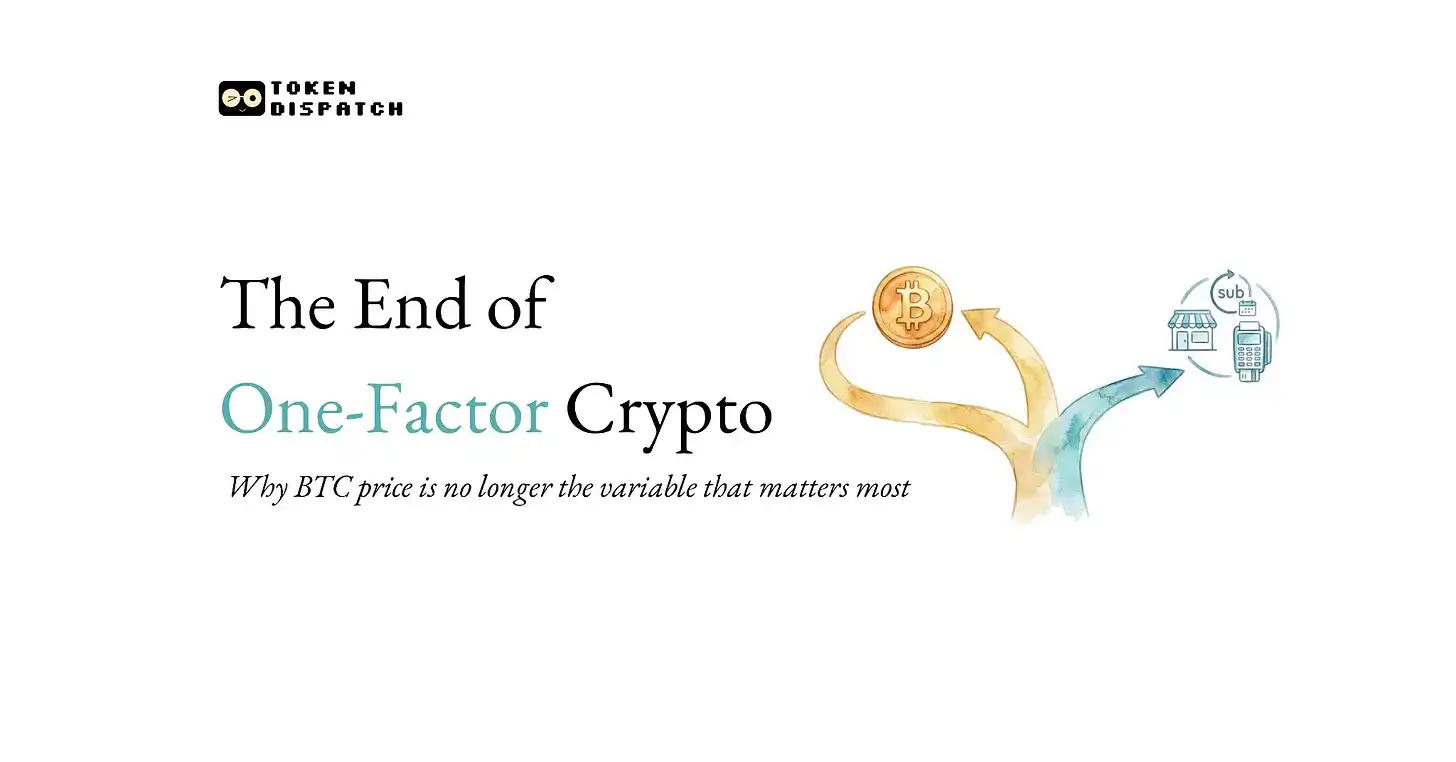
The End of Single-Factor Cryptography

The article "The End of Single-Factor Crypto" posits a fundamental shift in the cryptocurrency ecosystem. It argues the era where crypto asset valuations were predominantly driven by, and correlated with, Bitcoin's price is ending. The space is bifurcating into two distinct economies: endogenous and exogenous. The endogenous economy represents traditional crypto, where token and project values are directly tied to crypto market prices. The emerging exogenous economy comprises projects and businesses that may utilize blockchain technology or tokens but derive their fundamental value from external, non-crypto factors like consumer demand, subscription revenue, or real-world utility. Examples include AI inference platforms like Venice, fintech lenders using blockchain for efficiency, and stablecoin/payment infrastructure companies acquired by giants like Mastercard and Stripe. This shift means investment analysis must change. For exogenous assets, evaluating traditional business fundamentals—such as revenue streams, unit economics, and competitive moats—becomes more critical than tracking Bitcoin charts. While endogenous assets like Bitcoin remain relevant, the growth of the exogenous category is driven by measurable demand independent of crypto price cycles, paving the way for a new, more diversified market phase. Consequently, crypto is evolving from a single-factor, reflexive asset class into a multifaceted ecosystem with varied drivers and investment theses.

marsbit27 мин. назад

The End of Single-Factor Cryptography

marsbit27 мин. назад

Morning Post | Bitmine Plans to Raise $300 Million Through Preferred Stock Issuance; Polymarket Accuses Kalshi of Commercial Espionage

ChainCatcher's Daily Crypto Brief: Key developments from the past 24 hours include significant funding moves, regulatory actions, and market predictions. Bitmine announced a $300 million preferred stock fundraising. Polymarket accused rival prediction platform Kalshi of corporate espionage, citing numerous suspicious coincidences in product launches, a claim Kalshi strongly denied. The U.S. Department of Justice, in a joint "Disruption Week" anti-fraud operation with companies like Coinbase and Meta, froze over $3.8 million in cryptocurrency linked to scams. In infrastructure news, Macau completed its integration with the multi-central bank digital currency bridge, mBridge, aiming to build efficient cross-border payment channels. Cosmos Labs acquired the block explorer Mintscan. Market-wise, Geoffrey Kendrick, Standard Chartered's Head of Digital Assets Research, stated Bitcoin is nearing a bottom around $63,000, maintaining a year-end target of $100,000. He noted stability in U.S. spot Bitcoin ETF holdings. Ahead of SpaceX's anticipated IPO, internal insiders at Rocket Lab (RKLB) sold over $18.41 million in stock. In tokenization, Goldman Sachs partnered with Apex and Archax to launch a tokenized real estate fund. The meme token tracker GMGN reported the top trending tokens: on Ethereum, HEX, SHIB, LINK, PEPE, mUSD; on Solana, TROLL, swarms, WORLDCUP, neet, Buttcoin; and on Base, PEPE, toby, ODDS, ELSA, SKI.

链捕手42 мин. назад

Morning Post | Bitmine Plans to Raise $300 Million Through Preferred Stock Issuance; Polymarket Accuses Kalshi of Commercial Espionage

链捕手42 мин. назад

Торговля

Спот
Фьючерсы

Популярные статьи

Как купить ADA

Добро пожаловать на HTX.com! Мы сделали приобретение Cardano (ADA) простым и удобным. Следуйте нашему пошаговому руководству и отправляйтесь в свое крипто-путешествие.Шаг 1: Создайте аккаунт на HTXИспользуйте свой адрес электронной почты или номер телефона, чтобы зарегистрироваться и бесплатно создать аккаунт на HTX. Пройдите удобную регистрацию и откройте для себя весь функционал.Создать аккаунтШаг 2: Перейдите в Купить криптовалюту и выберите свой способ оплатыКредитная/Дебетовая Карта: Используйте свою карту Visa или Mastercard для мгновенной покупки Cardano (ADA).Баланс: Используйте средства с баланса вашего аккаунта HTX для простой торговли.Третьи Лица: Мы добавили популярные способы оплаты, такие как Google Pay и Apple Pay, для повышения удобства.P2P: Торгуйте напрямую с другими пользователями на HTX.Внебиржевая Торговля (OTC): Мы предлагаем индивидуальные услуги и конкурентоспособные обменные курсы для трейдеров.Шаг 3: Хранение Cardano (ADA)После приобретения вами Cardano (ADA) храните их в своем аккаунте на HTX. В качестве альтернативы вы можете отправить их куда-либо с помощью перевода в блокчейне или использовать для торговли с другими криптовалютами.Шаг 4: Торговля Cardano (ADA)С легкостью торгуйте Cardano (ADA) на спотовом рынке HTX. Просто зайдите в свой аккаунт, выберите торговую пару, совершайте сделки и следите за ними в режиме реального времени. Мы предлагаем удобный интерфейс как для начинающих, так и для опытных трейдеров.

2.2k просмотров всегоОпубликовано 2024.03.29Обновлено 2026.06.02

Как купить ADA

SNEK: ведущий мемкоин на блокчейне Cardano, открывающий новую эпоху для экосистемы Cardano

SNEK - это дефляционный мемкоин, выпущенный на блокчейне Cardano. Он создаёт децентрализованную культурную и развлекательную ценность за счёт участия глобального сообщества.

2.1k просмотров всегоОпубликовано 2025.10.15Обновлено 2025.10.15

SNEK: ведущий мемкоин на блокчейне Cardano, открывающий новую эпоху для экосистемы Cardano

Неделя обучения по популярным токенам 8: запуск основной сети Ouroboros Leios для ADA ожидается в 2026 году

Основная сеть Ouroboros Leios для ADA, как ожидается, будет запущена в 2026 году, а хардфорк до версии протокола 11 запланирован на I квартал 2026 года.

2.0k просмотров всегоОпубликовано 2026.02.10Обновлено 2026.02.12

Неделя обучения по популярным токенам 8: запуск основной сети Ouroboros Leios для ADA ожидается в 2026 году

Обсуждения

Добро пожаловать в Сообщество HTX. Здесь вы сможете быть в курсе последних новостей о развитии платформы и получить доступ к профессиональной аналитической информации о рынке. Мнения пользователей о цене на ADA (ADA) представлены ниже.

活动图片