Breaking! A Historic Turning Point in U.S. Crypto Regulation: A Guide to the New Framework (Essential Edition)

比推Опубликовано 2026-03-18Обновлено 2026-03-18

Введение

The U.S. SEC and CFTC jointly released a landmark 68-page regulatory framework on March 17, 2026, marking a historic shift in crypto regulation. The framework classifies crypto assets into five categories: Digital Commodities (e.g., BTC, ETH), Digital Securities, Regulated Payment Stablecoins, Digital Tools, and Digital Collectibles. A key innovation is the "Separation" mechanism, allowing assets to transition from securities to commodities once they become decentralized and no longer rely on managerial efforts. The guidance also clarifies that activities like mining, staking, wrapping, and airdrops (without consideration) are generally not securities transactions. This clarity aims to reduce compliance costs, encourage innovation, and solidify U.S. leadership in crypto regulation, ending the "Wild West" era of digital assets.

The era of the 'Wild West' for crypto assets is officially over.

On March 17, 2026, the U.S. Securities and Exchange Commission (SEC) and the Commodity Futures Trading Commission (CFTC) jointly released an interpretive document numbered 33-11412. This 68-page regulatory framework officially marks the end of a decade-long era of 'regulation by enforcement' for U.S. crypto oversight, ushering in a new epoch of clarity and harmony driven by "Project Crypto".
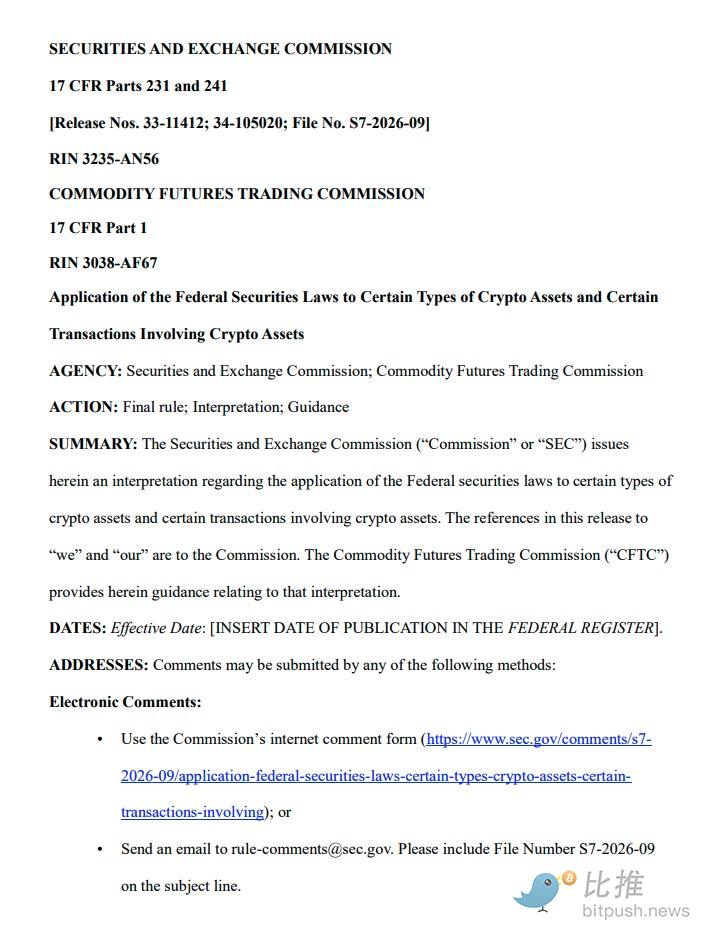
This document is not only a rare product of regulatory collaboration between the SEC and CFTC but also the most landmark guidance in the history of U.S. crypto regulation. Below is the full essential interpretation:

I. Background: "Project Crypto" - From Conflict to Collaboration

In 2017, the SEC first applied the Howey Test to crypto assets through "The DAO Report." For the following decade, regulation primarily relied on enforcement actions to define asset attributes, leaving the market in a prolonged state of uncertainty and controversy.

In early 2025, the SEC established the "Crypto Task Force," subsequently launching the "Project Crypto" initiative, co-led by SEC Chairman Paul S. Atkins and CFTC Chairman Michael S. Selig. The initiative aimed to coordinate the mandates of the two regulatory bodies, establish a unified asset classification methodology, and provide a clear path for crypto innovation to remain in the U.S. In January 2026, the project was officially upgraded to a joint SEC-CFTC operation.

II. Asset Classification: The "Five-Category" Logic for Crypto Assets

Based on asset characteristics, use cases, and functionality, the document divides crypto assets into five major categories, providing the market with a clear classification standard for the first time:

  1. Digital Commodities

    Definition: Assets whose value derives from the programmed operation and supply-demand dynamics of a "functional" crypto system, not from the managerial efforts of others.

    Core List: The document explicitly names mainstream tokens such as BTC, ETH, SOL, XRP, ADA, DOT, AVAX, LINK, etc., as digital commodities. These assets are not controlled by any single centralized entity and do not possess economic rights that generate passive income.

  2. Digital Securities

    Definition: "Tokenized securities," referring to traditional securities represented in the form of crypto assets, or digital assets possessing the economic substance of securities (e.g., representing corporate ownership, dividend rights).

    Regulation: Regardless of whether on-chain or off-chain, as long as the economic substance is met, they fall under SEC jurisdiction.

  3. Regulated Payment Stablecoins

    Definition: Stablecoins that meet the definition of the 2025 "GENIUS Act" and are issued by authorized institutions.

    Classification: These stablecoins are explicitly excluded from the definition of "securities" and are primarily constrained as payment instruments under specific legislation.

  4. Digital Tools

    Use: Tokens with utility functions (e.g., access rights or service payments) only within specific crypto systems, typically not considered securities.

  5. Digital Collectibles

    Definition: Assets intended to be collected and/or used, representing items such as artwork, music, videos, in-game items, or internet memes.

    Examples: CryptoPunks, Chromie Squiggles, WIF, VCOIN, etc.

    Classification: Not securities themselves; value derives from supply and demand, not the managerial efforts of others. However, if fractionalized and sold, they may constitute securities.

III. Innovation: "Separation" and "Dynamic Conversion" of Security Attributes

This is the document's most groundbreaking legal innovation—the SEC acknowledges for the first time that the "security attribute" of a crypto asset is not permanent.

"Separation" Mechanism

  • Principle: A project in its early financing stages might be considered a security (investment contract) if it meets the Howey Test. However, once the project completes its roadmap, achieves autonomous operation of open-source code, and decentralizes network power, the asset can be "separated" from the investment contract.

  • Judgment Standard: When investors no longer reasonably rely on the "essential managerial efforts" of the issuer for profits, but instead rely on the system's own operation and market supply and demand, the asset transitions from a "security" to a "digital commodity."

  • Separation Timing: Can occur immediately upon delivery of the asset to the purchaser or at a future date.

Three Scenarios for Separation

  1. Issuer Fulfills Promises: After completing essential managerial efforts, even if non-essential maintenance continues, the asset is no longer bound by the investment contract.

  2. Issuer Abandons Project: If development is publicly abandoned and promises are no longer fulfilled, the asset falls outside securities law jurisdiction (though the issuer may still face legal liability for fraud).

  3. Secondary Market Trading: If subsequent purchasers no longer reasonably expect to rely on the issuer's efforts for profit, the transaction does not constitute a securities transaction.

Transparency Recommendation

The SEC encourages project teams to publicly disclose roadmap progress and milestone achievements to help the market identify the "point of separation."

IV. Qualification of On-Chain Activities: "Demining" Decentralization

The document provides extremely detailed and favorable interpretations of long-debated activities like staking, mining, wrapping, and airdrops:

Protocol Mining

  • Qualification: PoW mining is an "administrative or ministerial" activity that secures the network and validates transactions.

  • Conclusion: Whether solo mining or joining a mining pool, it does not involve securities issuance.

  • Pool Operation: The activities of pool operators are administrative and do not constitute essential managerial efforts.

Protocol Staking

  • Qualification: Staking is an administrative activity for maintaining network operation.

  • Coverage: Includes solo staking, delegated third-party staking, custodial staking, liquid staking.

  • Custodial Staking: If a custodian stakes on behalf of users, and it does not involve re-lending, leveraging, or discretionary trading of assets, it does not constitute a securities activity.

  • Ancillary Services: Auxiliary services like slash insurance, early unstaking, flexible reward distribution, and asset aggregation are all considered administrative tasks.

Staking Receipt Tokens

  • Qualification: If the underlying asset is a non-security commodity and not subject to an investment contract, the receipt token itself is not a security.

  • Principle: The receipt merely acts as a "receipt"; it does not generate yield—yield originates from the underlying staking activity.

Wrapping Tokens

  • Definition: Users deposit crypto assets with a custodian or cross-chain bridge to obtain 1:1 pegged, redeemable wrapped tokens.

  • Qualification: If the underlying asset is a non-security commodity and not subject to an investment contract, wrapping is an "administrative function" aimed at enhancing interoperability and does not constitute a securities transaction.

  • Key Restriction: The custodian must lock the assets and cannot lend, collateralize, or re-stake them.

Airdrops

  • Qualification Breakthrough: As long as the recipient does not provide money, goods, services, or other consideration, it does not meet the "investment of money" element of the Howey Test.

  • Applicable Scenarios:

    • Airdropping to wallets holding a specific token, without prior announcement.

    • Rewarding early testnet users.

    • Airdropping to eligible users based on application usage.

  • Red Line: If recipients need to provide services (e.g., social media promotion) in exchange for the airdrop, it may constitute a securities offering.

V. Consolidation of U.S. Leadership

The document details its economic significance at the end:

  1. Eliminate "Chilling Effect": By providing legal clarity, it reduces business stagnation caused by opaque compliance and encourages crypto innovation to return to the U.S.

  2. Reduce Compliance Costs: Clear classification and separation paths significantly lower legal consulting and regulatory response costs for enterprises.

  3. Enhance Market Transparency: The new framework requires more detailed disclosure during the "investment contract" stage, better protecting investors.

  4. Promote Competition and Innovation: Clear rules will attract more issuers and entrepreneurs to the market.

  5. Improve Pricing Efficiency: Reduce price distortions caused by uncertainty.

VI. Historic Breakthrough in Regulatory Collaboration

Structurally, the document establishes a clear analytical path: first classify the asset, then judge the transaction structure, and finally analyze whether the investment relationship continues to exist.

More importantly, this is a rare instance of coordination between the SEC and CFTC on crypto regulatory issues. Previously, the two agencies had long-standing disagreements over the "security vs. commodity" definition. This joint framework essentially provides a preliminary division for the归属 (guīshǔ -归属) of major asset categories, marking a shift in U.S. crypto regulation from the stage of "inter-agency jurisdictional competition" to a "division of labor system based on unified rules."

This 68-page document not only ends a decade of regulatory chaos but also establishes U.S. leadership in the global crypto regulatory landscape. For practitioners, it is a must-read "industry constitution"; for investors, it is a clear "rights protection guide"; for entrepreneurs, it is a definitive "compliance roadmap".

The era of the 'Wild West' for crypto assets is officially over.


Twitter:https://twitter.com/BitpushNewsCN

Bitpush TG Discussion Group:https://t.me/BitPushCommunity

Bitpush TG Subscription: https://t.me/bitpush

Disclaimer: All articles on Bitpush represent the author's views only and do not constitute investment advice.
CFTCHoweySECRegulationSecurities

Трендовые криптовалюты

Связанные с этим вопросы

QWhat is the significance of the joint SEC and CFTC interpretive release (33-11412) for US crypto regulation?

AThe release marks a historic shift from a decade of 'regulation by enforcement' to a new era of clear, harmonized rules under 'Project Crypto'. It provides a comprehensive 68-page framework that clarifies asset classification, establishes a path for innovation, and signifies unprecedented collaboration between the two major US financial regulators.

QHow does the new framework classify crypto assets, and can you name some examples?

AThe framework classifies crypto assets into five categories: 1) Digital Commodities (e.g., BTC, ETH, SOL, XRP, ADA, DOT, AVAX, LINK), 2) Digital Securities (tokenized traditional securities), 3) Regulated Payment Stablecoins (as defined by the 2025 GENIUS Act), 4) Digital Tools (utility tokens for system access), and 5) Digital Collectibles (e.g., CryptoPunks, WIF).

QWhat is the 'Separation' mechanism, and why is it a legal breakthrough?

AThe 'Separation' mechanism is a legal breakthrough where the SEC acknowledges that an asset's 'security' status is not permanent. An asset can be 'stripped' from being an investment contract (security) when a project completes its roadmap, becomes decentralized, and its value no longer relies on the 'essential managerial efforts' of a promoter but on the system's own operation and market supply and demand.

QHow does the framework regulate on-chain activities like staking, wrapping, and airdrops?

AThe framework provides favorable clarifications: Protocol Staking and Mining are 'administrative or ministerial' activities, not securities offerings. Wrapping is an 'administrative function' if the underlying asset is a non-security commodity. Airdrops are generally not securities if recipients provide no consideration (money, goods, services); however, they can be if they require services like social media promotion.

QWhat are the expected economic impacts of this new regulatory framework?

AThe framework is expected to: 1) Eliminate the 'chilling effect' of regulatory uncertainty, encouraging crypto innovation to return to the US; 2) Lower compliance costs for businesses; 3) Enhance market transparency and investor protection; 4) Foster competition and innovation; and 5) Improve pricing efficiency by reducing distortions caused by uncertainty.

Похожее

Банк Италии не увидел системных преимуществ стейблкоинов в переводах

Исследование Банка Италии показало, что стейблкоины (на примере USDC) не демонстрируют устойчивых системных преимуществ в стоимости и скорости международных денежных переводов по сравнению с традиционными сервисами. Анализ транзакций на 200 USDC в 10 платежных коридорах (Италия — Бразилия, Аргентина, Япония, ОАЭ, ЮАР и др.) выявил, что финальная стоимость переводов варьировалась от 0,3% до почти 9%. Сроки исполнения колебались от менее 20 минут в коридорах с инфраструктурой мгновенных платежей до 1-2 рабочих дней в ее отсутствие. Ключевые издержки и задержки связаны не с комиссиями блокчейна, а с процессами конвертации в фиатные валюты и работой локальных платежных систем. Хотя в большинстве изучных направлений стоимость переводов со стейблкоинами была ниже среднемирового показателя в 6,65%, по сравнению с сервисом Wise преимущество наблюдалось только в трех из семи сопоставимых случаев. Авторы отмечают, что преимущества стейблкоинов могли бы быть более заметны, если бы их можно было напрямую тратить без конвертации. Также подчеркивается, что запретительное регулирование не устраняет спрос на стейблкоины, а излишне жесткие правила лишь усложняют их использование для розничных клиентов. В контексте исследования упоминается значительное снижение общей капитализации рынка стейблкоинов в июле.

cryptonews.ru16 мин. назад

Банк Италии не увидел системных преимуществ стейблкоинов в переводах

cryptonews.ru16 мин. назад

«Биткойн-бум» в разгаре: новое заявление Сэйлора вызвало спекуляции о покупках

Исполнительный председатель MicroStrategy Майкл Сэйлор 2 августа опубликовал сообщение «Bitcoin Drive engaged», что вызвало спекуляции о новой покупке биткойнов компанией. Его отчет показал, что резерв MicroStrategy составляет 843 775 BTC стоимостью около $53,25 млрд, со средней себестоимостью $75 653 и нереализованным убытком в $10,58 млрд. Ранее аналогичный сигнал предшествовал объявлению о пополнении долларового резерва. В то же время, реестр компании отразил две недавние продажи на общую сумму 3 588 BTC, сократив запасы. Эти продажи, согласно документам SEC, были проведены для финансирования выплат по привилегированным акциям. Неделей ранее компания не покупала биткойны, увеличив свой долларовый резерв примерно до $3,75 млрд. Финансовые риски остаются высокими после отчетности об операционном убытке в $8,33 млрд за второй квартал 2026 года. Ожидается, что обновление данных в понедельник покажет, означает ли сообщение Сэйлора возврат к накоплению биткойнов, поскольку компания балансирует между своими крупными запасами криптовалюты и растущими денежными обязательствами.

cryptonews.ru18 мин. назад

«Биткойн-бум» в разгаре: новое заявление Сэйлора вызвало спекуляции о покупках

cryptonews.ru18 мин. назад

Паттерн на графике биткоина «голоса и плечи» сулит подъём к $67,200

Несмотря на медленное снижение в начале августа, на графике биткоина формируется перевёрнутая разворотная модель «голова и плечи». Цена $BTC колеблется около $63,200, формируя правое плечо, что является основным поводом для краткосрочного оптимизма. Ключевой вопрос — хватит ли покупателям сил для рывка к уровню $67,200 для подтверждения разворота. В то же время в паре ETH/BTC уже пробито разворотное дно. Ethereum демонстрирует относительную силу, закрепился в восходящем тренде и движется к цели 0,0312, а против доллара тестирует уровень $1875, открывая путь к $2163. Эта ротация капитала в пользу ETH лишает биткоин объёма, необходимого для быстрого роста. Таким образом, ситуация для биткоина остаётся напряжённой: либо он в ближайшие дни последует примеру Ethereum и осуществит быстрый рост выше $67,200, либо, если атака на «шею» паттерна не состоится, медведи возьмут контроль и отправят цену к уровням поддержки $60,000 и $58,000.

cryptonews.ru18 мин. назад

Паттерн на графике биткоина «голоса и плечи» сулит подъём к $67,200

cryptonews.ru18 мин. назад

Акции компаний, занимающихся искусственным интеллектом, торгуются как «мемокоины», в то время как биткоин практически не меняет цены — обзор недели

В еженедельном обзоре рассматривается волатильность на рынках, вызванная распродажей в секторе ИИ и проблемами крупного хедж-фонда «Situational Awareness», что привело к значительным падениям на азиатских фондовых рынках. Акцентируется внимание на макроэкономических факторах, включая политику ФРС и интервенции Банка Японии. В криптосфере обсуждаются закрытие бирж BitMart и банкротство Storj Labs, трудности компаний вроде Coinbase, а также действия MicroStrategy по наращиванию резервов. Поднимаются темы инсайдерской торговли на Hyperliquid и отключения малопопулярных активов в Aave. Отдельно выделяется энтузиазм венчурных инвесторов вокруг Bittensor ($TAO). Завершается обзор серьёзным предупреждением об уязвимости аппаратных кошельков Coldcard, призывая пользователей к немедленным действиям и повышенной бдительности при самохранении активов.

cryptonews.ru30 мин. назад

Акции компаний, занимающихся искусственным интеллектом, торгуются как «мемокоины», в то время как биткоин практически не меняет цены — обзор недели

cryptonews.ru30 мин. назад

Coinkite подвергся критике за хранение электронных писем клиентов после взлома Coldcard на сумму 88 млн долларов

Coinkite столкнулась с критикой из-за хранения электронных адресов клиентов после взлома, связанного с аппаратными кошельками Coldcard, в результате которого было похищено более 1000 BTC (свыше 88 млн долларов). Инцидент произошел из-за ошибки в генерации случайных сид-фраз. Чтобы предупредить пострадавших, компания отправила письма на адреса, связанные с покупками с 2019 года, что вызвало вопросы о хранении таких данных. Coinkite сослалась на свою политику, согласно которой электронные адреса сохраняются для возможности входа и проверки удаления остальной информации, но не указала сроки их хранения. Соучредитель компании Родольфо Новак подчеркнул, что Coinkite не хранит данные клиентов и предлагает анонимные покупки с удалением информации через 90 дней. Тем не менее, ущерб от взлома продолжает расти, достигнув к субботе 1 367 BTC.

cryptonews.ru30 мин. назад

Coinkite подвергся критике за хранение электронных писем клиентов после взлома Coldcard на сумму 88 млн долларов

cryptonews.ru30 мин. назад

Торговля

Спот

Популярные статьи

Как купить ERA

Добро пожаловать на HTX.com! Мы сделали приобретение Caldera (ERA) простым и удобным. Следуйте нашему пошаговому руководству и отправляйтесь в свое крипто-путешествие.Шаг 1: Создайте аккаунт на HTXИспользуйте свой адрес электронной почты или номер телефона, чтобы зарегистрироваться и бесплатно создать аккаунт на HTX. Пройдите удобную регистрацию и откройте для себя весь функционал.Создать аккаунтШаг 2: Перейдите в Купить криптовалюту и выберите свой способ оплатыКредитная/Дебетовая Карта: Используйте свою карту Visa или Mastercard для мгновенной покупки Caldera (ERA).Баланс: Используйте средства с баланса вашего аккаунта HTX для простой торговли.Третьи Лица: Мы добавили популярные способы оплаты, такие как Google Pay и Apple Pay, для повышения удобства.P2P: Торгуйте напрямую с другими пользователями на HTX.Внебиржевая Торговля (OTC): Мы предлагаем индивидуальные услуги и конкурентоспособные обменные курсы для трейдеров.Шаг 3: Хранение Caldera (ERA)После приобретения вами Caldera (ERA) храните их в своем аккаунте на HTX. В качестве альтернативы вы можете отправить их куда-либо с помощью перевода в блокчейне или использовать для торговли с другими криптовалютами.Шаг 4: Торговля Caldera (ERA)С легкостью торгуйте Caldera (ERA) на спотовом рынке HTX. Просто зайдите в свой аккаунт, выберите торговую пару, совершайте сделки и следите за ними в режиме реального времени. Мы предлагаем удобный интерфейс как для начинающих, так и для опытных трейдеров.

875 просмотров всегоОпубликовано 2025.07.17Обновлено 2026.06.02

Как купить ERA

Обсуждения

Добро пожаловать в Сообщество HTX. Здесь вы сможете быть в курсе последних новостей о развитии платформы и получить доступ к профессиональной аналитической информации о рынке. Мнения пользователей о цене на ERA (ERA) представлены ниже.

活动图片













