BlackRock CEO's Annual Shareholder Letter: How Will Wall Street Continue to Make Money with AI and National Pension Funds?

marsbitОпубликовано 2026-03-24Обновлено 2026-03-24

Введение

BlackRock CEO Larry Fink's 2026 shareholder letter warns that AI is creating a "K-shaped outcome," accelerating wealth concentration. Over the past 20 years, the S&P 500 grew eightfold, but 54% of stock wealth went to the top 1% of U.S. households, while the bottom 90% held just 7%. Fink argues that AI could exacerbate this inequality by benefiting large corporations and investors. He proposes two solutions: a bipartisan plan to inject $1.5 trillion into a government-managed investment fund to address Social Security shortfalls, and the promotion of tokenization to lower investment barriers for ordinary investors through regulated digital wallets. Notably, BlackRock’s tokenized U.S. Treasury fund (BUIDL) has grown significantly, positioning the firm to benefit from both proposals. Simultaneously, JPMorgan launched a credit default swap basket targeting major tech firms, signaling institutional preparation for AI-related debt risks. Fink’s diagnosis of inequality is accurate, but his solutions align closely with BlackRock’s business interests, highlighting a structural overlap between his policy advocacy and the firm’s growth strategy.

Larry Fink, CEO of BlackRock, which manages $14 trillion in assets, released his 2026 annual shareholder letter on March 23. In the letter, he warned that AI is creating a "K-shaped outcome," with leading companies accelerating away from everyone else. He wrote, "When market capitalization climbs while ownership remains narrow, prosperity can feel increasingly distant."

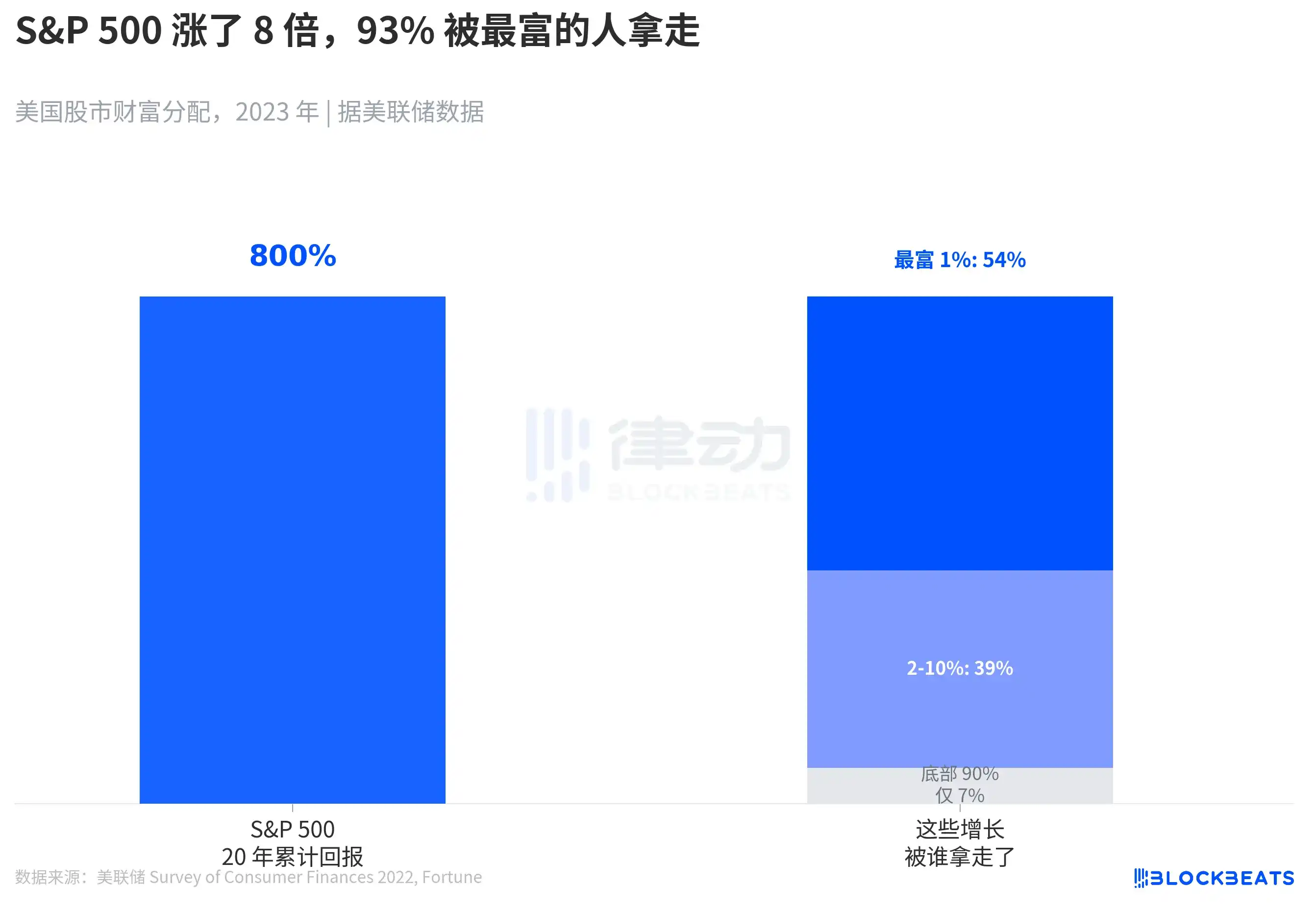
This is not an empty statement. Over the past 20 years, the S&P 500 has increased 8-fold. But according to the Federal Reserve's 2022 Survey of Consumer Finances (SCF), the distribution of this 8-fold growth has been extremely concentrated.

The wealthiest 1% of U.S. households captured 54% of all stock market wealth, a figure that was 40% 20 years ago. The next 2-10% captured 39%. The bottom 90% of Americans collectively hold only 7% of stocks, and the bottom 50% hold just 1%. According to Gallup data, 87% of households with an annual income over $100,000 own stocks, compared to only 28% of those with incomes under $50,000.

Fink used a precise analogy in his letter. "Since 1989, one dollar invested in the U.S. stock market has appreciated more than 15 times one dollar tied to the median wage." In other words, the gap between those with money to invest and those relying solely on wages has widened 15-fold over 35 years. He worries that AI will "repeat this pattern on a larger scale, concentrating wealth in the companies and investors capable of capturing it."

This diagnosis is accurate. The prescription that follows is the part of the letter that is truly worth dissecting.

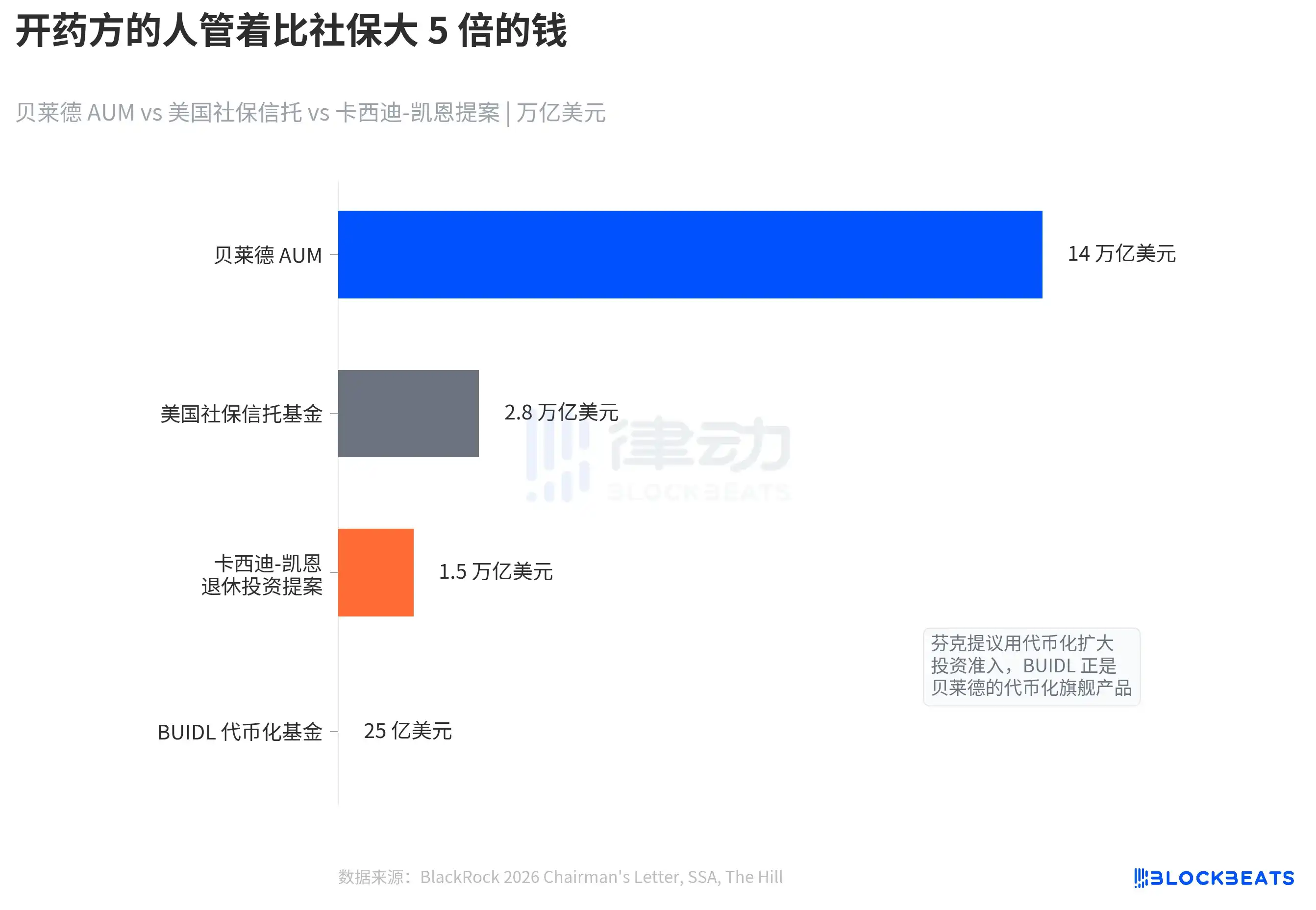
Fink cited a bipartisan proposal by Senators Bill Cassidy and Tim Kaine. The content involves the federal government borrowing $1.5 trillion over 5 years to inject into an investment fund independent of the existing social security system. This fund would buy stocks, private equity, and other assets, lock them in for 75 years, and use the returns to supplement the social security shortfall. The U.S. Social Security Trust Fund is projected to be depleted by 2033, at which point beneficiaries would receive only 83% of promised benefits.

Compare the numbers. The U.S. Social Security Trust Fund is about $2.8 trillion; the Cassidy-Kaine proposal would inject $1.5 trillion. BlackRock's assets under management are $14 trillion, 5 times the size of the Social Security fund. If the government really establishes a $1.5 trillion investment fund, who will manage it? Fink didn't say it directly, but BlackRock is the world's largest asset manager.

Even more intriguing is the second prescription Fink offers. He positions tokenization as being "roughly equivalent to the internet in 1996" and proposes establishing "a regulated digital wallet" that would allow ordinary investors to use it to hold ETFs, bonds, stablecoins, and infrastructure shares. This would lower the barrier to investment and allow more people to participate in the market.

This vision corresponds perfectly to BlackRock's biggest business bets over the past two years. BlackRock's BUIDL fund (an on-chain tokenized U.S. Treasury fund) surpassed $1 billion in AUM in March 2025, peaking at nearly $2.9 billion mid-year, capturing over 40% of the tokenized Treasury market. In February 2026, BUIDL launched on Uniswap, allowing whitelisted investors to trade with stablecoins 24/7. According to CCN, BUIDL has become one of the world's largest tokenized cash products.

Fink's declaration of interest and policy recommendations align perfectly. He calls for more people to enter the investment market through tokenization, and BlackRock's flagship tokenized product is already waiting to onboard clients. He proposes the government establish a large investment fund, and BlackRock is the most qualified institution to manage that money. This is not an accusation that he is lying; it is pointing out a structural fact. When the CEO of the world's largest asset manager calls for expanded investment access, he is simultaneously calling for an expansion of his own client base.

On the same day, another signal came from Wall Street.

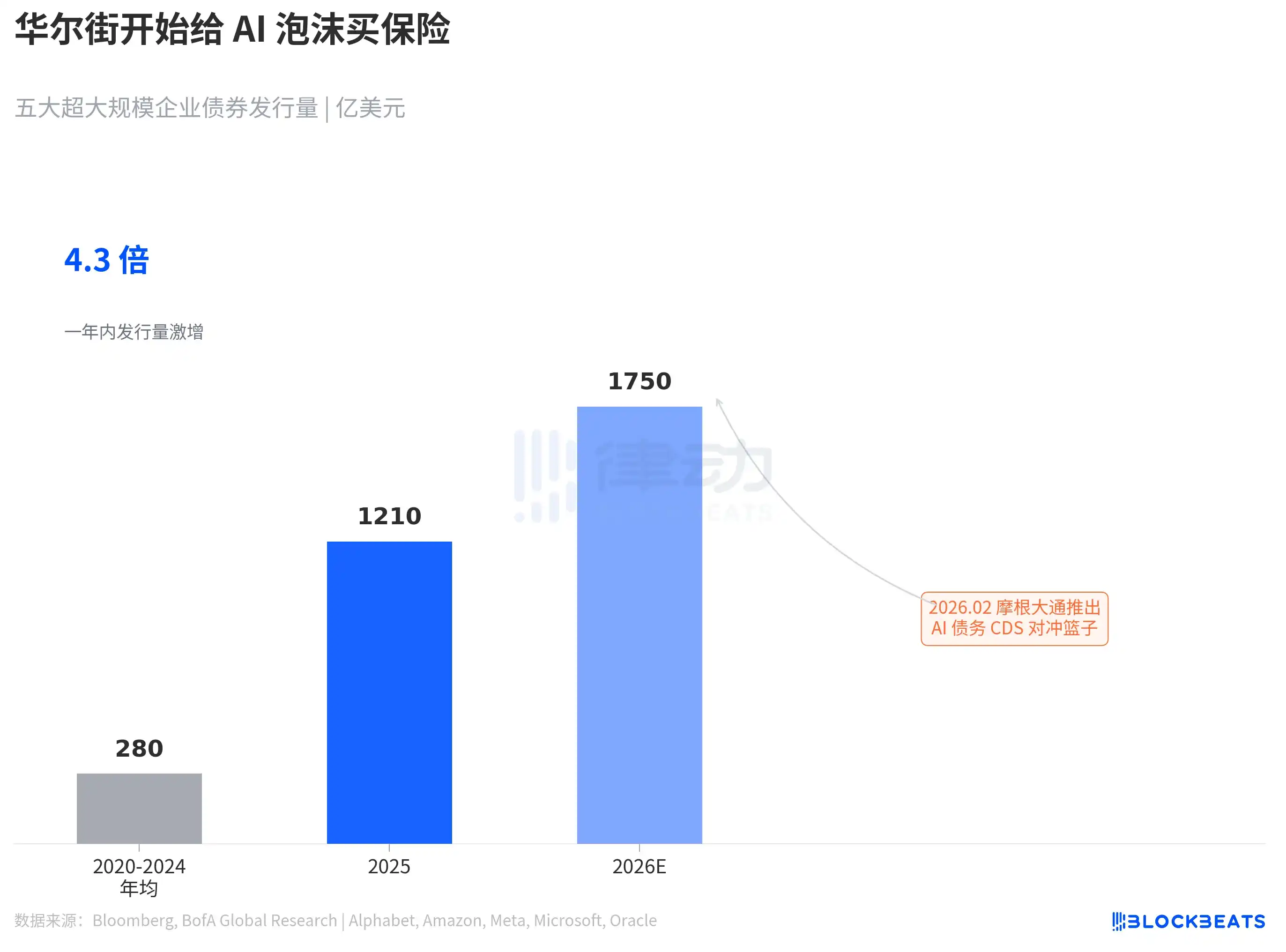
According to Bloomberg, JPMorgan Chase launched a CDS (credit default swap) basket in February 2026 targeting the five hyperscale companies (Alphabet, Amazon, Meta, Microsoft, Oracle), with a trading unit of $25 million. These five companies issued approximately $121 billion in bonds in 2025, 4.3 times the average annual issuance of $28 billion from 2020-2024. According to Bank of America forecasts, issuance will further climb to $175 billion in 2026.

When Wall Street starts designing hedging tools for AI infrastructure debt, it indicates that institutional investors are already preparing for a potential bubble burst. Fink says AI will exacerbate inequality; JPMorgan says AI's debt risk is already significant enough to warrant selling insurance. Both signals point to the same fact. The AI boom is creating enormous wealth, but the distribution of this wealth and its risk exposure are repeating the pattern of the previous cycle in a familiar way.

Fink manages $14 trillion. His diagnosis of inequality is accurate. But the medicine he prescribes happens to be his own product.

Связанные с этим вопросы

QWhat is the 'K-shaped outcome' that BlackRock CEO Larry Fink warns about in his annual shareholder letter?

ALarry Fink warns that AI is creating a 'K-shaped outcome,' where leading companies accelerate and pull away from everyone else, concentrating wealth among those with the capacity to capture it.

QAccording to the Federal Reserve's 2022 Survey of Consumer Finances, what percentage of total stock market wealth do the top 1% of U.S. households hold?

AThe top 1% of U.S. households hold 54% of all stock market wealth, up from 40% twenty years ago.

QWhat is the bipartisan proposal mentioned by Fink that involves the federal government borrowing $1.5 trillion?

AThe bipartisan proposal by Senators Bill Cassidy and Tim Kaine suggests the federal government borrow $1.5 trillion over five years to inject into an independent investment fund that buys stocks, private equity, and other assets to supplement the Social Security shortfall.

QWhat is BlackRock's BUIDL fund, and what milestone did it achieve in 2025?

ABlackRock's BUIDL fund is an on-chain tokenized U.S. Treasury fund. In March 2025, it surpassed $1 billion in assets under management (AUM), with a mid-year value nearing $2.9 billion, capturing over 40% of the tokenized Treasury market.

QWhat does the launch of JPMorgan's CDS basket for five mega-cap tech companies indicate about the AI boom?

AJPMorgan's launch of a CDS basket for Alphabet, Amazon, Meta, Microsoft, and Oracle indicates that institutional investors are preparing for potential risks and a possible bubble burst in AI infrastructure debt, highlighting the concentrated wealth and associated risks in the AI sector.

Похожее

The Value Distribution of Stablecoins

**Summary: The Value Distribution of Stablecoins** The article argues that stablecoins are evolving from mere trading tools into broader channels for dollar access. It divides the stablecoin ecosystem into four layers to analyze how value is distributed: 1. **Issuance Layer:** Mints stablecoins, holds reserve assets, and captures the spread between reserve yield and user costs (e.g., Tether, Circle). This layer currently earns the largest profit margin. 2. **Infrastructure Layer:** Connects stablecoins to the traditional financial system, handling fiat on/off-ramps, banking integration, compliance (KYC/AML), and asset management (e.g., Bridge, BVNK). This is the "unglamorous" but critical work, building the essential bridges between crypto and real-world finance. 3. **Acquiring/Distribution Layer:** Integrates stablecoins into merchant systems, manages payment flows, and provides enterprise financial software (e.g., Stripe, Coinbase). They act as the access point for businesses. 4. **Application Layer:** The end-users and businesses that ultimately use stablecoins for payments, settlements, or as a store of value. They benefit from convenience but have little pricing power. The core thesis is that while the issuance layer currently dominates profits, the often-overlooked **infrastructure layer holds significant long-term potential**. The real challenge and barrier to mass adoption is not the on-chain transfer of stablecoins (which is simple), but the complex "last mile" integration into existing business workflows, banking systems, and regulatory frameworks across different countries. Companies in this layer are currently in a "land grab" phase, investing heavily to build networks, secure bank partnerships, and establish compliance pathways. While their position is currently pressured by the profitable issuers above and distribution platforms below, the article suggests that if stablecoins become a default financial rail for businesses, the infrastructure providers who have done the hard work of integration will ultimately gain strong pricing power and become entrenched, essential players.

marsbit13 мин. назад

The Value Distribution of Stablecoins

marsbit13 мин. назад

The Value Distribution of Stablecoins

The Value Distribution of Stablecoins The article argues that stablecoins are evolving from a mere trading tool into a broad "dollar channel." It analyzes the industry's value chain through four layers: 1. **Issuance Layer (e.g., Tether, Circle):** The top layer that mints stablecoins, holds reserve assets, and captures the thickest interest rate spread. 2. **Infrastructure Layer (e.g., Bridge, BVNK):** Connects stablecoins to the traditional financial system, handling critical but complex "dirty work" like fiat on/off-ramps, banking integration, compliance (KYC/AML), and cross-border settlement. 3. **Acquiring/Distribution Layer (e.g., Stripe, Coinbase):** Embeds stablecoins into merchant systems, manages payment flows, and integrates with enterprise software. 4. **Application Layer:** End-users and businesses that ultimately use stablecoins for payments, settlement, or storing value. The author posits that while the issuance layer currently captures the most profit, the most overlooked and potentially critical layer is infrastructure. The core challenge for stablecoin adoption isn't the on-chain transfer (which is simple), but bridging the gap between blockchain and the real-world financial system. This involves solving practical problems for businesses: fiat conversion, reconciliation, tax handling, and user onboarding. Infrastructure companies are currently in a difficult "land-grab" phase—building networks, securing banking relationships, and achieving compliance country-by-country. They face pressure from both the profitable issuance layer above and distribution platforms below. However, the author suggests this layer is building a crucial moat. Once stablecoins become a default business rail, the infrastructure players who have done the hard work of integration may gain significant, durable value and pricing power.

链捕手17 мин. назад

The Value Distribution of Stablecoins

链捕手17 мин. назад

Why Is Nvidia Borrowing $20 Billion When It's Not Short of Cash?

Nvidia's recent announcement to issue at least $20 billion in senior notes, despite holding a strong cash position with over $48.6 billion in free cash flow last quarter, is not a sign of financial need. Instead, it represents a strategic move to leverage its high credit rating (recently upgraded to AA by S&P) to secure low-cost, long-term debt. This capital will support long-term AI infrastructure investments, data centers, R&D, supply chain prepayments, and strategic investments, while allowing the company to continue aggressive shareholder returns through stock buybacks and dividends. The decision reflects a mature capital management strategy: using debt to finance long-term growth assets is more efficient and less dilutive to shareholders than equity financing. It signals that Nvidia, like other tech giants (Alphabet, Meta, Amazon), is entering a new phase of heavy AI capital expenditure, shifting from a pure growth story to a story about capital allocation, credit strength, and long-term ecosystem positioning. The key question for investors is whether Nvidia can maintain its high cash flow generation and ensure that returns from these AI investments justify the cost of capital over the long term. The bond issuance amplifies its expansion capabilities but also ties its valuation more closely to the broader AI investment cycle's sustainability and profitability.

marsbit53 мин. назад

Why Is Nvidia Borrowing $20 Billion When It's Not Short of Cash?

marsbit53 мин. назад

How to Do Research Well: Deliberately Practice the Real Skills That Matter

No one truly teaches you how to do research. You're often given a desk, a pre-selected problem, and vague instructions to "create something new." Consequently, many people reverse-engineer the job based on visible outputs—papers, posts, announcements—learning only how to *appear* like a researcher rather than how to *become* one. True research capability is built from stacking small, trainable skills, nearly all of which can be developed through deliberate practice. **Pick Your Own Problem:** Most researchers absorb problems from advisors or trends, lacking the underlying reasoning. Choosing a problem you genuinely care about, as John Schulman advises, leads to original work. Develop "taste" like a muscle: predict experiment outcomes, guess paper results from methods, and track which findings remain important over time. **Upgrade Your Inputs:** Relying on shared reading lists (arXiv hot lists, filtered group chats) leads to unoriginal conclusions. Undervalued old literature often holds crucial insights (e.g., MoE, LSTM, backpropagation). Richard Sutton's "The Bitter Lesson" or Claude Shannon's 1952 talk on creative thinking are more predictive than lengthy modern surveys. Breadth matters as much as depth: draw from neuroscience, mechanism design, hardware knowledge, and honest statistics. Read papers directly, especially appendices and limitations sections. **Write Everything Down:** As Paul Graham noted, writing exposes flaws in seemingly mature ideas. Writing is the cheapest defense against self-deception. Following Feynman's principle, Darwin programmatically wrote down facts contradicting his theory to combat memory bias. Maintain a detailed log of hypotheses, setups, predictions, results, and updated understandings. Reviewing past logs fosters essential humility.

marsbit2 ч. назад

How to Do Research Well: Deliberately Practice the Real Skills That Matter

marsbit2 ч. назад

Торговля

Спот
Фьючерсы

Популярные статьи

Неделя обучения по популярным токенам (2): 2026 может стать годом приложений реального времени, сектор AI продолжает оставаться в тренде

2025 год — год институциональных инвесторов, в будущем он будет доминировать в приложениях реального времени.

1.8k просмотров всегоОпубликовано 2025.12.16Обновлено 2025.12.16

Неделя обучения по популярным токенам (2): 2026 может стать годом приложений реального времени, сектор AI продолжает оставаться в тренде

Обсуждения

Добро пожаловать в Сообщество HTX. Здесь вы сможете быть в курсе последних новостей о развитии платформы и получить доступ к профессиональной аналитической информации о рынке. Мнения пользователей о цене на AI (AI) представлены ниже.

活动图片